
Decoding Ats Scoring for Non-linear Career Paths (2026 Complete Guide)
I've seen resumes with perfect qualifications get immediately binned because Workday couldn't parse their custom font, turning 'Senior Software Engineer' into 'Seni r S ftware Eng neer.' That's not a human recruiter making a judgment; that's a machine choking on bad data.
I've seen resumes with perfect qualifications get immediately binned because Workday couldn't parse their custom font, turning 'Senior Software Engineer' into 'Seni r S ftware Eng neer.' That's not a human recruiter making a judgment; that's a machine choking on bad data. For non-linear career paths, this problem is amplified by a factor of 10. You're not just fighting for attention; you're fighting for basic legibility. As The Job Helpers on LinkedIn point out, it's usually a 'bot rejection.'
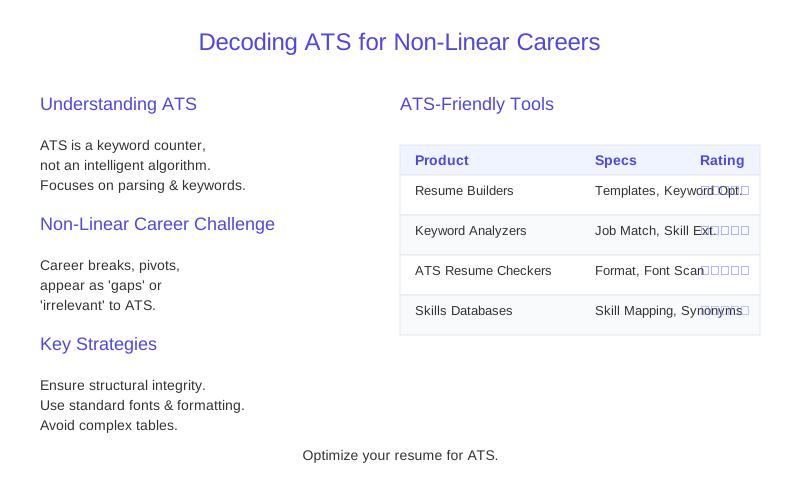
Most people think 'ATS scoring' is some grand, intelligent algorithm designed to find the best candidate. It's not. It's a glorified keyword counter with a sophisticated parsing engine. When I configured Lever instances, my goal was efficiency: could the system extract name, contact, last job, and skills without breaking? Could it then match a few dozen keywords from the job description? That's about 80 percent of the battle.
Mastering your ATS in 2026 is about understanding it's a strategy tool.
For someone whose career zigzags, this is a nightmare. Your rich, varied experience often doesn't fit neatly into the predefined categories or linear timelines these systems expect. A career break for caregiving or a pivot from marketing to product management looks like a 'gap' or 'irrelevant experience' to a machine. My recruiter brain would see a person; the ATS just sees missing keywords or inconsistent dates.
The 'ATS black hole' is real, but it's often less about your qualifications and more about your resume's structural integrity. Imagine building a database where every entry needs to fit into specific fields. If your data doesn't conform, it gets corrupted or ignored. Your resume is that data. And if it's corrupted, no human is ever going to find it, no matter how much you paid for that fancy template.
This isn't some abstract problem. It's why 75 percent of resumes are rejected by ATS before a human ever sees them, according to Harvard Business School research. My job was to fill roles, not to play detective with poorly formatted PDFs. If I couldn't quickly find what I needed, I moved on. It's a brutal reality, but one you need to understand.
The Real Answer
The dirty secret of ATS scoring, especially for non-linear paths, isn't that the system is trying to disqualify you. It's that the system is fundamentally lazy and designed for speed, not nuance. When I set up the scoring parameters in iCIMS, I wasn't thinking about career pivots; I was thinking about reducing 500 applications to 50 viable ones in 15 minutes. As Reddit users discuss, ATS is a factor, especially for big companies.
ATS platforms like Greenhouse and Lever operate on a basic principle: parse, extract, match. Your resume is broken down into discrete data points: job titles, company names, dates, skills. Non-linear paths often mean inconsistent job titles, gaps in dates, or skills gained in contexts the ATS doesn't recognize as 'work experience.' This isn't a bug; it's a feature of how these systems are architected to handle high volume.
The 'score' you hear about is almost entirely a function of keyword density and semantic match against the job description. Recruiters load specific keywords into the system - often directly copied from the job posting - and the ATS assigns a percentage based on how many of those keywords it finds in your parsed resume. If you were a 'Project Lead' in a non-traditional setting, but the job asks for a 'Senior Project Manager,' the system won't make that leap.
It sees a mismatch.
My 'recruiter brain' knew that context matters. An ATS doesn't. It doesn't care that your two-year sabbatical to build a startup gave you more leadership experience than your previous corporate role. It just sees a two-year gap in employment dates. This lowers your 'score' because the system prioritizes unbroken, linear progression as a proxy for stability and relevant experience.
Companies often use ATS to enforce strict qualification filters before I even see a resume. 'Must have 5+ years in X' or 'Bachelor's degree required.' If your resume doesn't explicitly state these in a parseable format, you're out. It's not personal; it's just the HR policy pattern coded into the system. My hiring committee didn't want to waste time interviewing someone who didn't meet the absolute minimums, even if those minimums were arbitrary.
The real reason behind these low scores for non-linear paths is the system's inability to interpret qualitative data or infer relevance. It's a blunt instrument, not a sophisticated AI. It's about signal vs noise, and if your signal is too complex for its simple filters, it gets discarded as noise. Checking your ATS score is critical to understand how your resume is being interpreted.


What's Actually Going On
When your resume hits an ATS like Workday or Taleo, the first thing it does is try to parse it. This means breaking your document down into structured data fields: name, contact info, job titles, companies, dates, skills, education. If your resume uses a non-standard format - say, a two-column layout or a fancy infographic - the parsing can fail spectacularly. I've seen Greenhouse mangle a perfectly good resume, putting the 'Skills' section into the 'Education' field.
Scale.jobs notes that non-standard resumes with graphics or unconventional layouts may get misread.
Once parsed, the system begins keyword matching. This is the core of ATS scoring. Recruiters, or often the hiring manager, provide a list of essential keywords and phrases from the job description. The ATS scans your extracted data for these exact matches. For non-linear paths, this is where it gets tricky. If you've gained 'project management' skills in a volunteer role, but the system only looks for 'Project Manager' job titles, you're at a disadvantage.
Different ATS platforms handle this slightly differently. Lever might prioritize keywords in your 'Experience' section, while iCIMS might give more weight to a dedicated 'Skills' section. The system doesn't understand context. It doesn't care that your 'Content Strategist' role involved significant 'SEO optimization' if 'SEO' isn't explicitly listed as a skill or in a bullet point. TealHQ explains how ATS technology works.
Company size also plays a role. A small startup using BambooHR might have a recruiter manually review more resumes, even those with lower ATS scores, because they receive fewer applications. A Fortune 500 company using Taleo or Workday, however, relies heavily on strict ATS filtering due to the sheer volume. They have to. My average req at a large tech company pulled in 300-500 resumes per week.
Regulatory facts can also influence ATS behavior. For example, some systems are configured to anonymize certain demographic data to prevent bias, or to flag candidates who meet specific diversity criteria. This doesn't directly impact non-linear paths, but it shows how HR policies are baked into the ATS configuration. The system is a tool for compliance as much as it is for candidate screening.
Finally, the scoring itself is often a weighted average. Years of experience might be weighted at 30 percent, specific hard skills at 40 percent, and educational background at 20 percent. For non-linear paths, if your 'years of experience' in a directly relevant role is low due to a pivot, that weighted component can drastically pull down your overall score, even if your skills are a perfect match. It's a simple math problem, not a judgment of your capability.


How to Handle This
Okay, so you've got a non-linear career path, and you know the ATS is a heartless machine. Here's how to fight back. First, treat your resume like a database entry, not a narrative. Your goal is parseability above all else. OwlApply emphasizes scanning for parsing risks and matching against the job description.
1. Simplify Your Format (Immediately): Ditch the fancy templates, two-column layouts, graphics, and text boxes. Seriously. I've seen too many brilliant candidates get lost because their resume was 'too pretty.' Use a clean, single-column layout. Standard headings like 'Experience,' 'Education,' 'Skills.' Stick to common fonts like Arial or Calibri. Save as a .docx file if possible; PDFs are usually okay, but .docx gives the ATS the least chance to mess up.
2. Keyword Mirroring (Every Time): This is non-negotiable. Take the job description, copy-paste it into a word cloud generator or a keyword analysis tool. Identify the 10-15 most frequent and critical keywords. Then, ensure those exact words and phrases appear in your resume, especially in your 'Skills' section and bullet points. If the job says 'Python programming,' don't just say 'Python.' Say 'Python programming.' MyPerfectResume's checker can help you identify 30+ issues.
3. 'Skills' Section is Your Cheat Sheet: Create a dedicated 'Skills' section, typically right after your summary. List both hard and relevant soft skills here. This is prime real estate for keyword stuffing (within reason, don't make it unreadable for humans). Use bullet points or a comma-separated list. This allows the ATS to quickly find what it's looking for without digging through your job descriptions.
4. Reframe Non-Traditional Experience: If you have gaps or non-traditional roles (freelance, volunteer, sabbatical), don't just leave them blank or omit them. Create a section like 'Additional Experience' or 'Project Work.' For each entry, focus on quantifiable achievements and, critically, use keywords relevant to the job you're applying for. Frame your responsibilities and accomplishments using the language of the target role, even if the title was different.
5. Chronological Still Rules (Mostly): While functional resumes try to highlight skills over dates, most ATS systems still prefer a reverse-chronological format for experience. It's easier to parse. If your non-linear path has significant pivots, make sure the dates are clear and consistent. If you have a short-term role, include it to avoid perceived gaps.
6. Leverage the Summary/Objective: This isn't just fluff. Use a 2-3 sentence summary at the top to immediately hit key skills and experience that align with the job description. This is another high-impact area for keywords, signaling to the ATS that you're a match right out of the gate. Think of it as your elevator pitch to the bot.

What This Looks Like in Practice
I once saw a candidate for a 'Senior Data Scientist' role get a 20 percent ATS score in Greenhouse, even though they had 10 years of experience. The problem? Their resume listed 'Analyst' and 'Researcher' titles, and their bullet points used terms like 'statistical modeling' instead of the job description's preferred 'machine learning algorithms' and 'predictive analytics.' The ATS didn't connect the dots. As Tech Fabric points out, non-linear career paths get penalized for gaps or pivots.
Consider a career changer moving from teaching to project management. Their resume might highlight 'curriculum development' and 'student engagement.' The ATS, scanning for a 'Project Manager' role, would be looking for 'agile methodologies,' 'stakeholder management,' and 'budget oversight.' Without explicitly translating their teacher skills into project management terms and keywords, that resume would likely hit the resume graveyard.
Another common scenario is the entrepreneur who ran their own business for five years. While incredibly valuable, an ATS often struggles with the 'Owner' or 'Founder' title if it's not explicitly tied to a specific industry or set of responsibilities that match the target job. I've had to manually search for these because the ATS didn't rank them high enough, even though they were highly qualified. ResumeAdapter highlights 9 steps to pass ATS screening.
Then there's the candidate who took a two-year sabbatical to travel and volunteer. The ATS sees a gap. My recruiter brain sees potentially valuable cross-cultural experience and initiative. But the system's default setting is to flag gaps as a potential concern, lowering the score. You need to proactively fill those gaps with relevant, keyword-rich experience, even if it's not traditional paid employment.
Finally, the 'ghost jobs' scenario. I've worked on reqs that were open for months but had no real intention of hiring. The ATS continued to process applications, generating low scores for candidates who were perfectly viable, because the hiring manager had simply stopped reviewing. Your ATS score might be fine, but the job itself is a charade. That's a human problem, not a parsing one.

Mistakes That Kill Your Chances
Here are the mistakes that will absolutely kill your chances, especially if you have a non-linear path:
| Mistake | Why It Fails ATS (and Recruiters) |
|---|---|
| **Fancy Graphics & Layouts** | ATS parsing engines (like those in Workday or Taleo) often can't read text embedded in images or complex multi-column designs. Your experience becomes invisible. CV Anywhere stresses optimizing your resume for ATS. |
| **Missing Exact Keywords** | If the job description says 'CRM software' and you write 'customer relationship management,' the ATS might not make the connection. It's a literal matching game. |
| **Functional Resume Format** | While good for highlighting skills, ATS systems are built for chronological parsing. My 'recruiter brain' found these harder to scan for dates and progression too. |
| **Vague Job Titles/Descriptions** | 'Self-Employed Consultant' without specific industry or project details provides no parseable keywords for the ATS to match to a specific role. |
| **Unexplained Gaps in Dates** | A two-year gap without any explanation (e.g., 'Sabbatical for professional development') is a red flag to the ATS, lowering your score and signaling inconsistency. |
| **Irrelevant Skills Section** | Listing 50 skills, many unrelated to the job, dilutes the impact of relevant keywords and makes it harder for the ATS to identify your core competencies. |
| **Saving as a .jpeg or .png** | These are image files. ATS systems cannot extract text from them, rendering your entire resume unsearchable. It's like sending a blank page. |
| **Contact Info Issues** | Putting your email or phone number in the header of a custom template can sometimes lead to parsing errors, making it impossible for me to call you. |
Key Takeaways
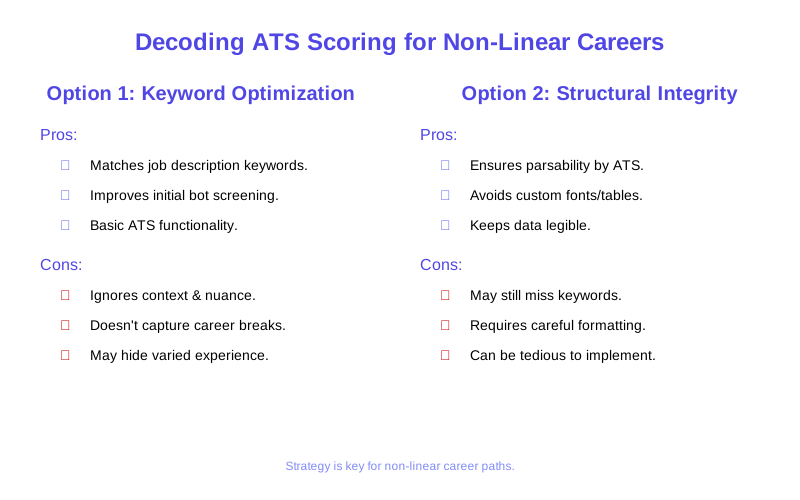
Cracking the ATS code for non-linear career paths isn't about tricking the system; it's about understanding its limitations and playing by its rules. Your resume isn't a beautiful story to an ATS; it's a data structure. Klaxos emphasizes learning how ATS algorithms parse and score resumes.
- Simplify, Simplify, Simplify: Ditch the visual flair. Single-column, standard fonts, clear headings. Make it easy for the machine to read.
- Keywords are King: Mirror the job description's language exactly. This is the single most impactful thing you can do to boost your ATS score.
- Contextualize Non-Linearity: Don't hide gaps or pivots.
Frame them with relevant keywords and achievements that align with the target role. * Use a Dedicated Skills Section: This is your prime real estate for hitting those critical hard and soft skills the ATS is searching for. * Test Your Resume: Use online ATS checkers to see how your resume parses and scores before you apply. It's a 60-second sanity check that can save you weeks of frustration.
Remember, the ATS is a gatekeeper, not a judge of your true potential. My 'recruiter brain' knows there's more to a candidate than a score. But you have to get past the bot first to even get on my radar.
Frequently Asked Questions
Should I pay for an online ATS resume checker or just use a free one?
My job title was 'Growth Hacker' but the company wants a 'Digital Marketing Manager.' Do I just change my title on the resume?
What if I meticulously optimize my resume for ATS, and I still don't hear back?
Can using too many keywords in my resume get me penalized by the ATS?
I heard AI is making ATS systems obsolete. Is that true?
Sources
- ATS Resume Scanning: How to Fix Common Issues and Boost Your ...
- How to Pass ATS Screening (2026): 9 Steps to Get Your Resume ...
- How to Optimize Resume for ATS in 2026 and Beat ... - CV Anywhere
- Is ATS a reliable factor for resume shortlisting? - Reddit
- Mastering Your Applicant Tracking System in 2026: A Complete Guide
- Free ATS Resume Checker: Scan & Score Your Resume
- ATS Score Breakdown: What Each Component Measures [2026 ...
- How Resume Detective improves ATS filtering with AI - LinkedIn
- Beat the ATS: Optimize Resumes via Writing & AI: 2026 Guide - Klaxos
- Applicant Tracking Systems (ATS): Everything You Need to Know
- ATS-Friendly Resume Guide (2026): Format, Keywords, Score, and ...
- Understanding ATS Scoring Algorithms - Scale.jobs