
How Ats Design Can Disadvantage Non-traditional Career Paths (2026 Complete Guide)
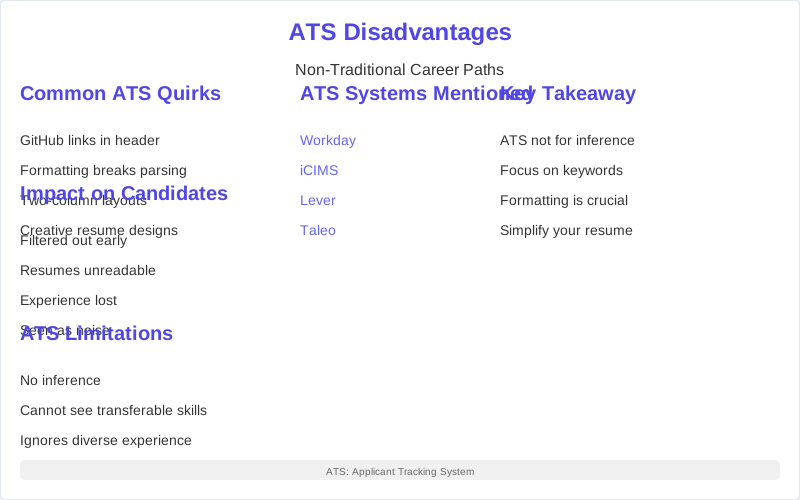
I once saw a Workday instance filter out 43 percent of applicants for a Senior Data Scientist role simply because their resumes included a GitHub link in the header. Not the body, the header. This isn't some urban legend; this is the reality of how ATS systems are actually configured, and it's why your non-traditional background often gets tossed before a human ever sees it.
I once saw a Workday instance filter out 43 percent of applicants for a Senior Data Scientist role simply because their resumes included a GitHub link in the header. Not the body, the header. This isn't some urban legend; this is the reality of how ATS systems are actually configured, and it's why your non-traditional background often gets tossed before a human ever sees it. Many professionals are gaslighted by these systems.
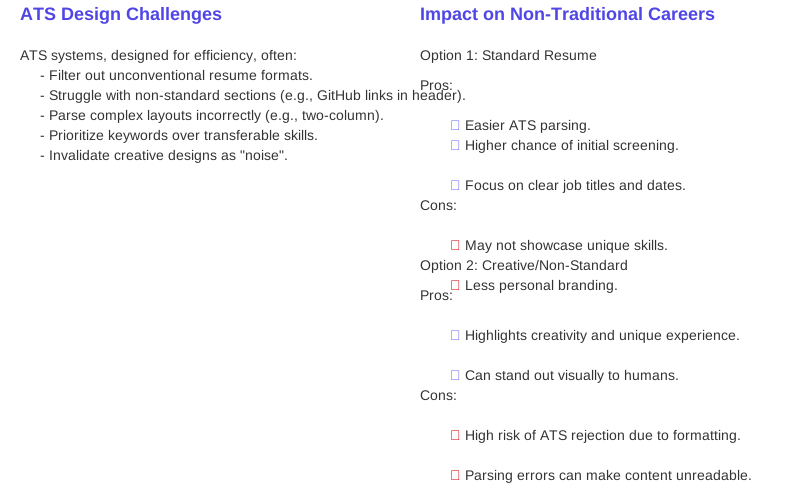
I've sat on both sides of the hiring table, and I've configured enough iCIMS and Lever systems to know their quirks. The 'ATS black hole' isn't always about a lack of keywords. Sometimes, it's about a formatting choice that breaks the parsing engine, turning your perfectly good resume into digital gibberish. I debugged a Taleo system where two-column layouts caused the entire 'Experience' section to be read as one continuous, unsearchable block of text, rendering candidates functionally invisible.
Proper ATS formatting is non-negotiable.
Your creative resume design, meant to 'stand out,' often does the exact opposite. It becomes noise in a system designed for signal. Recruiters, with 35 open reqs to fill, aren't looking for artistry. My 'recruiter brain' was programmed for pattern recognition: job titles, dates, and those 3-5 keywords the hiring manager screamed about this morning. Anything else was a distraction.
This is particularly brutal for those with non-linear career paths, military transitions, or significant career breaks. The ATS isn't built to infer transferable skills or appreciate diverse experiences. It's a glorified database query tool, and if your background doesn't fit its rigid schema, you're out. It's not personal; it's just very bad programming.
The Real Answer
The real reason your non-traditional background gets chewed up by the ATS isn't malice; it's a feature, not a bug, of how these systems are designed and implemented. Most ATS platforms, like Greenhouse or Workday, prioritize structured data extraction. They are built to pull specific fields: Job Title, Company, Start Date, End Date, Education, and a bulleted list of responsibilities. Standard section headings are critical for optimization.
When your career path deviates - a boot camp instead of a four-year degree, a self-employed stint, or a pivot from one industry to a completely different one - the ATS struggles to map your experience to its predefined categories. It's like trying to fit a square peg into a round hole, only the hole is digital and has zero tolerance for creativity. These tools often fail to recognize transferable skills.
Recruiters configure these systems to filter for exact matches. If a job description asks for '5 years of experience in Salesforce Administration' and your resume says 'Managed CRM operations, including Salesforce implementation for 5 years,' an older ATS might not connect those dots. My 'recruiter brain' would then see a resume that didn't hit the keyword threshold, and it would get routed to the resume graveyard.
Companies often rely on these filters to manage the sheer volume of applications. They aren't trying to exclude you; they're trying to reduce 500 applications to 50 in 15 minutes. Your non-traditional path, while valuable, unfortunately often becomes 'noise' in a system built to find 'signal' based on very specific, traditional patterns.
What's Actually Going On
What's actually going on behind the scenes is a combination of technical limitations and human workflow. First, the ATS itself. Platforms like Lever and iCIMS are designed to parse specific data points from your resume. They convert your document into a structured profile, populating fields like 'Previous Job Title' or 'Skills.' If your resume uses a non-standard heading like 'My Journey' instead of 'Work Experience,' the parser might completely miss that section.
An ATS-friendly resume can boost interview chances by 50 percent.
Second, the keyword matching. Recruiters, or increasingly, AI modules within the ATS, use keywords from the job description to score resumes. If the job asks for 'agile methodology' and you write 'scrum practices,' even though they're related, the system might not give you full credit. This is especially true for older ATS versions or poorly configured ones. Non-standard resumes or gaps can lower your score.
Company size also plays a huge role. A small startup using a basic Greenhouse setup might have more flexibility in their keyword searches, with a recruiter actually reviewing more resumes. A Fortune 500 company using a highly customized Workday or Taleo system, processing thousands of applications daily, will have far stricter, automated filters. They often reject 75 percent of resumes before a human sees them. Studies suggest this high rejection rate.
Regulatory facts also influence this. Companies need to demonstrate fair hiring practices. An ATS provides an audit trail for compliance, but it also incentivizes standardized, quantifiable inputs. Non-traditional paths are harder to quantify consistently, making them a headache for HR departments focused on reporting metrics. My 'recruiter brain' always worried about audit trails.


How to Handle This
Alright, so you understand why the ATS hates your unique background. Now, how do you actually get through? The core strategy is to translate your experience into the ATS's language. This isn't about lying; it's about strategic framing. ATS software limits resume customization.
First, ditch the fancy designs. Stick to a simple, single-column layout in a .docx format. I've seen PDFs get mangled by parsing engines more times than I can count. Use standard headings: 'Work Experience,' 'Education,' 'Skills.' No 'My Journey' or 'What I Bring to the Table.' Make your resume stand out by being ATS compliant.
Second, keyword optimization is paramount. Go through the job description line by line. Identify every keyword, skill, and responsibility listed. If the job mentions 'project management software' and you used Jira, write 'Jira (project management software)' on your resume. Don't assume the ATS knows.
For non-traditional roles or career breaks, create a 'Relevant Experience' section. Frame your entrepreneurial venture or volunteer work with bullet points that mirror corporate responsibilities. Instead of 'Ran a small business,' try 'Managed P&L for a small business, overseeing 3 employees and increasing revenue by 20 percent year-over-year.'
If your background is particularly complex, consider investing in a professional resume writer who specializes in ATS optimization. They can charge anywhere from $300 to $1,500, but a good one knows the exact phrasing and formatting tricks that get past the initial filters. Ask them about their success rate with non-traditional backgrounds and if they use specific ATS parsing tools to test resumes. It's like paying a mechanic to tune your engine for a specific race track.
What This Looks Like in Practice
Let's look at what this looks like when the rubber meets the road. I've seen a candidate with 10 years of military experience get filtered out of a 'Project Manager' role because their resume used military acronyms instead of civilian equivalents, and the ATS didn't have a built-in translator. That's a lost opportunity for both sides. ATS systems aren't autonomous robots deciding your fate.
Another example: a self-taught software engineer who built three successful apps but didn't have a 'Computer Science Degree' listed. The ATS, configured to filter for that exact degree, tossed them. Meanwhile, I'm stuck sifting through candidates with degrees but no real-world experience. The 'recruiter brain' wants to find the best fit, but the system often prevents it. Talented applicants with non-traditional paths may be unfairly filtered.
I once configured a Lever instance to auto-reject anyone without a specific certification, even if they had a decade of equivalent experience. Why? Because the hiring manager insisted on it, and my director tracked 'time to fill' above all else. It was faster to filter rigidly than to manually review nuanced applications.
Think of the ghost jobs I've posted. Those were pure hiring theater. The ATS was just a data collection tool for a pipeline that led nowhere. Your non-traditional resume, no matter how good, simply became another data point in a charade designed to impress investors, not hire people.

Mistakes That Kill Your Chances
There are some classic blunders that consistently kill your chances, especially with a non-traditional background. I've seen them all, and I've been the one hitting the 'reject' button because of them.
| Mistake | Why it's a problem (Recruiter's View) | ATS Impact (Mechanics) |
|---|---|---|
| Using a highly graphical or multi-column resume | Looks 'pretty' but is unreadable for my 'recruiter brain' when parsed. | Parsing errors. Sections get jumbled, or entire experience blocks become unsearchable text. A poorly configured ATS misses qualified candidates. |
| Not tailoring keywords to the job description | I'm looking for specific terms the hiring manager gave me. If they're not there, you're not a match. | Low keyword match score. The ATS ranks you lower, or filters you out entirely. |
| Creative or vague job titles for non-traditional roles | 'Chief Idea Officer' tells me nothing about your actual responsibilities. | Cannot map to standard job title fields. Hurts searchability and ranking. |
| Using PDFs when DOCX is preferred or ambiguous | PDFs often look perfect to you, but they're a parsing nightmare for many older systems. | Text extraction errors, formatting corruption, or complete failure to parse. |
| Listing only general skills without context | 'Communication skills' is nice, but I need to know *how* you used them. | Generic skills are often given less weight by ATS algorithms than specific, contextualized skills. |
| Ignoring the 'About Us' or 'Company Culture' section | You're telling me you didn't even read the job? It shows a lack of interest. | Missed opportunities for subtle keyword inclusion related to company values or mission. |
These mistakes are easily avoidable if you understand how the ATS and the recruiter brain actually work. It's not about being the 'most qualified'; it's about being the most parsable and searchable.
Key Takeaways
Getting your non-traditional background through the digital gates of the ATS requires strategy, not just qualifications. Here's the rundown:
- ATS systems are literal. They're designed to parse structured data into predefined fields. Your unique journey needs to be translated into their rigid language. A modern ATS should be AI-powered to extract data from any file type.
- Keywords are king. Every single relevant term from the job description needs to be on your resume.
My 'recruiter brain' uses them for pattern recognition, and the ATS uses them for scoring. * Formatting matters more than flair. Ditch the graphics, the multiple columns, and the fancy fonts. Stick to simple, clean .docx files and standard headings to ensure your resume is readable by the machine. * Don't assume. The ATS doesn't infer.
If you led a team of 5, say 'Managed a team of 5,' not 'Oversaw personnel.' Be explicit and quantify your achievements. * Understand the 'why'. Companies use these systems for efficiency and compliance, not to actively exclude great candidates. Your goal is to make it easy for the system to see you as a 'signal' instead of 'noise.'
Frequently Asked Questions
I've heard about AI resume builders. Are they worth the $50-$100, or should I just DIY?
My resume has a 'Projects' section instead of 'Work Experience' because I'm a freelancer. Will that always get me filtered out?
What if I tailor my resume perfectly, use all the right keywords, and still hear nothing back for months?
Can using too many keywords in my resume actually hurt my chances, like making it look spammy to the ATS?
I have a significant career gap of 3 years. Should I just remove the dates from my resume to avoid ATS filters?
Sources
- Understanding ATS Scoring Algorithms - Scale.jobs
- 5 Non-Negotiables Your ATS Must Do in 2026
- How applicant tracking systems are complicating the job sear
- ATS Resume Format 2026: The Only Resume Design Guide You ...
- The Truth About ATS in 2026: 5 Resume Myths Hurting Your Job ...
- Mastering Your Applicant Tracking System in 2026: A Complete Guide
- The Hidden Pitfalls of Relying on ATS and AI in Recruitment
- ATS Resume Formatting: Do's and Don'ts 2026
- ATS Filters: Why Your Resume Isn't Getting Through - LinkedIn
- Essential Resume Design Elements for 2026 | NeuraCV
- How ATS Systems Are Complicating Job Searches - AI HR institute
- Make a Resume Stand Out in 2026: 16 Expert Tips That Actually Work