
Understanding Ats Scoring Models Beyond Keyword Density (2026 Complete Guide)
I've seen resumes with a 95 percent keyword match get instantly rejected, while others at 60 percent sailed through to an interview. This idea that simply stuffing your resume with keywords from the job description guarantees you a pass through the ATS is a relic of 2010.
I've seen resumes with a 95 percent keyword match get instantly rejected, while others at 60 percent sailed through to an interview. This idea that simply stuffing your resume with keywords from the job description guarantees you a pass through the ATS is a relic of 2010.
I know because I once configured a Workday instance where the 'keyword density' score was just one of 18 weighted factors, and frankly, it often carried less weight than 'time in previous role' or 'education tier'. The reality is more complex.
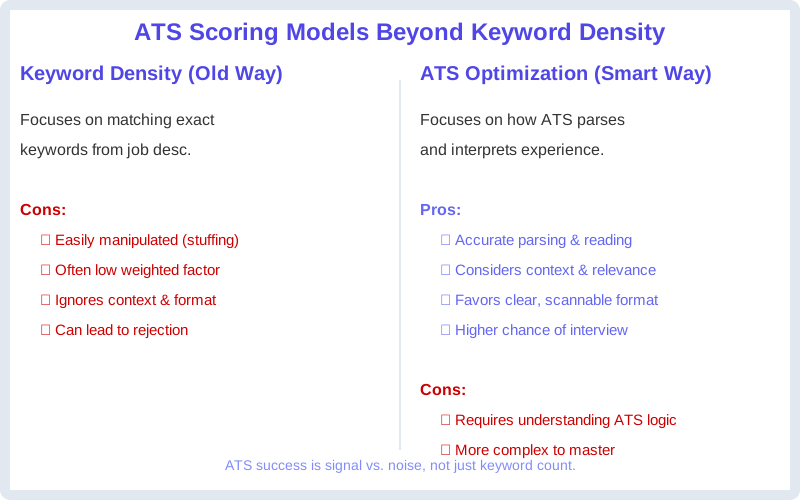
People confuse keyword density with ATS optimization. One is a mathematical calculation; the other is about how the system actually parses your document and interprets your experience. I've watched candidates obsess over hitting a 2 percent keyword density for 'project management' when the real issue was their resume format completely butchering their experience section in Taleo. The ATS black hole isn't always about missing keywords; sometimes it's about the system literally not being able to read what you wrote.
My 'recruiter brain' never cared about a precise keyword percentage. What I cared about was whether the ATS presented me with a candidate profile that made sense, was easy to scan, and didn't look like someone had just copy-pasted the job description 17 times. Modern ATS algorithms are smarter than that, and so are the recruiters who use them. They're looking for signal vs noise, not just a keyword count.
I've set up these systems. I've seen the backend. The keyword density score is often a low-priority flag, easily overridden by other factors like chronological work history, education, or even the sheer absence of critical skills. The resume graveyard is full of perfectly keyword-dense documents that never saw the light of a recruiter's screen because they failed on other, less obvious metrics. It's not just about what you say, but how the system hears it.
It's a broken system, sure, but understanding how it's broken is your only way out. Stop thinking like a content marketer trying to game Google and start thinking like a database architect designing for clean data entry. That's the real shift.
The Real Answer
The real answer is that ATS platforms don't just count keywords like a primitive search engine; they build a structured data profile of you. I configured a Greenhouse instance once where the system would assign a 'skill confidence score' based on where the keyword appeared. A skill listed under a dedicated 'Skills' section got a lower confidence score than the same skill embedded within a bullet point describing an achievement. Placement and context matter more than raw frequency.
Recruiters, myself included, often set up Boolean search strings within Lever or iCIMS that go beyond simple keywords. We'd use operators like 'AND', 'OR', 'NOT', and proximity searches to find candidates. So, 'project management' AND 'Agile' AND 'Scrum Master certification' would be a common string. If your resume just had 'project management' listed 20 times, it wouldn't hit that specific combination.
Many ATS platforms, especially those favored by larger enterprises like Workday and Taleo, employ natural language processing (NLP) to understand synonyms and related concepts. If a job description says 'MarTech' and your resume says 'marketing automation,' the ATS might actually recognize the match. It's not perfect, but it's far more sophisticated than a simple CTRL+F.
Another critical factor is the parsing engine itself. I've seen resumes with tables or complex graphics completely fail parsing in older Taleo versions, resulting in blank fields for 'Experience' or 'Education.' Your meticulously crafted resume became an ATS black hole because the system couldn't extract the data, regardless of keyword density. A low ATS score isn't always about keywords.
Finally, some companies use third-party AI screening tools integrated with their ATS, which add another layer of complexity. These tools might analyze tone, quantify achievements, or even try to infer soft skills. Your resume isn't just a document; it's a data source for multiple layers of algorithms before it ever hits a human's recruiter brain.
What's Actually Going On
What's actually going on is a multi-layered evaluation process, not a simple keyword tally. The first hurdle is always parsing. I remember a time when a candidate's resume, perfectly formatted for human eyes, was rendered as gibberish in our Greenhouse system because they used a custom font. The parsing engine couldn't read it, leading to a functional ATS black hole for that application. Clean, standard formatting is non-negotiable.
Beyond parsing, ATS platforms look for specific data fields. When I built out configurations for Lever, I'd define what fields were most important: 'Job Title History,' 'Company Names,' 'Dates of Employment,' 'Education Level,' and 'Skills.' If the system can't pull that data cleanly, your application is dead in the water, regardless of how many times you mentioned 'synergy.'
Company size also matters. A small startup using a basic Lever or Greenhouse account might rely more heavily on simple keyword matching because their recruiters are swamped and need quick filters. A Fortune 500 company running Workday or Taleo will have far more intricate configurations, often with weighted scoring models. These models prioritize certain sections or keywords over others.
Regulatory facts play a role too. For instance, in some regions, 'blind hiring' features are enabled, where identifying information is stripped out. This means the ATS might be configured to prioritize skills and experience over names or photos. Your resume needs to stand on its own data points, not just pretty presentation.
Some ATS systems even track 'time in previous roles.' If you have a pattern of staying at jobs for less than 18 months, that could be a negative flag, even if your resume is keyword-perfect. It's a feature designed to filter for stability, and it's something I've seen hiring managers specifically request. It's another human-driven rule built into the machine. These systems don't just scan; they evaluate.
How to Handle This
To handle this, stop thinking about keyword density and start thinking about data integrity and targeted relevance. First, open the job description and create a list of 15-25 core keywords and phrases. Don't just pick single words; look for multi-word phrases like 'data visualization' or 'stakeholder management.' These are the exact phrases I'd use in my Boolean searches in Greenhouse. This is your translation layer.
Next, integrate these keywords naturally throughout your resume, focusing on your 'Experience' section. For each bullet point, try to weave in 1-2 keywords, showing how you used that skill, not just that you have it. I always told candidates, 'Don't just say 'Agile,' say 'Led 3 Agile Scrum teams to deliver X product 20 percent faster.' Context and measurable results are golden.
Third, ensure your formatting is clean and simple. Use a standard font like Arial or Calibri, and avoid fancy graphics, tables, or columns. I've seen too many otherwise qualified candidates get caught in the ATS black hole because their resume looked like a design portfolio. The goal is easy parsing for the machine. Text-based is always safer for initial screening.
Fourth, use a dedicated 'Skills' section. While I mentioned earlier that skills in context get higher confidence, a clean, keyword-rich skills section is still crucial for initial filtering. I'd often run a quick search just on the 'Skills' section in Lever to get a preliminary list. List both hard skills (e.g., Python, SQL) and relevant soft skills (e.g., Cross-functional leadership) if they are explicitly mentioned in the job description. This creates clear data points for the ATS.
Finally, tailor your resume for every single application. Yes, it's a pain. But that's the only way to ensure optimal keyword alignment and context. My recruiter brain could spot a generic resume from a mile away, and so can the ATS. Think of it as a custom database query for each role.
What This Looks Like in Practice
I once posted a 'Senior Software Engineer' role where the hiring manager insisted on 'Kubernetes' as a non-negotiable skill. After two weeks, I had 150 applicants in our Workday system. I ran a search for 'Kubernetes' and only 12 resumes came up. Of those 12, only 3 had it listed in their 'Experience' section, the rest just in a 'Skills' list.
The 90 percent of candidates who didn't explicitly use that keyword were immediately binned by my recruiter brain, even if they had related skills. Specificity kills the generic resume.
Another time, for a 'Marketing Manager' role, the job description heavily emphasized 'HubSpot CRM.' I received 200 applications in Greenhouse. I prioritized candidates who mentioned 'HubSpot' and specifically detailed their experience with it in their bullet points. Someone who just wrote 'CRM experience' was instantly deprioritized. It wasn't about keyword density; it was about the exact keyword and its application. The ATS is a blunt instrument, but specific keywords are its scalpel.
For an 'Account Executive' position, the hiring committee valued sales metrics above all else. My Lever setup was configured to extract numbers like 'achieved 120 percent of quota' or 'grew revenue by $2M.' If a candidate's resume didn't have quantifiable achievements, even if it had all the right sales keywords, their 'score' in the system was lower. This is where the human element, the hiring committee's priorities, directly influences ATS configuration.
It's not just keywords; it's the story the data tells, even if it's just numbers.
I've seen resumes for 'Data Analyst' roles where candidates listed 'SQL' multiple times, but never mentioned 'Python' or 'R,' which were also in the job description. Even if the SQL density was high, the absence of other critical keywords meant they didn't pass the initial filter. It's a holistic match, not just a single keyword game. The ATS is looking for the full package, not just one impressive skill.


Mistakes That Kill Your Chances
People make these mistakes all the time, sending their resumes straight into the resume graveyard. I've seen it from both sides of the hiring table.
| Mistake | The Real Reason It Kills Your Chances |
|---|---|
| Keyword Stuffing | Modern ATS systems (like Workday, Greenhouse) flag excessive repetition as spam, reducing your score. Recruiters also see it as desperate and unprofessional, leading to manual rejection. It's a huge red flag. |
| Complex Formatting | Graphics, tables, text boxes, and non-standard fonts often cause parsing errors in ATS (especially older Taleo versions). Your content becomes unreadable, creating an ATS black hole. |
| Generic Resume | Sending the same resume for every job ensures you won't hit the specific keyword combinations or contextual requirements of any single role. My recruiter brain will see it as low effort. |
| Missing Action Verbs | Many ATS configurations prioritize strong action verbs linked to achievements. Without them, your experience sounds passive and less impactful, lowering your 'achievement score.' |
| Ignoring Synonyms | While some ATS use NLP, relying solely on a single term (e.g., 'MarTech' vs. 'marketing automation') can miss matches if the system isn't sophisticated enough. Cover both bases. |
| Not Quantifying Achievements | Many hiring managers ask for metrics-driven candidates. ATS systems like Lever are often configured to extract numbers and percentages, which significantly boost your internal score. |
| Incorrect File Type | Submitting a PDF when the job explicitly asks for a .docx, or vice-versa, can lead to parsing failures. Always follow instructions; I've seen this cause instant rejection. |
Key Takeaways
The days of simply keyword-stuffing your resume and hoping for the best are long gone. I've configured too many ATS systems to tell you otherwise. It's not about a magical keyword density percentage; it's about understanding how the system parses, interprets, and scores your data. It's a battle of mechanics, not just words.
- Focus on Data Integrity: Ensure your resume is clean, simple, and easily parseable by any ATS, no fancy layouts that turn your experience into an ATS black hole.
- Context Over Quantity: Weave keywords naturally into your achievement-oriented bullet points. Show how you used the skill, don't just list it.
- Tailor Every Application: There's no shortcut here.
Each job description is a new set of requirements, and your resume needs to reflect that specific signal vs noise. * Understand Recruiter Workflow: Remember, the ATS is just a tool for the recruiter's brain. They're looking for quick signals that you're a plausible candidate, not a perfect one. Make it easy for them. * Quantify Everything: Numbers speak louder than words, both to the ATS and to the human recruiter. If you can measure it, include it.
This is where your resume really shines through the hiring theater.
Frequently Asked Questions
I saw an online tool that gives my resume an 'ATS score' for $20. Is that worth it, or can I do it myself?
Do I really need to use a plain text resume for ATS, or can I get away with a nicely designed PDF?
What if I tailor my resume perfectly for a ghost job? Will it hurt my chances for future real roles with that company?
Can repeatedly applying to the same company with slightly different resumes eventually get my profile blacklisted by their ATS?
I heard that putting keywords in white text at the bottom of my resume can trick the ATS. Does that actually work?
Sources
- Resume Keywords: How ATS Systems Really Read Your Resume
- ATS Resume Keywords Guide: What Actually Works in 2026 - Upplai
- Understanding ATS Scoring Algorithms
- ATS Score Breakdown: What Each Component Measures [2026 ...
- Full Guide to Optimizing Resume Keywords to Pass ATS Screening
- ATS Optimization: 7 Proven Techniques to Beat Applicant Tracking ...
- linkedin.com
- How ATS Works (2025): Parsing vs Keyword Scoring + How to Beat It
- ats-formatting.html
- Keyword Density for ATS: 7 Tips to Avoid Stuffing 2026 |...
- Mastering Resume Keywords: Standing Out Without Keyword Stuffing
- Difference Between ATS Optimization and Keyword Density - Resumly