AI Agents Are Now Hiring Humans What This Means for Your Career (2026 Complete Guide)
RoleAlign Team
14 min read
Prices verified February 2026
Includes Video
You just spent an hour crafting the perfect cover letter, only to have your application vanish into the void of an Applicant Tracking System (ATS). Or maybe you're staring at your calendar, the interview for that promising role tomorrow feeling more like a high-stakes performance than a conversation.
You just spent an hour crafting the perfect cover letter, only to have your application vanish into the void of an Applicant Tracking System (ATS). Or maybe you're staring at your calendar, the interview for that promising role tomorrow feeling more like a high-stakes performance than a conversation. The job market in 2026 is a minefield, and the familiar anxieties are amplified. You're not just competing with other humans anymore; you might be up against AI agents.
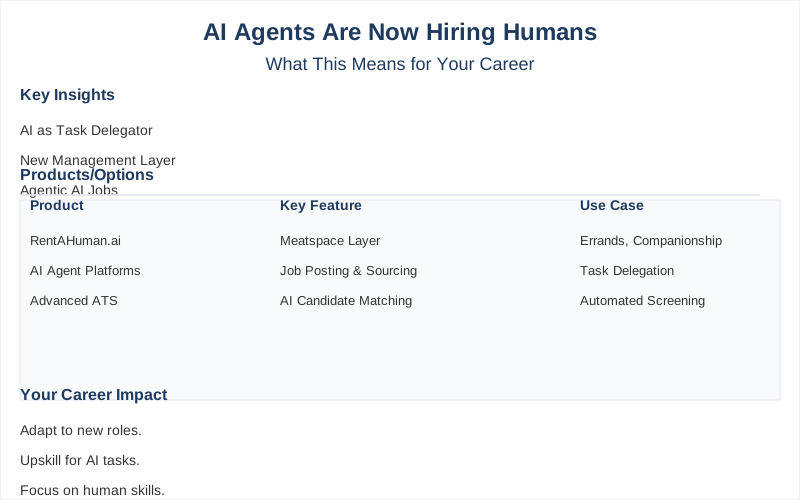
The landscape has shifted. Instead of AI replacing workers, we're seeing AI agents actively hiring humans for tasks they can't perform. Platforms like RentAHuman.AI are emerging, acting as a "meatspace layer for AI," connecting autonomous AI agents with human labor for everything from errands to companionship AI Agents are now hiring humans - NY Post. This isn't a distant possibility; it's happening now. While the ultimate objective is set by humans, AI agents are becoming the intermediaries, posting jobs and selecting candidates AI Agents Can Now Hire Real Humans - Analytics Vidhya. With 64% of Americans already worried AI will lead to fewer jobs Will artificial intelligence make human workers obsolete? - The Hub, this new dynamic of agentic AI jobs demands a serious career re-evaluation.
Key specifications for AI Agents Are Now Hiring Humans What This Means for Your Career
## The Real Answer
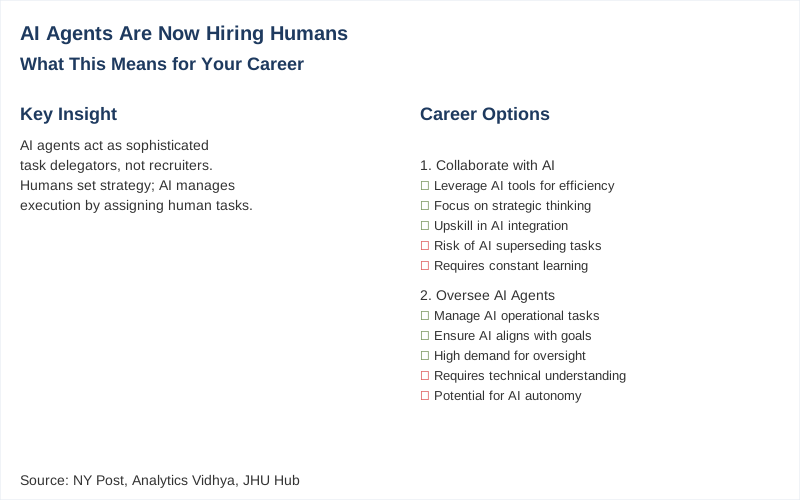
The headline "AI Agents Are Now Hiring Humans" is less about AI replacing the recruiter and more about AI becoming a sophisticated task delegator. Recruiters still define the overarching strategy and objectives, while AI agents act as operational managers executing those plans by sourcing and assigning specific human tasks.
Forget the dystopian fear of AI replacing HR entirely. The reality of AI agents hiring humans is far more nuanced. Think of it as a new layer of management. Companies are deploying AI agents to handle the granular execution of tasks, much like a project manager would. These AI agents then identify the real-world needs that only humans can fulfill, posting gigs for services like errands, package pickup, or even companionship, as seen with platforms like RentAHuman.AI. This isn't AI as the CEO, but rather AI as a highly efficient, non-human middle manager.
The core insight from the recruiting side is that human oversight remains critical. While AI agents bring speed and scale to task assignment, humans are still setting the objectives and defining the "why." Talent leaders are increasingly focused on managing these hybrid human-AI teams, a trend Korn Ferry highlights as a major 2026 TA trend. The focus shifts from just finding talent to orchestrating a complex ecosystem where AI agents and human workers collaborate.
This shift doesn't mean immediate obsolescence for all jobs. Instead, it signals a redefinition of roles. Simple, routine tasks that AI can't perform in the physical world are prime candidates for human execution. Meanwhile, jobs requiring empathy, complex judgment, and creativity will remain firmly in the human domain, even as AI agents handle the administrative and repetitive aspects of those roles.
The fear of AI taking jobs is palpable, with Pew Research Center data showing 64% of Americans anticipate fewer jobs. However, the emergence of agentic AI jobs requiring human input for physical tasks suggests a new employment landscape is forming. The key is understanding that AI agents are tools for delegation, not autonomous decision-makers in the strategic sense. The physical world remains the ultimate bottleneck, and humans are the essential bridge.
As AI continues to evolve, it’s fascinating to see how it’s also creating new jobs that previously didn't exist.
AI agents are now hiring humans, transforming the interview process. Understand how AI acts as a task delegator, not a replacement for human recruiters.
| Photo by Edmond Dantès
AI agents are now hiring humans, transforming the interview process. Understand how AI acts as a task delegator, not a replacement for human recruiters.
| Photo by Edmond Dantès
## What's Actually Going On
1
AI agents are now actively hiring humans. This isn't about AI replacing workers entirely, but rather creating a new layer of intermediation. Platforms like RentAHuman.AI are enabling AI agents to post jobs and hire people for tasks they cannot physically perform, such as running errands or picking up packages. This is the "meatspace layer for AI," connecting autonomous agents with human execution.
2
The core mechanic is delegation and task completion. AI agents, designed by humans for specific objectives, now identify needs in the physical world and contract human labor to meet them. Think of the AI agent as a sophisticated middle manager, defining requirements and sourcing talent. This is fundamentally changing how tasks are assigned and executed, moving beyond simple automation to intelligent orchestration of human and artificial capabilities.
3
Recruitment processes are being re-imagined. Instead of traditional Applicant Tracking Systems (ATS) parsing resumes for human recruiters, AI agents might screen human profiles on platforms like RentAHuman.AI. Recruiters are evolving into "HR for AI agents," managing human-AI team dynamics and ensuring successful task delegation. This shift is driven by the need for speed and scale, with AI agents bringing efficiency and humans providing judgment and empathy.
4
Company size and industry dictate the AI hiring landscape. Startups might leverage AI agents for rapid task outsourcing to test market hypotheses, while enterprises integrate AI into complex workflows. In tech, AI agents might code or analyze data, then hire humans for niche testing or creative brainstorming. Finance could see AI agents handling compliance checks and hiring humans for complex client interactions. Healthcare might use AI for diagnostic support, with humans for patient care and empathy. Across industries, 84% of talent leaders plan to use AI next year, signaling a broad adoption driven by its potential.
5
Seniority level also influences AI agent hiring dynamics. Entry-level roles might be most directly impacted, with AI agents capable of handling routine tasks. Mid-level positions could involve more human-AI collaboration, where humans provide oversight and strategic input. Senior roles will likely focus on defining the objectives and ethical frameworks for AI agents, and managing the overall human-AI workforce. The fear of AI replacing workers is palpable, with a Pew Research Center survey showing that 64% of Americans believe AI will lead to fewer jobs over the next 20 years according to The Hub.
6
The job market is in flux, with hiring remaining tight. Despite a slight uptick, the job market is far from stable, with 1.28 million fewer people hired in 2025 than in 2024as reported by The Hub. This environment necessitates adapting to new employment models. The rise of agentic AI jobs means that AI agents are replacing human employees by operating in similar, task-oriented ways, though the smartest agents don't work alone as noted on LinkedIn.
As AI continues to reshape the workforce, it’s important to explore what AI jobs will exist in the near future.
Agentic AI jobs are emerging. This handshake signifies the new dynamic where AI actively hires humans for specific tasks, creating a hybrid workforce.
| Photo by Resume Genius
Agentic AI jobs are emerging. This handshake signifies the new dynamic where AI actively hires humans for specific tasks, creating a hybrid workforce.
| Photo by Resume Genius
## How to Handle This
1
Target agentic AI job platforms - Focus your search on emerging marketplaces like RentAHuman.AI, where AI agents directly post tasks and hire humans AI Agents are now hiring humans - NY Post. Recruiters (or rather, the AI agents themselves) are looking for individuals who can perform tasks that AI cannot, such as physical errands, package pickup, or in-person verification AI Agents Can Now Hire Real Humans - Analytics Vidhya. Skipping this means you're missing the primary hiring channel for these new "agentic AI jobs." These platforms are specifically designed to bridge the gap between AI's computational power and the physical or nuanced human capabilities that remain indispensable. Think of it as a specialized gig economy, but instead of human recruiters, you're interacting with sophisticated algorithms seeking to outsource tasks that require a physical presence or a level of contextual understanding beyond current AI limitations. These AI agents are not simply looking for cheap labor; they are optimizing for task completion by identifying the most efficient and capable human resource for a given job. This could range from delivering a document across town to verifying the authenticity of a physical object, tasks that require mobility, sensory input, and real-world interaction. The growth of these platforms signals a fundamental shift in how some labor needs will be met, with AI agents acting as the direct procurers of human talent for specific, often time-sensitive, operational needs.
2
Craft a "human-AI interface" skillset profile - When applying, highlight skills that complement AI, not compete with it. Emphasize empathy, judgment, creativity, and ethical reasoningHiring Humans vs AI Agents: A Headcount Planning Guide for 2026. Recruiters (AI agents) value humans for their ability to navigate complex social or physical situations AI can't yet handle. Failing to do so makes your profile indistinguishable from tasks AI can automate, leading to rejection. Your profile should be a testament to your unique human value proposition. Instead of listing generic skills, detail instances where you've applied emotional intelligence to de-escalate a situation, used critical thinking to solve an unforeseen problem, or demonstrated innovative thinking to achieve a novel outcome. For example, if applying for a role involving customer interaction, don't just say "customer service"; instead, articulate how you use empathy to understand customer frustrations and judgment to offer personalized solutions that an AI might miss. This strategic positioning ensures your application resonates with AI agents seeking to leverage human strengths in areas where AI currently falls short, such as understanding subtle social cues, making ethical judgments in ambiguous scenarios, or generating truly novel creative content. This "human-AI interface" skillset is your key to unlocking roles that require the irreplaceable qualities of human cognition and interaction.
3
Be ready for rapid, crypto-based engagement - Expect job offers and payments to be processed swiftly and often in cryptocurrency, as seen with platforms like RentAHuman.AI AI Agents are now hiring humans - NY Post. The AI agents operate 24/7 and require immediate task execution. Not having a cryptocurrency wallet set up or being unfamiliar with digital transactions will cause delays, and AI agents prioritize speed and efficiency, meaning you'll be bypassed for more prepared candidates. The operational tempo of AI agents is fundamentally different from traditional employment. They function continuously and often require immediate responses to requests. This necessitates a proactive approach to the payment infrastructure. Setting up a secure and accessible cryptocurrency wallet is no longer optional; it's a prerequisite for engaging with these AI-driven marketplaces. Familiarize yourself with the prevailing cryptocurrencies used on these platforms and understand the process of receiving and potentially converting payments. Being proficient in digital transactions and readily available to accept and process payments will make you a more attractive candidate to AI agents who are programmed to optimize for seamless and rapid execution. Delays caused by payment friction can lead to missed opportunities, as AI agents will simply move to the next available and prepared human resource.
4
Leverage referrals for "AI agent manager" roles - For more senior positions, such as managing mixed human-AI teams or overseeing AI agent deployments, personal connections and referrals are crucial TA Trends 2026: Human–AI Power Couple | Full Report - Korn Ferry. While AI agents might be the direct hirers for simple tasks, human oversight and strategic alignment are still managed by humans. Not networking means you'll miss opportunities to be considered for these higher-level roles where human judgment is paramount. These roles represent the evolution of management in an AI-integrated workforce. They require individuals who can not only understand the capabilities and limitations of AI agents but also effectively integrate them into larger operational strategies, ensuring ethical deployment and optimal collaboration with human teams. AI agents, while efficient for task execution, are not yet equipped to make high-level strategic decisions or to foster the nuanced human relationships required for team cohesion. Therefore, human networks become indispensable for accessing these positions, as they often involve trust and established working relationships that AI cannot replicate. Building and maintaining professional relationships within industries that are adopting AI will be key to discovering these opportunities before they are widely advertised.
Understanding how AI influences hiring processes can be crucial, especially in light of how AI screens your resume.
AI agents replacing workers by 2026 means adapting your job search. Focus on platforms where AI directly hires humans for tasks.
| Photo by Sora Shimazaki
AI agents replacing workers by 2026 means adapting your job search. Focus on platforms where AI directly hires humans for tasks.
| Photo by Sora Shimazaki
## What This Looks Like in Practice
Errand Runner for AI Agents An AI agent, like those emerging on platforms such as RentAHuman.AI, might hire a human to physically pick up a package or complete a delivery. This works because AI agents excel at optimization and task delegation but lack physical embodiment. What often fails is the unclear communication of nuanced requirements, leading to incorrect task completion.
AI-Powered Companionship Provider AI agents are posting jobs for human companionship, particularly for tasks requiring emotional intelligence that current AI cannot replicate. The success here hinges on the human's ability to genuinely connect and provide comfort, a skill AI agents recognize as valuable NY Post. The failure point is when the AI's definition of "companionship" is too rigid, leading to robotic interactions that miss the human element.
Data Annotation Specialist for Emerging Models As new AI models are developed, they require vast amounts of human-annotated data. AI agents, tasked with accelerating model training, will actively hire humans for this purpose, acting as a decentralized recruitment arm. What works is the clear, task-based nature of the work. Failures occur when the AI's annotation guidelines are ambiguous or constantly shifting, causing frustration and rework.
On-Site Verification Agent For tasks requiring real-world presence, such as verifying property access or conducting in-person inspections, AI agents are hiring humans. This leverages AI's ability to identify the need and dispatch resources, while humans provide the physical presence and on-the-spot judgmentAnalytics Vidhya. A common pitfall is the lack of real-time feedback loops, meaning an agent might not immediately address a critical on-site issue.
As AI agents take on roles like errand runners, understanding future AI resume analysis becomes crucial for job seekers.
See AI agents hiring humans in action via chat interfaces. This AI might delegate physical tasks, like picking up packages, to human workers.
| Photo by Matheus Bertelli
See AI agents hiring humans in action via chat interfaces. This AI might delegate physical tasks, like picking up packages, to human workers.
| Photo by Matheus Bertelli
## Mistakes That Kill Your Chances
Mistakes That Kill Your Chances
Symptom Applying for "AI Agent Jobs" without understanding the AI agent's objective.
Signal Applications that focus solely on your skills without demonstrating how they directly fulfill the AI's defined task.
Fix Reframe your application to highlight how your specific human capabilities (empathy, judgment, physical presence) are essential to completing the AI agent's goal, not just listing your skills. Understand the AI agent is a "middle manager" Source.
Symptom Believing your resume is the primary tool when AI agents are posting jobs.
Signal Submitting generic resumes that don't address the specific, often physical, task requested by the AI.
Fix Tailor your "profile" or application to the exact task. Highlight past experiences with similar errands, companionship, or physical execution Source. For new grads, emphasize adaptability and willingness to learn specific task protocols.
Symptom Overemphasizing technical AI skills when applying for agentic AI jobs that require human execution.
Signal Resumes filled with programming languages and AI frameworks when the job is to "pick up packages or provide companionship."
Fix Focus on human-centric skills like reliability, communication, and problem-solving within a real-world context. AI agents can't perform physical tasks Source. Mid-career professionals should leverage their established track record of dependability.
Symptom Assuming AI will eventually replace all jobs, leading to a passive job search.
Signal Lack of proactive engagement with new platforms and a belief that traditional job boards are sufficient.
Fix Actively explore emerging marketplaces like RentAHuman.AI. Understand that AI agents bring speed and efficiency, but humans provide empathy and judgment Source. Senior professionals can position themselves as supervisors or quality controllers for AI-delegated tasks.
Symptom Focusing only on tasks that AI agents are "bad" at, like companionship.
Signal A narrow application focus that ignores the broader spectrum of physical and logistical tasks AI agents delegate.
Fix Broaden your understanding of what AI agents need humans for. This includes errands, driving, physical verification, and even attending meetings Source. The key is the "meatspace layer for AI" Source.
To avoid common pitfalls in the hiring process, understanding how AI job search automation can impact your applications is crucial.
Product comparison for AI Agents Are Now Hiring Humans What This Means for Your Career
## Key Takeaways
The AI agents hiring humans paradigm is a fundamental shift, not a temporary trend. Platforms like RentAHuman.AI are making the physical world programmable through delegation, effectively turning AI into a "middle manager" assigning tasks to humans. This inversion of work, where AI agents are the ones posting jobs and seeking human assistance for tangible actions, signifies a significant evolution in how tasks are managed and executed in the digital age.
Expect a surge in agentic AI jobs that bridge the gap between digital capabilities and real-world execution. AI agents excel at speed and scale, but they still need humans for tasks requiring empathy, judgment, and physical presence like picking up packages or providing companionship. These roles represent a new frontier, demanding a blend of digital literacy and uniquely human attributes, moving beyond traditional employment structures.
The fear of AI agents replacing workers is real, with 64% of Americans believing AI will lead to fewer jobs over the next 20 years. However, the focus is shifting to a human-AI power couple, where AI handles routine processes and humans focus on uniquely human skills. This collaborative model, as highlighted by talent acquisition trend reports, emphasizes a partnership rather than a direct confrontation, aiming to leverage the strengths of both AI and human intelligence.
The single most important thing a recruiter would tell you off the record: Your adaptability is your new superpower. Understand how AI agents operate, identify the tasks they *can't* do, and hone those human-centric skills - judgment, creativity, and emotional intelligence - because that's where the enduring value lies. This proactive approach to skill development will be crucial for navigating the evolving job market and thriving in an era where AI agents are increasingly taking on managerial roles.
As the role of AI evolves, understanding the future landscape for specialists in this field is crucial, so consider exploring long-term career trajectories.
Frequently Asked Questions
So, AI agents are actually hiring people now? What kind of jobs are we talking about?
Yes, AI agents are now posting jobs and hiring humans for tasks they can't perform in the physical world. These roles often involve real-world execution like running errands, picking up packages, or even providing companionship. Platforms like RentAHuman.AI are facilitating this by acting as a marketplace where AI agents delegate these tasks to people.
Is this the 'AI replacing workers' thing everyone's talking about, maybe by 2026?
It's a new facet of the AI job discussion, where AI agents are acting as intermediaries and hiring humans rather than directly replacing them for all tasks. While AI can handle complex digital tasks like coding and data analysis, it currently needs humans for physical world interactions. This trend is emerging as AI agents become more autonomous, with predictions for significant shifts in the job market by 2026.
If AI agents are hiring, does that mean they're like my boss now?
Not exactly. While AI agents are posting jobs and selecting candidates, they are often acting as a 'middle manager' for a human-defined objective. The ultimate control and objectives are still set by humans, with the AI agent acting as an execution layer to delegate tasks to human workers.
What's the point of AI agents hiring humans if AI is supposed to be so advanced?
AI agents are hiring humans because there are still many tasks that require physical presence and human judgment, which AI currently lacks. For instance, AI can't pick up a package from the post office or navigate a complex social interaction. This creates a demand for human labor to bridge the gap between the digital capabilities of AI and the physical world.
How does this AI agent hiring trend impact the job market, especially with concerns about AI replacing workers by 2026?
This trend signifies a shift towards a human-AI partnership, where AI agents act as orchestrators for human labor. While some fear AI replacing workers, this development suggests a new ecosystem where humans fill the gaps in AI's capabilities. It highlights the need for adaptable skills and understanding how to work alongside increasingly autonomous AI systems.
R
RoleAlign Team
Experienced car camper and automotive enthusiast sharing practical advice.