
The Hidden Biases Embedded in Ats Screening Logic (2026 Complete Guide)
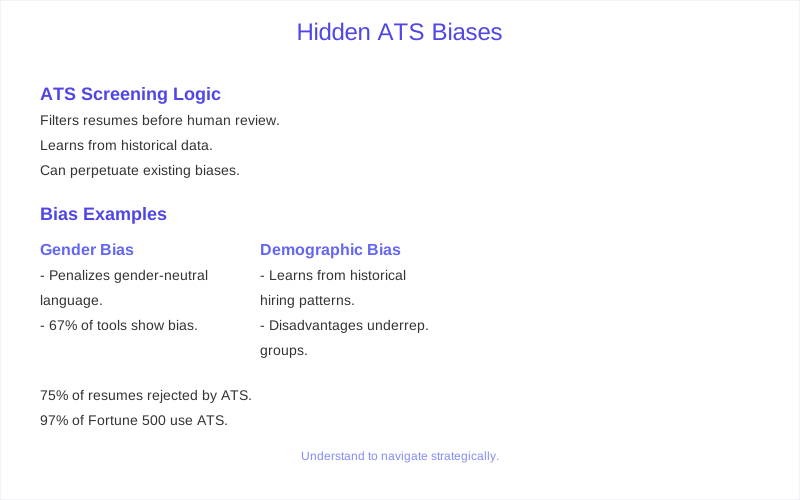
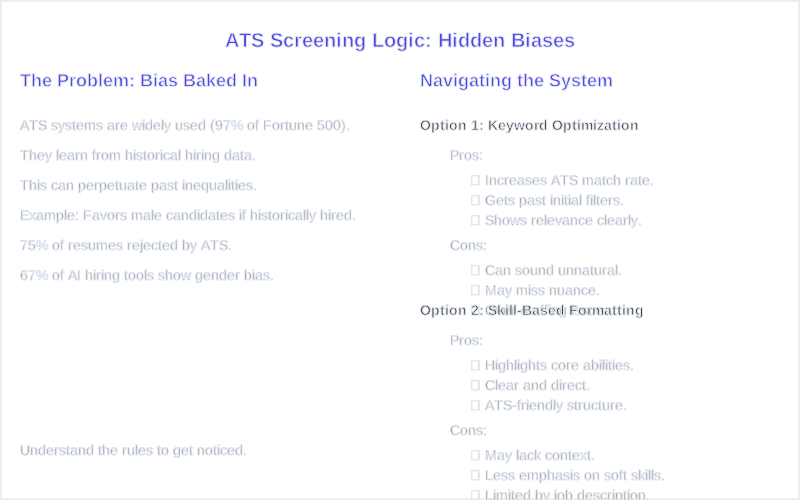
I've seen the internal reports. About 97 percent of Fortune 500 companies, and 60 percent of large companies, now use Applicant Tracking Systems (ATS) to filter resumes. This isn't just about efficiency; it's about control, and it's where the first layer of hidden bias often gets baked in before a human ever sees your name.
I've seen the internal reports. About 97 percent of Fortune 500 companies, and 60 percent of large companies, now use Applicant Tracking Systems (ATS) to filter resumes. This isn't just about efficiency; it's about control, and it's where the first layer of hidden bias often gets baked in before a human ever sees your name. Harvard Business School research indicates 75 percent of resumes are rejected by ATS before reaching a recruiter's desk.
My years in HR have shown me that these systems, while designed to streamline, can inadvertently perpetuate bias. They learn from historical hiring data. If a company historically hired predominantly male engineers, the AI can learn that "male" correlates with success, even if the actual job performance data doesn't support it. This creates a feedback loop that disadvantages qualified candidates from underrepresented groups.
It's not about the ATS being inherently malicious; it's about the data it's fed and the parameters it's given. A 2023 MIT study found that 67 percent of commercial AI hiring tools exhibited measurable gender bias, often penalizing resumes that used gender-neutral language. This is a systemic issue, not a personal failing on your part.
My role is to help you understand these mechanics so you can navigate them strategically. You need to know how to present your qualifications in a way that satisfies the machine, without compromising your authentic professional identity. It's about playing the game by their rules to get to the human round.
Without this understanding, your perfectly qualified resume might end up in a digital black hole, not because you lack the skills, but because the system couldn't parse them correctly. This is where your protective actions begin.
The Real Answer
The real reason bias is embedded in ATS screening logic isn't some grand conspiracy; it's a byproduct of how these systems are designed and trained. They are built on historical data, which often reflects past biases. If a company's past hiring leaned heavily towards a specific demographic, the ATS learns those patterns.
I've witnessed this firsthand. When an ATS is fed years of hiring data where, for example, most successful project managers came from a handful of prestigious universities, the system begins to rank candidates from those schools higher. This isn't about current merit; it's about historical precedent. Smart data and transparent models are crucial for avoiding AI pitfalls.
This creates what I call the 'echo chamber effect.' The AI is designed to find patterns that predict success based on what has already happened. It doesn't innovate or challenge existing norms. It simply reinforces them, often at the expense of diversity and fresh perspectives.
Another significant factor is feature selection bias. Certain resume features, like specific keywords or years of experience, are weighted more heavily. This can disadvantage non-traditional candidates or those who use slightly different terminology for similar skills. Researchers have explored potential biases in AI-Recruitment Systems through interviews with HR professionals.
My experience tells me that companies, despite good intentions, often prioritize speed and keyword matching over a nuanced understanding of a candidate's full profile. The system's triggers are keyword density and formatting compatibility, not necessarily true potential or a diverse skill set. Your goal is to understand these triggers.
This isn't just about 'matching keywords'; it's about the inherent limitations of algorithms trying to replicate human judgment, but only having historical, potentially biased, data to learn from. The company's self-preservation instinct here is efficiency, which sometimes overrides true equity.
What's Actually Going On
What's actually going on is a complex interplay of algorithm design, data quality, and the sheer volume of applications. Modern ATS platforms, like Workday or Oracle, are no longer simple resume repositories; they're powerful recruiting engines with AI-assisted screening. They support skills-based hiring and automated workflows.
Research indicates that 50 percent of employers inadvertently overlook qualified candidates due to these embedded biases. This often stems from training data bias, where the model learns from historical hiring data that may already be skewed towards certain demographics or career paths.
For example, if past hires for a software engineering role were predominantly male, the AI might inadvertently associate male-coded language or activities with higher suitability. This isn't intentional discrimination by the company, but a reflection of the data it was fed.
Algorithmic bias is another layer. The mathematical model itself can amplify patterns that aren't truly predictive of job performance. It might identify correlations that are proxies for protected class status, such as specific names, zip codes, or even extracurricular activities.
Different ATS providers, like Greenhouse or Lever, have varying parsing strengths and matching algorithms. This means a resume that sails through one system might get tripped up by another, even for the same job. Major ATS providers each have different parsing strengths.
Companies, especially larger ones, rely on these systems to manage thousands of applications. The sheer scale makes manual review impractical. This reliance means that the biases embedded in the ATS have a significant impact on who gets seen.
Moreover, user-interface bias can play a role. Recruiters might unconsciously favor profiles that the AI has already scored highly, reinforcing the algorithm's preferences. Companies can combat these biases by adopting data-driven approaches and implementing regular audits.
It's a system built for volume, not necessarily for nuance or equity. Your objective is to understand how these systems work so your application doesn't get lost in the shuffle.


How to Handle This
To navigate these hidden biases, your first step is meticulous tailoring. Resist the urge to send a generic resume. For every application, download the job description and dissect it. Pay close attention to keywords, required skills, and qualifications. Modern ATS platforms now support AI-assisted screening, making keyword matching paramount.
Integrate those exact keywords into your resume and cover letter. Don't just list them; weave them naturally into your experience and skill sections. If the posting says "project management software," use that exact phrase, even if you typically say "PM tools."
Next, ensure your formatting is ATS-friendly. Avoid complex graphics, tables, or unusual fonts. Stick to a clean, simple layout. Most ATS systems are designed to parse text, not elaborate design. A plain text resume is often your safest bet. Hidden associations in resume screening can unintentionally favor or disadvantage candidates.
I always advise using a functional or chronological resume format, clearly labeling sections like "Experience," "Skills," and "Education." This helps the ATS categorize your information correctly. Missing or ambiguously named sections can lead to your qualifications being overlooked.
Proofread everything rigorously. Typos or grammatical errors can signal to an ATS that you lack attention to detail, leading to a lower score. Remember, the machine doesn't understand context; it just flags discrepancies.
Finally, don't rely solely on online applications. After submitting your ATS-optimized resume, try to network. Find someone at the company on LinkedIn and reach out. A referral, even a casual one, can sometimes bypass the initial ATS filters or give your application a second look. This creates a human connection that the ATS cannot block.
What This Looks Like in Practice
I've seen resumes for a 'Senior Software Engineer' role that were rejected because the candidate used 'Lead Developer' on their resume, despite identical responsibilities. The ATS, programmed for exact keyword matching, filtered them out. This is a common pitfall. Automated talent acquisition tools are conducting blind screenings, but they're not always context-aware.
Another scenario involves 'years of experience' requirements. A job posting asked for 5 years of experience, but the candidate had 4 years and 10 months. The ATS, set with a hard minimum, automatically discarded the application, missing a highly qualified individual by a mere two months. It's a binary system.
I recall a candidate applying for a position requiring a 'PMP certification.' Their resume clearly stated 'Project Management Professional (PMP) certified.' However, the ATS was only programmed to recognize 'PMP' as a standalone keyword, not the full phrase. The candidate was rejected.
This isn't just theory; it's a 12-second decision made by a machine. ATS systems can perpetuate bias by favoring certain demographics, often unintentionally. It's about how the system is configured.
One company's ATS was found to penalize resumes that included volunteer experience in non-profit sectors, as its training data had historically prioritized corporate experience. This unintentionally screened out candidates with valuable leadership skills gained in different environments.
These systems operate on strict rules. Your goal is to understand those rules and adapt your application to meet them precisely. It's not about tricking the system, but about speaking its language.
Mistakes That Kill Your Chances
| Mistake | Why It Kills Your Chances | Protective Action to Take |
|---|---|---|
| Generic Resume | Fails keyword matching, gets low ATS score. Missing exact keywords is the number one reason for ATS rejection. | Tailor every resume to the specific job description. |
| Fancy Formatting | Complex graphics, tables, or unusual fonts confuse parsers. | Use simple, clean formatting; avoid non-standard elements. |
| PDF-Only Submission | Some older ATS systems struggle to read PDFs accurately. | Submit in both PDF and Word document if allowed, or prefer Word. |
| Keyword Stuffing | Overloading with keywords looks unnatural, can flag as spam. | Integrate keywords naturally into sentences and bullet points. |
| Omitting Acronyms/Full Names | If the job says 'PMP,' don't just write 'Project Management Professional.' | Use both the acronym and the full term (e.g., 'PMP (Project Management Professional)'). |
| Irrelevant Experience | Including too much unrelated experience dilutes keyword density for target role. | Focus on experience directly relevant to the job posting. |
| Not Using a Cover Letter | Missed opportunity to include more keywords and express fit. | Always submit a tailored cover letter when possible. |
| Applying to Too Many Jobs | Spreading yourself thin means less time to optimize each application. | Focus on fewer, highly targeted applications. |
Key Takeaways
Navigating the hidden biases in ATS systems isn't about outsmarting a malevolent entity; it's about understanding a highly structured, data-driven gatekeeper. My years in employee relations have taught me that knowledge of these systems is your most powerful tool.
- Tailor Rigorously: Every single application must be customized to the job description. This is non-negotiable. Aligning resume content to specific job posting language dramatically improves ATS ranking.
- Prioritize Clarity: Simple, clean formatting ensures the ATS can parse your information without errors. Avoid anything that might confuse a machine.
- Speak the System's Language: Use the exact keywords and phrases from the job posting.
The ATS doesn't infer; it matches. * Document Everything: While not directly applicable to ATS, the principle of creating a paper trail for any perceived discrimination or issues remains critical once you move past the initial screening. * Network Strategically: Don't let the ATS be your only point of contact. A human referral can sometimes bypass the initial filters or at least guarantee a human eye on your application.
Your goal is to move your resume from the 'unseen' pile to the 'human review' pile. This requires a strategic approach to how you present your qualifications. It's about playing by the rules of the machine to unlock the opportunity to connect with a person.
Frequently Asked Questions
Is it worth it to pay a resume writing service $300 to 'ATS optimize' my resume, or can I do it myself for a $0 cost?
Do I really need to use the exact same keywords, or will the ATS understand synonyms?
What if I tailor my resume perfectly, but I still don't get any calls back?
Can using a non-standard resume format, like a highly visual one, permanently damage my chances with a company?
I heard that ATS systems can detect if you're overqualified. Is that true, and how can I avoid it?
Sources
- Fair or Flawed? How Algorithmic Bias is Redefining Recruitment ...
- AI in Recruitment is Neutralizing Unconscious Bias | 2026
- How to avoid AI pitfalls in 2026: A marketer's guide to smarter, safer AI
- Navigating ATS in 2026: Get Your Resume Through
- What are the hidden biases in ATS algorithms, and how can ...
- How to Understand Bias in AI Hiring Tools - Resumly
- Reducing AI bias in recruitment and selection: an integrative ...
- How to Pass ATS Screening (2026): 9 Steps to Get Your Resume ...
- The Hidden Bias in ATS Systems: How Great Candidates Are Being ...
- Mastering Your Applicant Tracking System in 2026: A Complete Guide
- What are the hidden biases in ATS algorithms, and how can ...