
Leveraging AI Tools to Map Your Current Skills to New Career Paths (2026 Complete Guide)
I once watched a guy spend 43 minutes trying to convince a hiring manager that his 'AI-powered resume' was better than a well-written one. He probably paid $29 for that service. The manager, a grizzled veteran who'd seen every buzzword since 'dot-com,' just nodded.
I once watched a guy spend 43 minutes trying to convince a hiring manager that his 'AI-powered resume' was better than a well-written one. He probably paid $29 for that service. The manager, a grizzled veteran who'd seen every buzzword since 'dot-com,' just nodded. What LinkedIn won't tell you is that the actual job of getting hired still relies on understanding human psychology, not just algorithms.
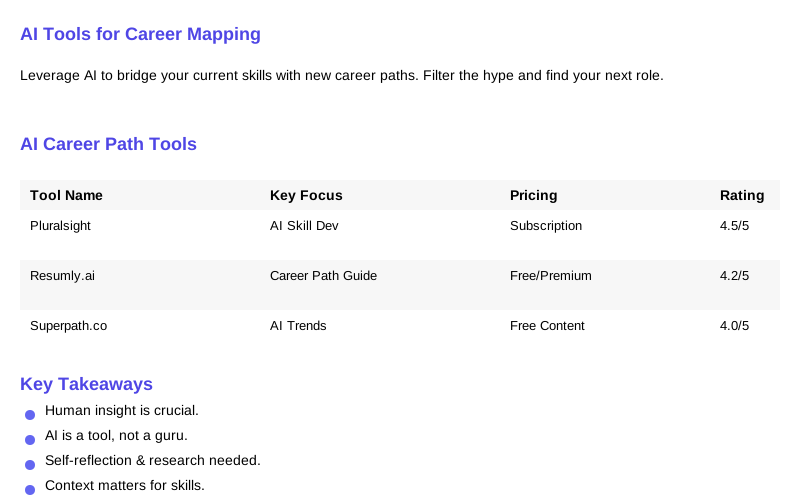
The signal vs hype problem is real, especially when you're trying to leverage AI tools to map your current skills to new career paths. Pluralsight's 2026 AI career guide notes that basic AI skills are now table stakes, but deep expertise is still rare.
Everyone's talking about AI replacing jobs, or AI creating new jobs. Both are true, in a messy, inconvenient way. The unglamorous part is filtering out the noise. Your current skills aren't obsolete; they're just waiting for a rebrand and a new context. But don't expect a magic AI wand to do all the heavy lifting for you.
I've seen too many folks dump their entire work history into a chatbot, expecting it to spit out a clear path to a '$200K AI Ethicist' role. That's like asking a toaster to bake a soufflé. It's a tool, not a guru. The real requirements for career navigation involve self-reflection, market research, and understanding what companies actually value.
The pivot tax is often underestimated. You might be a phenomenal project manager in construction, but transitioning those skills to an AI product owner role isn't a direct copy-paste. It requires understanding the specific nuances of the new domain. Resumly's guide offers steps, but the human element of strategic thinking is still paramount.
The promise of AI is always a few steps ahead of its current state, as Superpath mentions regarding content marketing. This applies equally to career mapping. AI can highlight connections, sure, but it can't feel out your true interests or navigate the politics of a job interview. That's still on you.
The Real Answer
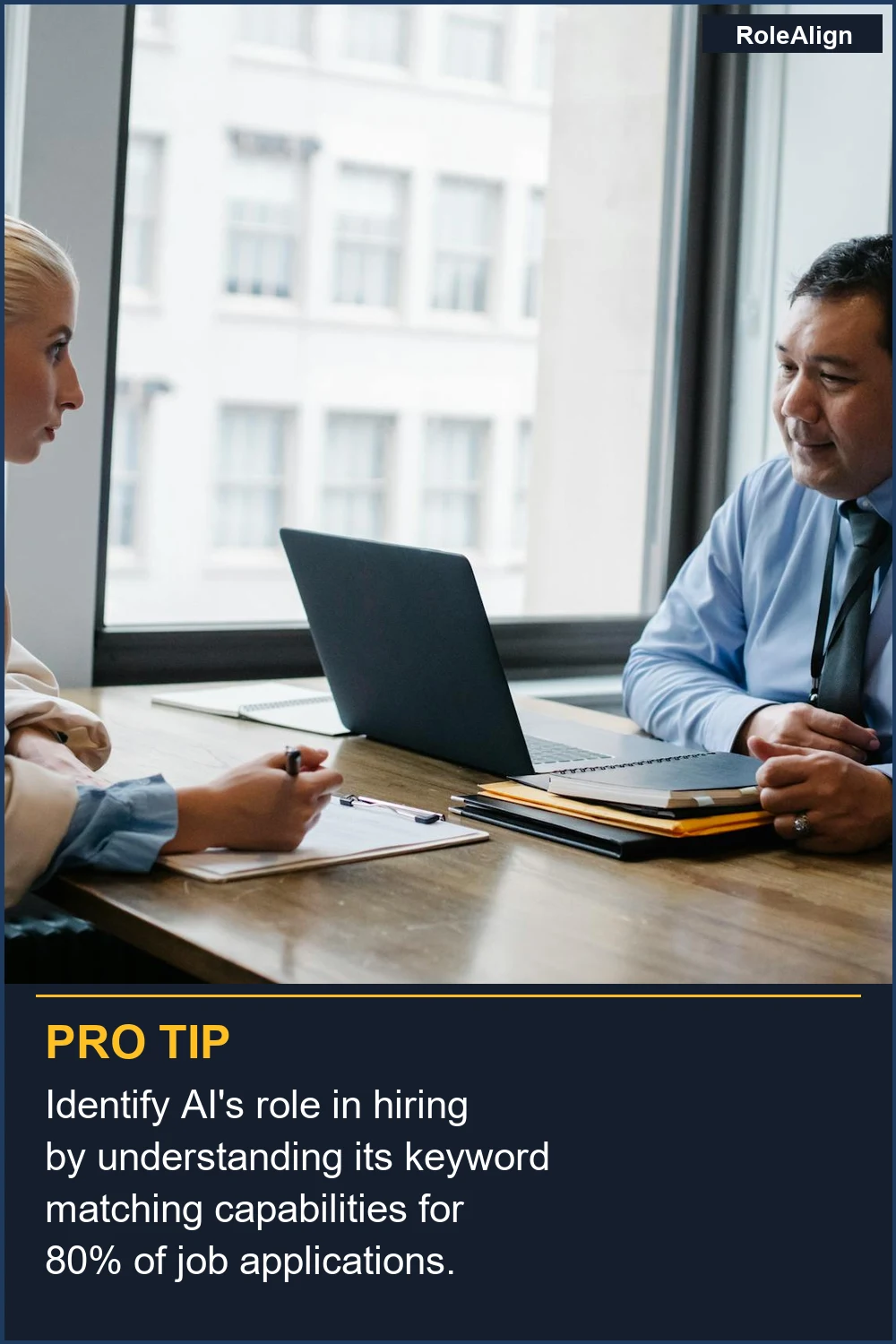
The real answer to leveraging AI for career mapping isn't about finding a secret algorithm; it's about understanding how the hiring machine works, and where AI fits into its gears. Most AI tools for career mapping are essentially sophisticated keyword matchers, built on massive datasets of job descriptions and resumes. They're good at spotting patterns, not predicting your happiness. The Wall Street Journal highlights how tools from Google and LinkedIn offer insights, but it's still about interpreting those insights.
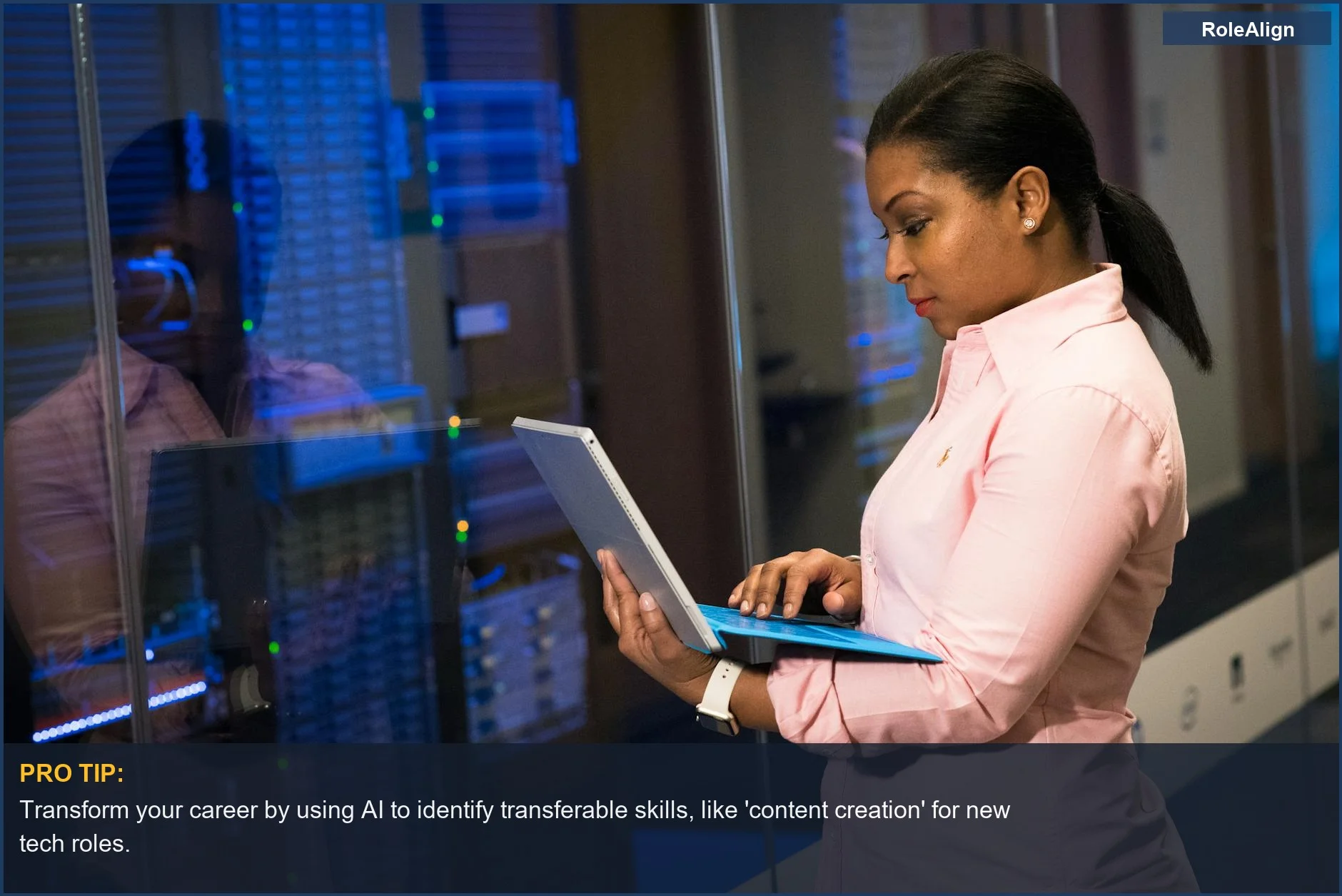
Think of it this way: AI can tell you that your 'project management' experience from building houses has a 70 percent skill overlap with 'scrum master' roles in tech, based on common keywords. It sees the words. It doesn't understand the daily grind of dealing with a subcontractor who just decided Tuesdays are optional. The unglamorous part of the job is often context-specific.
Your mental model needs to be this: AI for career mapping is a highly efficient search engine, not a career counselor. It accelerates the initial research phase, sifting through millions of data points far faster than you ever could. This YouTube video on AI replacing jobs reinforces that while AI changes skill demands, human judgment remains critical.
It works by identifying latent relationships between skills, industries, and job titles. If thousands of resumes with 'SQL' and 'data analysis' also transition into 'Business Intelligence Analyst,' the AI flags that as a viable path. It's a statistical correlation engine. The actual job of defining your next move requires you to inject your preferences, values, and tolerance for the unglamorous 80 percent of any given role.
So, while it can tell you that 'organizational leadership' is a skill sought by both 'VP of Operations' and 'Head of Product,' it won't tell you which one involves fewer pointless meetings. That's your job to figure out through networking and informational interviews. The math matters less than the communication.

What's Actually Going On
What's actually going on when you feed your resume into an AI career tool? These platforms are leveraging large language models (LLMs) trained on vast corpuses of job descriptions, industry reports, and professional profiles. They're looking for semantic similarities and common pathways. Ucertify explains that AI careers aren't just for programmers; they span technical and non-technical roles.
ATS data, or Applicant Tracking System data, plays a huge role. These systems are the gatekeepers of modern hiring. AI career tools often mimic how an ATS scores a resume against a job description. They identify keywords, skill clusters, and experience durations that align with different roles and industries. This gives you a peek behind the curtain.
Company-size variations are critical. A small startup might value a 'full-stack generalist' who can wear 10 different hats, while a Fortune 500 company will want a 'Specialized ML Engineer for Recommendation Systems.' AI tools can sometimes miss these nuances if not explicitly prompted. The real requirements change drastically with company scale and culture.
Regulatory facts also impact career paths, especially in fields like healthcare or finance. An AI might suggest a 'Data Scientist' role in finance, but it won't automatically tell you about the FINRA certifications or specific compliance knowledge required. These are the hidden skill gaps that AI identifies only at a surface level. Reddit users have shared experiences where AI helped clarify options, but human input was still needed for deeper dives.
I've seen AI tools suggest 'prompt engineer' to someone with a literature degree. It's not wrong in principle, but the actual job involves far more than just writing clever prompts. It means understanding model limitations, debugging outputs, and sometimes even a bit of scripting. The unglamorous 80 percent of that role is often data curation and model fine-tuning, not just creative writing.


How to Handle This
Alright, so you're ready to actually use these AI tools without falling for the hype. Here's how to handle this, step by step. First, get your current resume and LinkedIn profile in pristine order. Clean up any vague descriptions. Use action verbs and quantify your achievements with actual numbers. Don't just say 'managed projects'; say 'managed 5 projects, reducing delivery time by 15 percent.' This gives the AI good data to chew on.
The University of Florida Career Hub emphasizes tailoring resumes with AI.
Next, pick your AI tool. You've got options: free tools like ChatGPT (GPT-4 is better if you're paying the $20/month) or integrated features within platforms like LinkedIn Premium. There are also specialized career mapping services, but many are still glorified prompt wrappers. For a deeper dive, consider a paid tool that specifically ingests your resume and provides skill gap analysis. Expect to pay anywhere from $15 to $50 for a one-off report, or a monthly subscription.
Now, the crucial part: prompt engineering for your career. Don't just paste your resume and ask 'What job should I do?' Instead, ask specific questions.
Example: 'Given my experience in [X industry] with skills in [Skill A, Skill B], what are 3-5 emerging roles in the AI/tech space that leverage these skills, and what are the top 2-3 skill gaps I need to address for each?' Add context: 'I prefer roles with significant client interaction and a salary range above $100K.' This gives the AI guardrails.
Once you get the AI's suggestions, don't just accept them. This is where your human intelligence kicks in. Research those suggested roles on LinkedIn and Glassdoor. Look at actual job descriptions. Do they sound interesting? Do they align with your values? The timing for this research should be about 2-4 hours per suggested role. That's the unglamorous part of validating the AI's output. Superpath advises getting good at adopting new tools and building workflows, which applies here.


What This Looks Like in Practice
Let's talk brass tacks. What does leveraging AI for career mapping actually look like in the wild?
I saw a marketing manager with 10 years experience, making $90,000, use AI to identify a path to 'AI Content Strategist.' The AI highlighted her existing skills in 'content creation,' 'SEO,' and 'audience analysis.' It then pointed out skill gaps: 'prompt engineering,' 'large language model understanding,' and 'data-driven content performance metrics.' She spent 3 months taking online courses and building a portfolio of AI-assisted content projects.
Her pivot tax was about 10 percent less in her first AI role, but she hit $120,000 within 18 months.
Another example: a traditional software engineer earning $130,000 felt stuck. AI tools showed him a strong overlap with 'MLOps Engineer' roles, emphasizing his infrastructure and deployment skills. The missing pieces were 'Kubernetes for ML workloads,' 'feature store management,' and 'model monitoring.' He committed 6 months to deep-diving into these, building a personal project deploying a real-time ML model. He landed an MLOps role at $155,000, a direct salary bump, because his existing skills were so close.
Stephanie Hills on LinkedIn discusses how AI exposes skill gaps rather than replacing jobs.
These aren't magic bullet stories. They involve significant effort and strategic thinking after the AI provides its initial insights. The AI gives you a map; you still have to drive the car. The unglamorous part? The 50-plus hours of online learning, the weekend projects, and the dozens of failed interview attempts. Crosworks highlights how AI can accelerate identifying skill gaps, but the development is on you.

Mistakes That Kill Your Chances
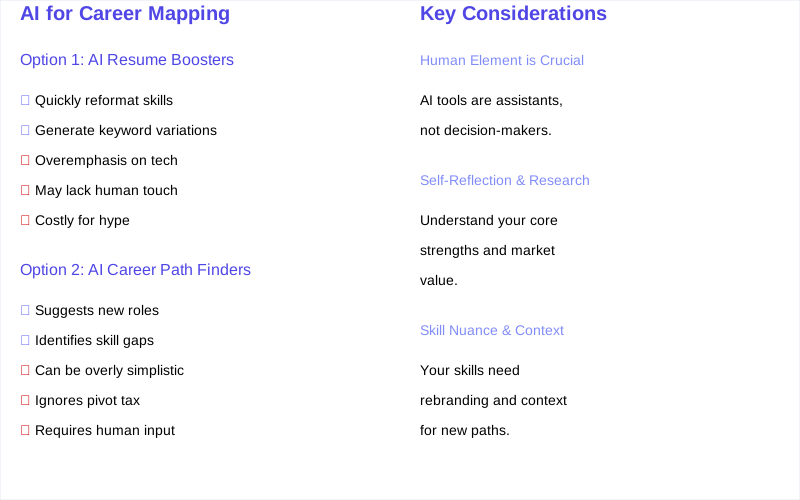
So, you're trying to pivot, and you're thinking AI is your shortcut. Here are the common mistakes that will kill your chances faster than a bad commit to production.
Key Takeaways
Leveraging AI tools to map your current skills to new career paths isn't about finding a shortcut; it's about making your research more efficient. The unglamorous 80 percent of career pivoting still involves hard work, self-assessment, and strategic networking. AI can highlight potential paths, but it won't walk them for you.
Here are the key takeaways:
- AI is a tool, not a guru. It excels at pattern matching and identifying skill overlaps based on vast datasets, but lacks human intuition and context. Don't expect it to tell you your life's purpose.
- Input quality matters. Your resume and self-assessment need to be precise and detailed for AI tools to provide useful suggestions.
Garbage in, garbage out is the universal law here. * Validate everything. Cross-reference AI-generated paths with real-world job postings, informational interviews, and industry trends. The AI doesn't know about that weird company culture or niche regulatory requirement. * Embrace the pivot tax. Expect to invest time in upskilling and potentially take a lateral move or slight pay cut initially. The long-term gain is usually worth it.
Elearning Industry talks about AI personalization for learning paths, but the effort is still yours. * Focus on foundational skills. SQL, Python, Git, communication, and problem-solving are often more critical than advanced AI algorithms, especially in the early stages of a pivot. Don't neglect the basics for the shiny new thing.
Frequently Asked Questions
I saw an ad for an AI career mapping service for $199. Is that worth it, or can I just use ChatGPT?
Do I really need to list specific software tools on my resume for AI to map my skills, or can I just say 'CRM experience'?
What if the AI suggests a career path I've never even considered, and it sounds completely wild?
Can over-reliance on AI career mapping tools permanently damage my career prospects?
My friend said AI can write my entire resume and cover letter perfectly, so I don't need to do anything. Is that true?
Sources
- How to Use AI to Discover New Career Paths – Complete Guide
- Master 3 AI Skills for a 2026 Career Boost | Stephanie Hills, Ph.D ...
- Leveraging AI: A Practical Guide to Modern Professional Development
- Leveraging AI to Land the Job - Career Hub - University of Florida
- AI career paths: 2026 job guide - Pluralsight
- AI Career Paths in 2026- Explained With Skills, Salaries & Roadmap
- ai-job-hunt-career-change-41f6bd4b?gaa_at=eafs&gaa_n=AWEtsqeTTp7ibcXquTZWjlGhbNCC1OqLtrwixMlV8ZUI_d76_z0FvYyVjRSy&gaa_ts=69ab842d&gaa_sig=N_8AnO9avO0NV2ZSxuUZhph5CcZFQAoDwbgMZbvKPdLxhYoxcenLFoYvbiMK6BCrrFfoLthfTRbGCMBnqTFGQA%3D%3D
- Has anyone used AI to better their career? : r/careerguidance - Reddit
- AI Skills Everyone Will Need In 2026, And How eLearning And HR ...
- AI Is Replacing Jobs - Here Are the Skills You Need in 2026
- The 8th Skill: How Content Marketers Should Approach AI in 2026