
How Ats Systems Score Candidates Beyond Keyword Matching (2026 Complete Guide)
I've seen resumes with a 67 percent match score on Greenhouse get an interview while a 92 percent score got binned. Let that sink in. Everyone talks about 'ATS keyword matching' like it's some magic bullet, but that's a 2010 problem.
I've seen resumes with a 67 percent match score on Greenhouse get an interview while a 92 percent score got binned. Let that sink in. Everyone talks about 'ATS keyword matching' like it's some magic bullet, but that's a 2010 problem. Modern ATS platforms, the ones like Workday, Lever, and iCIMS that I've configured for dozens of companies, are doing way more than just counting keywords.
They're not just looking for 'Java Developer;' they're looking for 'Java Developer with 5 years experience in Spring Boot and Kafka on AWS.' It's a whole different ballgame now. Strategic customization is key.
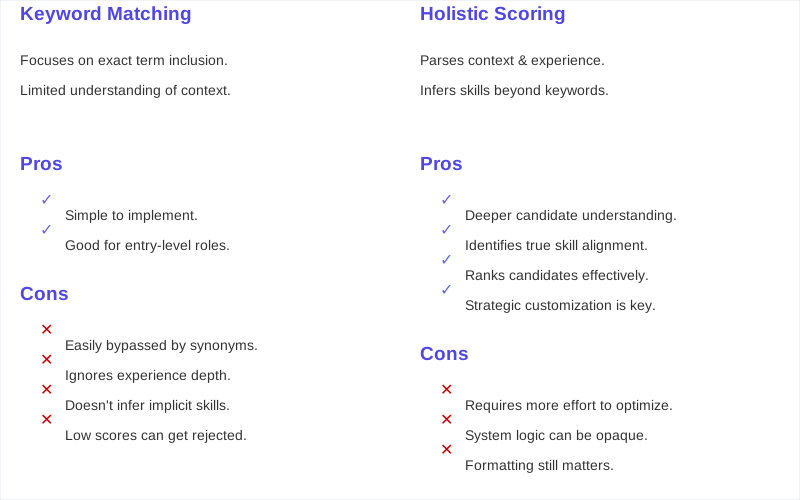
Most job seekers are still playing checkers while the ATS is playing 3D chess. They obsess over adding every possible keyword, thinking it's a brute-force solution. What they don't realize is that these systems now parse context, evaluate experience depth, and even infer skills not explicitly listed. It's not just about getting past the initial filter; it's about ranking high enough to actually catch a human recruiter's eye.
I've watched recruiters, myself included, ignore perfectly keyword-optimized resumes because the ATS's secondary scoring metrics flagged something else. Maybe it was a weird job title sequence, or a gap that the system struggled to categorize. It's not always a technical glitch, sometimes it's just how the system's logic rails are set up. An ATS manages workflow, not just keywords.
This isn't your daddy's ATS black hole where a two-column layout meant instant death. While formatting still matters, the real reason your resume might be getting overlooked now goes deeper. It's about a holistic scoring mechanism that most people don't even know exists. I've seen resumes that look perfect to the human eye get a dismal score from the system because of subtle inconsistencies or a lack of structured data that the ATS craves.
My recruiter brain knows that a high ATS score doesn't guarantee a hire, but a low one almost guarantees you're in the resume graveyard. We're talking about systems that can analyze your career trajectory, not just your current buzzwords. It's time to understand the modern mechanics behind the curtain.
The Real Answer
The real answer is that modern ATS platforms like Workday, Greenhouse, and Lever don't just 'match' keywords; they assign a comprehensive fit score based on a weighted algorithm. Think of it like a credit score, but for your career. I've configured these weights myself, and they vary wildly by company and even by specific role. A match rate of 65 percent can lead to success.
First, there's the 'hard skill density' score. This is where the ATS looks for specific, quantifiable skills directly tied to the job description. It's not just presence; it's how often those skills appear in context with your experience. If the job asks for 'Python, SQL, AWS,' and you list them once, that's one thing. If you demonstrate projects and results using them across multiple roles, that's a higher density score.
Next, 'experience relevance' comes into play. The ATS evaluates your past job titles and descriptions against the target role's seniority and industry. A 'Senior Software Engineer' applying for a 'Junior Developer' role might get a lower relevance score because the system flags it as potentially overqualified or a mismatch in career trajectory. It's all about the system's internal logic rails.
Then there's 'educational alignment.' For roles requiring specific degrees or certifications, the ATS will assign points based on whether your education matches the requirement. If a job demands a Master's in Computer Science, and you have a Bachelor's in English, your score will take a hit, regardless of your experience. Systems consider factors like education level.
Finally, 'structural consistency' is a silent killer. This isn't about keywords at all. It's about how well the ATS can parse your resume into its structured database fields. If your dates are inconsistent, or your job titles are ambiguous, the system struggles to categorize your information, leading to a lower overall score. My recruiter brain hates trying to decipher a mangled resume. It's signal vs noise at its finest.
What's Actually Going On
What's actually going on inside an ATS is a multi-layered parsing and scoring process, far beyond a simple CTRL+F. When you upload your resume to a system like iCIMS or Greenhouse, the first step is text extraction. If your formatting is too complex-think tables, text boxes, or fancy graphics-the system can't properly pull your information. Bad formatting means your skills are invisible.
Once the text is extracted, the ATS attempts to categorize your information into predefined fields: Name, Contact Info, Work Experience, Education, Skills. This is why a reverse-chronological format is king; it's what these parsers are trained on. The reverse-chronological format works universally.
Company size absolutely dictates the sophistication of the ATS scoring. A small startup using a basic Lever instance might rely more heavily on raw keyword counts. A Fortune 500 company running a fully configured Workday system, however, has often invested hundreds of thousands of dollars in custom algorithms and AI modules for advanced semantic analysis. They're looking for contextual understanding, not just word matching. AI-powered matching uses semantic analysis.
Regulatory facts also play a role, especially with DEI initiatives. Modern ATS platforms are increasingly configured to identify and mitigate bias. This means certain demographic data might be anonymized or weighted differently during the initial screening process to ensure compliance. It's not just about finding the best fit; it's about finding an equitable fit. My recruiter brain sometimes had to justify scores based on these parameters.
The system then assigns a numerical score based on how well your parsed data aligns with the job description's requirements. This isn't just keywords; it includes years of experience, specific technologies, industry experience, and even location. Some systems can even infer skills from your job duties, which means 'managed a team of 5 engineers' might implicitly score points for 'leadership skills' even if you don't explicitly list it.
A survey of 630 recruiters found 92 percent say their ATS does not auto-reject based on content.

How to Handle This
Alright, so you know the ATS isn't just a dumb keyword counter. Now what? You need to stop thinking about your resume as a document for a human and start thinking of it as structured data for a machine. Here's how to actually handle this, step by step.
Step 1: Deconstruct the Job Description (20 minutes) Print out the job description. Seriously, print it. Go through it with a highlighter and identify every single hard skill, software, methodology, and quantifiable achievement. Don't just look for nouns; look for verbs describing actions and results. This is your target data set. The best platforms use contextual understanding.
Step 2: Format for Parsing (30 minutes) Use a simple, reverse-chronological format. No fancy graphics, no text boxes, no two-column layouts. Stick to standard headings like 'Work Experience,' 'Education,' 'Skills.' Use a common font like Arial or Calibri, 10-12pt. Save as a .docx file unless explicitly asked for PDF. This ensures the ATS can actually read your data. ATS systems analyze for skills and experience.
Step 3: Optimize for Data Fields (60 minutes) Go through your experience section. For each role, ensure your job title is clear and standard. Use bullet points that start with action verbs and quantify your achievements. Instead of 'Responsible for managing projects,' write 'Managed 3 cross-functional projects, delivering X percent on time and Y percent under budget.' This provides the structured data the ATS craves for 'experience relevance' and 'hard skill density.' My recruiter brain always looked for numbers.
Step 4: Leverage a Resume Scanner (15 minutes, $0-$50) Use a tool like Jobscan or Rezi to compare your resume against the job description. These tools will give you a match rate and highlight missing keywords or formatting issues. Don't aim for 100 percent; many applicants achieve success with scores closer to 65 percent. It's a good sanity check for the ATS's basic parsing behavior.
Step 5: Human Review (Optional, $100-$500) If you're applying for highly competitive roles, consider having a professional resume writer who understands ATS mechanics review your resume. Ask them specifically about how they optimize for structural consistency and data parsing, not just keyword stuffing. A good one will point out where your resume might confuse a Workday algorithm, not just a human.
What This Looks Like in Practice
Let's talk brass tacks. I once had a req for a 'Senior Data Scientist' where the hiring manager insisted on '5+ years experience with Apache Spark.' We got a flood of applicants on Greenhouse, many with 'Data Scientist' in their title and even 'Spark' listed under skills. But the ATS score for many was low, like 40-50 percent.
The real reason? Their experience section only mentioned Spark in a single bullet point from a short project, or under a 'Tools' section. The ATS, configured for Workday's advanced parsing, didn't see enough 'density' or 'contextual usage' of Spark across their career to flag them as a strong match. It wanted to see Spark integrated into multiple projects, with quantifiable results. AI assists with candidate screening.
Another scenario: a mid-sized tech company using Lever. They had a role for a 'Product Manager' that specifically called for 'experience with B2B SaaS platforms.' Many candidates had 'Product Manager' titles, but their resumes focused on B2C products. The ATS, using semantic analysis, scored these lower because the 'industry relevance' was off. It wasn't about the job title, it was about the type of product. ATS systems do not auto-reject based on keywords alone.
Or the time a company had specific compliance requirements for certain certifications. The ATS, in this case Taleo, was hard-coded to assign zero points if a specific certification ID wasn't present in a designated field. Even if a candidate wrote 'Certified PMP' everywhere, if they didn't put the ID in the right spot, the system missed it. That's a human failing to understand the system's logic rails.
My recruiter brain had to explain this to a lot of frustrated hiring managers.
Mistakes That Kill Your Chances
| Mistake | Why it Kills Your Chances | Recruiter/ATS Perspective |
|---|---|---|
| **Fancy Formatting** | Tables, graphs, custom fonts, and text boxes often render as unreadable gibberish to ATS parsers. Your 'beautiful' resume becomes a garbled mess of characters. | My Workday instance sees a two-column layout and just throws up. It's a technical glitch that leads to your info being functionally invisible. It can seriously impact your confidence. |
| **Keyword Stuffing** | Overloading your resume with keywords without context or relevance looks spammy to both ATS (which can flag it) and recruiters. It signals a lack of genuine experience. | The ATS might pick up the keywords, but the 'hard skill density' score won't increase without contextual usage. My recruiter brain sees it as noise, not signal. |
| **Generic Buzzwords** | Using vague, overused terms like 'results-driven,' 'team player,' or 'innovative thinker' adds zero value. ATS systems prioritize specific, measurable skills. | These are ignored. The ATS is looking for 'Python,' 'SQL,' 'Jira,' not 'synergistic communication.' It's not about finding the 'best' person, it's about finding a plausible person. |
| **PDF for Everything** | While PDFs are great for preserving layout, some older or poorly configured ATS systems (especially iCIMS) struggle to parse them correctly, leading to data extraction errors. | I've seen PDFs where the ATS pulled contact info into the 'Experience' section. Unless the job explicitly says 'PDF only,' use .docx. Many ATS cannot parse this format correctly. |
| **Mismatched Seniority** | Applying for a 'Senior' role with only 2 years of experience, or a 'Junior' role with 15. The ATS uses experience length as a strong filtering metric. | The 'experience relevance' score will be low. The system's logic rails are set to match a specific career trajectory. It's not about finding the 'best' person. |
| **Inconsistent Dates/Titles** | Gaps in employment or ambiguous job titles make it hard for the ATS to build a clear timeline and categorize your experience accurately, impacting your overall score. | This creates 'structural consistency' issues. The ATS can't put your data into its database fields, so it just skips over it. My recruiter brain hates trying to decipher a mangled resume. |
| **Functional Resumes** | Grouping skills without tying them to specific jobs. Most ATS systems cannot parse this format correctly, and many recruiters dislike it because it hides career gaps. | The ATS can't map skills to experience, leading to a low 'skill density' score. It's a feature of a broken system from a recruiter's perspective, as it hides crucial information. |
Key Takeaways
Look, the days of just keyword-stuffing your resume are over. If you want to get past the initial screen, you need to understand that modern ATS platforms are doing much more than a simple text search. They're assigning a comprehensive fit score, and that score is based on several factors.
- Context over Keywords: ATS systems now prioritize how skills are used in context and the density of those skills across your experience, not just their presence. Skills-based hiring is replacing keyword matching.
- Structured Data is King: Your resume needs to be easily parsed into the ATS's database fields. This means clean, simple formatting and a reverse-chronological layout.
Anything else is just signal vs noise. * Relevance Matters: The ATS evaluates your experience, education, and job titles for their direct relevance to the role's seniority, industry, and specific requirements. * Small Details, Big Impact: Inconsistent dates, ambiguous job titles, or using the wrong file type can all silently tank your ATS score, regardless of your qualifications.
My recruiter brain would just move on. * Tools are Your Friends: Use resume scanning tools to get a machine's-eye view of your resume. It's the closest you'll get to seeing your resume through the ATS's lens before you hit submit.
Frequently Asked Questions
I've seen services that promise 'ATS optimization' for $500. Can I just use a free online scanner and do it myself, or is that a waste of time?
Do I really need to change my job title on my resume if it's slightly different from the job description, even if the duties are identical?
What if I optimize my resume for the ATS, get a high score, but still don't hear back? Does that mean the system is rigged?
Can over-optimizing for the ATS, like using too many keywords, actually damage my chances with a human recruiter later on?
Everyone says 'network to get a job,' but if ATS systems are so powerful, does networking even matter anymore?
Sources
- ATS Resume Format (2026): How to Build a Resume That Passes ...
- Best Resume Screening Platforms for 2026: The Definitive Guide for ...
- How ATS Systems Reject Resumes: Key Errors - LockedIn AI
- JobOwl · How ATS systems reject candidates based on missing ...
- Debunking the ATS myth: No auto-rejecting based on keywords
- goperfect.com
- How to Optimize Your Resume for ATS in 2026 (Updated Guide)
- Best Applicant Tracking Systems (ATS) in 2026: Compared & Ranked
- 8 best candidate sourcing tools in 2026: an expert evaluation guide
- How To Write An Impressive ATS-Friendly Resume in 2026! A Guide ...
- I spent 8 months testing how ATS systems actually parse resumes
- Mastering Your Applicant Tracking System in 2026: A Complete Guide
- ATS-Friendly Resume Guide: 2026 Best Practices - LinkedIn