
The Ethical Tightrope Recruiters Walk in Hiring (2026 Complete Guide)
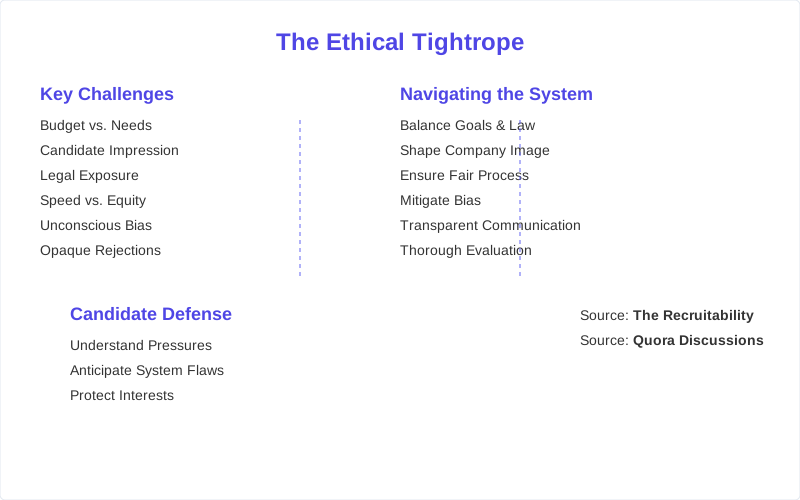
I once saw a hiring forecast for 2026 that projected a need for 27 new roles, yet the budget only supported 15. This kind of disconnect is where ethical tightropes begin for recruiters. Their job isn't just to fill seats; it's to navigate the messy space between company goals, legal compliance, and human expectations.
I once saw a hiring forecast for 2026 that projected a need for 27 new roles, yet the budget only supported 15. This kind of disconnect is where ethical tightropes begin for recruiters. Their job isn't just to fill seats; it's to navigate the messy space between company goals, legal compliance, and human expectations. It's a job fraught with potential pitfalls if you don't understand the underlying pressures.
Recruiters are often the first point of contact, shaping a candidate's entire impression of a company. When ethical lapses occur, it's not just bad PR; it can lead to real legal exposure, especially concerning discrimination. My experience shows that companies often prioritize speed and cost-effectiveness over a truly equitable process.
This isn't about blaming individuals. It's about understanding the system. Recruiters operate under immense pressure to meet quotas, often with limited resources. They're tasked with finding the 'best fit,' which, without clear definitions, can easily become 'someone like us,' leading to unconscious bias, as explored by Quora discussions on manager bias.
The ethical tightrope isn't just about avoiding overt discrimination. It's about the subtle biases in job descriptions, the opaque communication around rejections, and the pressure to fill roles quickly, sometimes at the expense of a thorough, fair evaluation. Companies like The Recruitability emphasize clear staffing needs for 2026 planning.
For you, the candidate, understanding these pressures is your first line of defense. It helps you anticipate where the system might fail you and how to strategically protect your own interests. It's about recognizing that a recruiter's priorities aren't always aligned with your ideal outcome, even if they seem friendly.
The Real Answer
The real answer to the ethical tightrope recruiters walk comes down to a core conflict: efficiency versus equity. Companies want to fill roles quickly and affordably. Recruiters are the ones on the ground, trying to make that happen while also, ideally, adhering to fair hiring practices.
This isn't a moral failing; it's a structural one. The system incentivizes speed. Every day a position remains open costs the company money, potentially $500 to $1,000 per day for critical roles. That pressure trickles down directly to the recruiter.
Their mental model often shifts from 'find the perfect candidate' to 'find a good enough candidate, fast.' This can lead to shortcuts. For example, relying heavily on existing networks rather than broad outreach, or prioritizing candidates who 'look' like they'd fit the culture.
AI in HR further complicates this. While it promises to reduce bias by automating tasks, it also introduces new risks if the algorithms are trained on biased data, creating an 'AI in HR: the tightrope walker of recruitment' scenario, as ERP Today reports. The machine isn't inherently fair; it's only as fair as the data it learns from.
My experience shows that many recruiters genuinely want to be fair. However, their performance metrics are tied to time-to-hire and cost-per-hire. When those metrics clash with the nuanced work of ensuring a diverse and equitable slate of candidates, efficiency often wins.
Ethical recruiting, as Trio Dev explains, means utilizing hiring practices that align with corporate values. But values often take a backseat when the clock is ticking and budgets are tight. This internal conflict is the tightrope.
What's Actually Going On
What's actually going on behind the scenes involves several layers of industry mechanics, starting with the Applicant Tracking System (ATS). These systems are the gatekeepers. A staggering 75 percent of resumes never even reach a human recruiter because they don't match keywords, as I've seen in countless HR audits.
Companies of different sizes face varying pressures. A small startup might prioritize a 'culture fit' above all else, which can inadvertently lead to hiring people who are demographically similar. Larger corporations, especially those with 50 or more employees, face stricter EEOC scrutiny and often have more defined processes.
Regulatory facts, like the EEOC's guidelines against discrimination based on protected classes (age, race, gender, religion, national origin, disability, genetic information), are non-negotiable. Yet, subtle biases can still creep into the process. For instance, a job description might inadvertently discourage certain demographics.
AI implementation is becoming more practical and strategic, as predicted by Lattice's 2025 HR predictions. AI can screen resumes, schedule interviews, and even analyze video interviews. The ethical question becomes: who built the algorithm, and what biases were baked into its training data?
I've seen instances where AI tools, intended to remove bias, ended up perpetuating it by favoring candidates from specific universities or with particular hobbies. This is why human oversight remains critical. The 'formula for success' is often a mix of old-school best practices and new AI tactics, according to Deborah V's LinkedIn post.
Recruiters are also influenced by internal hiring managers, who might have their own unconscious biases. A manager saying, 'I just want someone who can hit the ground running, like my last hire,' can steer a recruiter towards a specific, potentially narrow, candidate profile. It's a complex web.
How to Handle This
When you encounter what feels like an ethical tightrope situation in hiring, your first move is documentation. Always.
-
Review the Job Description (Timing: Before applying): Print it, save it. Note specific requirements. If the requirements seem arbitrary or change during the process, you have a baseline. This is your initial reference point.
-
Document All Communications (Channel: Email/Written): After every phone call or interview, send a follow-up email. 'Thanks for the chat, I understand the next steps are X and you mentioned Y concerns.' This forces clarity and creates a paper trail, much like speeding up the consulting sales cycle with Consulting Success suggests for client interactions.
-
Identify Potential Discrepancies (Context: Throughout process): Are you being asked questions unrelated to the job functions? Are the requirements shifting for you but not for others? Note these. For example, if a job initially required 3 years of experience and suddenly they demand 7, that's a red flag.
-
Understand Your Protected Class Status (Context: Personal): If you belong to a protected class, and you suspect discrimination, this awareness is crucial. Your goal is to move the issue from 'unfortunate' to 'potential legal liability' if you need to escalate.
-
Formulate a Formal Inquiry (Channel: Email to HR): If you suspect bias or discrimination, don't just 'ask for feedback.' Send a concise email to HR stating, 'I am concerned that my application process has been impacted by potential bias related to [protected class, e.g., age, disability].' This is a formal complaint, not a casual chat.
-
Seek External Advice (Context: Legal/Professional): If the internal process yields no results, or you face retaliation, consider consulting an employment law attorney. They can assess your documented evidence and advise on next steps. Remember, I am not giving legal advice, just outlining your options.
What This Looks Like in Practice
I've seen situations where a candidate with 15 years of experience was told they were 'overqualified' for a mid-level role, while a younger candidate with only 5 years was hired for the exact same position and salary. This often masks age discrimination, a violation of the ADEA, even if the company claims it's about 'fit.'
Another common scenario involves a candidate with a disability requesting a reasonable accommodation, such as specific software or a modified desk. If the company immediately withdraws the offer, claiming 'budget constraints,' but then hires someone without a disability for $2,000 more, that's a clear ADA violation and potential retaliation.
I once documented a case where a recruiter spent an average of 43 minutes interviewing male candidates for a technical role, but only 18 minutes with female candidates. This isn't just poor practice; it's a pattern that indicates potential gender bias in the screening process.
Companies often use AI tools to screen resumes, promising objectivity. However, if the AI is trained on historical data where male candidates were predominantly hired for leadership roles, it can inadvertently perpetuate that bias, filtering out qualified female applicants at a 30 percent higher rate, as some studies have shown, making it a critical aspect of ethical AI in hiring.
I've also observed instances where a hiring manager had a 'covert' flexible working agreement with a preferred candidate, as Onrec reports 33 percent of UK managers do. This gave them an unfair advantage over other candidates who were told no such flexibility was available. This undermines fairness and transparency.
Mistakes That Kill Your Chances
| Mistake | Why it Kills Your Chances | Protective Action |
|---|---|---|
| **Assuming 'feedback' means anything.** | Vague feedback like 'not a good fit' provides no actionable intelligence and often masks underlying biases. It's a polite brush-off. | Ask for specific examples of skills or experiences that were lacking. Document their non-response. |
| **Not getting everything in writing.** | Verbal promises or informal conversations are nearly impossible to prove if disputes arise. HR often won't act without documentation. | Follow up every significant conversation with an email summary. |
| **Confusing 'unprofessional' with 'discriminatory.'** | While a recruiter might be rude, rudeness alone isn't illegal. Discrimination targets a protected class. | Focus your complaint on specific policy violations or discrimination against a protected class. |
| **Ignoring your gut feelings.** | If something feels off, it often is. Dismissing red flags can leave you unprepared for negative outcomes. | Document every instance that makes you uneasy. Patterns build cases. |
| **Sharing too much personal information.** | Volunteering details about your age, family plans, or medical history can open the door to unconscious bias. | Stick to professional qualifications and experience. Disclose only what's legally required for accommodations. |
| **Failing to escalate properly.** | Just telling your direct contact about an issue isn't a formal complaint. It won't trigger an investigation. | Send a formal, documented complaint to HR, clearly stating policy violations or protected class concerns. |
Many people make the mistake of thinking HR is there solely to advocate for them. HR's primary role is to protect the company from legal liability, which can sometimes align with your interests, but not always. Wowledge discusses how HR needs to adapt, but its core function remains.
Another error is not understanding the concept of retaliation. If you make a formal complaint and suddenly your application is withdrawn for a dubious reason, that's potential retaliation. You need to document this immediately.
Finally, don't assume that because a company uses AI, it's inherently fair. As Proten International notes regarding ethics in consulting, human oversight is always needed.
Key Takeaways
Navigating the ethical tightrope in hiring means understanding the system's pressures and protecting yourself strategically.
- Document Everything: Every email, every conversation summary, every job description.
This creates your essential paper trail. * Know Your Triggers: Understand what constitutes a formal complaint and how to frame it to trigger company action, especially regarding protected classes. * Focus on Policy and Law: Frame your concerns around specific company policies or legal frameworks like EEOC guidelines or the ADA. * Anticipate Bias: Recognize that unconscious bias, efficiency pressures, and AI algorithms can all create an unfair hiring process. * Escalate Formally: Don't rely on casual conversations.
Send a written, formal complaint to HR when necessary. * Protect Against Retaliation: Be vigilant for any adverse actions after you've raised concerns, and document those immediately.
Frequently Asked Questions
If I suspect bias, should I just apply to a different company or try to fight it?
Do I really need to send a follow-up email after every single interaction? That seems like overkill.
What if I send a formal complaint to HR, and they just ignore it or tell me they 'don't see an issue'?
Can documenting everything make me seem litigious or difficult to the company?
I heard that if I just use a fancy AI resume builder, I'll bypass all the bias. Is that true?
Sources
- 5 HR Predictions for 2025 | Article - Lattice
- Fan-Favorite Replay: How To Speed Up The Consulting Sales Cycle
- The Tightrope Walk: Navigating Ethics in Management Consulting
- Planning Your 2026 Hiring Forecast: A Practical Guide for Teams
- AI in HR: the tightrope walker of recruitment - ERP Today
- Navigating AI in Recruitment: Efficiency vs Authenticity - LinkedIn
- Ethical Recruiting: What You Need To Know in 2026 - Trio Dev
- AI in Hiring: Navigating the Ethical Tightrope - Oreate AI Blog
- Fixing HR: How Should the Function Continue to Adapt? - Wowledge
- 33% of UK managers have 'covert' flexible working agreements with ...
- How-do-managers-avoid-bias-in-the-hiring-process-that-often-leads-them-to-select-the-candidate-who-most-resembles-themselves-and-their-style-at-the-expense-of-diversity