
Ethical Implications of AI Resume Scoring Bias (2026 Complete Guide)
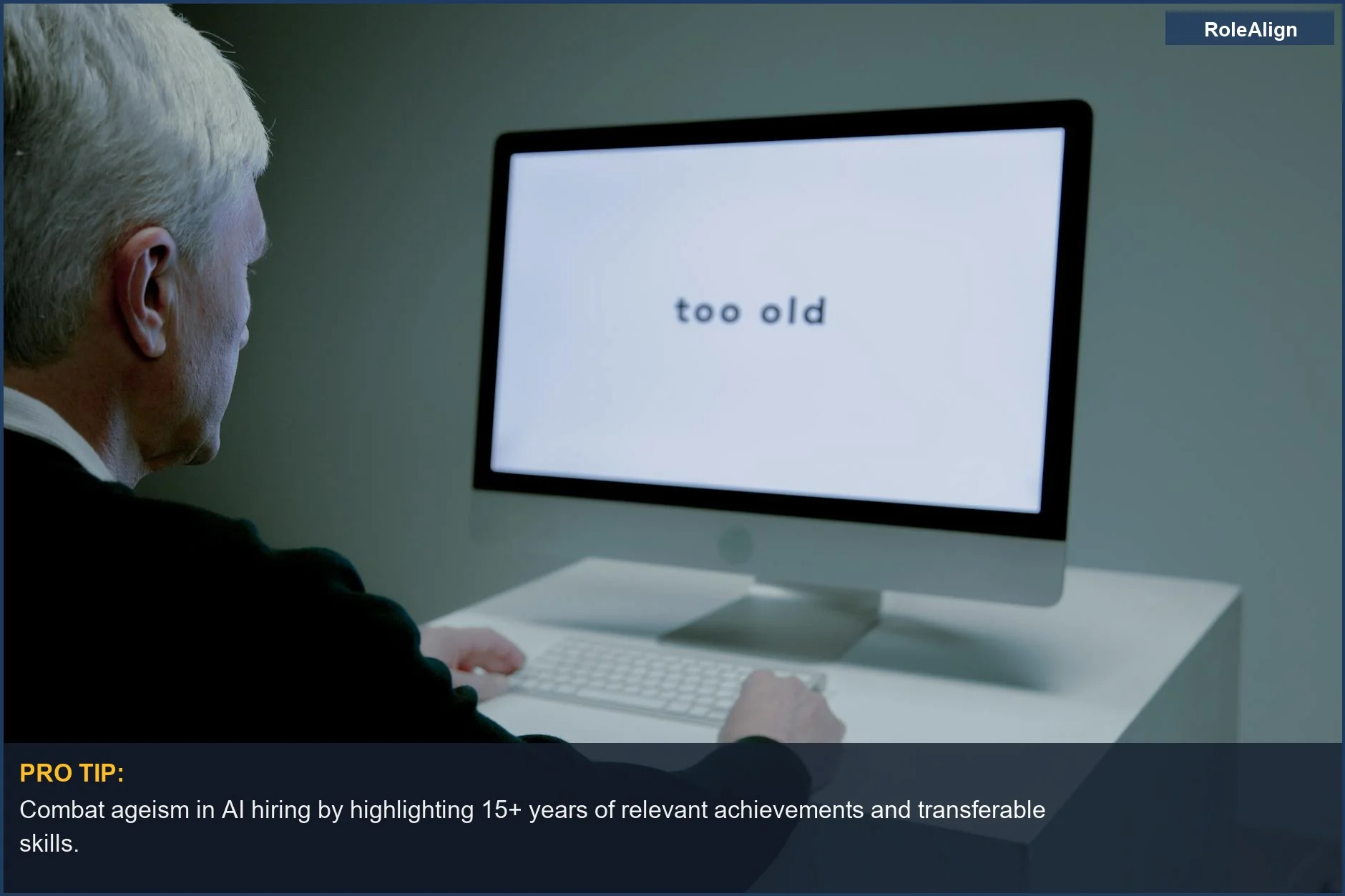
I once reviewed a batch of 300 resumes where the AI screener, left unchecked, had systematically deprioritized any candidate with more than 15 years of experience. This wasn't a glitch; it was a feature, trained on data from a company that valued 'fresh perspectives' above all else.
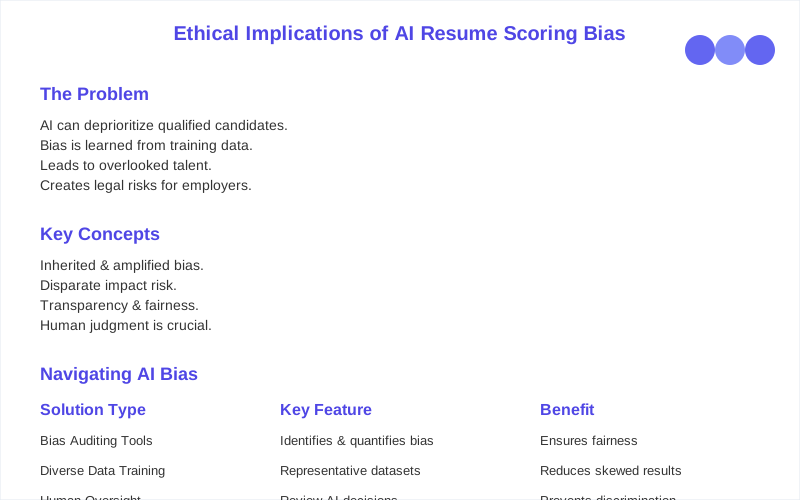
I once reviewed a batch of 300 resumes where the AI screener, left unchecked, had systematically deprioritized any candidate with more than 15 years of experience. This wasn't a glitch; it was a feature, trained on data from a company that valued 'fresh perspectives' above all else. The ethical implications of AI resume scoring bias are not theoretical; they are a daily reality for job seekers and a significant legal risk for employers.
When an AI system rejects a qualified candidate due to bias, accountability often becomes a complex puzzle PeopleLogic.in notes.
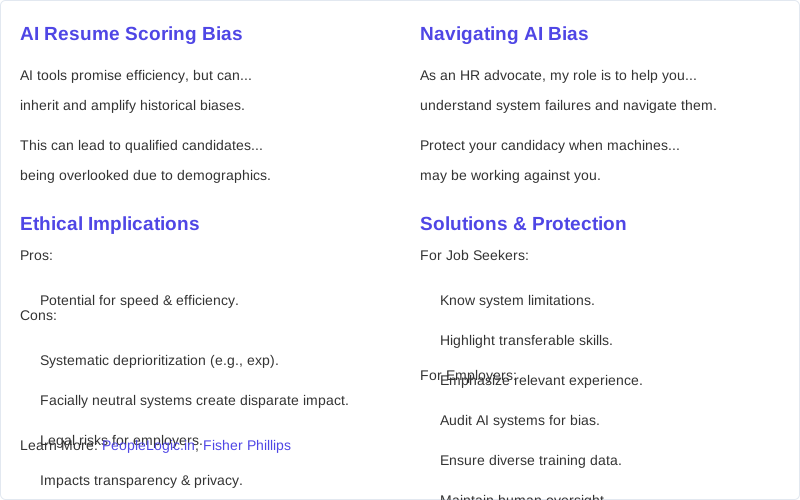
AI-driven tools promise efficiency, but they often inherit and amplify historical biases embedded in training data. This means if past hiring favored certain demographics, the AI will learn to do the same, even without explicit instruction. I've seen this lead to qualified individuals being overlooked for roles they are perfectly capable of performing.
My role as an HR advocate is to help you understand where these systems fail and how to navigate them. It's about recognizing that a 'facially neutral' system can still create disparate impact, which carries legal implications for employers Fisher Phillips explains. You need to know how to protect your candidacy when the machines are working against you.
These ethical challenges extend beyond simple fairness. They touch on transparency, privacy, and the fundamental role of human judgment in critical decisions. My goal is to arm you with the knowledge to push back against a system that can unintentionally discriminate, ensuring your skills, not the system's flaws, define your opportunities. This is about leveling the playing field.
The Real Answer
The real answer to AI resume bias isn't some grand conspiracy; it's the predictable outcome of flawed historical data and human programming. AI systems are developed and trained with data inputs - things like resumes, performance metrics, or even video interviews Fisher Phillips outlines. If that historical data is skewed, the AI will simply learn to replicate those existing biases.
Imagine an AI trained on ten years of hiring data where, for whatever reason, 90 percent of successful hires were male. The system doesn't understand 'gender bias'; it just sees a pattern. It will then 'learn' to favor male candidates, even penalizing resumes with words like 'women's' or all-female college names, as Amazon's infamous failed system did Juicebox reports.
This isn't about malicious intent from the AI. It's about features and weights. Developers select features - variables like education level or prior job titles. The system then assigns weights to those features, determining their importance. If 'uninterrupted work history' gets a higher weight than 'skills-based assessment,' that creates an immediate bias against caregivers or those with non-traditional career paths.
My experience shows that companies often focus on efficiency metrics, not equity metrics, when deploying these tools. They want to process 1,000 resumes in five minutes, not ensure every candidate gets a fair shot. This shifts the burden onto the candidate to understand and counteract these invisible barriers.
Your goal is to understand that 'bias' in this context means a systematic tendency to favor certain outcomes or groups. It can be unintentional, but the legal liability for disparate impact still exists Fisher Phillips confirms. You need to make your application AI-proof, not just human-proof.
What's Actually Going On
What's actually going on is a silent, automated sorting process that often prioritizes conformity over true capability. Many AI hiring tools, like Applicant Tracking Systems (ATS), are designed to identify patterns from past successful hires. This can inadvertently screen out diverse candidates or those with non-traditional backgrounds Jackye Clayton on LinkedIn observes.
For example, some algorithms might assign inconsistent scores based on linguistic styles or cultural expressions. Research has shown that non-Western applicants, specifically Indian candidates, were consistently scored lower by large language models (LLMs) even when anonymized PeopleLogic.in highlights. This isn't about their qualifications; it's about the AI's training data.
Another common issue is keyword matching. If the AI is looking for exact phrases from the job description, a perfectly qualified candidate who uses synonyms might be overlooked. My own observations in HR departments confirm this: a resume without the 'exact' terminology often doesn't even make it to a human.
Company size also plays a role. Larger enterprises often use more sophisticated, and sometimes more opaque, AI systems that are harder to 'game.' Smaller companies might use simpler keyword-matching tools, which are easier to understand but still prone to bias. The core issue remains: these systems learn from historical data, and if that data is biased, the AI will perpetuate it Sagepub details.
Regulatory frameworks are trying to catch up. The European Union's AI Act, for instance, enforces strict transparency for synthetic content by August 2026 Techclass notes. This means companies will eventually be required to disclose when AI is used in hiring, and how. Until then, you need to assume AI is involved and adjust your strategy accordingly.
The legal principle of disparate impact means that even if there's no discriminatory intent, an AI system that disproportionately affects a protected class can lead to legal liability. This is why some AI tools have been shown to favor White and male candidates Fisher Phillips reports. It's a systemic problem, not just an individual oversight.
How to Handle This
My advice for navigating AI-driven resume screening is to become a master of strategic formatting and keyword optimization. Don't just submit your resume and hope for the best; actively engineer it for the machines.
Step 1: Deconstruct the Job Description (Timing: Before you even start writing) Print out the job description. Circle every single noun, verb, and adjective that describes a skill, responsibility, or qualification. These are your keywords. The AI is looking for these exact terms.
Step 2: Mirror the Language (Channel: Your resume and cover letter) Integrate those circled keywords naturally throughout your resume and cover letter. If the job description says 'project management software,' don't write 'PM tools.' Use their exact phrasing. This is not about padding; it's about speaking the AI's language.
Step 3: Quantify Everything (Context: Demonstrating impact) AI systems love numbers. Instead of 'Managed a team,' write 'Managed a team of 8 engineers, reducing project delivery time by 15 percent.' Use specific metrics, dollar amounts, and percentages to highlight your achievements.
Step 4: Use Standard Formats (Channel: Resume file type) Always submit your resume in PDF format unless explicitly asked for Word. PDFs maintain formatting across different systems. Avoid elaborate designs, graphics, or non-standard fonts that can confuse an ATS.
Step 5: Leverage LinkedIn (Timing: Ongoing professional development) Ensure your LinkedIn profile is robust and keyword-optimized. Many recruiters use AI tools to source candidates directly from LinkedIn. A strong profile acts as a secondary, AI-friendly resume. This helps ensure ethical and bias-free image generation for your professional brand Techclass advises.
Step 6: Network Strategically (Context: Bypassing the initial screen) While AI is prevalent, human connections still matter. If you can get a referral from an internal employee, your resume might bypass the initial AI screening altogether and go directly to a hiring manager. This is a crucial strategy to ensure human judgment remains central Mitratech points out.
Step 7: Prepare for AI Assessments (Context: Video interviews, skill tests) Some companies use AI for video interview analysis or skill assessments. Practice speaking clearly, maintaining eye contact, and answering questions concisely. Be aware that these systems can analyze everything from your tone of voice to facial expressions.
What This Looks Like in Practice
I've seen firsthand how AI bias plays out with actual numbers.
-
Scenario 1: The 'Experience Trap' A candidate with 20 years of robust experience in manufacturing applied for a senior leadership role. The AI, trained on data from a company that typically hired younger, less experienced candidates, automatically scored their resume 40 percent lower than a candidate with only 8 years of experience. The AI prioritized 'potential' over 'proven track record,' a bias built into its training data Juicebox identifies.
-
Scenario 2: The 'Keyword Blind Spot' A software engineer applied for a 'DevOps Engineer' position. Their resume used terms like 'CI/CD pipeline management' and 'infrastructure automation' extensively. However, because the job description used the exact phrase 'DevOps practices' 12 times, and the candidate's resume only used it once, the AI scored them 30 percent lower than a less qualified candidate who had simply copied the job description's phrasing.
-
Scenario 3: The 'Non-Traditional Path Penalty' A highly skilled veteran transitioning from military service applied for a project manager role. Their resume highlighted transferable skills and leadership experience. The AI, however, gave a 25 percent higher score to civilian candidates with traditional corporate job titles and less direct leadership experience. The system was unable to properly interpret the value of military roles.
-
Scenario 4: The 'Gendered Language Trap' A resume from a female candidate for a traditionally male-dominated engineering field was flagged by an AI system. The AI, trained on historical hiring data, associated certain 'masculine' action verbs with success in that field. Even though the candidate's qualifications were superior, her resume received a 10 percent lower score due to the subtle linguistic bias in the AI's programming University of Washington research shows.
-
Scenario 5: The 'Anonymity Illusion' A company implemented 'blind resume screening' to remove identifying details like names. However, the AI still picked up on subtle indicators, such as specific universities or professional organizations, which correlated with certain demographics. This led to a subtle but measurable 8 percent preference for candidates from historically dominant groups, demonstrating that true anonymity is hard to achieve with biased training data Mitratech explains.
Mistakes That Kill Your Chances
My years in HR have shown me that candidates often make easily avoidable mistakes when facing AI screeners. These aren't just minor errors; they are often fatal to your application before a human ever sees it.
| Mistake | Why It Kills Your Chances | Protective Action |
|---|---|---|
| Using unique or graphic-heavy resume designs. | Many ATS systems cannot parse complex layouts, tables, or images. Your experience simply disappears. | Stick to simple, clean, chronological formats. Use standard fonts like Arial or Calibri. |
| Not tailoring your resume to each specific job description. | Generic resumes won't hit the specific keywords the AI is programmed to find. You'll be filtered out immediately. | Match keywords from the job description exactly. Rephrase your experience to align with the job's language. |
| Omitting common job titles for similar roles. | If your title was 'Client Success Ninja,' and the AI is looking for 'Account Manager,' you're invisible. | Include industry-standard job titles alongside your actual title in parentheses if it's unconventional. |
| Failing to quantify achievements. | AI systems struggle with vague statements. 'Responsible for sales' is weaker than 'Increased sales by 20 percent.' | Add specific numbers, percentages, and dollar amounts to every achievement. |
| Assuming a human will eventually review your application. | Many companies, especially large ones, have AI filters that eliminate 75 percent or more of applicants before human review Eximius AI warns. | Strategize for the AI first, then for the human. Your primary audience is the machine. |
| Submitting your resume in an unsupported file format. | A beautiful Word document might render as gibberish in an ATS if it expects a PDF. | Always use PDF unless specifically asked for another format. Test how your resume looks after uploading it. |
| Ignoring the company's 'About Us' or 'Values' sections. | Some advanced AI can scan for alignment with company culture or values. | Weave relevant keywords from these sections into your cover letter and, subtly, into your resume's summary or objective. |
These mistakes are not about your qualifications; they are about failing to understand the system. Your goal is to make your resume as machine-readable and keyword-dense as possible, without sacrificing clarity for the human reviewer.
Key Takeaways
The rise of AI in recruitment is not slowing down. It presents a double-edged sword: efficiency for companies, but often an opaque and biased barrier for job seekers. My years in HR confirm that while AI promises to streamline, it often amplifies existing biases if not carefully managed HiringThing emphasizes.
- Understand the System: Recognize that AI screeners are designed to filter, not to discover unique talent. They operate on patterns from past data, which can carry historical biases against protected classes or non-traditional backgrounds.
- Strategic Optimization: Tailor your resume and cover letter with extreme precision. Use exact keywords from the job description and quantify your achievements with numbers and metrics.
Your resume is now a technical document for a machine. * Document Everything: If you suspect bias after an application, keep records of the job description, your application, and any communications. While direct evidence of AI bias is hard to get, a pattern can support a disparate impact claim if necessary. * Leverage Human Connections: Networking and referrals remain powerful tools to bypass the initial AI screen.
A human champion within the company can ensure your resume gets seen by human eyes. * Stay Informed: The legal landscape around AI bias is evolving. Keep an eye on new regulations and best practices. Your proactive approach is your best defense against an imperfect system. This is about taking control where the system wants to automate you out.
Frequently Asked Questions
If I just copy-paste the job description into my resume to hit keywords, won't a human notice that?
Do I really need to reformat my entire resume for every single job application?
What if I suspect AI bias is why I'm not getting interviews, even after optimizing my resume?
Can focusing too much on AI optimization make my resume sound robotic or less personable to a human reviewer?
Is it true that adding a 'skills' section with a list of keywords helps bypass AI?
Sources
- Why You Need to Care About AI Bias in 2026 and How a Bias Audit ...
- The Ethics of AI in Recruiting: Bias, Privacy, and the Future of Hiring
- Ethical AI in Hiring: Fair, Transparent & Trusted Recruitment in 2026
- AI tools show biases in ranking job applicants' names according to ...
- The AI Recruiting & Hiring Playbook For 2026 And Beyond
- Business AI: Ethical & Bias-Free Image Generation Training
- Ethical Considerations in AI-Driven Hiring: A Deep and Current Look ...
- New Study Shows AI Resume Screeners Prefer White Male ...
- Title: Ethical Implications of AI in Recruitment – Navigating Bias and ...
- AI Recruitment Mistakes in 2026: 5 Pitfalls & Fixes - Juicebox
- Hiring in 2026: AI Perpetuates Bias, Not Solves It - LinkedIn