
The Role of Micro-credentials in Accelerating Career Pivots (2026 Complete Guide)
I've seen hundreds of resumes with a second, useless master's degree that cost someone $60,000 and 24 months, while a targeted micro-credential for $500 could have gotten them the same pivot in three months. That's the cold, hard math of career change in 2026.
I've seen hundreds of resumes with a second, useless master's degree that cost someone $60,000 and 24 months, while a targeted micro-credential for $500 could have gotten them the same pivot in three months. That's the cold, hard math of career change in 2026. People are constantly trying to reinvent themselves, but they often choose the most expensive, time-consuming route, usually because they think it's the 'right' way. It's not. It's the old way.
TieTalent points out that over half of potential career changers are worried about financial risk and lack of experience, which makes sense when you're thinking about another degree.
Recruiters like me aren't impressed by another generalist degree when we're searching for specific skills. My 'recruiter brain' is a finely tuned keyword scanner, not a history professor. When I'm looking for a "Cloud Security Analyst," I don't care if you have a Master of Arts in Medieval Literature. I care if you have an AWS Certified Security - Specialty badge. The resume graveyard is overflowing with over-educated, under-skilled candidates who missed the point entirely.
Micro-credentials are not just some trendy HR buzzword; they are a direct response to a fundamental shift in how companies hire. They're about proving you can do something, not just that you studied something. Life In Progress Coaching highlights how these credentials help professionals demonstrate competency in new fields without a full degree commitment. It's about efficiency and impact.
My job was to fill roles, not to admire academic achievements that didn't translate to immediate value. If your resume didn't scream "I can start doing this job tomorrow," it was noise. Micro-credentials, when chosen correctly, are pure signal. They bypass the traditional gatekeepers and speak directly to the skills gap that hiring managers are desperate to fill. They are the fast pass through the ATS black hole, if you use them right.
The Real Answer
The real reason micro-credentials accelerate career pivots isn't some magical HR secret; it's pure, unadulterated market demand and the mechanics of modern hiring. When I was configuring a Workday or Greenhouse instance, I wasn't just setting up fields; I was defining the search parameters that would dictate who I'd ever see. Hiring managers, especially in tech, constantly gave me lists of specific, in-demand tools and methodologies. My job was to find candidates who had those exact keywords.
A full degree is broad; it's like a general store. A micro-credential is a specialty boutique. When a hiring manager needs a specific type of cheese, they don't go to the general store and hope to find it. They go to the cheese shop. Forbes notes how these credentials empower leaders to strengthen specific skills, which is exactly what companies want.
My ATS parsing behavior was always optimized for keywords. If a candidate had 'Certified ScrumMaster' or 'Google Data Analytics Certificate' listed, those were immediate hits. Why? Because those are tangible, verifiable skills that directly map to job requirements. A Bachelor's in Business Administration, while respectable, tells me very little about your ability to run a SQL query or manage a Kubernetes cluster.
Recruiters operate under immense pressure to fill roles quickly. We don't have time to decipher what skills a generic degree might imply. Micro-credentials act as a verifiable shortcut, a badge that says, "I possess this specific skill set." ResearchGate emphasizes their transformative force in workforce development, and I saw that firsthand.
They cut through the noise. They offer a clear signal to my 'recruiter brain' that you've invested in a relevant, in-demand skill. This isn't about replacing degrees entirely, but about supplementing them with targeted proof of competency that directly addresses the skill gaps companies are facing. It's about getting past the initial screen, which is often the biggest hurdle.


What's Actually Going On
The mechanics behind why micro-credentials work come down to three core areas: ATS parsing, recruiter workflow, and hiring committee dynamics. First, the ATS. Systems like Workday and iCIMS are essentially sophisticated databases. When I'm searching for candidates, I input keywords provided by the hiring manager - 'Python,' 'AWS,' 'Agile,' 'Salesforce Admin.' A micro-credential like 'Google IT Support Professional Certificate' contains those exact keywords. This ensures your resume isn't lost in the ATS black hole, but actually surfaces in my searches.
Second, recruiter workflow. I averaged 28 open requisitions at any given time. My goal wasn't to read your life story; it was to find the 5-7 most qualified candidates for a hiring manager to interview. The faster I could identify those, the better. A micro-credential acts as a clear, concise data point that immediately tells me you have a relevant, validated skill.
Modern Campus reports that while institutional adoption has plateaued, individual involvement in developing new credential initiatives has risen, showing the internal push for these skills.
Third, hiring committee dynamics. When I present a slate of candidates, the hiring manager doesn't want to guess what someone learned in a four-year degree. They want proof of specific capabilities. A micro-credential offers that proof. It's a tangible achievement that demonstrates initiative and a direct alignment with the job's technical or functional requirements. It's a stronger signal than a vague job description bullet point.
Company size also plays a role. Smaller startups, especially in tech, are often more agile and less tied to traditional degree requirements. They prioritize immediate skill utility. Larger, more established companies might still prefer degrees but are increasingly recognizing micro-credentials to fill specific, urgent skill gaps. MDPI notes how micro-credentials offer flexible, targeted learning opportunities that boost competitiveness.
For instance, if a company needs someone to manage their HubSpot CRM, a 'HubSpot Marketing Software Certification' is gold. It's not about replacing a degree, but about adding a layer of specialized, verifiable competence that directly addresses a business need. It's about being immediately hirable.


How to Handle This
To actually make micro-credentials work for a career pivot, you need a strategy, not just a random course. First, identify your target role and the exact skills required. Don't guess. Look at 10-15 job descriptions for your desired position on LinkedIn and Glassdoor. List out the recurring keywords - these are your gold standard. The Interview Guys found 90 percent of employers offer higher pay for micro-credentials, often 10-15 percent more.
Next, research reputable micro-credential providers that teach those exact skills. Look for industry-recognized names. For tech, think Google Career Certificates, AWS certifications, Microsoft certifications, IBM SkillsBuild, or Coursera specializations from top universities. For project management, a CAPM or ScrumMaster certification. These cost anywhere from $39 per month for Coursera to $300-$500 for an exam voucher for a professional certification.
Enroll, complete the credential, and get the digital badge. The badge isn't just a pretty picture; it's often a verifiable link that recruiters can click to confirm your achievement. This verification is crucial for my 'recruiter brain' - it's proof, not just a claim.
Then, integrate it into your resume and LinkedIn profile strategically. Don't just list it at the bottom. Create a 'Certifications & Skills' section near the top. Use the exact credential name as a keyword. For example, if you're pivoting to data analytics, don't just say 'data skills.' Say 'Google Data Analytics Professional Certificate.' A systematic review highlights that understanding the conceptions and discourses of micro-credentials is key.
Finally, apply for roles. Focus on companies that emphasize skills-based hiring or are known for valuing certifications. During interviews, be ready to articulate how you applied the skills learned in your micro-credential to real-world scenarios, even if they were personal projects. That's the difference between a certificate collector and a capable candidate.

What This Looks Like in Practice
I once saw a candidate pivot from retail management to a Salesforce Administrator role in six months. She had no prior tech experience, but she completed a Salesforce Administrator certification. Her resume, previously full of retail buzzwords, now prominently featured 'Salesforce Certified Administrator.' She immediately started getting interviews.
Metrics: This certification typically takes 6-8 weeks of dedicated study and costs about $200 for the exam. Her starting salary was $65,000, a 40 percent jump from her retail job. Lifetime America's blog mentions how retail workers leverage transferable skills for high-paying tech sales, and the same applies here.
Another example: a former marketing coordinator wanted to move into project management. Instead of going back for an MBA, he got his Certified Associate in Project Management (CAPM) credential. This isn't the full PMP, but it's an entry-level, recognized project management certification. He landed a Project Coordinator role within four months.
Metrics: The CAPM exam fee is $300 for non-PMI members. His salary increased by 25 percent, from $50,000 to $62,500. This is a clear case of using a targeted credential to provide a signal that his 'recruiter brain' could immediately process.
Even in leadership, I've seen mid-level managers take micro-credentials in specific areas like 'Leading with Emotional Intelligence' or 'Digital Transformation Strategy.' These aren't just for entry-level. They show continuous learning and a commitment to modern leadership skills, making them more attractive for internal promotions or external senior roles. It's all about filling a perceived skill gap with a verifiable solution.

Mistakes That Kill Your Chances
People make some bone-headed mistakes with micro-credentials that send them straight to the resume graveyard. Here are the killers:
Key Takeaways
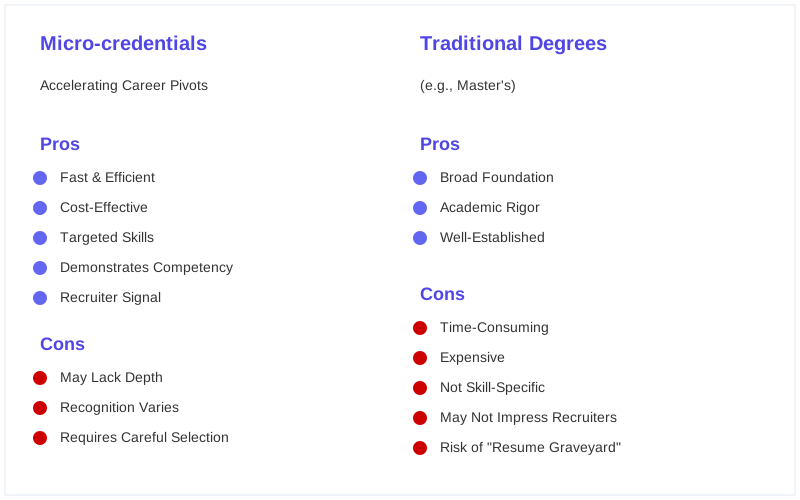
Micro-credentials are not a fad; they are a strategic tool for career pivots, a direct response to the market's insatiable hunger for specific, verifiable skills. I've seen firsthand how they can cut through the noise of the resume graveyard and bypass the ATS black hole, landing candidates in front of hiring managers who desperately need those exact capabilities.
My 'recruiter brain' is wired for signal versus noise, and a well-chosen micro-credential is a high-fidelity signal. It tells me you're not just interested; you're invested and capable. GSD Council highlights that these are short, specialized programs allowing professionals to gain expertise without a full degree commitment.
They're faster, cheaper, and often more directly applicable than traditional degrees for a pivot. But you have to be smart about it: pick the right ones, display them correctly, and be ready to prove you can actually do the work. That's the insider secret to making them work for you. It's about being efficient with your career capital.
Frequently Asked Questions
What's the real cost difference between a micro-credential and a full degree if I'm just trying to pivot into tech?
Do I really need a digital badge, or can I just list the course on my resume?
What if I get a micro-credential and still don't get interviews for my target role?
Can relying on micro-credentials permanently damage my long-term career growth compared to someone with a second degree?
I heard that micro-credentials are just for entry-level jobs. Is that true?
Sources
- The Value of Micro-Credentials to Employers and Learners
- High-Paying Career Pivots for 2026: From Retail to Tech-Sale...
- The 10 Micro-Credentials That Actually Get You Hired in 2026
- 3 Leadership Micro-Credentials Are Redefining The Modern Career ...
- Unlocking Career Potential: How Micro-Credentials Are ... - MDPI
- The Rise of Career Micro-Credentials: Reshaping Career Paths
- Career Change in 2026, Part 2: A Step-by-Step Guide - TieTalent
- Are Degrees Dead? The Role of Certifications, Micro-Credentials ...
- The State of Microcredentials in 2026: What the Data Reveals
- A systematic review of the opportunities and challenges of micro ...