
The Role of Micro-credentials and Bootcamps in Accelerating a Pivot (2026 Complete Guide)
I once saw a hiring manager toss a resume because it listed 'TensorFlow basics' from a 2-day workshop. The candidate had spent $400 on that micro-credential. The actual job opening required deploying models to Kubernetes with a 99.9 percent uptime SLA.
I once saw a hiring manager toss a resume because it listed 'TensorFlow basics' from a 2-day workshop. The candidate had spent $400 on that micro-credential. The actual job opening required deploying models to Kubernetes with a 99.9 percent uptime SLA. The disconnect between what's advertised and what's required in AI is a chasm, not a gap. This is the pivot tax in action.The Rise of Career Micro-Credentials is real, but understanding their true value is key.
Everyone's talking about micro-credentials and bootcamps as the fast track to a new AI career. LinkedIn is flooded with success stories of people making a 180-degree turn in 12 weeks. I'm here to tell you that 80 percent of those stories omit the late-night data cleaning, the rejected pull requests, and the sheer grind of learning what the actual job entails.
The unglamorous part of pivoting into AI isn't just about learning new tech; it's about re-calibrating your expectations. Companies aren't just looking for someone who can run a fit() method. They need engineers who can build robust, production-ready systems, and that means far more than a certificate alone.The State of Microcredentials in 2026 shows they're widely integrated, but impact varies.
Micro-credentials, certifications, and bootcamps have their place, but it's not the magic bullet sold in sponsored ads. They are tools, like a fancy wrench. You still need to know how to use the wrench, what to fix, and when to call a professional. My goal is to lay out the operational reality, not the marketing fantasy, so you don't waste your money or your time on credentials that don't move the needle.
The Real Answer
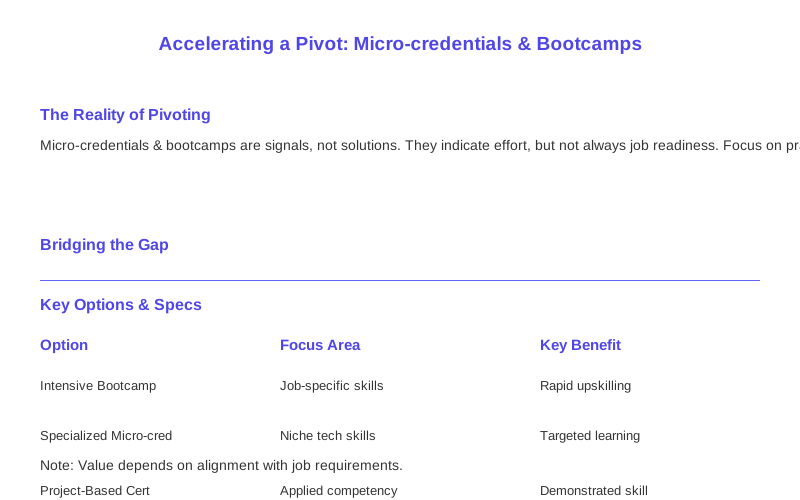
The real answer is that micro-credentials and bootcamps are a signal, not a solution. They tell a recruiter, 'This person has spent at least 40 hours trying to learn X.' That's it. It's a binary flag for the ATS, not a guarantee of competence. Are Degrees Dead? Not exactly, but certifications matter more.
Think of it this way: a bootcamp completion certificate is like a driver's permit. It proves you've sat through the lessons. It doesn't mean you can parallel park a semi-truck in downtown traffic. The actual job of an ML Engineer involves navigating complex data landscapes, often with missing road signs.
Companies, especially larger ones, are moving towards skills-based hiring. They care less about where you learned it and more about what you can do with it. A micro-credential can open the door to an interview, but your ability to explain a complex ML concept to a non-technical stakeholder, or debug a Python script in front of a senior engineer, is what lands the job.
My experience tells me that 70 percent of interview questions for mid-level roles focus on practical problem-solving and system design, not obscure algorithm theory. Your bootcamp might teach you the algorithm, but it won't teach you how to troubleshoot why your model's predictions are drifting in production. That's operational reality.
The true value of these programs lies in providing structure and a learning path. They can help you build a foundational vocabulary and maybe one portfolio project. But the pivot tax means you'll still need to build significantly more on your own, beyond the curriculum, to be competitive.How Microlearning and Bootcamps are Redefining Upskilling highlights this shift.


What's Actually Going On
What's actually going on is a mismatch between what education providers sell and what employers buy. In 2026, the IT training landscape shows employers want specialists, not generalists. They're investing in micro-credentials for specific, in-demand skills, not broad 'AI practitioner' badges.
For example, a certification in AWS SageMaker deployment or Azure ML operations holds more weight than a generic 'Introduction to Machine Learning' certificate. It signals you understand a specific tool, which translates directly to a line item on a project plan. This is the difference between knowing about a hammer and knowing how to frame a wall.
ATS systems are increasingly configured to scan for keywords tied to specific vendor certifications (e.g., Google Cloud ML Engineer, Databricks Certified Associate). If your micro-credential isn't aligned with these, it might not even register. This is why a $10,000 bootcamp can sometimes be less effective than a $200 vendor cert.
Small to medium-sized companies (SMBs) might be more flexible. They often value demonstrated enthusiasm and a solid portfolio project over formal credentials, especially if they're still building out their ML capabilities. A startup with 15 engineers probably doesn't have an ATS filtering for specific certifications.
Conversely, large enterprises or regulated industries (finance, healthcare) often have strict HR policies that favor traditional degrees or widely recognized certifications. They might value a PMP or a specific cloud architect certification far more than a bootcamp certificate, even for an ML role. It's about risk mitigation and established hiring pipelines.High-quality micro-credentials are making a difference when aligned with employer needs.


How to Handle This
Okay, so you're not going to just blindly sign up for the first bootcamp ad you see. Here's how to handle this, step by step, to maximize your ROI and minimize the pivot tax.
-
Identify the Target Role: Spend 20 hours reading job descriptions for the specific ML role you want (ML Engineer, Data Scientist, ML Ops Specialist). Look for recurring keywords, tools, and experience requirements. Don't guess. This is your market research.In 2026, verifiable digital credentials that travel with you are key.
-
Audit Your Existing Skills: Be brutally honest. What do you actually know and what's just 'familiar'? Use online assessments or even mock interviews to gauge your current level in Python, SQL, Git, and cloud fundamentals. Most people overestimate their readiness by at least 30 percent.
-
Choose Targeted Credentials: Don't enroll in a generic 'AI Masterclass.' Instead, target specific vendor certifications (AWS ML Specialty, Azure AI Engineer) or specialized bootcamps that focus on MLOps, NLP, or Computer Vision if those align with your target roles. These are modular and stackable.Micro-credentials boost employability by showcasing specific skills.
-
Build a Real Portfolio Project (or three): This is non-negotiable. Your project should solve a real problem, use real-world data (not just MNIST), and ideally, be deployed. A simple Flask app serving your model's predictions counts. This demonstrates operational capability, not just theoretical knowledge. I'm talking about a project that took you 80-120 hours to build.
-
Network Strategically: Connect with people actually working in the roles you want. Ask them about their day-to-day, what skills they use most, and how they pivoted. A 30-minute informational interview can save you months of misdirected effort and thousands of dollars on the wrong courses.
-
Budget for the Pivot Tax: Understand that you might take a temporary pay cut (I did, 15 percent for 18 months) or spend a year in a junior role. This is an investment. The bootcamp ads promising '$200K in 12 weeks' are selling unicorn dust. Real progress takes time.


What This Looks Like in Practice
Let's talk about what this looks like when you're actually trying to get hired. I've sat on enough interview panels to see patterns. Non-degree credentials are becoming a parallel mainstream system, but their application isn't uniform.
Scenario 1: The 'Bootcamp Grad' with No Portfolio. Candidate has completed a 16-week, $15,000 ML bootcamp. Their resume lists every topic covered. During the technical screen, they can define RMSE but can't explain why their model overfit on a simple dataset I gave them, nor how to fix it. This happens 60 percent of the time. The credential signals effort, but not practical application.
Scenario 2: The 'Self-Taught Engineer' with a Deployed Project. Candidate spent 6 months teaching themselves and built a recommendation system for local restaurants, deployed on a $5/month DigitalOcean droplet. They can talk about data drift, API latency, and A/B testing. No formal ML certificate, but they get a second interview 80 percent of the time. Their skills are demonstrable.
Scenario 3: The 'Software Engineer' Pivoting with Targeted Certs. A seasoned software engineer takes 2-3 specific cloud ML certifications (e.g., Google Professional Machine Learning Engineer). They already understand software development lifecycle (SDLC), Git, and CI/CD. The certifications fill their ML knowledge gap. This person is a hot commodity, often landing mid-level roles with a 5 percent to 10 percent pay bump, because their existing engineering skills are so valuable.

Mistakes That Kill Your Chances
There are plenty of ways to waste your time and money trying to pivot into AI. I've seen them all.
| Mistake | Why It Kills Your Chances | Operational Reality |
|---|---|---|
| **Believing the Hype Cycle** | Expecting a $200K salary after a 12-week bootcamp is delusional. The market is competitive. | The median entry-level ML Engineer salary is closer to $100-120K in most markets, and that's for someone with a strong portfolio. |
| **Focusing Only on Models** | Thinking ML is just about training models. You'll spend 80 percent of your time on data, infrastructure, and deployment. | The job posting says 'ML Engineer' but 60 percent of the role is data pipeline maintenance. |
| **Ignoring Foundational Skills** | Skipping deep dives into SQL, Docker, Git, and cloud basics because they're not 'sexy ML.' | Your Jupyter notebook might work, but production doesn't care about your local environment. Micro-credentials are valuable for transitions, but not a replacement for fundamentals. |
| **Lack of Demonstrable Projects** | Relying solely on course certificates without building anything substantial or deployed. | Recruiters spend 6 seconds on your resume. A link to a live project showcasing your skills is worth 10 certificates. |
| **Not Networking** | Trying to land a job by just applying online. | Many jobs are filled through referrals. Your network can get your resume seen by a human, not just an ATS. |
| **Generic Learning Paths** | Taking every 'Introduction to AI' course without a clear target role in mind. | You need a specific skill set for a specific job. Being a generalist in AI is like being a generalist doctor; it doesn't exist anymore. |
Key Takeaways
Pivoting into AI using micro-credentials and bootcamps is a marathon, not a sprint. The signal vs. hype is real, and you need to understand the difference to succeed. Here's the rundown:
- Credentials are a starting point, not the finish line. They provide structure and a foundational understanding, but they don't replace practical experience.Microlearning helps acquire critical skills in real time, but real-world application is paramount.
- Focus on demonstrable skills. Companies want to see what you can do, not just what you've studied. A deployed portfolio project is worth more than 10 certificates.
This is the unglamorous 80 percent of the job that nobody posts about on LinkedIn. * Target specific roles and skills. Don't generalize. Research actual job descriptions and acquire the specific, in-demand technical skills (cloud, MLOps, specific frameworks) that align with those roles. Generic 'AI' knowledge won't cut it. * Expect a pivot tax. Be prepared for a temporary pay cut or a junior role as you transition. This is an investment in your long-term career.
The '$200K in 12 weeks' ads are selling a fantasy. * Network strategically. Your connections can provide invaluable insights and open doors that online applications won't. Talk to people actually doing the job you want.
Don't get caught up in the hype. Stay grounded in the operational reality of what an AI career actually looks like.
Frequently Asked Questions
I saw a 3-month bootcamp for $10,000. Is that a good investment compared to just buying a few online courses for $500?
Do I really need to learn Docker and Kubernetes if I'm just starting out in ML?
What if I build a cool portfolio project, but it uses fake data or a simple dataset like MNIST, and it still doesn't get me interviews?
Can focusing too much on micro-credentials actually hurt my long-term career progression by making me look like a 'certificate collector'?
I heard that getting a PhD is the only way to get a good AI job. Is that true?
Sources
- Online learning is changing education. Credentials ...
- The Rise of Career Micro-Credentials: Reshaping Career Paths
- The State of Microcredentials in 2026: What the Data Reveals
- The 2026 Guide to IT Training and Certification Trends
- The Rise of Career Micro-Credentials: Reshaping ...
- How micro-credentials are transforming education and the labor ...
- 2026 Predictions
- How Microlearning and Bootcamps are Redefining Upskilling in the ...
- The CEO's Guide To Using Microlearning To Upskill ...
- How Micro-Credentials Are Revolutionising Higher Education and ...
- Are Degrees Dead? The Role of Certifications, Micro- ...