
Uncovering Your Unique Transferable 'meta-skills' for a Career Pivot (2026 Complete Guide)
I've seen resumes with 17 years of experience get trashed in 3 seconds because the candidate couldn't articulate their 'meta-skills' for a career pivot. It's not because they lacked the skills; it's because they didn't speak the language the ATS or the recruiter's brain was trained to understand.
I've seen resumes with 17 years of experience get trashed in 3 seconds because the candidate couldn't articulate their 'meta-skills' for a career pivot. It's not because they lacked the skills; it's because they didn't speak the language the ATS or the recruiter's brain was trained to understand. You might have been a project manager wrangling contractors for a construction firm, but if you don't translate 'budget oversight' into 'resource allocation for SaaS product launches,' Workday will just shrug.
That's the brutal truth. Many folks think a career pivot means starting from scratch, learning entirely new hard skills. That's usually a waste of time and money, and it's rarely what companies are truly looking for. What they need are people who can adapt. Employers are prioritizing transferable skills because technical abilities are fleeting.
My 'recruiter brain' is looking for the underlying competencies that prove you can learn, lead, and solve problems, regardless of the specific industry jargon you used in your last role. It's about the signal vs noise. When I was staring at 200 applications for a Marketing Director role, I wasn't looking for someone who had 'marketing' in their last five job titles.
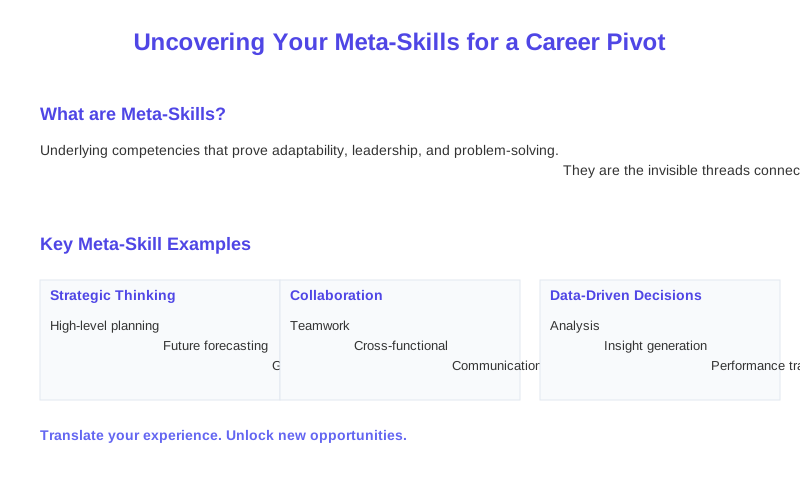
I was looking for someone who could demonstrate strategic thinking, cross-functional collaboration, and data-driven decision-making, even if their last gig was in logistics. Those are meta-skills. They're the invisible threads that weave through every successful career, and they're what allow you to jump from one industry to a completely different one without losing your footing. It's the difference between being a specialist tied to a dying industry and being a resilient professional ready for anything.
And frankly, it's what separates the candidates who get calls from those who disappear into the resume graveyard.
The Real Answer
The real reason you're struggling to articulate your transferable skills for a career pivot isn't a lack of those skills, but a fundamental misunderstanding of how the hiring machine actually works. Recruiters and ATS systems aren't looking for a direct 1:1 match of job titles. They're programmed to find patterns and keywords that map to the underlying competencies a role requires. This is especially true for career changers.
My hiring committee didn't care if your last job was 'Senior Widget Polisher' if the job description for 'Director of Operations' called for 'process optimization' and 'team leadership.' Your resume needed to reflect those meta-skills, not just the widget-polishing specifics. The ATS, whether it's Greenhouse or Lever, is running a keyword search against the job description. If 'project management' is listed, and your resume only says 'coordinated vendor schedules,' you're toast. Your valuable experience becomes invisible.
It's a technical parsing issue. Your job is to translate your past into their future, using their vocabulary. Then, when I, the recruiter, scan that parsed data, I'm looking for evidence of those meta-skills. My 'recruiter brain' is hardwired for pattern recognition. I'm not looking for a narrative; I'm looking for data points that confirm you possess adaptability, critical thinking, or problem-solving. Identifying transferable skills is critical. Your past achievements, stripped of industry-specific jargon, become the proof.
Did you reduce costs by 15 percent? That's 'financial acumen' and 'process improvement,' not just 'saved money on widgets.' This isn't about lying; it's about accurate, strategic translation for a system that doesn't understand nuance.

What's Actually Going On
When you're trying to make a career pivot, the ATS isn't your friend unless you speak its language. A system like Workday or iCIMS is essentially a database that parses your resume into structured fields. If your experience doesn't neatly fit those fields, or if you use jargon that isn't in their dictionary, your valuable skills become lost in the ATS black hole.
For example, 'driving strategic initiatives' might be a key phrase, but if you write 'spearheaded big projects,' the system won't connect the dots. The ATS only knows what it's told. Many smart career pivots rely on this translation. Company size also dictates how much a recruiter can dig. At a large enterprise, I might have 500 applications for one role. My process is ruthless: 10 seconds per resume, maximum. I'm relying heavily on the ATS to filter.
If I'm at a smaller startup using Lever, I might have 50 applications, giving me a bit more time to manually search for keywords the ATS might have missed. But 'a bit more time' still means I'm not reading your whole life story. I'm still looking for signal vs noise. Regulatory facts also play a role. Certain industries, like finance or healthcare, have strict compliance requirements.
If you're pivoting into one of these, your resume needs to explicitly state experience with 'regulatory compliance' or 'data privacy,' even if your previous role just called it 'following the rules.' The ATS will be specifically flagged for these terms. My own career pivot was all about this. What's actually going on is that the hiring process, from ATS to recruiter, is a series of gates. Each gate is looking for specific indicators.
Your job is to make sure those indicators are visible, relevant, and articulated in the language of the gatekeeper, not just your old industry.


How to Handle This
First, dedicate 90 minutes to a brutal self-audit. List every major accomplishment from your last five years, then strip out all industry-specific jargon. Did you 'manage a team of 8 engineers'? Rephrase as 'led cross-functional teams' or 'mentored junior staff.' This is about identifying the core meta-skills. These meta-skills are higher-order abilities. Next, spend another 60 minutes researching 5-7 target job descriptions for the role you want. Copy and paste the 'responsibilities' and 'required skills' sections into a document.
Look for recurring verbs and nouns: 'optimize,' 'strategize,' 'collaborate,' 'data-driven,' 'stakeholder management.' These are your new keywords. Now, for the hard part: for 30 minutes, compare your jargon-free accomplishments against those keywords. Where do they align? Where are the gaps? This isn't about inventing experience; it's about translating it. For example, 'managed customer complaints' becomes 'resolved complex customer issues, improving satisfaction by 20 percent.' This is where professional help can save you months.
A good career coach, costing anywhere from $150 to $500 an hour, can help you identify these connections in about 2-3 sessions. Ask them specifically about 'transferable skills identification' and for examples of how they've helped clients reframe experience for a pivot. Look for coaches with a recruiting background; they speak my language. Alternatively, online resume review services like TopResume or Resume.io, for $100-$300, can provide feedback on keyword optimization, though they won't offer the deep dive a coach will.
Employees with strong meta-skills show higher performance ratings. When you talk to them, ask: 'How will you ensure my experience translates to the specific ATS systems used by companies in my target industry?' This ensures they're not just giving generic advice. For your resume, focus on a functional or hybrid format. This allows you to highlight skill categories at the top, before diving into chronological work history.
This helps my 'recruiter brain' immediately see the meta-skills, bypassing any initial industry confusion.

What This Looks Like in Practice
Imagine a project manager from construction trying to pivot into tech. Their resume might list 'oversaw 15 concurrent building projects, ensuring on-time and on-budget delivery.' For a tech role, that translates to 'managed complex software development lifecycles (SDLCs), delivering products within 10 percent of allocated budget.' The underlying meta-skill is 'project management' and 'resource allocation.' Defining your goals is key to this process. Or consider a teacher aiming for a corporate training role.
Their resume might say 'designed and delivered curriculum to 30 students daily, achieving 90 percent student engagement.' This becomes 'developed and facilitated corporate learning programs, increasing participant knowledge retention by 25 percent' - highlighting 'instructional design' and 'communication skills.' The metrics are crucial. My 'recruiter brain' loves numbers. Instead of 'improved processes,' say 'streamlined onboarding process, reducing new hire ramp-up time by 18 percent.' These concrete metrics prove the impact of your meta-skills.
Transferable skills are how you build the right career. This isn't about fabricating; it's about quantifying the value you already bring.


Mistakes That Kill Your Chances
The biggest mistake I see is candidates treating their resume like a historical document, not a marketing tool. Auditing your human premium is step one. Here's a table of common screw-ups:
Key Takeaways
Look, making a career pivot isn't magic; it's mechanics. You're not trying to become a different person; you're just learning to speak a new dialect of 'professional.' The core meta-skills you've developed - your ability to solve problems, lead teams, adapt to change, or analyze data - are your true currency. Adaptability is an essential soft skill. The ATS doesn't understand your potential, only your keywords. My 'recruiter brain' is looking for patterns, not prose.
Your job is to make those patterns undeniable. Translate your achievements, quantify your impact, and speak the language of your target industry. It's about being strategic, not just hopeful. Don't let your valuable experience get buried in the resume graveyard because you didn't know how the system works. Understand the game, and you'll play to win.
Frequently Asked Questions
I'm thinking of paying for one of those AI-powered resume builders. Is that better than a human coach for identifying meta-skills?
Do I really need to quantify every single bullet point on my resume, even for soft skills?
What if I tailor my resume perfectly, but I'm still getting rejection emails or no responses at all?
Can over-optimizing my resume for keywords make it sound robotic or inauthentic to a human recruiter?
I heard that if I just apply to enough jobs, eventually one will stick. Is that true for a career pivot?
Sources
- How to pivot your career effectively | Brian Honigman posted on the ...
- ?hl=en
- 10 Transferable Skills for 2026 Employers Actually Want
- The 2026 Career switch Roadmap: A Skill-First Guide to Job ...
- What new skill to learn in 2026?
- The Complete Guide to Changing Careers in 2026
- 6 Meta Skills You'll Need for Your Career in 2026
- In the Age of AI: Meta Skills Are Your New Career Advantage
- What is the Smartest Career Pivot in 2026?
- Preparing for a Career Change: a Step-by-Step Guide ...
- Unlock Transferable Skills for a Career Pivot
- How transferable skills helped this marketing leader pivot her career