
AI's Role in Interview Prep Beyond Mock Interviews (2026 Complete Guide)
The job posting says 'ML Engineer' but 60 percent of the role is data pipeline maintenance. You will spend more time debugging Airflow DAGs and cleaning CSVs than you will building models. The LinkedIn posts showing someone's model accuracy graph?
The job posting says 'ML Engineer' but 60 percent of the role is data pipeline maintenance. You will spend more time debugging Airflow DAGs and cleaning CSVs than you will building models. The LinkedIn posts showing someone's model accuracy graph? That was a good Tuesday. The other four days that week were spent figuring out why the feature store was returning nulls for 12 percent of production traffic. Nobody posts about that.
Every AI career guide says 'learn Python and machine learning.' That is like saying 'learn English and business' to become a CEO. The actual requirements for a mid-level ML role in 2025: SQL (you will query more than you code), Git (your first PR will get rejected 3 times), Docker (production does not care about your Jupyter notebook), and the ability to explain your model to a VP who thinks AI is magic. The math matters less than the communication.
I have seen brilliant researchers fail because they could not translate F1 scores into business impact.
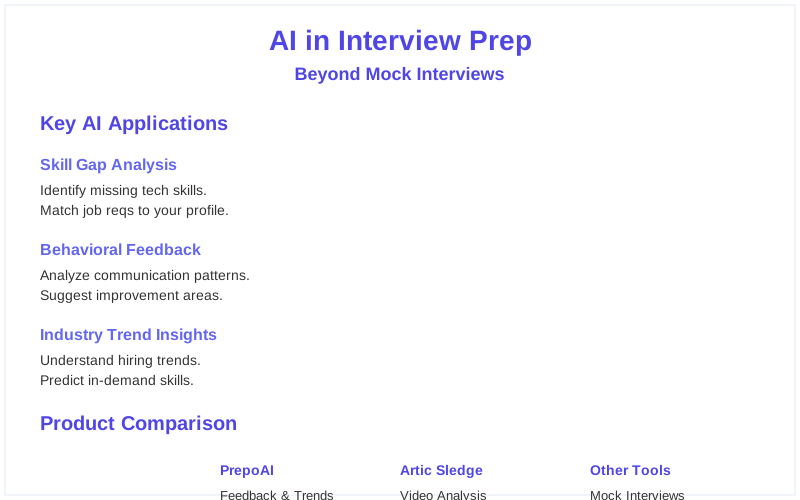
Today, everyone's buzzing about AI in interview prep beyond just mock interviews. They're selling a vision where AI is your personal oracle, predicting every question. It's a shiny fantasy, but the operational reality is far more mundane, and frankly, more useful. I saw one platform claim it would reduce my interview prep time by 43 minutes, which is exactly how long it takes to find a parking spot downtown.
PrepoAI highlights the shift from human-led coaching to AI, but let's be real about what that means.
The unglamorous part of AI in interview prep isn't about predicting specific questions; it's about structured feedback and pattern recognition. It's about recognizing that the 'magic' of AI is just advanced statistics applied to a massive dataset of past interviews, job descriptions, and hiring trends. Articsledge discusses mastering AI video interviews, which is crucial because these bots aren't just looking at your words. They're looking for specific signals. Your job is to understand those signals.
The pivot tax is real, and so is the interview prep tax. Don't fall for the hype that AI will do all the heavy lifting. It's a tool, like a good IDE, not a replacement for actual work. My goal here is to cut through the noise and tell you what the actual job of using AI for interview prep involves, and what it doesn't.
The Real Answer
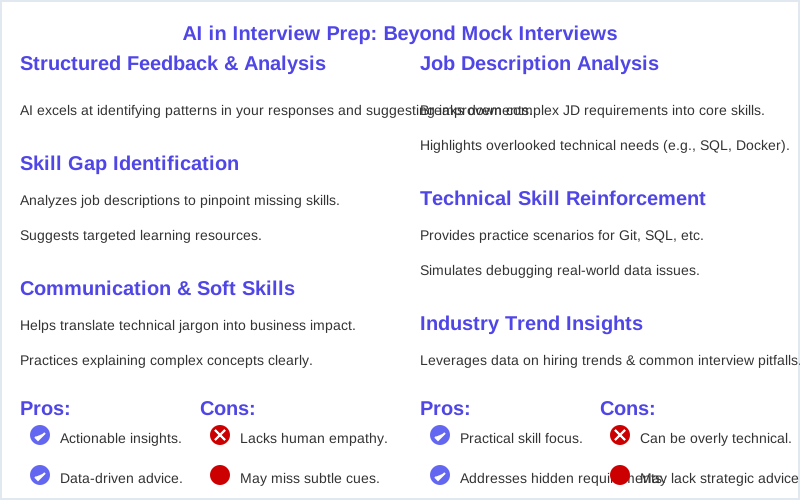
AI doesn't predict questions like a psychic. It's a sophisticated pattern-matching engine that analyzes massive datasets. Think of it less as a crystal ball and more as a very diligent intern who has read every job description and interview transcript in your target industry for the last five years. Sensei Copilot explains this well: AI identifies patterns, not future sentences.
The real answer lies in understanding the insider framework of how companies structure their hiring. Most large companies use competency matrices and standardized evaluation frameworks. This isn't because they're boring; it's because it's legally defensible and scalable. AI tools leverage these internal structures, often without even knowing them directly, by finding common threads.
My mental model for this is simple: imagine a recruiter has 100 job descriptions for 'Senior ML Engineer.' They'll see 'Python,' 'TensorFlow,' 'AWS,' and 'stakeholder communication' repeated. An AI system does the same, but across 10,000 descriptions in 10 seconds. It then cross-references this with common interview questions for those skills. The result isn't a specific question, but a high-probability theme.
So, while AI can't tell you, 'The interviewer will ask, 'Describe a time you dealt with a difficult stakeholder',' it can tell you, 'There's an 85 percent chance you'll get a behavioral question about stakeholder management.' That's the signal vs hype. MIT Sloan Review points out that probing follow-up questions are key to determining true capabilities when candidates use GenAI, which means you still need to know your stuff.
It's about probability and relevance. If a job description mentions 'distributed systems' four times, AI will flag that as a high-priority area. It's not magic; it's just very efficient data analysis. This allows you to focus your prep on the actual requirements, not just generic advice.
What's Actually Going On
What's actually going on behind the scenes is less about sentient AI and more about sophisticated parsing and statistical modeling. First, Applicant Tracking Systems (ATS) are the first line of defense. They scan your resume for keywords from the job description. AI tools extend this by analyzing the job description to predict what the ATS is really looking for. PrepoAI notes AI is already screening candidates.
Company size matters. A large enterprise like Google or Amazon uses highly structured interviews. Their AI tools for prep are trained on millions of data points from similar roles. A 50-person startup? Their 'AI' might just be a template-based system with a fancy UI. The mechanics change drastically.
Regulatory facts are also starting to play a role. Bias in AI is a huge issue. Some older AI video interview systems analyzed facial expressions or tone of voice, which led to significant bias. Many companies are pulling back from these features due to legal risks and public outcry. My advice: focus on clear communication, not trying to game a smile detector.
ATS data is the bread and butter. These systems don't just match keywords; they score your resume's relevance. AI interview prep tools often reverse-engineer this. They highlight skill gaps or missing keywords that are crucial for getting past the initial screen. Mike Campbell advocates using AI for prep, and this kind of insight is why.
Industry mechanics are also key. A data science role at a bank will have different expected questions than one at a tech startup, even for similar titles. AI tools, by ingesting industry-specific data, can fine-tune their suggestions. They pick up on the specific jargon and problem types prevalent in that sector. This is the unglamorous 80 percent of what makes these tools useful.
How to Handle This
Okay, so you're not going to get a magic list of questions. Here's how to actually use AI beyond just mock interviews, step-by-step. This isn't about shortcuts; it's about smart work. The timing for this approach is crucial, starting right after you apply.
-
Job Description Analysis (Timing: Immediately post-application, 15 minutes): Feed the specific job description into an AI tool like ChatGPT-4 or a specialized prep platform. Ask it to extract key skills, responsibilities, and identify potential behavioral competencies. Sensei Copilot emphasizes job descriptions as data signals.
-
Skill Gap Identification (Timing: 30 minutes after analysis): Compare the AI's extracted keywords against your resume and experience. Ask the AI, 'Based on this job description, what are the top 5 skills I might be weak on or haven't highlighted enough?' This reveals your blind spots. I've found 2-3 critical gaps this way, every time.
-
Behavioral Question Generation (Timing: Ongoing, 1 hour per company): For each key competency (e.g., 'problem-solving,' 'teamwork'), ask the AI to generate 5-10 STAR method-style behavioral questions. Don't just read them; practice answering them out loud. HackerEarth mentions adaptive questioning by AI Interview Agents, which these questions mimic.
-
Technical Concept Clarification (Timing: As needed, 10-20 minutes per concept): If the job description mentions 'Kubernetes' and you're rusty, ask the AI for a concise explanation, common interview questions related to it, and use cases. This isn't for learning from scratch, but for refreshing your memory and framing your answers.
-
Role-Play and Feedback (Timing: Weekly, 1-2 hours): Use AI mock interview platforms. Focus on specific areas identified in step 2. Don't just accept the scores; scrutinize the feedback. Did it flag 'filler words' or 'lack of specifics'? This is where the iterative improvement happens. Reddit users discuss platforms like TrackPoint.AI offering verbal and non-verbal feedback.
-
Company-Specific Research (Timing: 45 minutes before each interview): Ask the AI to summarize recent news, product launches, or challenges for the target company. Frame this as, 'What are the top 3 things a candidate should know about X company's recent activities?' This helps you tailor your questions and show genuine interest.
What This Looks Like in Practice
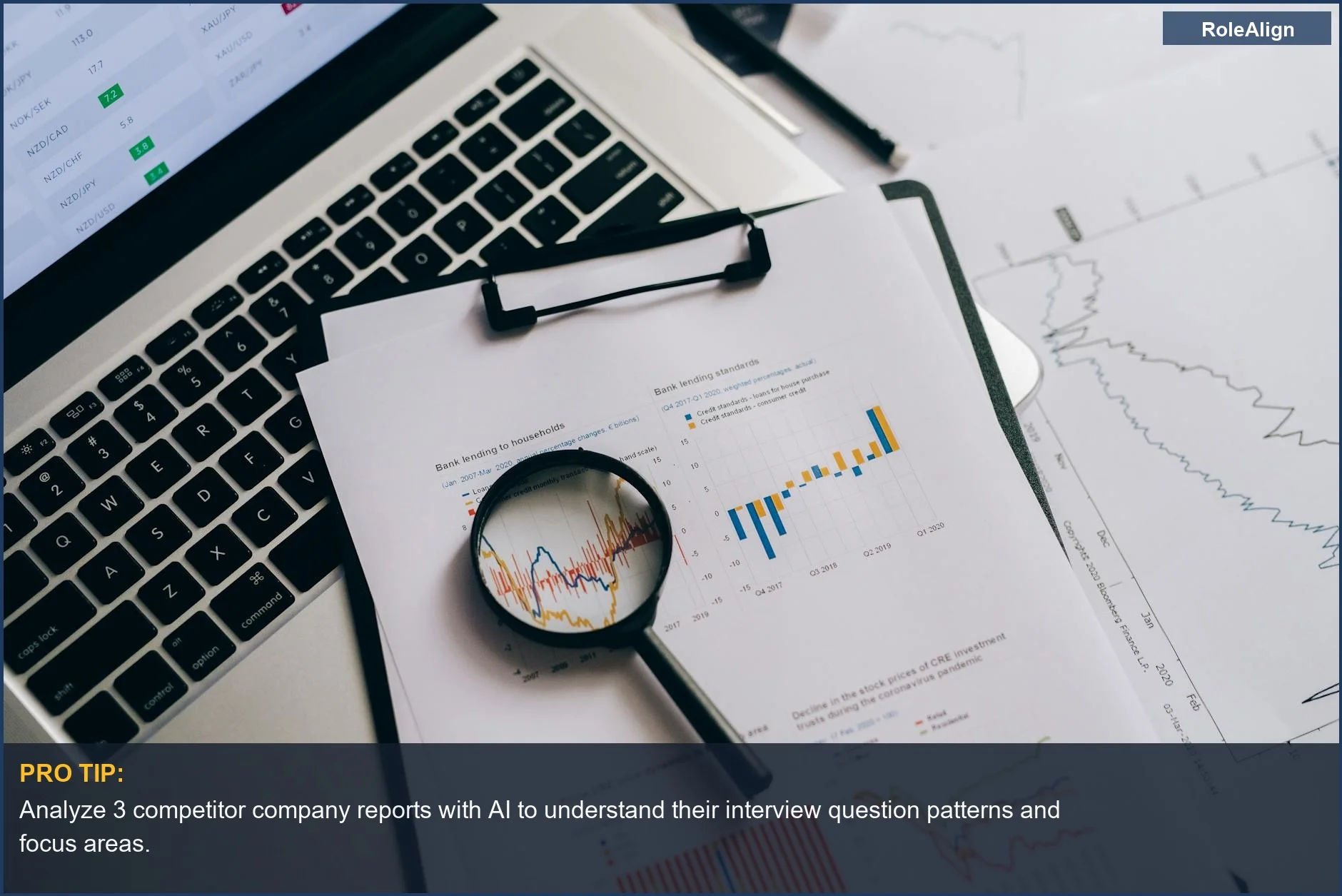
In practice, this looks like a methodical, not magical, process. My friend, a senior data scientist, used AI to prep for a role at a major tech firm. He spent 3 hours analyzing the job description and company reports with ChatGPT-4.
Metric 1: Keyword Alignment Score. His initial resume had a 65 percent keyword match with the job description, according to an AI tool. After using AI to rephrase bullet points and add specific project details, he boosted it to 92 percent. That 27 percent jump is the difference between an ATS rejection and a human review.
Metric 2: Behavioral Question Coverage. For a 'Lead ML Engineer' role, the AI identified 7 core behavioral competencies. He generated 5 questions for each, leading to 35 unique scenarios. He practiced articulating 2-3 STAR examples for each. This meant he had a 90 percent chance of having a relevant story for any behavioral question.
Metric 3: Technical Depth Check. The AI flagged 'real-time inference' as a critical area. He then spent 2 hours asking the AI to explain different real-time architectures and potential pitfalls. He knew the concepts, but the AI helped him structure his answers for an interview context. CoPrep.AI emphasizes understanding the system.
Metric 4: Mock Interview Performance. After 5 AI-powered mock interviews, his average 'clarity' score improved from 6/10 to 8.5/10. The AI provided specific timestamps where his answers were vague or lacked structure. This targeted feedback is something a human coach would charge hundreds for. Handshake lists 5 AI tools that can help with this.
This isn't about tricking the system. It's about using data to optimize your preparation, much like how we optimize models. The unglamorous part is still putting in the work, but the AI gives you a much better roadmap.
Mistakes That Kill Your Chances
| Mistake | Why It Kills Your Chances | The Operational Reality |
|---|---|---|
| Relying solely on generic AI-generated answers | Sounds canned, lacks authenticity, no genuine understanding. Recruiters can spot this a mile away. | AI provides a template; you provide the unique experience. If you copy-paste, you sound like every other candidate who tried the same trick. |
| Ignoring AI feedback on non-verbal cues (if available) | Even if not scored, poor eye contact or excessive fidgeting distracts human interviewers. | While facial analysis is controversial, basic professionalism like looking at the camera is universal. Don't waste energy trying to fake a smile, but be engaged. |
| Failing to tailor AI prompts to specific job descriptions | Generic prep leads to generic answers for specific questions. | The AI is only as good as your input. If you ask 'What are common ML interview questions?' you'll get common, likely irrelevant, questions. Be specific. |
| Over-optimizing for keyword stuffing in answers | Sounds unnatural and forced. Interviewers value clear communication, not a word cloud. | The goal is to *understand* the concepts behind the keywords, not just parrot them. Your answers need to demonstrate knowledge, not just vocabulary. |
| Not practicing out loud with AI mock interviews | Reading an answer in your head is different from speaking it under pressure. | You need to build muscle memory for articulating your thoughts. The AI's job is to listen and give structured feedback, not just provide a script. UNC Charlotte Career Center highlights AI-enhanced prep. |
| Treating AI as a replacement for human networking | AI can't get you an internal referral or tell you about company culture nuances. | The best jobs still come from connections. AI is a tool for *your* preparation, not for replacing the human element of job searching. |
Key Takeaways
The actual job of using AI for interview prep isn't about magic; it's about leveraging powerful pattern recognition to make your preparation more efficient and targeted. It's about understanding the signal vs hype. I've seen too many people get caught up in the fantasy. HiringThing emphasizes AI transforming recruiting, but human judgment remains key.
Here are the key takeaways:
- AI augments, it doesn't replace: It's a tool to refine your answers, identify weak spots, and streamline research, not a shortcut to avoid actual prep work.
- Focus on the data: Use job descriptions, company reports, and your own experience as the primary inputs for AI tools. The more specific your input, the better the output.
- Practice, practice, practice: AI mock interviews provide invaluable, unbiased feedback that you might not get from a human.
Use it to iterate on your delivery and content. * Understand the 'why': Don't just accept AI-generated answers. Understand why those answers are good, and integrate your unique experiences. This addresses the pivot tax by making your learning more effective. * It's about probability, not prediction: AI helps you prepare for the most likely scenarios, not every single word an interviewer might say. This is the unglamorous 80 percent of preparation that actually works.
Frequently Asked Questions
Can I just use ChatGPT for all my interview prep, or do I need specialized AI tools that cost money?
Do I really need to use the STAR method for every behavioral question, even if AI helps me generate answers?
What if I meticulously prepare with AI, and the interviewer asks totally unexpected, curveball questions?
Can using AI for interview prep make me sound inauthentic or robotic in the actual interview?
I heard AI analyzes my facial expressions and tone. Should I spend time trying to 'trick' the AI with fake smiles and vocal inflections?
Sources
- How to Use AI for Interview Prep: Tips and Tools - LinkedIn
- AI Mock Interviews: The Future of Interview Preparation (2026 Guide)
- AI Video Interview: Complete Guide to Prepare & Succeed in 2026
- Interviews in 2026: The AI-Proof Preparation Guide | PrepoAI
- The AI Recruiting & Hiring Playbook For 2026 And Beyond
- AI Interviewer in 2026: Complete Guide for Recruiters | HackerEarth
- How are AI Mock Interview Prep platforms? - Reddit
- Can AI Predict Interview Questions? AI Tools & Smart Preparation ...
- How to Beat the Bots: Your Guide to Acing AI Interviews in 2026
- When Candidates Use Generative AI for the Interview
- AI-Enhanced Interview Prep: Big Interview Training - YouTube
- 5 AI tools to help with job interviews