
The Long-term Career Trajectory Cost of Poor Offer Negotiation (2026 Complete Guide)
I've seen job offers that were 15 percent lower than market rate, and the candidate accepted without a peep. That's not just a bad day; that's literally hundreds of thousands of dollars evaporating from your lifetime earnings. Most people think salary negotiation is about haggling for a few extra grand, but it's far more insidious.
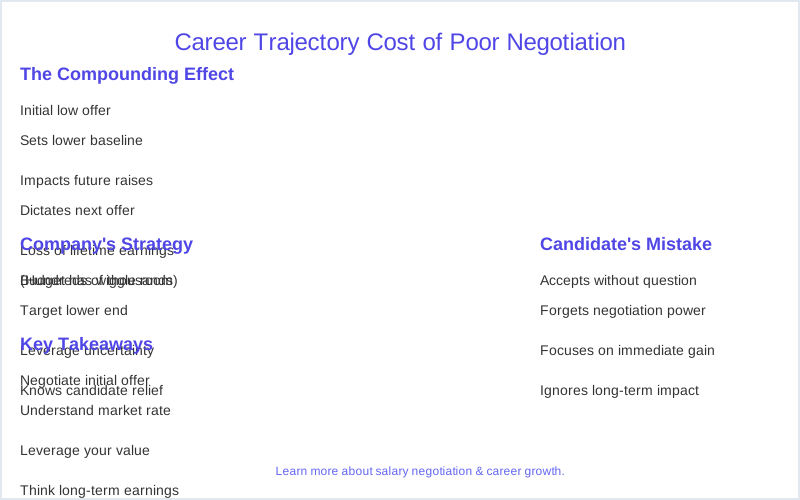
I've seen job offers that were 15 percent lower than market rate, and the candidate accepted without a peep. That's not just a bad day; that's literally hundreds of thousands of dollars evaporating from your lifetime earnings. Most people think salary negotiation is about haggling for a few extra grand, but it's far more insidious. It's about setting a baseline that compounds against you for the next 40 years.
That initial offer isn't just a number; it's the anchor for every future raise, bonus, and even your next job offer. It's a pricing conversation under uncertainty, and companies know exactly what they're doing when they lowball you.
I've sat in enough hiring committee meetings to tell you that the 'budget' for a role often has a 10-20 percent wiggle room built-in. It's not a fixed number carved in stone by ancient HR deities. It's a range, and the company's goal is to pay you on the lower end of it. Your goal is to get to the higher end. Simple economics, really.
But most job seekers are so relieved to get an offer, they forget they have any leverage at all. Twenty-six percent of job seekers decline offers due to poor communication, but a far greater number accept offers that are simply too low.
This isn't just about a single paycheck. It's about how your initial salary dictates your future earning potential. A 5,000 dollar difference today can become a 50,000 dollar difference over a decade, thanks to compounding annual raises and subsequent job offers that use your current salary as a benchmark. Every hire is expensive for a company, taking 3-6 months to reach full productivity and incurring training costs. They want you, but they want you cheap.
My recruiter brain knows this. Your manager knows this. The HR department definitely knows this. Yet, somehow, the average candidate acts like they're asking for a personal favor instead of negotiating their market value. It's a huge opportunity cost, and it's one of the biggest financial mistakes I see people make over and over again, all because they're afraid to ask.
The Real Answer
The real reason poor offer negotiation costs you so much over your career isn't some grand conspiracy; it's rooted in the mundane mechanics of how compensation systems and recruiter workflows are designed. It's about anchoring and internal equity, not about how much you 'deserve.'
First, there's the 'anchoring effect.' When a company gives you an initial offer, that number becomes the psychological anchor for the rest of the negotiation. Whoever sets the first number tends to shape the rest of the negotiation. Recruiters are trained to start low because they know most people won't push back significantly, if at all. My director always told me, 'If they accept the first offer, you started too high.'
Then there's the internal equity issue. Companies, especially larger ones using Workday or Oracle HCM, track salary bands meticulously. Your starting salary places you within a specific band. Future raises and promotions are almost always percentage-based increases from that current salary. If you start at the bottom of the band, a 3 percent annual raise on 60,000 dollars is 1,800 dollars. A 3 percent raise on 70,000 dollars is 2,100 dollars. That 300 dollar difference compounds year after year.
My recruiter brain also knows that once you're in the system, it's incredibly difficult to jump salary bands without changing companies. HR policies are rigid. They don't want to create internal friction by paying someone significantly more than their peers for the same role, even if you were underpaid when you started. It's a feature, not a bug, of their internal compensation structure.
Finally, there's the 'market value' perception. Recruiters at your next company will almost certainly ask for your current salary. If your current salary is low because you didn't negotiate, it signals to them that your market value is lower. Negotiate salary first, before talking about benefits. It's a self-fulfilling prophecy of underpayment, a true resume graveyard for your earning potential.


What's Actually Going On
What's actually going on behind the scenes is a combination of rigid HR policies, the limitations of ATS systems, and the sheer volume recruiters are dealing with. It's not personal; it's just business mechanics.
Most companies operate with defined salary bands for every role, stored in systems like Workday or SuccessFactors. These bands have a minimum, midpoint, and maximum. When a recruiter extends an offer, they're usually aiming for the lower third of that band. Why? Because it leaves room for negotiation without exceeding the budget. There's probably a salary band with a high and low range.
Your starting salary is entered into the ATS (e.g., Greenhouse, Lever) and becomes a permanent data point. This data point is used for future internal promotions, annual reviews, and even when a recruiter at another company asks for your salary history. It's a digital anchor that's hard to move.
Company size also plays a huge role. At a large enterprise, HR policies are often centralized and inflexible. A manager might want to pay you more, but the system or policy simply won't allow it without multiple layers of approval that no one wants to deal with. At a smaller startup, there might be more flexibility, but also less established salary bands, making research even more critical.
Regulatory facts, like pay transparency laws in some states, are starting to shift this. Companies in places like New York or California are now required to post salary ranges. This transparency actually helps candidates anchor their expectations and negotiate more effectively. Poor timing and framing can weaken your position, but knowing the range gives you a solid starting point.
Finally, recruiters are often measured on 'time to fill' and 'cost per hire.' Dragging out a negotiation for a few extra thousand dollars isn't always their top priority, especially if they have 30 other open roles. They want to fill the role and move on. This creates an implicit pressure to accept the first reasonable offer, even if it's not optimal for you.
How to Handle This
Alright, so you know the mechanics. Now, how do you actually handle this without looking like a jerk or getting your offer rescinded? It's about timing, data, and framing.
First, never give your salary expectations upfront. When asked, deflect. My favorite line was always, 'I'm more interested in finding the right fit for my skills and experience, and I'm confident we can agree on a fair compensation package once we've determined that fit.' Or, 'What is the salary band range for this role?' Always let them make the first offer.
Once you receive an offer, don't respond immediately. Take 24-48 hours. This signals confidence and gives you time to research. Use tools like Glassdoor, Levels.fyi, and LinkedIn Salary Insights to benchmark the offer against market rates for your role, location, and experience. This is your ammunition.
When you counter, do it over the phone, then follow up in writing. A phone call allows you to gauge their reaction and build rapport. Start by reiterating your excitement for the role and the company. Then, present your counter-offer, anchoring it with data.
Say something like, 'Based on my research for similar roles with my experience in [your city], a competitive compensation package for this position is closer to [your desired number].' Poor negotiation outcomes often lead to dissatisfaction, so get it right.
Negotiate total compensation, not just base salary. Consider signing bonuses, equity, vacation time, and even professional development budgets. If they can't move much on base, they might have flexibility elsewhere. For example, 'If you can't increase the base to X, could we explore a signing bonus of Y or an additional week of PTO?' Target 15-25 percent salary increases when changing jobs. This is your chance to make a significant leap.
Practice your delivery. Even if you understand the concepts, poor delivery can weaken your position. Sound confident, not demanding. Remember, they want to hire you; you're just aligning expectations.


What This Looks Like in Practice
Let's look at what this actually means in numbers, because that's where the rubber meets the road.
Scenario 1: The 10 percent Miss. You accept an 85,000 dollar offer when the market rate for your experience and role was 95,000 dollars. Assuming a conservative 3 percent annual raise, after 5 years, you've lost over 15,000 dollars in compounded earnings. After 10 years, that number balloons to over 35,000 dollars. A low base compounds against you over time.
Scenario 2: The Equity Erosion. You negotiate a 5,000 dollar higher base salary, but overlook a 10,000 dollar signing bonus or 500 shares of stock that vested over 4 years. The base salary looks good on paper, but you've left significant long-term wealth on the table, especially if the company is growing.
Scenario 3: The 'Internal Promotion' Trap. You've been at a company for 3 years, consistently outperforming. You get promoted, but your raise is only 8 percent, bringing you to 75,000 dollars. Meanwhile, a new hire with similar experience is brought in at 85,000 dollars for the same role. Your initial low base salary has now created an internal equity issue that's almost impossible to fix without leaving. A low initial offer often leads people to negotiate.
Scenario 4: The Benefits Blind Spot. You focus solely on base salary and forget to negotiate an extra week of vacation, a higher 401k match, or a larger professional development budget. That extra week of vacation is worth thousands in personal time, and professional development can boost your future earning potential significantly. It's not just about the cash.
These aren't hypothetical; these are conversations I've had with candidates and hiring managers countless times. The recruiter brain sees these numbers, and we know exactly where the leverage is.

Mistakes That Kill Your Chances
Negotiation isn't just about what you say, but also what you don't say, and how you say it. Here are the common mistakes that kill your chances, straight from my experience configuring ATS systems and dealing with the fallout.
| **Mistake** | **Why it Fails (Recruiter's View)** |
| Accepting the first offer immediately | Signals lack of market research or confidence. My immediate thought: 'Could have started lower.' |
| Negotiating via email only | Lacks nuance and personal connection. Easy to dismiss. Hard to build rapport. |
| Giving a specific number first | You've anchored yourself, likely too low. The company will try to beat *that* number, not your true market value. |
| Focusing only on base salary | Ignores total compensation package. Companies have more flexibility with bonuses, equity, or benefits. |
| Being vague or emotional | 'I need more money' is not a negotiation. It's a plea. Provide data and a clear rationale. |
| Threatening to walk away too early | Unless you mean it, it's an empty threat. Can sour the relationship and make them move to the next candidate. A poor reaction to polite negotiation kills chances. |
| Not understanding the salary band | If you ask for 150,000 dollars when the top of the band is 120,000 dollars, you look out of touch. Do your research. |
These mistakes turn a potential win into a missed opportunity. My recruiter brain flags these immediately as 'easy close' candidates, meaning I can get them in at a lower rate without much fuss. Don't be that candidate.
Key Takeaways
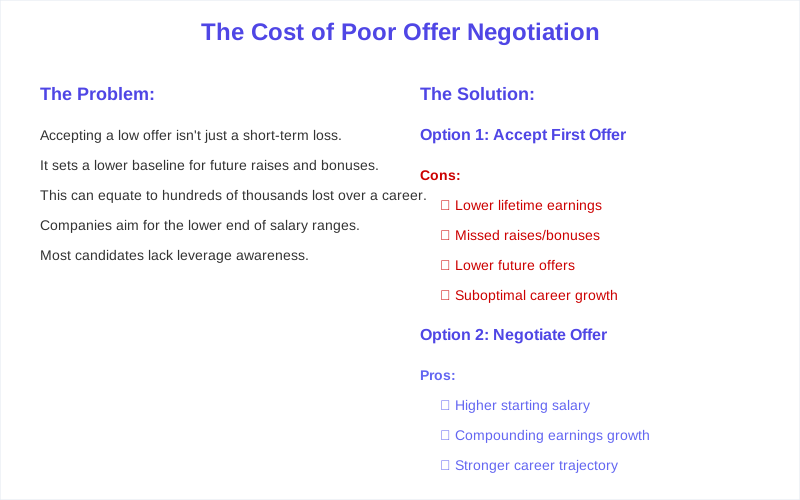
The long-term career trajectory cost of poor offer negotiation is real, substantial, and entirely avoidable. It's not just about the initial offer; it's about the compounding effect of that number over your entire working life.
- Anchoring is Key: Your initial salary sets the baseline for all future compensation. A low anchor means every subsequent raise and offer is built on a weaker foundation.
- Internal Systems are Rigid: Once you're in the system (Workday, Greenhouse), moving significantly outside your salary band is difficult. HR policies prevent it.
- Recruiters Have Wiggle Room: Companies typically build a 10-20 percent negotiation buffer into their offers.
You're expected to use it. * Research is Your Leverage: Knowing market rates for your role and location gives you the data to back up your counter-offer. Don't guess. * Negotiate Total Compensation: Look beyond just base salary. Signing bonuses, equity, and benefits all add significant value to your overall package. Negotiate total compensation packages rather than just base salary.
Don't leave hundreds of thousands of dollars on the table over your career because you were afraid to ask. This isn't a personal request; it's a business transaction where you're selling your skills at market value. Get what you're worth.
Frequently Asked Questions
I'm thinking of just accepting the first offer because I need a job fast. What's the real cost if I skip negotiation this one time?
Do I really need to research salary ranges on multiple sites, or can I just use one like Glassdoor?
What if I try to negotiate and they just pull the offer entirely?
Can a low initial salary permanently damage my career progression?
Isn't negotiating just being greedy and ungrateful for an offer?
Sources
- How to Negotiate Salary Without Sounding Risky Salary ... - Instagram
- How to avoid salary negotiation mistakes that cost you money
- Athletic Trainers' Experiences With and Perceptions of Salary ... - PMC
- How Much Should Your Salary Increase When... - Metaintro
- Negotiating Job Offers: Breaking the Cycle of Early Turnover - LinkedIn
- Should I Accept the First Salary Offer? (2026) | SalaryGuide
- What are the hidden costs of salary negotiation that employees often ...
- Career-Limiting Moves That Will Cost You the Job: A 2026 Reality ...
- Master Salary Negotiation with Free Guide - TikTok
- Your lucrative new plan for negotiating a better salary during job offers