
The Hidden Costs of Accepting a Lowball Offer Beyond Salary (2026 Complete Guide)
I once saw a company lose out on a candidate who would have generated an additional $2.3 million in revenue in their first year, all because they lowballed the initial offer by $12,000. That's a 191x return on investment they walked away from.
I once saw a company lose out on a candidate who would have generated an additional $2.3 million in revenue in their first year, all because they lowballed the initial offer by $12,000. That's a 191x return on investment they walked away from. This isn't just about the money you leave on the table; it's about the long-term impact on your career trajectory and how the company views your value from day one.
The first offer is rarely the best one, yet many people accept out of fear or lack of strategy.
My years in HR have shown me that a lowball offer isn't a personal affront. It's often a calculated move, a pricing test, or a sign their internal compensation data is out of sync with the market. SalaryGuide explains that companies often build padding into their initial offers, expecting a counter. Your job is to understand what that means for your leverage.
Accepting a significantly lower salary can anchor your future earnings. Subsequent raises and even future job offers often reference your current or previous pay. You're not just underpaid for this role; you're setting a lower ceiling for every role that follows. This creates a documented pattern of undervaluation that can be incredibly difficult to break.
It also impacts your engagement. I've watched employees who accepted low offers quickly become disengaged, feeling resentful and undervalued. This isn't just a subjective feeling; it affects performance and retention. Companies understand the hidden cost of turnover, which can be 100 percent or more of an employee's salary. Atmargin highlights that saving a small percentage on salary can cost a company far more in lost performance.
Your goal isn't just to get more money; it's to ensure the offer reflects your market value and the scope of the role. This sets a precedent for how you'll be treated and compensated throughout your tenure. It's about protecting your financial future and professional standing, not just for the next year, but for the next five to ten years.
The Real Answer
Companies don't just pull numbers out of a hat when they make an offer. There's a specific, tiered system at play, and understanding it is your first line of defense against a lowball. I've seen countless offers structured around these layers.
First, there's the compensation band. Every modern company has these predefined pay ranges tied to specific job levels. Recruiters and even hiring managers often cannot move outside these bands. InterviewPal explains that these bands typically have a minimum, midpoint, and maximum. If your market value is above their maximum, they literally cannot hire you for that specific level.
Next is the internal equity check. HR departments are obsessed with preventing what's called a 'pay inversion issue.' This means they don't want a new hire making significantly more than a loyal, existing employee doing similar work. This can cap how high an offer goes, not because you aren't worth it, but because it creates internal problems they'd rather avoid.
Then there's budget availability. Sometimes, the specific department or project simply has a fixed budget. While the company might have the money overall, that particular cost center might be constrained. This is where non-salary components often come into play.
Finally, it's a test. Companies often start with a lower number to see if you'll accept. It's not malicious; it's business. They anticipate a counteroffer. If you don't negotiate, you're essentially telling them their initial, lower valuation was correct. Work It Daily notes that all companies build in padding for negotiation. This framework shows you where the actual leverage points are, and where the company's flexibility really lies.


What's Actually Going On
When you get a lowball offer, it's rarely a sign the company doesn't want you. It's usually a symptom of deeper, systemic issues within their hiring and compensation practices. I've seen these patterns repeat across various industries.
One common factor is outdated market data. Many companies rely on annual salary surveys that can quickly become irrelevant in a rapidly changing job market. If their data is six months old, they're already behind, especially for in-demand roles. This often leads to offers that don't reflect current market rates.
Another issue is a misaligned leveling system. You might interview for a 'Senior Engineer' role, but their internal banding might classify that work as 'Mid-Level,' leading to a lower offer. InterviewPal emphasizes that these compensation bands are locked by HR.
Company size also plays a role. Smaller startups might have less structured compensation plans and rely more on equity, while larger corporations adhere rigidly to their established bands. This can lead to significant variations in offers for similar roles. I've seen this result in a 20 percent difference for identical positions.
Some companies use low offers as a 'pricing test' to see how much they can save. They assume a certain percentage of candidates won't negotiate. This isn't personal; it's a cost-saving strategy. SalaryGuide points out that this is a common tactic.
Regulatory facts also impact offers. In some states, salary history bans prevent employers from asking about past pay, forcing them to rely solely on market data and internal equity. This theoretically levels the playing field, but companies still have their own internal benchmarks.
Finally, a lowball offer can damage a company's reputation. Frank Benzo highlights that this can hinder their ability to attract top talent in the long run. Candidates talk, and a reputation for lowballing travels fast.


How to Handle This
Your response to a lowball offer is critical, and timing is everything. Don't respond immediately. I always advise candidates to take at least 24 hours. The initial shock can lead to emotional decisions.
Step 1: Express enthusiasm, then request details. Within one to three hours, send a polite email to HR or the recruiter. State your excitement for the role and the team. Then, ask for a detailed breakdown of the total compensation package, including base salary, bonus structure, equity, benefits, and any other perks. SalaryGuide recommends this as a low-pressure way to start.
Step 2: Research your market value. This is non-negotiable. Use sites like Glassdoor, LinkedIn Salary, and industry-specific salary guides. Look for data specific to your location, experience level, and the company's size. Aim for a range, not a single number. This data is your ammunition.
Step 3: Craft your counteroffer. This should be a confident, data-backed number. Aim for the higher end of your research-backed range, typically 10-20 percent above their initial offer. Don't just ask for more; justify it with your skills, experience, and market data. InterviewPal suggests understanding the internal compensation bands to frame your request realistically.
Step 4: Negotiate non-salary components. If they can't budge much on base salary, pivot. Ask for a sign-on bonus, additional PTO, professional development stipends, or remote work flexibility. SalaryGuide confirms that one-time costs like sign-on bonuses are often easier to approve.
Step 5: Document everything. Every conversation, every email, every revised offer. If you discuss it on the phone, follow up with an email summarizing the discussion: 'Just to confirm, we discussed X, and you agreed to Y.' This creates a clear paper trail and protects you if there's any misunderstanding or potential for retaliation.
Step 6: Set a deadline. Give them a reasonable timeframe to respond, typically 24-48 hours. This shows you're serious and respectful of their time. It also prevents endless back-and-forth.


What This Looks Like in Practice
I've seen lowball offers manifest in predictable ways, often tied to specific metrics companies track. Understanding these can help you anticipate and counter.
Scenario 1: The 'Internal Equity' Trap
- Metric: New hire salary vs. existing employee salary for similar roles.
- Example: A candidate with 5 years of experience is offered $80,000 for a Senior Analyst role. Market rate is $95,000. HR explains that their current Senior Analysts only make $85,000. This is an internal equity issue. Your options include negotiating for a higher title (e.g., Lead Analyst) or pushing for a sign-on bonus to bridge the gap without disrupting internal pay structures.
InterviewPal emphasizes that internal equity checks are a core part of offer creation.
Scenario 2: The 'Budget Constraint' Pivot
- Metric: Departmental budget allocation for new hires.
- Example: A small marketing team has a fixed budget for a new hire. They offer $70,000, but you know the market rate is $80,000. The hiring manager genuinely can't increase base salary. This is where you pivot to non-salary components. Ask for an additional 10 days of PTO, a $5,000 professional development budget, or a one-time $7,500 sign-on bonus. SalaryGuide notes that one-time costs are often easier to approve.
Scenario 3: The 'Testing the Waters' Offer
- Metric: Percentage of candidates who accept the first offer.
- Example: A recruiter makes an offer of $100,000 for a role with a known market range of $110,000-$125,000. They're waiting to see if you'll accept without negotiation. This isn't a hard 'no' to more money. It's an invitation to counter. Present your market data and ask for a specific number within that range, say $118,000.
Staffing by Starboard highlights that a significant share of workers never attempt to negotiate, which companies capitalize on.
Scenario 4: The 'Benefits Package' Trade-off
- Metric: Total compensation value, including health, retirement, and perks.
- Example: You receive an offer for $90,000. Another company offers $95,000 but with a less robust health plan and no 401(k) match. The first company might be low on base salary but has a $10,000 value in benefits. This is where you calculate the 'total compensation.' If the benefits are truly superior, you might accept a slightly lower base.
Staffing by Starboard advises not to neglect hidden costs like benefits carriers' regional variance.

Mistakes That Kill Your Chances
I've seen many candidates unknowingly sabotage their negotiation efforts. These mistakes are common, but entirely avoidable.
| Mistake | Why It Kills Your Chances | Protective Action to Take |
|---|---|---|
| Accepting or declining on the spot | Emotional responses lead to bad decisions. You lose leverage immediately. | Always thank them, express enthusiasm, and ask for time (24-48 hours) to review the offer. |
| Not researching market rates | Your counteroffer sounds like a demand, not a data-backed business proposal. | Use multiple reputable salary aggregators (Glassdoor, LinkedIn Salary) to find a precise range for your role, location, and experience. |
| Revealing past salary history | You anchor their offer to your previous pay, often limiting their flexibility upward. | When asked, state your salary expectations for the *new* role, not your past earnings. Focus on market value. Hanna Goefft debunks the myth that you should always tell a recruiter your salary. |
| Focusing only on base salary | You miss opportunities for significant value in other compensation components. | Consider the entire package: bonus, equity, sign-on, benefits, PTO, professional development, and remote work flexibility. |
| Making ultimatums or being aggressive | This creates an adversarial dynamic and can lead to the offer being rescinded. | Maintain a professional, collaborative tone. Frame your counter as a mutual understanding of value and market rates. |
| Not getting everything in writing | Verbal agreements are easily forgotten or denied. You have no documented proof. | Every agreed-upon change, whether salary or non-salary, must be confirmed via email. This creates a clear paper trail. |
| Ignoring the 'why' behind flexibility | You might miss out on benefits that truly enhance your work-life balance and long-term satisfaction. | Ask about hybrid policies, remote options, and company culture around flexibility. Robert Half notes that flexibility often means trust, not just remote work. |
Key Takeaways
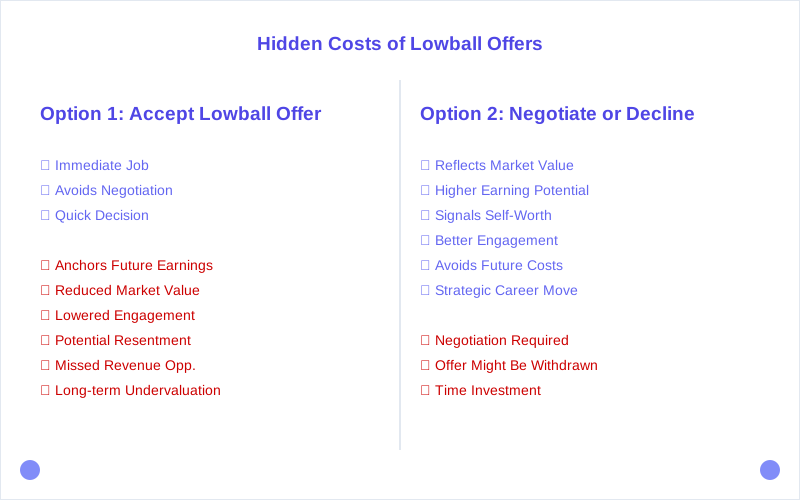
Accepting a lowball offer isn't just about the immediate financial hit; it sets a long-term precedent for your professional value.
- Your Earning Potential is Anchored: Future raises and subsequent job offers often reference your current salary, creating a ripple effect that can cost you hundreds of thousands over a career. Maryland Nonprofits highlights that taking a pay cut devalues you.
- Disengagement is a Hidden Cost: Feeling undervalued leads to decreased motivation and higher turnover. For the company, this means lost productivity and high replacement costs, often 100 percent or more of your salary.
Atmargin explains this economic reality. * Negotiation is Expected, Not Risky: Most companies anticipate negotiation. SalaryGuide states that 78 percent of new hires who negotiated received a better offer. Your fear of losing the offer is usually greater than the actual risk. * Documentation is Your Shield: Always get offers and any subsequent agreements in writing. This creates a paper trail, protecting you from misunderstandings and potential retaliation if you need to escalate.
Residency Advisor provides scripts for renegotiating. * Value Beyond Base Salary: If base salary is fixed, explore other components like sign-on bonuses, equity, PTO, or professional development funds. These often have more flexibility and can significantly increase your total compensation package. Robert Half emphasizes that flexibility and skill development can level the playing field.
Frequently Asked Questions
I'm looking at two offers: one for $85,000 with a 10 percent 401(k) match, another for $90,000 with no match. Which one is actually better?
Do I really need a formal 'market value report' from a consultant, or can I just use Glassdoor?
What if I counter, and the company rescinds the offer entirely?
Can accepting a low salary now permanently damage my future earning potential, even if I perform well?
I heard that if I negotiate, I'll seem greedy and the company won't like me. Is this true?
Sources
- How to negotiate your offer without losing the offer (The 2026 Master ...
- Robert Half Real Talk: The 2026 Salary Trends You Can't Afford to ...
- 7 Reasons Why Accepting a Low Ball Salary Offer is a Bad ...
- How to Negotiate Salary After a Lowball Offer (2026) | SalaryGuide
- The Hidden Cost of Lowball Offers: Respect in the Hiring Process
- How to negotiate your salary in 2026 with Robert Half's guide
- Lowball Offer? A Step-by-Step Script to Renegotiate Your Physician ...
- 5 Mistakes That Lead To Low-Ball Salaries - Work It Daily - WorkItDaily
- The Economics of Lowball Offers: Why Saving 10% Costs You 100%
- How to Negotiate Salary Without Losing the Offer