
The Psychological Leverage Points in Salary Negotiation (2026 Complete Guide)
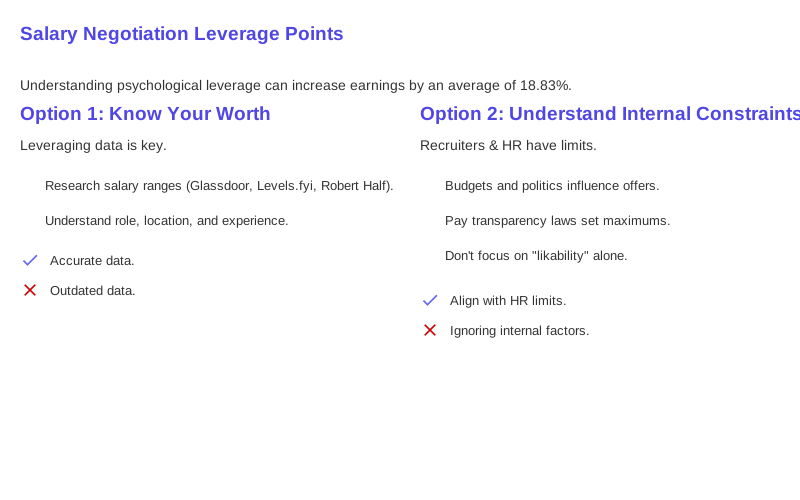
I've seen countless candidates leave 18.83 percent of their potential salary on the table because they didn't understand the psychology of leverage. That's not a guess; that's hard data from studies showing the average difference for those who negotiate versus those who don't.
I've seen countless candidates leave 18.83 percent of their potential salary on the table because they didn't understand the psychology of leverage. That's not a guess; that's hard data from studies showing the average difference for those who negotiate versus those who don't. The real cost isn't just the initial offer; it compounds into hundreds of thousands over a career. Yotru data shows candidates who negotiate earn significantly more.
The Real Answer
Recruiters and hiring managers aren't negotiating out of the goodness of their hearts; they're operating within a rigid, often arbitrary, framework of budgets and internal politics. The real answer to salary negotiation isn't about being 'assertive' or 'likable'; it's about understanding and manipulating the levers they can pull, not the ones they can't. Many people build leverage in the wrong place.


What's Actually Going On
When I was a recruiter, my 'recruiter brain' was always balancing two things: the hiring manager's desperate need for a body and HR's iron-fisted grip on the compensation bands. The salary range posted on a job description, especially in states with new pay transparency laws, isn't some aspirational goal; it's often the absolute maximum HR will approve without a fight. Robert Half's 2026 salary guide highlights these tight budgets.


How to Handle This
First, do your homework. Before you even interview, use sites like Glassdoor, Levels.fyi, and the Robert Half Salary Guide to get a realistic range for your role, location, and experience. Don't just look at the average; find the 75th percentile. That's your target.
When the recruiter asks for your salary expectations, and they will, pivot. My favorite line was always, 'I'm looking for a competitive offer that reflects my experience and the market rate for this role. What's the target salary range for this position?' This puts the ball back in their court and forces them to reveal their hand, especially in states with pay transparency laws. Yotru suggests asking about their target range.
Once you get an offer, don't respond immediately. Seriously, take 24-48 hours. This isn't about playing hard to get; it's about giving yourself time to analyze the full compensation package - base, bonus, equity, benefits. My old VP of Talent used to say, 'A rushed offer is a weak offer.'
When you do respond, always do it in writing, even if you had a phone call. This creates a paper trail. Start by expressing enthusiasm for the role and the company. Then, respectfully state your counter-offer. Be specific with your numbers. Don't say 'a little more'; say 'I'm looking for $125,000 base salary.' Leverage is built long before the offer letter.
If they push back on base salary, shift to other components. Ask about signing bonuses, additional vacation days (I once got an extra five days for a candidate), professional development budgets, or even a review in six months instead of twelve. Remember, many companies have different buckets of money. The HR policy might restrict base salary but allow for a one-time signing bonus or relocation package. These are often easier for a recruiter to get approved.
If you have another offer, use it. This is your strongest leverage. Don't lie about it, but don't be shy about saying, 'I've received another offer for $130,000, and while I'm more excited about your opportunity, I need to consider the full compensation.' This isn't being greedy; it's presenting a clear business case for why they need to pay more to get you. Leverage is built, not created on the spot.
Finally, be prepared to walk away. Seriously. If they can't meet your reasonable expectations, and you have other options, walking away is the ultimate psychological leverage. It forces them to reconsider their 'final' offer. I've seen countless times where a candidate declining an offer led to a call back within 24 hours with a better deal. They don't want to restart the hiring process, especially if they've already invested 43 staff-hours into interviewing you.


What This Looks Like in Practice
I remember one candidate for a Senior Product Manager role. Her initial target was $160,000. The company's first offer was $150,000. She had done her research and knew the market rate for her experience was closer to $165,000. She also had an active interview process for another company, though no formal offer yet. Robert Half's 2026 trends show companies being strategic with compensation.
She responded, thanking them, expressing her excitement, but stating that based on her market research and her unique skill set, she was looking for $165,000. She also casually mentioned she was 'still exploring other opportunities.' This wasn't a threat; it was a statement of fact that created a subtle sense of competition.
The recruiter came back with $155,000 and an extra 500 stock options. The candidate, knowing her true value, held firm on the base salary. She reiterated her $165,000 request, adding that the equity was a nice bonus, but the base was crucial. She even suggested a 6-month performance review with a potential salary bump, knowing the company was desperate to fill the role.
They ultimately met her at $165,000 base, kept the 500 options, and added a $5,000 signing bonus to make up for the initial gap. This wasn't about being aggressive; it was about clear communication, knowing her worth, and understanding the company's pain points. She leveraged her perceived scarcity and the cost of restarting the search. Salary negotiation is about leverage, built over time.


Mistakes That Kill Your Chances
Synectics Inc. outlines common negotiation pitfalls.
| Mistake | Why It Kills Your Chances (Recruiter POV) |
|---|---|
| Giving a specific salary expectation too early | You just anchored yourself low. My recruiter brain will target that number, not your true market value. You gave away your power for free. |
| Not doing market research | If you ask for $100,000 when the role pays $75,000-$85,000, you look out of touch. If you ask for $80,000 when it pays $110,000, you're just leaving money on the table. |
| Focusing only on base salary | Companies have different budget buckets. If base is maxed, I might have flexibility for a signing bonus, more PTO, or equity. Don't ignore the other chips on the table. |
| Being confrontational or demanding | Negotiation is a conversation, not a hostage situation. I'm looking for a team player, not someone who's going to be difficult from day one. This triggers my 'avoid at all costs' response. |
| Not getting the offer in writing | Verbal offers are meaningless. I've seen hiring managers 'forget' details. Always get the official offer letter before you even *think* about resigning from your current job. |
| Accepting the first offer immediately | This signals desperation or a lack of understanding of your worth. It also means I didn't have to work for it, which makes me wonder if I could have gotten you for less. |
| Lying about competing offers | Recruiters talk. The talent acquisition world is smaller than you think. If you get caught, your credibility is shot, and the offer will likely be rescinded. |
Key Takeaways
- Leverage is king: It's not about being a smooth talker; it's about having options or demonstrating scarcity. Build it before you get an offer. Knowing your worth and market value is crucial.
- Information is power: Research market rates. Understand the company's compensation philosophy. Know the full value of the benefits package. This reduces information asymmetry.
- Patience pays: Don't rush. Take time to evaluate offers and craft a thoughtful counter.
A quick 'yes' is a missed opportunity. * Negotiate the whole package: Base salary is just one component. Look at bonuses, equity, PTO, and development opportunities. Companies have different budget lines they can tap. * Always get it in writing: Protect yourself. Verbal agreements are unreliable in the hiring theater. My old director used to say, 'If it's not in the offer letter, it doesn't exist.'
Frequently Asked Questions
I'm seeing salary negotiation coaches online charging $500-$1,000 for a few sessions. Is that even worth it, or should I just use free online guides?
What if I have an offer for $120,000, but my dream company offers $110,000? Can I really use the lower offer to negotiate up?
What happens if I counter-offer and the company rescinds the offer entirely? Should I just accept what they give me to be safe?
My recruiter told me, 'This is the absolute maximum the company can offer.' What's the real reason they say that, and can I push past it?
I heard that if you ask for too much, you'll look greedy and turn off the hiring manager. Is it better to be conservative?
Sources
- How to Negotiate Salary with a Recruiter: A Complete Guide for 2026
- What are your salary negotiation success stories or fail-proof ...
- How to negotiate your salary in 2026 with Robert Half's guide
- Job Offer Salary Negotiation Tips That Work in 2026 - Synectics Inc.
- Salary Negotiation in 2026: What Changed and What Didn't - LinkedIn
- Salary Negotiation Strategies: Leverage Before the Offer - LinkedIn
- salary-negotiations-the-leverage-you%E2%80%99re-building-in-the-wrong-place-3380bde588fe
- Robert Half Real Talk: The 2026 Salary Trends You Can't Afford to ...