
The Hidden Costs of Accepting a Dream Job Offer (2026 Complete Guide)
I once saw a candidate turn down an offer that was 12 percent higher than their current salary because the 'dream job' felt right. They didn't realize that 'feeling right' often comes with hidden costs that HR knows all too well.
I once saw a candidate turn down an offer that was 12 percent higher than their current salary because the 'dream job' felt right. They didn't realize that 'feeling right' often comes with hidden costs that HR knows all too well. Companies don't just offer you a job; they offer a package that comes with invisible strings attached.
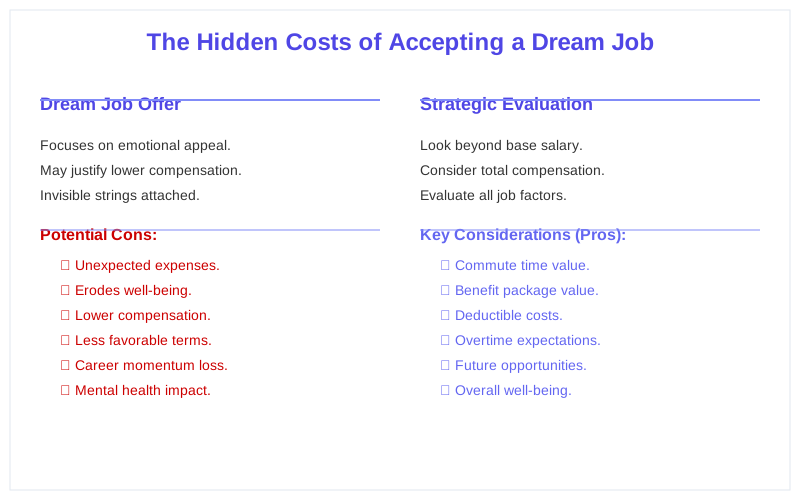
Many job seekers focus solely on the base salary, but that's just one piece of the puzzle. The true cost or benefit of a job offer extends far beyond your paycheck. It includes everything from your commute time to the actual value of your benefits package.
I've seen countless people jump into what they perceive as a perfect role, only to find themselves drowning in unexpected expenses or a work environment that erodes their well-being. This isn't about being pessimistic; it's about being strategic. As salary negotiation becomes more critical in 2026, understanding these hidden factors is your first line of defense.
A bad hire, from the company's perspective, can cost 3 to 5 times the employee's total compensation, factoring in lost revenue and team morale, according to IQ Partners. For you, the employee, a 'dream job' that sours can cost you far more than just money. It can cost you career momentum, mental health, and future opportunities.
My goal is to equip you with the knowledge to dissect an offer, not just accept it. You need to look past the shiny title and understand the actual implications of saying 'yes.' This means evaluating everything from the health insurance deductible to the unspoken expectations about overtime. This is how you protect yourself from a 'dream' turning into a nightmare.
The Real Answer
The real answer is that 'dream jobs' often leverage emotional appeal to justify lower compensation or less favorable terms. Companies know the allure of a prestigious title or a mission-driven organization. They use this to their advantage during negotiation.
It's a subtle form of leverage. When a candidate expresses strong enthusiasm, recruiters often interpret that as a willingness to compromise on other elements of the offer. This isn't malicious; it's a strategic move in the hiring process.
I've observed that companies build flexibility into compensation packages, but they won't automatically offer you the top of their range unless you push for it. Over 70 percent of hiring managers expect candidates to negotiate salary, yet many applicants don't.
Your goal is to shift the conversation from your emotional connection to the role to your objective market value. This requires research and a clear understanding of what you bring to the table. Don't let your excitement overshadow your financial and career needs.
Companies are looking to secure top talent faster and avoid reactive hiring decisions, as highlighted in Refactor Talent's 2026 hiring strategy guide. If you present yourself as a top candidate who understands their worth, they are more likely to meet your terms.
This isn't about being greedy; it's about making an informed decision that aligns with your long-term financial and professional goals. Your 'dream job' should enhance your life, not diminish it through hidden costs.


What's Actually Going On
What's actually going on when you receive a 'dream job' offer is a calculated process from the company's side. Every modern company operates within strict pay ranges tied to job levels. A recruiter cannot simply move these; HR locks them in.
These compensation bands usually have three zones: minimum, midpoint, and maximum. The minimum is rarely given unless the candidate is weak. The midpoint is the typical target, and the maximum is reserved for highly sought-after candidates, according to InterviewPal's 2026 master primer.
Another critical factor is internal equity. Your offer must make sense compared to what similar employees already earn. No manager wants to create a 'pay inversion issue' where a new hire earns more than a loyal, existing employee.
This is why some companies cap how high offers can go, not because you don't deserve more, but because paying you more would create an internal problem. This is a common HR practice to maintain fairness and prevent morale issues.
Beyond salary, consider the benefits package. A high deductible health plan, for instance, can effectively reduce your take-home pay by hundreds or even thousands of dollars annually. This is a hidden cost often overlooked.
Also, evaluate the company's culture around work-life balance. A 'dream job' with an expectation of 60-hour work weeks effectively lowers your hourly rate significantly. This isn't always explicitly stated but can be gleaned from Glassdoor reviews or during interviews.
Finally, assess the commute. An extra 30 minutes each way, five days a week, adds up to 260 hours annually. That's a significant time investment, not to mention fuel or public transport costs. These are real, tangible expenses. Future prospects and long-term earnings are impacted by these daily realities.


How to Handle This
My advice is always to approach a 'dream job' offer with the same rigor you would any other. First, conduct thorough research on salary ranges for comparable roles in your geographic area and industry. Sites like Glassdoor or LinkedIn's salary tools are a good starting point.
Don't rely on general averages; dig into specifics for companies of similar size and revenue. This data will be your foundation for negotiation. You need objective numbers, not just a gut feeling.
Next, itemize all non-salary benefits. Ask for a detailed breakdown of health insurance premiums, deductibles, 401k matching, PTO, and any other perks. Calculate the actual dollar value of these benefits.
For example, a company offering 100 percent health insurance coverage might save you $500 per month compared to one that only covers 50 percent. That's $6,000 annually in your pocket.
Put your counter-offer in writing. State your desired salary and justify it with your research and the value you bring. 'Based on my experience and market data for this role in [city], I am seeking a base salary of X.' This keeps the conversation professional and documented.
Be prepared to negotiate on elements beyond base salary. Perhaps more PTO, a signing bonus, or professional development funds are negotiable. Companies often have more flexibility in these areas than in the base salary band.
If the initial offer is a low-ball, don't be offended, but do ask if there's room to negotiate. Quora discussions suggest this is a common strategy. This starts the official back-and-forth.
Crucially, get everything confirmed in writing before accepting. A verbal agreement is not enough. Ensure the offer letter reflects all negotiated terms, from salary to benefits start dates. This is your documented record and protection.


What This Looks Like in Practice
I've seen situations where a candidate accepted a 'dream job' offer with a base salary of $90,000, believing it was a great step. However, their previous job had offered 100 percent employer-paid health insurance and a 10 percent 401k match.
The new 'dream job' offered a health plan with $600 monthly employee contributions and a 3 percent 401k match. The candidate quickly realized their net compensation was effectively $7,200 less for health insurance and thousands less in retirement savings.
Another scenario involved a candidate thrilled to join a prestigious startup for $85,000. They failed to account for the 90-minute commute each way, five days a week. This translated to 15 hours of unpaid time per week, plus $300 monthly in gas and tolls.
This meant their actual hourly rate dropped significantly, and they lost 780 hours annually to commuting. The 'dream' quickly became an exhausting, expensive reality. This is why you must calculate the true cost of your time and expenses.
I once guided an employee who received an offer for a 'passion project' role at $75,000. It was below their market value of $95,000, but the mission appealed to them. I advised them to counter, citing market data.
The company, valuing their enthusiasm, increased the base to $88,000 and offered a $5,000 signing bonus. This demonstrated the company's willingness to invest when presented with a strong, data-backed negotiation. This approach aligns with effective negotiation strategies.
These examples show that an emotional attachment to a role can blind you to financial realities. Always run the numbers. Don't let a 'dream' cloud your judgment. Your financial well-being is a critical component of any job.


Mistakes That Kill Your Chances
The biggest mistake I see is not understanding that your first offer is almost never the company's best offer. Many candidates accept immediately, leaving thousands on the table.
| Mistake | Why it Kills Your Chances | Protective Action |
|---|---|---|
| Not negotiating at all | Companies expect negotiation; you signal you undervalue yourself. | Always counter, even if it's for non-salary perks. |
| Focusing only on base salary | Ignores the total compensation package's true value. | Itemize all benefits and calculate their annual dollar value. |
| Revealing your current salary | Gives the company leverage to offer only a small bump. | State your salary expectations, not your current earnings. |
| Accepting a verbal offer | No legal standing; terms can change without documentation. | Insist on a written offer letter detailing all terms. |
| Not researching market rates | Your negotiation is based on emotion, not data. | Use salary tools like Glassdoor for your specific role/region. |
| Fearing offer retraction | The fear of 'losing the offer' is usually disproportionate to the risk. | Negotiate professionally; a good company won't retract for a fair counter. |
| Ignoring non-financial costs | Overlooks commute, work-life balance, and cultural fit. | Factor in commute time/cost, review company culture reports. |
Another common error is failing to document every interaction during the negotiation process. If you have a phone call, send a follow-up email summarizing the discussion. This creates your paper trail.
I also see candidates make the mistake of not understanding their own 'walk-away' number. You need to know your absolute minimum requirements before you even start the process. This prevents you from accepting an offer out of desperation.
Finally, don't let the phrase 'dream job' make you desperate. A company that truly values you will be willing to negotiate within reason. If they aren't, it might not be the 'dream' you imagined. Your dream job won't find itself, but it also shouldn't cost you everything.
Key Takeaways
Accepting a 'dream job' offer without scrutinizing its hidden costs is a common pitfall. My experience has shown that emotional appeal can blind even the most seasoned professionals to financial realities and critical workplace factors. Your goal should be to make an informed decision, not an impulsive one.
- Research Beyond Salary: Don't just look at the base pay. Dig into market rates for your role, location, and industry. Understand the full compensation band.
- Evaluate Total Package: Itemize and calculate the dollar value of all benefits, from health insurance to retirement contributions. Factor in commute time and expenses.
- Document Everything: Get every negotiated term in writing. A verbal agreement is not a documented record and offers no protection.
- Negotiate Strategically: Companies expect you to negotiate.
Use data, not emotion, to justify your counter-offer. Be prepared to discuss more than just base salary. * Understand Your Bottom Line: Know your 'walk-away' number. This provides a critical boundary and prevents you from accepting an offer that doesn't truly serve your long-term interests.
Ultimately, your 'dream job' should be a net positive for your life, not a drain on your finances or well-being. Protect yourself by understanding the system and leveraging its triggers. The true cost of a bad hire, for both company and employee, is always higher than the initial figures suggest. Make sure you're not that bad hire.
Frequently Asked Questions
What's the actual dollar difference between a job with a high deductible health plan versus a low deductible plan, assuming similar premiums?
Do I really need to calculate the exact dollar value of my commute time and costs?
What if I try to negotiate and the company just pulls the offer entirely?
Can accepting a lower-paying 'dream job' permanently damage my career progression or future earning potential?
I heard that if a company really wants you, they'll just offer you their absolute best from the start. Is that true?
Sources
- Job Offer Salary Negotiation Tips That Work in 2026
- Your dream job won't find itself. 🔍 Use our 2026 strategy ...
- How to negotiate your offer without losing the ...
- Your 2026 Hiring Strategy: The Ultimate Guide for ...
- Have you ever received a job offer for your dream job, but didn't take ...
- Boost Job Search Confidence with 2026 Salary Guide
- the-true-cost-of-a-bad-hire-updated-for-2026
- The True Cost of a Bad Sales Hire in 2026 (and How ...