
The Long Term Career Trajectory for AI Specialists (2026 Complete Guide)
I remember a recruiter once told me that 95 percent of organizations consider basic AI skills a hiring factor now. That sounds great on LinkedIn, right? Like just knowing how to prompt ChatGPT makes you a hot commodity. The actual job, what LinkedIn won't tell you, is that the demand for *deep* AI expertise is still rare and commands a premium.
I remember a recruiter once told me that 95 percent of organizations consider basic AI skills a hiring factor now. That sounds great on LinkedIn, right? Like just knowing how to prompt ChatGPT makes you a hot commodity. The actual job, what LinkedIn won't tell you, is that the demand for deep AI expertise is still rare and commands a premium.
You're not special for typing into a large language model; you're special if you can build one that actually solves a business problem and doesn't cost $10,000 a day to run.
The career guides out there, like Pluralsight's AI Career Guide 2025, will list five shiny paths: ML Engineer, Data Scientist, AI Researcher. They'll throw around salary ranges like '$127k to $201k' for an ML Engineer.
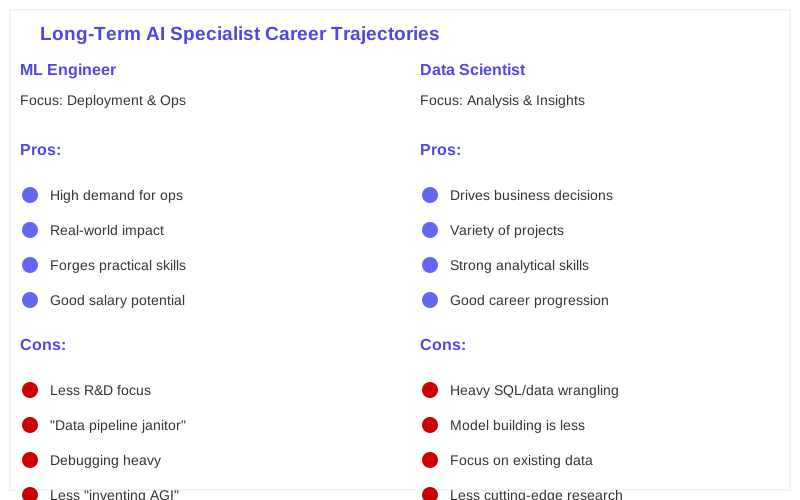
What they often skip is that the 'ML Engineer' role often means 60 percent data pipeline janitor, 30 percent debugging someone else's broken model, and maybe 10 percent actual model building.
I've seen too many bright-eyed candidates walk in thinking they'll be inventing AGI, only to find themselves knee-deep in SQL queries and Docker containers. The AI Developer 2026 mindset isn't about academic credentials; it's about operational reality.
It's about getting things to production and keeping them there, not just getting a high F1 score on a Kaggle dataset.
The unglamorous part is where the real money is made and the real skills are forged. It's not about the model accuracy graphs you see posted. It's about the late nights spent figuring out why your GPU cluster is only utilizing 43 percent of its capacity, or why your training data drifted five standard deviations last week.
That's the signal versus the hype. That's the grind.
The Real Answer
The long-term trajectory for AI specialists isn't a straight shot up the 'AI Scientist' ladder; it's a branching network of operational realities. You're either a builder, a strategist, or a bridge. The market needs all three, but your compensation and daily grind differ wildly. It's not just about technical vs. non-technical, as uCertify explains; it's about where you add tangible business value.
Builders are your ML Engineers, your AI Architects. They live in code and infrastructure.
Their trajectory involves deeper technical specialization, moving into MLOps leadership, or becoming principal engineers solving the hardest scaling problems. They optimize model inference from 100ms to 10ms and save the company millions in compute costs.
Strategists are your AI Product Managers, your AI Consultants, your Governance specialists. They translate technical capabilities into business outcomes and manage the ethical implications. Their path often leads to executive roles, shaping company-wide AI strategy.
They ensure a model's output aligns with regulatory compliance, avoiding a $5 million fine.
Then you have the bridge roles. These are often experienced software engineers who pivot into ML Engineering, or data scientists who learn deployment. Their value is in connecting the research with the reality of production systems. They prevent the brilliant-but-undeployable model from ever seeing the light of day, saving countless hours of refactoring.
The 'why' this happens is simple: AI systems are complex, multi-faceted products, not just algorithms.
A model alone is useless without data pipelines, deployment infrastructure, monitoring, and clear business objectives. ScienceDirect points out that AI actively shapes individuals' career trajectories by demanding this breadth.
The long-term career isn't about being the best at one specific algorithm. It's about understanding the entire lifecycle of an AI product and finding your niche in that ecosystem. The unglamorous part of making AI work is where the stable, high-paying jobs are.


What's Actually Going On
What's actually going on in the market is a clear bifurcation. On one side, companies are desperate for people who can productionize AI, not just prototype it. On the other, there's an explosion of 'AI-adjacent' roles that require strategic thinking rather than deep coding. The bootcamp ads promising '$200K salaries in 12 weeks' are selling a fantasy, as Towards Data Science notes.
Large enterprises, with their legacy systems and regulatory burdens, need AI Architects who understand enterprise integration.
They don't just want a fancy model; they want it to talk to their 30-year-old SAP system. This means heavy emphasis on cloud platforms like AWS, Azure, or GCP, and knowing how to secure data at scale.
Mid-sized tech companies are often looking for full-stack ML Engineers. You'll be expected to own the model from data ingestion to API deployment. This means strong Python, SQL, Docker, Kubernetes, and often a bit of front-end work to build a demo UI.
Your first PR will get rejected three times, I guarantee it.
Startups, especially the ones funded by venture capital, tend to look for 'unicorns' - people who can do everything from research to deployment. They're often less structured, but offer faster learning.
The pay might be lower initially, offset by equity that's probably worth less than the paper it's printed on until they hit product-market fit.
ATS (Applicant Tracking Systems) data often prioritizes keywords like 'Kubeflow,' 'MLflow,' 'Airflow,' and specific cloud certifications over just 'TensorFlow' or 'PyTorch.' This is the system filtering out the academic dreamers from the operational realists. You need to speak the language of deployment.
Regulatory facts are also shaping careers.
Roles in AI Governance and Ethics are emerging, especially in finance and healthcare. These aren't about coding; they're about ensuring models are fair, transparent, and compliant. Reddit discussions highlight that software architecture skills are more important than ever, especially for AI agents.
The 'AI Agent' as a standalone career path? Not really. It's an application of existing ML and software engineering principles. You're still building software, just with a more autonomous twist.
The unglamorous 80 percent of making it work involves debugging obscure API calls and managing state, not just prompting.


How to Handle This
Alright, so you want to navigate this mess. Here's how to actually do it, step-by-step, rather than just reading another 'learn Python' guide. First, identify your current skill set. Are you a software engineer? A data analyst? A researcher? This dictates your pivot strategy.
Step 1: Fill the SQL/Cloud Gap. Spend 2 months mastering advanced SQL and one major cloud provider (AWS, Azure, or GCP). Get a certification if your current role doesn't give you practical experience. This is non-negotiable.
This YouTube video on simple AI pivots emphasizes practical exposure.
Step 2: Build a Production-Ready Portfolio Project. This is where most people fail. Don't just do a Kaggle competition. Find a real-world problem, get messy data, and build an end-to-end solution. This means data ingestion, model training, API deployment (using Flask/FastAPI), and a simple UI. Spend 3-4 months on this. It needs to work.
Step 3: Learn MLOps Fundamentals. Understand Docker, Kubernetes basics, and CI/CD pipelines.
You don't need to be a DevOps engineer, but you need to speak their language. Knowing how to containerize your model and deploy it is what gets you hired for an ML Engineer role.
Step 4: Target Companies Willing to Hire for Potential. Don't exclusively apply to 'Senior ML Engineer' roles right away.
Look for 'Data Engineer with ML interest,' 'Software Engineer, ML,' or even 'Junior MLOps Engineer.' This reduces the 'pivot tax' - the initial pay cut you might take.
Step 5: Network with Operational AI Professionals. Forget the 'thought leaders' on LinkedIn. Find people actually deploying models. Ask them about their daily problems, the tools they use, and how their teams are structured. This gives you insider knowledge for interviews and tailors your resume.
The Muse highlights AI as a growing career path, but you need to know which path.
Step 6: Practice Explaining Technical Concepts to Non-Technical Stakeholders. This means translating F1 scores into 'this model will reduce customer churn by 15 percent, saving us $2 million next quarter.' The math matters less than the business impact. Spend 1 month practicing this.


What This Looks Like in Practice
Let's look at what this actually means on the ground. You're a junior ML Engineer. Your first six months aren't spent fine-tuning GPT-5. They're spent integrating a pre-trained sentiment analysis model into a customer service chatbot. This involves 70 percent API integration work and 30 percent debugging why the model misclassifies certain phrases.
A mid-level ML Engineer might be tasked with optimizing model inference latency. This isn't about new algorithms.
It's about containerizing the model, optimizing GPU usage, and setting up caching layers. We're talking about reducing a 250 millisecond response time to under 100 milliseconds for 10 million daily requests, saving the company $50,000 a month in cloud compute.
For an AI Product Manager, the job is less about code and more about defining the problem.
They spend 60 percent of their time in stakeholder meetings, translating business needs (e.g., 'we need to predict customer churn better') into technical specifications for the engineering team. They focus on metrics like 'customer retention increase by 5 percent' or 'fraud detection rate improved by 20 basis points.'
An MLOps specialist spends 8 hours a day monitoring production models. They're looking at data drift, model decay, and infrastructure health.
When a model's performance drops by 3 percent, they're the first to know and scramble to diagnose the issue, often involving rolling back to a previous version. This is the unglamorous part of keeping the lights on.
A senior AI Researcher in a big tech company might spend 80 percent of their time reading papers and prototyping novel architectures.
However, even their work is constrained by practical considerations: 'Can this be deployed on our existing infrastructure?' 'Will it scale to a billion users?' McKinsey & Company reports that AI will necessitate occupational transitions for millions; these scenarios show what those transitions look like.
These are the metrics-driven realities. It's not always glamorous, but it's where the tangible value is created and sustained. Cogent University's roadmap emphasizes problem-solving and collaboration over just coding.
Mistakes That Kill Your Chances
| Mistake | Why It Kills Your Chances | The Operational Reality |
|---|---|---|
| Focusing only on model training. | Ignores the entire MLOps lifecycle; models don't deploy themselves. | The job posting says 'ML Engineer' but 60 percent of the role is data pipeline maintenance. You will spend more time debugging Airflow DAGs and cleaning CSVs than you will building models. |
| Neglecting SQL and data engineering. | Most AI problems start and end with data; dirty data breaks models. | You will query more than you code. A mid-level ML role in 2025 requires SQL proficiency to wrangle data from various sources. |
| Ignoring communication and business impact. | Brilliant technical skills are useless if you can't articulate value. | I have seen brilliant researchers fail because they could not translate F1 scores into business impact for a VP who thinks AI is magic. |
| Only doing Kaggle competitions. | These are sanitized datasets; real-world data is a messy swamp. | Your portfolio project needs to actually work on real, messy, uncleaned data, not just a perfect dataset. |
| Believing bootcamp promises of quick riches. | Bootcamps sell a fantasy; the pivot tax is real. | Pivoting into AI from software engineering took me 8 months and a 15 percent pay cut. The bootcamp ads promising '$200K salaries in 12 weeks' are selling a fantasy. |
| Underestimating software engineering fundamentals. | AI systems are complex software products; robustness matters. | Production does not care about your Jupyter notebook. Docker, Git, and robust software development practices are essential. Your first PR will get rejected 3 times. |
These mistakes, as Research.com suggests, are common pitfalls when trying to break into AI. The unglamorous 80 percent of the role is where these gaps become glaringly obvious.
Key Takeaways:
- **Operational Skills Trump Algorithms:** Learn SQL, Git, Docker, and cloud platforms. These are the real requirements for getting models into production and keeping them there, as Ideas2IT's roadmap highlights.
- **The Pivot Tax is Real:** If you're transitioning, expect an initial pay cut or a longer job search. It's an investment in your future.
- **Communication is King:** You must translate technical metrics into tangible business value. A VP doesn't care about your AUC score; they care about reduced costs or increased revenue.
- **Embrace the Unglamorous 80 Percent:** Data cleaning, pipeline maintenance, and debugging are your daily bread. Nobody posts about that on LinkedIn, but it's where the real work happens.
- **Specialization vs. Breadth:** Decide if you want to be a deep technical expert (MLOps, AI Architect) or a bridge builder (AI Product Manager, Consultant). Both have value, but their paths diverge.
This field isn't a get-rich-quick scheme. It's a demanding, constantly evolving domain that rewards pragmatism, resilience, and a solid understanding of how to make AI actually *work* in the real world.
Frequently Asked Questions
My bootcamp instructor said I just need to know Python. Is it really worth spending $500 on a SQL course when I can just ask ChatGPT to write my queries?
Do I really need to learn Docker and Kubernetes if I'm just building models in Jupyter notebooks?
What if I build a fantastic portfolio project, but it uses a free, open-source dataset, not 'real' messy data?
Can focusing too much on MLOps and deployment skills permanently pigeonhole me away from cutting-edge research?
I heard AI is going to automate all the entry-level data jobs, so I should aim for senior roles immediately. Is that true?
Sources
- Is AI a Good Career Path? Pros and Cons to Help You Decide
- AI Developer in 2026: The Skills, Mindset, and Career Path That Will ...
- The Simplest AI Career Pivot That Actually Works in 2026 - YouTube
- Is "Ai agent" actually a standalone career path long term? - Reddit
- Roadmap to Becoming an AI Engineer in 2026 - Ideas2IT
- AI Career Roadmap 2026: How Artificial Intelligence Is Reshaping ...
- How AI is Reshaping Career Pathways | The Washington Center
- A Realistic Roadmap to Start an AI Career in 2026
- AI career paths: 2026 job guide - Pluralsight
- Navigating career stages in the age of artificial intelligence
- 2026 AI, Automation, and the Future of Intelligence Degree Careers
- AI Career Paths in 2026- Explained With Skills, Salaries & Roadmap