
The Long-term Career Impact of Early Salary Negotiation (2026 Complete Guide)
I once saw an employee leave $12,000 on the table in their first job offer. They were so afraid of appearing 'difficult' that they accepted the initial offer without a single counter. That decision didn't just cost them that year; it compounded, impacting every future raise, bonus, and even their next job offer.
I once saw an employee leave $12,000 on the table in their first job offer. They were so afraid of appearing 'difficult' that they accepted the initial offer without a single counter. That decision didn't just cost them that year; it compounded, impacting every future raise, bonus, and even their next job offer. This isn't just about a single paycheck; it's about the foundation of your entire career earnings.
MetaIntro's 2026 guide states that failure to negotiate can cost an average of $7,500 annually. Over a career, that can easily exceed $500,000.
Many early-career professionals treat salary negotiation as a discrete, confrontational event that only begins after a formal offer. This is a critical misstep. The conversation starts much earlier, and your approach sets a precedent. Synectics Inc. highlights that over 70 percent of hiring managers expect candidates to negotiate. They budget for it.
What happens in those initial salary discussions has a ripple effect. It's not just about the starting number, but how that number dictates subsequent increases, promotions, and even your perceived value within the organization. When I was in-house HR, I saw how a low starting base salary could anchor an employee's compensation for years, making it incredibly difficult to catch up to market rates.
This isn't about being greedy; it's about understanding the system. Employers typically extend offers 10-25 percent below their maximum budget, anticipating negotiation. When you don't negotiate, you're not being gracious; you're signaling that you undervalue yourself. This impacts your current compensation and creates a documented pattern of lower earnings that follows you.
The Real Answer
The long-term impact of early salary negotiation isn't just about the money you leave on the table in year one; it's about the compounding effect. Your starting salary often serves as the baseline for all future raises, bonuses, and even subsequent job offers. Companies rarely offer a 30 percent raise to bring someone up to market if their initial salary was significantly low, because it creates internal equity issues.
I've seen it countless times: an employee accepts a lowball offer, then struggles for years to get their compensation aligned with their experience. Each annual raise, typically a percentage of your current salary, further entrenches that lower base. If you start at $50,000 instead of $55,000, even a 3 percent raise means you're getting $1500 instead of $1650. That $150 difference doesn't seem like much, but it adds up over a 30-year career.
The system's triggers are set by the numbers. Your initial salary becomes a documented data point that informs every compensation decision thereafter. It's not just the immediate loss; it's the opportunity cost of what that higher base could have earned you through compounding interest, retirement contributions, and future negotiation leverage. A study revealed that individuals who negotiated their salaries after training ended up earning nearly $10,000 more annually.
Moreover, a low starting salary can impact your perceived value. If you accept the first offer without question, it can subtly communicate a lack of confidence in your worth. This perception, while not always conscious, can influence future promotion opportunities or project assignments. It moves you into the 'easy to manage' bucket rather than the 'high-value contributor' bucket, which impacts your career trajectory. Your goal is to establish your value from day one, not just accept what's handed to you.
This isn't just about money; it's about professional respect.


What's Actually Going On
Companies operate on budgets and internal compensation bands. When an offer is extended, it's usually within a pre-approved range, with room built in for negotiation. MetaIntro research indicates employers budget 10-25 percent above initial offers. If you don't negotiate, that allocated budget often just goes back into the company's pocket.
Applicant Tracking Systems (ATS) and HRIS platforms record your starting salary. This data point becomes part of your employee profile. When a manager proposes a raise or promotion, HR pulls up this history. A low starting point means every subsequent increase is calculated from that lower base, unless a significant market adjustment or promotion occurs.
Company size also plays a role. Larger companies often have more rigid compensation structures and less flexibility for individual negotiation beyond a certain band. However, even within these structures, there's usually a range. Smaller companies might have more fluid budgets but also potentially tighter overall limits. Understanding this helps you tailor your approach.
Regulatory facts, like salary transparency laws, are changing the game. Some states and cities now require companies to post salary ranges, giving you a clearer picture of what's possible. This data, such as that provided by Robert Half's Salary Guide, becomes a powerful tool in your arsenal. It removes some of the guesswork and empowers you to make data-driven requests.
Market conditions in 2026 also influence negotiation outcomes. A tight labor market with high demand for your skills gives you more leverage. Conversely, a saturated market might reduce a company's willingness to negotiate aggressively. Yotru explains that employer leverage and budget limits are key factors. Your goal is to understand these dynamics before you ever get to the offer stage, not just react to them. This is about proactive strategy.

How to Handle This
Your first step is always research, and it needs to be meticulous. Before you even interview, use sites like Glassdoor, LinkedIn, and the Robert Half Salary Guide to understand market rates for your target role, industry, and geographic location. Look for specific numbers, not ranges. MetaIntro suggests asking for '$87,000' is more effective than '$80,000-90,000 range'.
When asked about salary expectations early in the process, pivot. Don't give a number. Say something like, 'I'm more focused on finding the right fit, and I'm confident that if there's alignment, we can agree on a fair compensation package.' This keeps your cards close. If they press, state your research-backed range and immediately add, 'but I'm open to discussing the full compensation package once I understand the role's scope.'
Once you receive a formal offer, put everything in writing. Acknowledge the offer and express enthusiasm, but never accept immediately. Take at least 24-48 hours. Expressing enthusiasm before negotiating weakens your position. This time allows you to review the offer thoroughly and prepare your counter-proposal.
Your counter-proposal should also be in writing. Frame it professionally: 'Thank you for the generous offer. I'm very excited about this opportunity. Based on my research into market rates for this role and my unique qualifications, I was hoping for a base salary of [your desired number].' Reference specific data points if you have them. This is not a demand; it's a documented negotiation.
Consider the entire compensation package. If base salary isn't flexible, negotiate other components: signing bonus, stock options, PTO, professional development budget, or even a review for a raise at 6 months instead of 12. Robert Half's 2026 trends show that 83 percent of administrative and customer support leaders would offer higher pay for in-demand skills.
Document every interaction. Every email, every phone call summary. If you have a verbal agreement, send a follow-up email: 'Just confirming our conversation, we've agreed on X.' This creates your paper trail, protecting you against misinterpretations or future issues. It's your primary shield.


What This Looks Like in Practice
Imagine you're offered $70,000 for a marketing specialist role. Your research shows similar roles in your city with your experience are earning $78,000. Instead of accepting, you respond in writing, 'Thank you for the offer. I'm very excited about the role. Based on my market research for this position, I'm seeking a base salary of $78,000.' This isn't aggressive; it's data-backed.MetaIntro advises that such research creates an anchoring advantage.
If the company counters with $74,000, you have options. You could accept, or you could push for a signing bonus of $2,000 to bridge the gap, or additional PTO days. I've seen candidates successfully negotiate for 5 extra days of PTO, which has a tangible value. This is the 'interactive process' of negotiation.
Another scenario: you're offered a fantastic role, but the base salary is slightly below your target. However, the company offers excellent benefits, including 100 percent paid health insurance and a 401k match. In this case, you might accept the base salary but negotiate for a guaranteed performance review and potential raise within six months, documented in your offer letter. This protects your long-term earnings.
Early-career hires often hesitate, but 12twenty notes that many still do. Let's say you're a recent graduate. You might not have extensive experience, but you can quantify your project work, internships, and relevant skills. 'During my internship, I developed a new social media strategy that increased engagement by 15 percent.' This demonstrates value, justifying a higher ask. Your value isn't just time; it's impact.
If a company pushes back aggressively, claiming 'this is our standard offer,' you still have leverage. You can reiterate your market research and ask if there's any flexibility on other components. Sometimes, they can't move on base but can offer a professional development budget of $1,500 or a flexible work schedule. Always ask. The worst they can say is no, and you've created a documented record of your attempt.

Mistakes That Kill Your Chances
| Mistake | Impact on Your Career | Protective Action |
|---|---|---|
| Accepting the first offer immediately | Leaves significant money on the table; signals undervaluation. | Always take 24-48 hours to consider the offer and prepare a counter-proposal. |
| Not doing market research | You negotiate blindly, asking for too little or an unrealistic amount, weakening your position. | Use multiple sources (Glassdoor, Robert Half, LinkedIn) to find specific, data-backed salary ranges for your role and location. |
| Negotiating verbally only | Leaves no documented pattern; makes it easy for details to be 'forgotten' or misconstrued. | Put all counter-proposals and agreements in writing via email. Follow up verbal discussions with a clarifying email. |
| Focusing on personal needs | Sounds unprofessional and doesn't justify higher pay to the company. | Frame your negotiation around your market value, skills, and the value you bring to the company. |
| Giving a specific number too early | You might anchor yourself to a lower figure before understanding the full scope or budget. | Defer salary discussions until a formal offer is extended. If pressed, provide a researched range and pivot to the full compensation package. |
| Threatening to walk away | Can damage the relationship and lead to the offer being rescinded. It's aggressive, not strategic. | Maintain a professional, collaborative tone. Frame negotiation as a discussion about fair market value, not an ultimatum. |
| Not considering the full package | Overlooks valuable benefits that can significantly increase total compensation. | Evaluate health insurance, PTO, bonuses, stock options, 401k match, and professional development as part of the total offer. |
Many emerging professionals make these errors. Remember, negotiation is a professional conversation, not a battle. Your approach sets the tone.
Key Takeaways
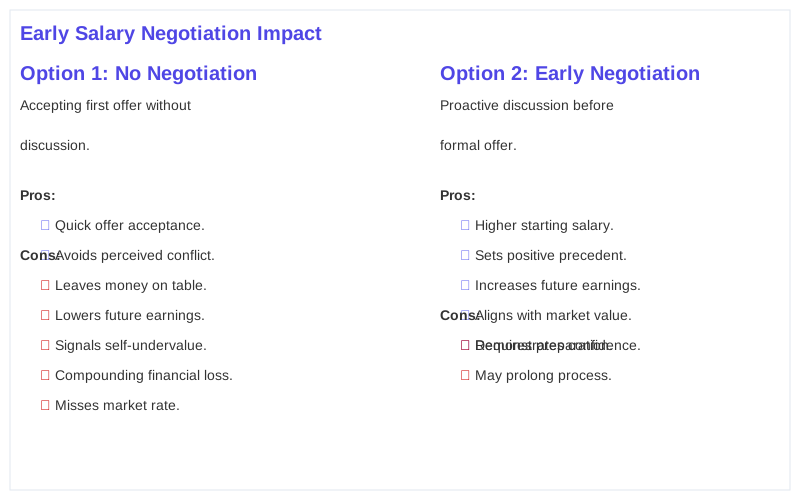
- Your initial salary choice isn't just a single transaction; it's the anchor for your entire career's earning potential. Failing to negotiate can cost over $500,000 across your working life due to compounding effects.
- Companies expect negotiation and often budget 10-25 percent above their initial offer. Not negotiating means you're leaving money on the table that was already allocated.
- Meticulous market research is non-negotiable.
Use data from reputable sources to back up your salary requests, framing your ask around market value, not personal needs. * All negotiation should be documented in writing. This creates a paper trail, protecting you from misinterpretations and establishing a clear record of your compensation discussions. Expert strategies emphasize this. * Consider the entire compensation package, not just base salary.
Benefits, bonuses, PTO, and professional development funds all have tangible value that can be negotiated if the base is firm. * Approach negotiation as a collaborative discussion, not a confrontation. Your goal is to establish your value professionally while maintaining a good relationship with your future employer. This sets a positive precedent for your career within the company.
Frequently Asked Questions
I found a salary range online, but it's really wide, like $60,000-$90,000. Do I just pick a number in the middle?
What if the hiring manager asks for my salary history? Do I have to give it?
What if I negotiate, and they withdraw the offer? Can they do that?
Can a low starting salary permanently damage my ability to earn a high income later in my career?
I heard that if I negotiate, I'll seem greedy and the company won't like me. Is that true?
Sources
- Early-Career Salary Negotiation 2025 - 12twenty
- What Are the LongTerm Effects of Salary Negotiation Training on ...
- How to negotiate your salary in 2026 with Robert Half's guide
- How to Negotiate Salary: Complete 2026 Guide (With Scripts)
- robert-half-real-talk-the2026-salary-trends
- 16 Common Mistakes Early-Career Professionals Make When ...
- Factors Affecting Salary Negotiation in the 2026 Job Market - Yotru
- Job Offer Salary Negotiation Tips That Work in 2026 - Synectics Inc.
- How to Negotiate Your Salary | Expert Strategies for 2026 Success