
The Impact of AI Resume Tools on Candidate Individuality (2026 Complete Guide)
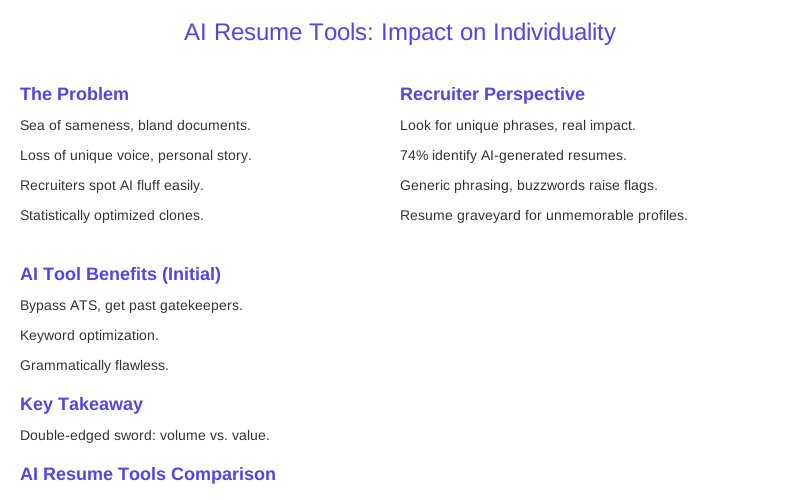
I've seen resumes that were essentially digital twins of each other, thanks to AI. Back in 2023, the average job opening was pulling in 242 applications. That's a 0.4 percent chance of even getting noticed Novorésumé's analysis . Now, with AI tools churning out perfectly keyword-optimized, grammatically flawless, yet utterly bland documents, that individuality is taking a serious hit.
I've seen resumes that were essentially digital twins of each other, thanks to AI. Back in 2023, the average job opening was pulling in 242 applications. That's a 0.4 percent chance of even getting noticed Novorésumé's analysis. Now, with AI tools churning out perfectly keyword-optimized, grammatically flawless, yet utterly bland documents, that individuality is taking a serious hit.
My 'recruiter brain' used to look for those unique phrases, that slightly off-kilter but impactful accomplishment. Something that told me a human actually did this work. Now, it's a sea of sameness.
Recruiters, myself included, are getting better at spotting the AI-written fluff. A 2026 study showed that 74 percent of hiring managers claim they can identify AI-generated resumes, especially those with generic phrasing and overused buzzwords EverydayTechy's findings via Novorésumé. It's like everyone suddenly started speaking corporate jargon, but without the actual corporate experience.
This isn't just about sounding robotic; it's about eliminating the very signals that used to make a candidate stand out. The ATS black hole might let you through, but the resume graveyard is where unmemorable, AI-scrubbed profiles go to die.
AI resume tools are designed to get past the initial digital gatekeepers, the Workday and Greenhouse parsing engines. They're good at that, no doubt. But they're also stripping away the unique voice, the personal story that grabs a human recruiter's attention, turning every applicant into a statistically optimized clone. It's a feature, not a bug, of a system optimized for volume, not value.
The Real Answer
Here's the real deal: AI resume tools are a double-edged sword. They'll get you past the ATS, but they often make you forgettable to the human on the other side. My experience configuring iCIMS and Lever systems taught me that the initial screen is all about keywords and formatting - exactly what AI excels at.
These tools optimize your resume for the ATS, ensuring it parses correctly and hits the right keywords from the job description. This is crucial because ATS platforms like Taleo or Greenhouse score resumes based on keyword density and relevance. If your resume doesn't have a 70 percent or higher match score, it often won't even make it to my screen.
However, this optimization often comes at the cost of individuality. When I'm sifting through a stack of 100 resumes for a Senior Data Scientist role, I'm looking for evidence of independent thought, specific project ownership, and a distinct career trajectory. AI-generated bullet points, while technically correct, often lack that personal touch.
It's a classic signal vs noise problem. The AI tools reduce the noise for the ATS, but they also homogenize the signal for the recruiter. You end up with a resume that's technically perfect but emotionally flat. This is why 74 percent of hiring managers claim they can spot AI-written resumes according to Novorésumé's analysis.
My recruiter brain is looking for something authentic, something that screams 'this person actually did this.' When everything reads like it came from the same corporate buzzword generator, it triggers a red flag. It tells me you're optimizing for the machine, not communicating with a human. It's the equivalent of a perfectly polished but utterly bland car. It runs, but it has no soul.
What's Actually Going On
What's actually happening when you feed your resume into an AI tool and hit 'optimize' is a complex dance between algorithms and human psychology. On the mechanical side, these tools analyze the job description and inject keywords that the ATS is programmed to detect OrionJobs explains. They'll rephrase accomplishments to match the language used in the job posting, ensuring your experience aligns perfectly with the algorithm's expectations.
For example, if a job description in Workday emphasizes 'cross-functional collaboration,' the AI will ensure your resume uses that exact phrase, rather than 'worked with different teams.' This is critical for getting past the initial automated screening, which can filter out up to 75 percent of applications before a human ever sees them.
However, this hyper-optimization can backfire. While 75 percent of HR teams report a measurable drop in screening time after adopting AI resume screening GoPerfect's research, this efficiency often comes at the expense of nuance. AI tools, especially older versions, often favor resumes tied to specific demographics, as a new study found many popular AI screeners prefer White and male candidates Fisher Phillips reports. This bias is baked into the training data.
Company size also matters. A small startup using Lever might have a recruiter who still reviews every single resume, looking for raw potential. A Fortune 500 company using Workday or Taleo, however, relies heavily on AI to manage the sheer volume. Their systems are designed to filter out anything that doesn't fit the mold.
My hiring committee dynamics also play a role. When I present a candidate, I often have to justify why this person, out of a hundred, is worth an interview. If their resume reads like a template, it's harder to make that case. The 'recruiter brain' needs a hook, a story, something beyond just keyword density.
Regulations are also starting to catch up. Some states are requiring audits of AI hiring tools to ensure fairness. But for now, the onus is on the candidate to navigate this technical minefield, making sure their application is both ATS-friendly and human-engaging. It's a tightrope walk where one misstep can land you in the resume graveyard.
How to Handle This
Okay, so you've got this AI-optimized resume that's a perfect fit for the bots, but you still need to impress a human. Here's how to navigate this mess without getting caught in the ATS black hole or looking like a generic clone.
First, use AI for the initial heavy lifting, but treat it like a dumb intern. It can help you identify keywords and structure for platforms like Greenhouse or Lever, making sure your resume actually gets parsed correctly as Daniel Kusnierik points out. But you are the editor, the one who adds the soul.
After the AI pass, go back through every bullet point and inject specific, measurable achievements. Instead of 'Managed projects,' try 'Led a 5-person team to deliver Project X 14 percent under budget and 3 weeks ahead of schedule.' My 'recruiter brain' sees numbers and instantly thinks 'impact.'
Next, craft a compelling summary or personal statement that cannot be AI-generated. This is your chance to showcase your personality and unique value proposition. Make it sound like you, not like a corporate press release. This is where you stand out from the other 241 applicants.
Consider using a professional resume writer for a final polish, but be picky. Don't just pick someone who promises 'AI optimization.' Look for a writer who understands personal branding and can articulate your unique story. Expect to pay anywhere from $300 to $1,000 for a good one. Ask them how they balance ATS compliance with human readability.
When applying, tailor your cover letter manually. This is where you can truly differentiate yourself. Reference something specific about the company or role that AI wouldn't pick up. Show you've done your homework. Even if the AI recruiter screen uses similar questions and rubrics to a human, a human always reviews outcomes Brandon Sammut notes.
Finally, use your network. A referral from an existing employee can bypass a lot of the initial AI screening. It gets your resume directly into a human's hands, often with a personal recommendation attached. That's gold.
What This Looks Like in Practice
Let's talk about what happens when your AI-scrubbed resume hits my desk for a real role, not one of those ghost jobs.
Scenario 1: Entry-Level Software Engineer (1200+ applications) * AI Impact: High. The ATS (usually Greenhouse or Lever for startups) is aggressively filtering for exact keywords like 'Python,' 'SQL,' 'AWS,' and 'React.' Your AI tool got you past this. Your resume scored 90 percent on keyword match. * Recruiter View: Your resume is one of 50 that made it through. I see perfectly formatted bullet points.
But when I look for a personal project, a unique approach to a problem, or even just a quirky hobby, it's boilerplate. You look identical to 40 other candidates. I might give you a quick 15-minute screen, but without a compelling story, you're easily forgettable.
Scenario 2: Mid-Senior Marketing Manager (300 applications) * AI Impact: Moderate. The ATS (often Workday for larger companies) is looking for specific marketing tech stack experience like 'HubSpot,' 'Salesforce Marketing Cloud,' and 'SEO strategy.' The AI ensures these are present and correctly parsed. * Recruiter View: Your resume is clean, but the accomplishments are generic. 'Increased engagement by X percent' is common. I'm looking for how you did it, the specific campaign, the creative solution.
AI tools often strip out these crucial details, leaving only the sanitized result. Automated systems achieve high accuracy rates, but can filter out strong candidates with non-traditional backstories Dishertalent points out.
Scenario 3: Executive Director (50 applications) * AI Impact: Low. At this level, human review is almost immediate. While the ATS still parses, the keywords are less about technical skills and more about leadership and strategic impact.
AI helps ensure clarity, but the 'recruiter brain' is looking for gravitas. * Recruiter View: Your AI-generated resume might be perfectly structured, but if it lacks the nuanced language of a seasoned leader, the specific challenges overcome, and a clear vision, it falls flat. I'm looking for executive presence, not just bullet points.
The best AI resume builders do far more than offer templates; they optimize for applicant tracking systems HR Future details, but they can't create a leader's voice.
Mistakes That Kill Your Chances
Let's call out some common blunders I see people making with AI resume tools. These mistakes will land you in the resume graveyard faster than a bad Yelp review.
| Mistake | Why It Kills Your Chances (Recruiter Brain Perspective) |
|---|---|
| Over-reliance on AI for content generation | Your resume sounds like everyone else's. Generic buzzwords like 'synergistic' or 'dynamic' scream 'AI wrote this.' I'm looking for specific, quantifiable achievements, not corporate jargon. The human touch is gone. |
| Not proofreading AI output | AI makes mistakes. I've seen 'Senior Manager' become 'Senior Manger.' It's a quick trip to the trash pile. It shows a lack of attention to detail, even if a robot made the error. |
| Losing your unique voice | The AI strips away your personality to optimize for keywords. Your specific project details, the 'how' behind your accomplishments, vanish. This makes you forgettable in a stack of identical resumes. |
| Ignoring the cover letter | If your resume is AI-generic, your cover letter is your last chance to show a human is behind the application. If that's also AI-generated, you've just confirmed you're a bot. |
| Using AI to exaggerate experience | AI can embellish, but I can spot a fake a mile away. If your resume says you 'spearheaded global initiatives' but your LinkedIn says 'intern,' we have a problem. This is a quick way to get blacklisted. |
| Not tailoring for *each* role | Even with AI, a one-size-fits-all resume will fail. Recruiters can tell when you've just done a quick keyword swap. My 'recruiter brain' sees through the minimal effort. |
| Focusing only on ATS keywords | While ATS compatibility is crucial, it's not the only goal. You need to get past the bot *and* impress the human. If your resume is just a keyword dump, it won't resonate. |
Job seekers with AI-assisted resumes are 8 percent more likely to be hired, receive 7.8 percent more job offers, and earn 8.4 percent higher wages Employers Council research found, but these are the ones using it smartly, not blindly.
Key Takeaways
The bottom line is this: AI resume tools are here to stay, and they're a necessary evil for getting past the initial ATS gatekeepers like Workday and Lever. They give your resume a fighting chance in the initial digital screen Novorésumé's insights.
- AI is a tool, not a ghostwriter: Use it to optimize formatting and keywords, ensuring your resume parses correctly. Don't let it write your entire story.
- Human touch is non-negotiable: Inject your unique voice, specific accomplishments, and personality back into the resume. This is what separates you from the other 200 AI-generated clones.
- Recruiters are getting smarter: We're on to the generic AI prose.
My 'recruiter brain' is constantly looking for genuine signals, not just noise. * Focus on impact, not just keywords: While keywords are for the ATS, measurable impact and unique challenges overcome are for the human. Give me numbers and stories. * Don't forget the cover letter: This is your prime real estate for showing individuality and genuine interest. Make it count. Remember, candidates prefer AI to be a supportive tool, not the sole decision maker HR Dive reports.
Navigating the modern hiring landscape means understanding both the machines and the people behind them. Use AI to open the door, but walk through it yourself. Otherwise, you'll just be another face in the resume graveyard.
Frequently Asked Questions
Should I pay $50 for an AI resume builder or $500 for a human resume writer?
Do I really need to manually edit every bullet point generated by an AI tool?
What if I use AI, get an interview, and the recruiter asks if I used AI for my resume?
Can using too much AI on my resume permanently damage my professional reputation?
Is it true that AI resume screeners are inherently biased against certain candidates?
Sources
- New Study Shows AI Resume Screeners Prefer White Male ...
- CV Writing Challenges in 2026: AI, Design, and Human Touch
- New Analysis Reveals How Job Seekers Who Use AI on Their ...
- I was skeptical about AI recruiter screens. | Brandon Sammut
- Beyond the Resume: How AI Will Help You Land the Perfect Job in ...
- In the Era of AI, Learn About the Real Candidate Behind the Resume
- Automated Resume Screening Tools vs. Human Review
- New Analysis Reveals How Job Seekers Who Use AI on Their ...
- Most job seekers say they're 'uncomfortable' with employers using AI ...
- The Best AI Resume Builders of 2026: Which One Actually Helps ...
- 10 AI Resume Screening Tools to Find Talents in 2026 | GoPerfect