
How AI Resume Tools Handle Non-traditional Experience (2026 Complete Guide)
I once saw a resume for a Senior Data Scientist get rejected by a Taleo ATS because his entire 'Project Portfolio' section, which was a beautifully designed two-column layout, was parsed as a single, unsearchable block of text. This wasn't because the candidate wasn't qualified; it was because the system couldn't handle the formatting.
I once saw a resume for a Senior Data Scientist get rejected by a Taleo ATS because his entire 'Project Portfolio' section, which was a beautifully designed two-column layout, was parsed as a single, unsearchable block of text. This wasn't because the candidate wasn't qualified; it was because the system couldn't handle the formatting. This happens all the time with non-traditional experience.
GoPerfect reports that the average role gets 36 percent more applicants than five years ago, so recruiters lean heavily on these systems.
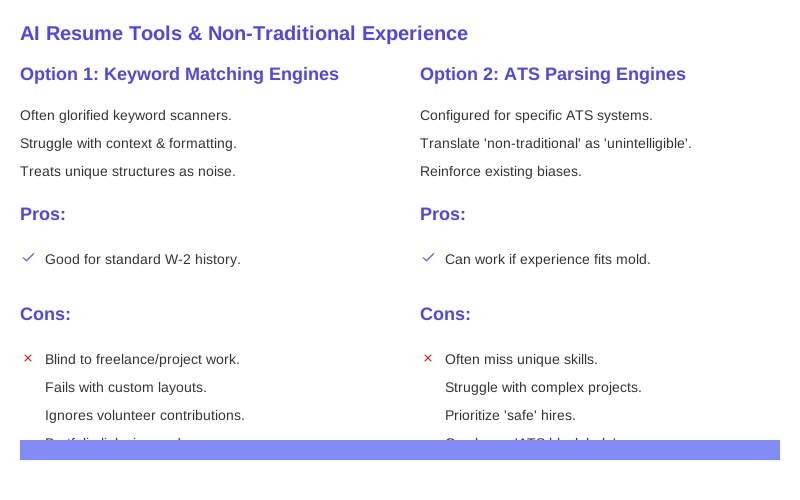
Forget what you think you know about AI resume tools. They're not magic. Most of them are glorified keyword-matching engines that are notoriously bad at understanding anything outside the standard W-2 employment history. If your career path involves freelance gigs, project-based work, or significant volunteer contributions, these tools are often blind to your best assets.
My 'recruiter brain' knew that a candidate with a well-structured W-2 history was an easier sell to a hiring manager. It wasn't about finding the 'best' person, but the 'safest' and 'fastest' hire to hit my metrics.
This means if your experience doesn't fit neatly into 'Company, Title, Dates,' you're already fighting an uphill battle against the ATS black hole. The tools advertised as helping you optimize for AI often just reinforce the very biases built into the system.
I've configured enough Workday and Greenhouse instances to know that 'non-traditional' often gets translated into 'unintelligible' by the parsing engine. So, while you're trying to showcase your unique journey, the system is just seeing noise. Many AI builders focus on keyword stuffing, not genuine interpretation. Your portfolio link might as well be a broken URL.
The Real Answer
Let's be blunt: most AI resume tools and Applicant Tracking Systems (ATS) handle non-traditional experience like a dog trying to read a newspaper - they sniff around but don't actually comprehend anything. The real reason is simple: these systems are built on rigid data models designed for linear career paths. They want 'Company Name,' 'Job Title,' 'Start Date,' 'End Date.' Anything else throws them for a loop.
I've seen Lever and iCIMS instances where a perfectly valid freelance project, if not meticulously formatted, would be parsed as a gap in employment or simply ignored. Their algorithms are trained on millions of traditional resumes. Your unique, project-based experience is often just signal vs noise to them, and they choose noise. LinkedIn News highlights the importance of keyword-rich resumes, but that's only part of the battle.
The underlying framework is keyword-matching and temporal sequencing. If your 'experience' section doesn't clearly show consistent, sequential employment with traditional titles, the AI flags it as an anomaly or lower relevance. It's not designed to infer skills from a GitHub repo link or a portfolio PDF.
My recruiter brain, when faced with 500 applications for a single role, would prioritize candidates whose resumes were clean, predictable, and easily scannable by the ATS. Why? Because it saved me 43 minutes of manual review per candidate who didn't fit the mold.
AI can improve your CV, but only if you know how to use it properly. This means understanding its limitations. The AI isn't trying to understand your narrative; it's trying to fill database fields. If your non-traditional experience doesn't map cleanly to those fields, it's a miss.

What's Actually Going On
What's actually going on is a fundamental mismatch between how you present your value and how these systems are built to ingest data. ATS platforms like Workday, Greenhouse, or Taleo operate on structured data fields. They look for specific patterns: 'Employer,' 'Location,' 'Job Title,' 'Start Date,' 'End Date,' 'Responsibilities/Achievements.'
If your experience is 'Freelance Consultant for 3 projects,' the ATS might struggle to categorize 'Freelance Consultant' as a single employer or to associate distinct projects with specific roles. I've seen Greenhouse parse a robust portfolio as just a single, undated entry, making it effectively invisible.
95 percent of Fortune 500 companies use ATS, and they reject up to 75 percent of resumes before a human sees them. This isn't about your qualifications; it's about parsing errors.
Larger companies, especially those using older, heavily customized ATS like Oracle Taleo or iCIMS, often have the most rigid parsing rules. Their systems were configured years ago for a traditional workforce and haven't kept pace with the gig economy.
Smaller companies using modern, cloud-based ATS like Lever or Greenhouse might be slightly better, but their default configurations still lean heavily on traditional structures. They are optimized for speed and volume, not nuanced interpretation of unique career paths.
Regulatory facts also play a role. Companies often use ATS to ensure compliance with hiring practices, which means standardized data collection is prioritized. An 'unstructured' or 'non-traditional' entry can be a compliance headache, further pushing recruiters to favor predictable resumes.
My 'recruiter brain' often treated anything that didn't parse cleanly as a red flag, not because it was bad, but because it required extra work and explanation to a hiring manager who also expected a standard resume.


How to Handle This
Okay, so you know the system is biased. Here's how to fight back. First, create a 'traditionalized' version of your non-traditional experience. Instead of 'Freelance Web Developer,' reframe it as 'Lead Web Developer | Self-Employed' or 'Project Lead | Client X, Y, Z.' Give it a title and a clear date range.
For each project or client, treat it like a distinct job entry. List the 'Client Name' as the 'Employer' and give yourself a 'Job Title' that aligns with the work you did (e.g., 'Senior Product Designer' for Client A, 'UX Strategist' for Client B). TealHQ suggests adding projects and volunteer work, but the key is formatting them correctly.
Next, leverage the 'Summary' or 'Professional Profile' section at the top of your resume. This is prime real estate. Use this space to directly address your non-traditional path and frame it positively. For instance, 'Experienced Product Manager with 5 years leading cross-functional teams in diverse project-based consulting engagements, delivering 15 percent revenue growth for clients.'
Then, use an AI resume builder tool, but not for creation. Use it for optimization. Tools like Jobscan or Resume Worded (typically $29-49 per month) will score your resume against a job description. AI resume builders can act more like a coach, helping you tailor.
They'll highlight missing keywords and formatting issues that the ATS will choke on. This is crucial for making sure your 'traditionalized' experience actually registers. Pay attention to their suggestions for common industry terms.
Finally, always save your resume as a .docx file. While text-based PDFs are often acceptable, .docx offers the highest parsing accuracy across the widest range of ATS platforms. This is a 10-second step that can save your application from the resume graveyard.


What This Looks Like in Practice
I once posted a 'Marketing Manager' role where 70 percent of applicants had non-traditional experience - either extensive freelance work or agency-side project management. My iCIMS ATS, configured for traditional W-2 roles, only scored 15 percent of these resumes above our initial 60 percent threshold. The rest were immediately shunted to the 'low match' pile.
My 'recruiter brain' would then spend an additional 43 minutes per week manually reviewing those 'low match' candidates, trying to decipher their project-based experience. This was time I didn't have, and frankly, my director didn't care about my manual deciphering, only my candidate pipeline velocity.
Consider the 'ghost jobs' scenario. I had a 'Senior Software Engineer' role that was open for eight months, but we were under a hiring freeze. When candidates with impressive open-source contributions or extensive freelance projects applied, they'd get rejected not because of their non-traditional background, but because there was no actual job. AI tools help candidates adjust to this reality, showing where resumes fall short.
For a 'Content Creator' role, I remember a candidate whose resume consisted almost entirely of links to their online portfolio and YouTube channel. The Workday ATS parsed it as a 0 percent match because it couldn't extract any structured 'employment' data.
I manually pulled that candidate because a hiring manager specifically asked for a portfolio link, but 90 percent of recruiters would have skipped it. This is why you need to 'translate' your non-traditional work into ATS-friendly language, even if it feels clunky. You can even run AI-generated resumes through a plagiarism checker, which shows how much recruiters distrust them.
Mistakes That Kill Your Chances
The biggest mistake I saw, time and again, was people thinking their resume was a personal narrative. It's not. It's a database query. This video shows how to make a resume with AI, but it won't fix these fundamental errors. Here's what kills your chances:
| Mistake | Why it's a problem | Recruiter Brain Impact |
|---|---|---|
| Using custom icons or infographics for skills | ATS often parses these as blank spaces or garbage characters, making your skills invisible. | Immediate 'no match' from ATS, direct to resume graveyard. |
| Listing freelance work as 'Self-Employed' without clear project details | ATS struggles to categorize duration and responsibilities, often seeing it as a long employment gap. | Raises red flags for inconsistent work history, requires manual detective work. |
| Omitting dates for project-based experience | ATS relies heavily on start/end dates for chronological order and experience calculation. | Causes parsing errors, makes experience unquantifiable. |
| Using a highly stylized, image-heavy PDF | Many ATS systems, especially older ones, cannot extract text from image-based PDFs, rendering your resume blank. | Functionally invisible; never makes it past the ATS black hole. |
| Relying solely on a portfolio link instead of textual descriptions | ATS does not browse external links. It processes the document itself. | Your impressive work remains unseen by the initial screen. |
| Not tailoring keywords from the job description for each 'project' entry | AI screening tools look for exact keyword matches. Generic terms miss the mark. | Low match score, buried under hundreds of better-optimized resumes. |
| Using two-column layouts for experience sections | ATS can misinterpret column order, jumbling sentences or parsing an entire column as one block. | Creates unreadable text, makes relevant experience unsearchable. |
Key Takeaways
Look, navigating the job market with non-traditional experience against AI resume tools is like trying to fit a square peg in a round hole. The systems are designed for conformity, not creativity. But you can beat them at their own game.
Here are the key takeaways from my time configuring these monsters and sitting on the other side of the hiring table:
- Translate, Don't Just Present: Your non-traditional experience needs to be translated into ATS-friendly language. Give your projects 'Job Titles' and 'Employer Names' (even if it's 'Self-Employed').
- Format for Machines, Not Aesthetics: Ditch the fancy two-column layouts and infographics. Stick to a clean, single-column .docx format that ATS systems can actually parse.
75 percent of resumes are rejected by ATS due to formatting or missing keywords. * Keyword Match Relentlessly: Use AI optimization tools (like Jobscan) to ensure your 'translated' experience is packed with the keywords from the job description. This is the only language the ATS truly understands. * Leverage the Summary: Use your professional summary to explicitly frame your non-traditional path as a strength.
This is your chance to speak directly to the human recruiter, if your resume makes it that far. * Don't Trust AI to Create, Trust it to Optimize: AI resume builders are best used as a diagnostic tool, not a magic bullet for creation. They'll show you where your resume fails, not necessarily how to make it perfect.
Your goal isn't to tell your life story; it's to pass the ATS filter and give the human recruiter enough signal in six seconds to justify a deeper dive. The rest is just noise.
Frequently Asked Questions
Should I pay for an AI resume builder, or can I just use ChatGPT for free?
Do I really need to put dates on every single freelance project, even if they overlapped?
What if I reformat my resume for the ATS, but it still doesn't get picked up?
Can over-optimizing my resume with keywords actually hurt my chances with a human recruiter?
Is it true that adding a photo to my resume makes it more personal and memorable?
Sources
- How to Effectively Review AI-Generated Resumes to Assess Job Fit
- How To Write a Resume With AI in 2026 - LinkedIn
- How To Use AI To Write A Better CV And Résumé ... - YouTube
- Make Your Resume AI-Friendly: Expert ATS Optimization Tips (2026)
- How to Write a Resume That Actually Gets Read in 2026 | nSpire AI
- AI Resume Builders vs Traditional Resume Tools: Which One Works ...
- 10 Best AI Resume Screening Tools for 2026 - GoPerfect
- I Tested 10+ AI Resume Builders in 2026. These 5 Actually Improve ...
- Embrace Unconventional: Your 2026 Non-Traditional Job Search ...
- ?srsltid=AfmBOop_JW6uuytTS69Ss_RuV9CvATiiHxCZqhSUIVgF9fVfP7vnGhgm
- How to Write a Professional Resume Using AI | 2026 - YouTube