
How AI Resume Tools Influence Hiring Manager First Impressions (2026 Complete Guide)
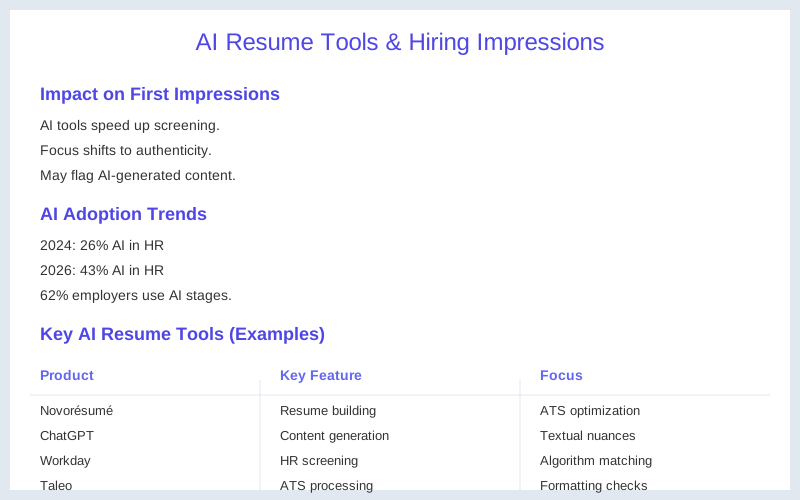
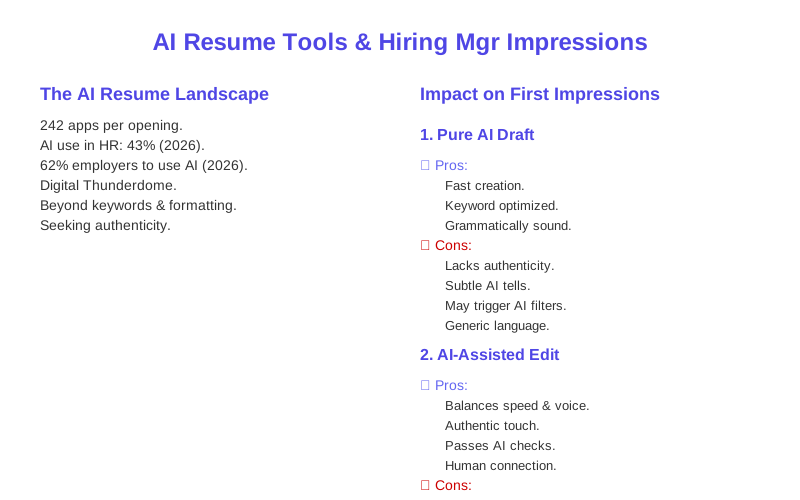
The average job opening now receives 242 applications. Let that sink in. That's a 0.4 percent chance of landing the role before you even consider the human element, and it's why everyone is scrambling for an edge with AI resume tools.
The average job opening now receives 242 applications. Let that sink in. That's a 0.4 percent chance of landing the role before you even consider the human element, and it's why everyone is scrambling for an edge with AI resume tools. I've seen this movie before, and trust me, the plot twists are getting wilder. Novorésumé analysis confirms this.
In 2026, AI use in HR tasks climbed to 43 percent, up from 26 percent in 2024. This isn't just pilot programs anymore; it's full-scale production. My old Workday system, the one I spent weeks configuring, is now likely running some flavor of AI screening, whether I like it or not. Articsledge reports that 62 percent of employers expect to use AI for most or all hiring stages by 2026.
So, when you submit a resume crafted by ChatGPT, you're entering a digital Thunderdome where algorithms are fighting other algorithms. You think your perfectly optimized resume is sailing through? Maybe. Or maybe it's hitting an AI-powered screening tool that's designed to spot other AI's fingerprints.
I remember debugging a Taleo instance where a single extra space could trash an entire 'Skills' section. Now, we're talking about AI-generated prose. The 'ATS black hole' used to be about formatting; now it's about linguistic patterns that flag your submission as low-signal.
Recruiters are getting smarter, or at least their tools are. You might get past the initial keyword scan, but the human eye - or the next layer of AI - is looking for authenticity. This isn't just about keywords anymore; it's about avoiding the subtle tells that scream 'I didn't write this.'
The Real Answer
Here's the real answer to how AI resume tools influence hiring manager first impressions: they create a false sense of perfection that often backfires. Your AI-generated resume might sail through the initial ATS, but it hits a wall when a human recruiter or a more advanced AI spots the tell-tale signs. Novorésumé data shows 74 percent of hiring managers claim they can identify AI-written resumes.
My recruiter brain, honed by reviewing hundreds of resumes daily in Greenhouse and Lever, developed a sixth sense for 'too good to be true.' Generic achievement language, overly symmetrical structures, and keyword density that feels unnatural are immediate red flags. BridgeViewIT calls these out as common AI patterns.
These red flags trigger a deeper, often skeptical, review. Instead of seeing a polished candidate, the hiring manager sees a potential time-waster who might be overstating their abilities or, worse, misrepresenting themselves. It's a signal vs noise problem, and AI often adds to the noise.
Companies like Mokka are even building in integrity checks. They don't just review resumes; they enrich profiles with third-party data and automated pre-screening interviews. If your AI-crafted resume doesn't align with these checks, you're flagged. Mokka's process specifically looks for mismatches.
So, while AI can get you past the initial gatekeepers by optimizing for keywords, it can also create a 'hiring theater' where you're playing a role the AI wrote, not one based on your authentic experience. The real reason this matters is that trust is essential, and AI can erode it before you even get a phone screen. Everworker emphasizes defining job-relevant criteria for AI screening.
The goal isn't just to get through the system; it's to make a genuine, positive impression. AI can help with efficiency, but it can't replace authenticity. When my team used HireVue for initial screenings, we'd still look for genuine responses, not perfectly rehearsed AI-generated answers.
What's Actually Going On
What's actually going on is a multi-layered dance between your AI-optimized resume and the company's AI-driven screening tools. First, there's the Applicant Tracking System (ATS) parsing behavior. Most modern ATS platforms like Workday, Greenhouse, or iCIMS use natural language processing (NLP) to extract information. Articsledge explains how these systems automate parts of recruitment.
AI resume tools excel at keyword identification and phrasing optimization, making your resume 'ATS-friendly.' This is critical for getting past the initial automated filter, which often scores resumes based on keyword match percentage. Novorésumé finds AI can provide a measurable advantage here.
However, the next stage involves more sophisticated AI, often integrated with or layered on top of the ATS. These tools, like those from GoPerfect or Eightfold, are designed to identify patterns indicative of AI generation. They look for generic language, a lack of specific metrics, and overly polished, uniform phrasing. GoPerfect lists several such tools.
Company size also matters. Smaller companies often rely more on manual recruiter review, where the human eye is the primary AI detector. Larger enterprises, especially those with high volume hiring, are more likely to deploy advanced AI screening tools that can spot subtle AI fingerprints. SHRM advises hiring managers to use a discerning eye.
Regulatory facts are also coming into play. New York City's Local Law 144, for example, requires annual bias audits for AI hiring tools. This pushes companies to use more transparent and explainable AI, which can ironically make it easier for them to detect AI-generated resumes. JD Supra details these practices.
My job as a recruiter involved identifying signal vs noise. An AI-generated resume, while technically perfect, can often lack the genuine 'voice' or specific details that make a candidate stand out to a human. This pushes it into the 'maybe later' pile, or worse, the resume graveyard. BridgeViewIT notes that the goal is to spot low-signal applications early.
How to Handle This
Alright, so you've realized that just hitting 'generate' in ChatGPT isn't the magic bullet. Here's how to handle this without landing your resume in the 'hiring theater' pile.
First, focus on what AI is good at: keyword optimization. Use AI tools to identify the most relevant keywords from the job description and industry trends. Integrate these naturally into your resume, especially in your 'Experience' and 'Skills' sections. Novorésumé analysis highlights the advantage here.
Next, critically edit for generic phrasing. AI loves words like 'leveraged,' 'optimized,' and 'streamlined.' These are fine in moderation, but a resume full of them sounds like a robot wrote it. Replace these with concrete actions and quantifiable results. Don't tell me you 'optimized processes'; tell me you 'reduced process time by 15 percent using Python scripts.' Forbes stresses that editing is key.
Third, personalize every single application. This means tailoring your summary, relevant experience, and skills section to each specific job description. Don't just swap out the company name. My recruiter brain could spot a generic resume from a mile away in Lever, even if the keywords were present.
Fourth, inject your unique voice and specific details. Mention actual tools, specific projects, challenges you overcame, and lessons learned. This is where AI struggles. A resume that talks about a specific bug you squashed or a client you saved from a meltdown shows genuine experience. BridgeViewIT points out that missing failure and learning signals are red flags.
Fifth, use AI for brainstorming, not final drafting. Think of it as your research assistant. Ask it to generate bullet points, alternative phrasings, or even cover letter ideas. Then, take its output and rewrite it in your own words, adding your unique experiences and personality.
Finally, get a human to review it. A fresh pair of eyes can catch awkward phrasing or AI tells that you might miss. This final human check is crucial for ensuring your resume comes across as authentic and compelling, not just technically perfect. This is the difference between getting an interview and ending up in the resume graveyard.

What This Looks Like in Practice
Let's look at what this actually looks like when your resume hits my desk, or more likely, the ATS first.
Scenario 1: High-Volume Entry-Level Role (e.g., Sales Development Rep) My iCIMS system is set to filter for 80 percent keyword match and specific degrees. An AI-generated resume, perfectly optimized, sails through this. It gets a score of 95 percent. But then it hits my desk. I see 'leveraged synergy' three times in the first paragraph. That's a 3-second mental red flag for me. It screams 'generic.' The candidate gets a low priority, even with the high ATS score.
Google's recruiter Olga notes red flags.
Scenario 2: Mid-Level Software Engineer (e.g., Python Developer) Your resume, AI-assisted, lands in Greenhouse. It uses all the right keywords: 'Django,' 'AWS Lambda,' 'Docker.' It scores 90 percent. But the experience section talks about 'cloud platforms' and 'data pipelines' without naming specific services or architectural patterns. My hiring manager immediately flags it. He wants to know if you used S3 or DynamoDB, not just 'cloud storage.' This is a specific pattern BridgeViewIT identifies.
Scenario 3: Senior Product Manager An AI-crafted resume for this role might have flawless structure and buzzwords. It passes the initial screen on Lever. But when it gets to the hiring committee, they're looking for evidence of strategic thinking, trade-offs made, and specific outcomes. An AI resume often lacks the narrative depth. It doesn't tell a story of why a decision was made, only what was done. This lack of nuance is a massive signal vs noise issue.
Peoplebox discusses how AI screens for skills and patterns.
In all these cases, the AI resume gets past the initial automated gate, but then it struggles with the human or more advanced AI review. It creates a good first impression for a machine, but a lukewarm or suspicious one for a human.
Mistakes That Kill Your Chances
There are plenty of ways to screw this up, even with AI in your corner. Here are the mistakes that will land your resume in the resume graveyard faster than you can say 'synergy.'
| Mistake | Why it Kills Your Chances (Recruiter's View) |
|---|---|
| 1. Over-reliance on generic AI templates | Your resume looks identical to 50 others. My recruiter brain sees a pattern, not a person. It screams 'low effort.' Novorésumé confirms 74 percent of hiring managers spot AI-written content. |
| 2. Neglecting human editing for flow and tone | AI-generated text often has an unnatural cadence or uses overly formal language. It lacks personality, which is crucial for soft skills roles. |
| 3. Stuffing keywords without context | You've crammed 'machine learning' 10 times, but without concrete project examples, it's just noise. ATS might like it, but I won't. |
| 4. Lack of quantifiable achievements | AI might give you 'improved efficiency,' but without numbers (e.g., 'reduced costs by 20 percent'), it's fluff. My hiring managers demand metrics. |
| 5. Inconsistent seniority or experience | AI might make a junior sound like a principal engineer, but the dates or scope don't match. This is a massive red flag for misrepresentation. BridgeViewIT highlights this. |
| 6. Omitting personal projects or unique interests | These are the details that show passion and initiative, which AI often skips. They help me see you as more than just a resume. |
| 7. Ignoring company culture/values in phrasing | A generic AI resume won't adapt to a company's specific values. If the job description emphasizes 'collaboration,' your AI resume should reflect that subtly. |
| 8. Using outdated AI-generated buzzwords | AI models trained on older data might suggest buzzwords that recruiters are now tired of seeing. It makes you look behind the curve. |
Key Takeaways
Look, AI is here to stay in the hiring process. The days of a purely human review are largely behind us, especially in high-volume environments. But that doesn't mean you just hand over the reins to ChatGPT and hope for the best.
-
AI for the machine, human for the human: Use AI tools to ensure your resume is ATS-friendly and passes the initial automated filters. This is non-negotiable for getting your foot in the digital door. Interviewer.AI notes AI eliminates bottlenecks like resume screening.
-
Authenticity is your trump card: Once past the initial AI screen, your resume needs to resonate with a human. This means injecting your unique voice, specific accomplishments, and genuine experiences. Generic AI language is a death sentence here. SHRM advises hiring managers to use a discerning eye for AI-written resumes.
-
Edit, edit, edit: Treat AI as a powerful assistant, not a ghostwriter. Review every word, ensuring it accurately reflects your skills and personality. Remove any tell-tale signs of AI generation, like repetitive phrasing or vague achievements.
-
Understand the 'Why': Recruiters and hiring managers are looking for signals of genuine fit and capability, not just keywords. Your resume needs to tell a compelling story that AI alone cannot craft. My goal was always to find a plausible person, not just a perfect document. Peoplebox shows AI screening for role relevance and patterns.
Don't let AI turn your job search into a 'hiring theater' where you're just a prop. Use it smartly to get noticed, then let your real self shine through.
Frequently Asked Questions
Is it worth paying $50 for a professional AI resume builder, or can I just use ChatGPT?
Do I really need to worry about AI detection if I just use it for a few bullet points?
What if I use AI, edit it heavily, and still get rejected? Does that mean I'm just a bad writer?
Can using AI on my resume permanently damage my reputation with a company?
I heard that AI resume tools actually increase your chances of getting an interview by 30 percent. Is that true?
Sources
- How Job Seekers Should Use AI To Get A New Job In 2026 - Forbes
- A recruiter's perspective on resumes | AI for Students | Google
- Top 10 AI Tools for Resume Screening in 2026 - GoPerfect
- AI-Written Resumes: Use a Discerning Eye, Hiring Managers Advise
- 7 Best Practices for Employers Using AI Resume Screeners | JD Supra
- The Ultimate Guide to AI in Recruitment (Updated 2026)
- Spot AI-Generated Resumes in Tech Hiring (2026) - Red Flags
- New Analysis Reveals How Job Seekers Who Use AI on Their ...
- AI in Hiring: How It Works in 2026 - Articsledge
- AI Resume Screening 2026: A Practical Guide for Hiring Teams
- AI Recruiting Platform Comparison: 15+ Tools Evaluated (2026)
- How AI Resume Screening Outperforms Manual Review in Recruiting