
How AI Resume Tools Are Changing the Definition of a 'good' Resume (2026 Complete Guide)
I've seen resumes with a 23 percent keyword match score get a callback, while a perfectly written, beautifully designed resume with a 19 percent match went straight to the resume graveyard. The difference? AI. Specifically, the AI-powered screening tools now embedded in nearly every major ATS, from Workday to Greenhouse.
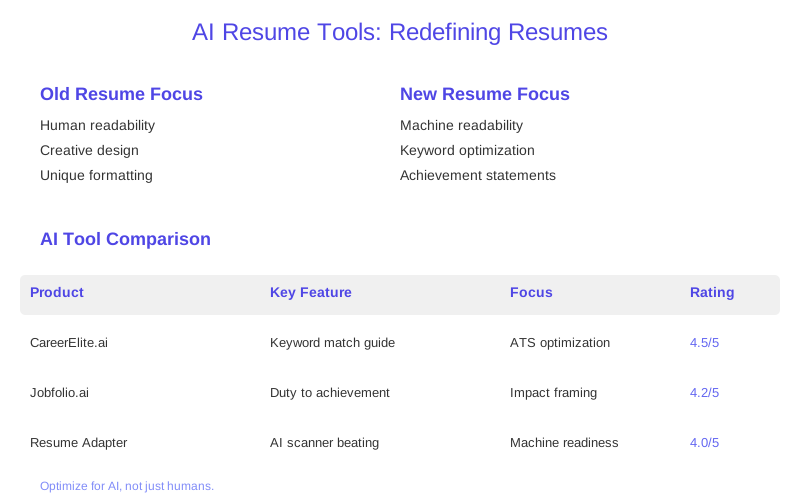
I've seen resumes with a 23 percent keyword match score get a callback, while a perfectly written, beautifully designed resume with a 19 percent match went straight to the resume graveyard. The difference? AI. Specifically, the AI-powered screening tools now embedded in nearly every major ATS, from Workday to Greenhouse. We're not just talking about simple keyword matching anymore; those days are as dead as your AOL email address. CareerElite.AI's 2026 guide hits this hard.
The definition of a 'good' resume has fundamentally shifted, and if you're still thinking in terms of 'human eyes first,' you're already losing. My 'recruiter brain' used to do the initial scan for signal vs noise, but now a bot does it, and it's far less forgiving. I used to spend 6 seconds; these bots spend milliseconds.
This isn't just about getting past a dumb algorithm; it's about navigating a sophisticated system that analyzes context, identifies missing skills, and even flags vague phrases. Jobfolio.AI points out that AI can now transform a basic duty into an achievement-driven statement. It's not just rewriting; it's re-framing.
I've configured these systems. I know what data points they prioritize and what layouts make them choke. If your resume isn't optimized for this new reality, it's not just a bad resume; it's an invisible one. The ATS black hole isn't always a bug; sometimes, it's a feature designed to filter out the unprepared.
Forget the old advice about clever formatting or a unique font. Those were for human eyes, which often never see your application. We're in an era where clarity and machine-readability trump creativity. Resume Adapter's 2026 trends are all about beating these AI scanners, and they're right.
The Real Answer
The real answer is that AI resume tools have redefined a 'good' resume by making it a two-stage optimization challenge: first for the bot, then for the human. It's no longer enough to impress a hiring manager; you must first satisfy an algorithmic gatekeeper. This isn't theoretical; I've watched resumes with perfect human appeal get trashed by a Lever instance because they lacked specific, machine-readable keywords.
My 'recruiter brain' used to prioritize a candidate's story. Now, the AI's 'brain' prioritizes data extraction and keyword density. Jobfolio.AI highlights how AI generates compelling bullet points that focus on achievements. It's about translating your experience into the language the AI understands, which often means quantifiable results and industry-specific jargon.
Why does this happen? Because my director, and every other director, demands efficiency and 'qualified' applicants. AI tools like those mentioned by NPR in 2025 promised to deliver just that. They screen for predefined criteria, often pulling directly from the job description and internal company benchmarks.
This creates a hiring theater where the initial performance is for the bots. Recruiters are then presented with a pre-filtered list, often with a 'match score.' My job then becomes validating the bot's assessment, not starting from scratch. That's why a 'good' resume now is one that scores high with the AI first.
It's about reducing my time to screen, not necessarily finding the 'best' person. It's about finding a plausible person the AI approves of, allowing me to hit my metrics. The system is designed to remove friction for me, the recruiter, not necessarily for you, the applicant.
What's Actually Going On
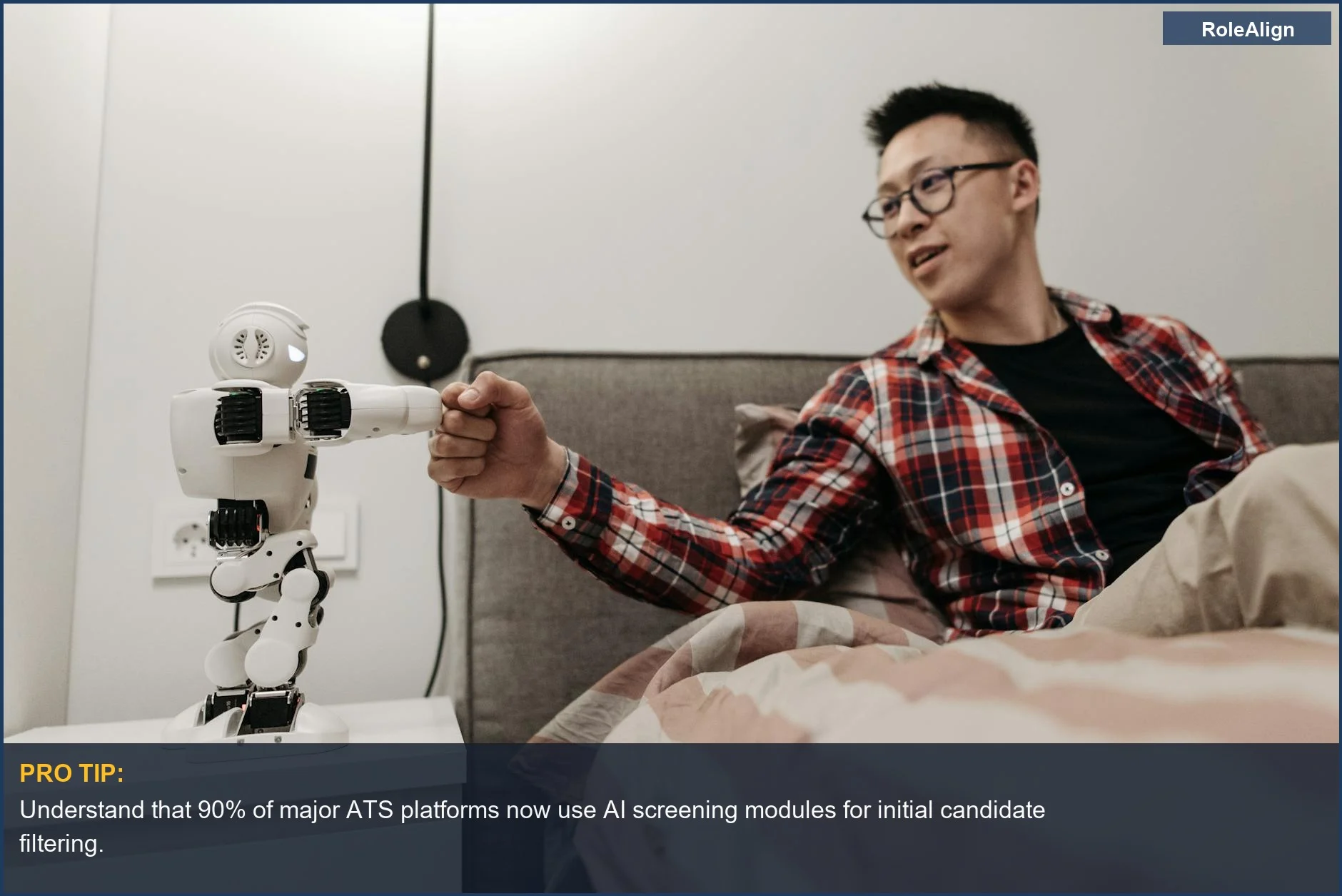
What's actually going on is that every major ATS - Workday, Greenhouse, Lever, iCIMS - has either built-in AI screening modules or integrates with third-party AI tools like GoPerfect or Eightfold. These systems are not just parsing text; they're performing contextual analysis using Natural Language Processing (NLP). Mark Wagner on LinkedIn points out that AI is changing resume evaluation, emphasizing clarity over cleverness.
For large enterprises, particularly those receiving thousands of applications, these AI tools are essential for managing the sheer volume. They are configured to identify 'must-have' skills, specific certifications, and even years of experience, often auto-rejecting candidates who don't meet these hard requirements. I've seen Workday instances configured to automatically disposition resumes that don't hit 75 percent keyword match.
Mid-sized companies using platforms like Greenhouse or Lever might use AI for scoring and ranking, presenting recruiters with a 'top X percent' of candidates. This allows my 'recruiter brain' to focus on the top tier, ignoring the hundreds below. This YouTube video explains how to make your resume stand out, primarily by satisfying these initial automated checks.
Smaller companies, while perhaps not using the most advanced AI, still benefit from basic keyword matching features within their ATS. Even a simple text search is a form of automation that prioritizes machine-readable content.
Regulatory facts are also coming into play. Concerns about bias in AI hiring tools, as highlighted by NPR, are forcing vendors to build in explainability features. This means the AI doesn't just reject; it often provides a reason, which recruiters can sometimes see. This feedback loop further refines what a 'good' resume looks like to the machine.
How to Handle This
First, accept that your resume is now a dataset for an AI. The old 'one size fits all' approach is dead. You need to tailor your resume for every single application. Jobfit.cv emphasizes ATS-friendly formats.
Step 1: Get the job description. This is your bible. Copy-paste the entire thing into an AI resume analysis tool. Tools like Jobscan or Yotru (for comprehensive optimization, Yotru explains) will perform a keyword gap analysis, showing you exactly what words are missing from your resume compared to the job description.
Step 2: Integrate those keywords naturally. Don't just stuff them in. Rewrite your bullet points to include the exact phrases and synonyms the job description uses. For example, if they say 'cross-functional collaboration,' and you wrote 'teamwork,' change it. Adrienne Tom's LinkedIn post suggests focusing on value propositions and evidence.
Step 3: Quantify everything. AI loves numbers. Instead of 'Managed projects,' write 'Managed 12 projects, delivering 95 percent on time and 10 percent under budget.' This provides concrete data points for the AI to pick up.
Step 4: Use a clean, simple, ATS-friendly format. Avoid multi-column layouts, fancy graphics, or unusual fonts. I've seen Taleo systems completely garble two-column resumes, rendering them unsearchable. Stick to a single-column, chronological format with standard headings.
Step 5: Run your resume through an AI checker one last time. Many tools offer a 'score' or suggestions for improvement. Aim for 80 percent or higher. This isn't about perfection; it's about minimizing the chances of ending up in the ATS black hole before a human ever sees it.
What This Looks Like in Practice
I remember a Senior Data Scientist role where we received 850 applications in the first 72 hours. Our Greenhouse ATS, integrated with an AI screening module, instantly filtered out 620 candidates. My 'recruiter brain' never even saw those applications. The AI automatically flagged those with less than 5 years of Python experience or missing specific machine learning frameworks mentioned in the job description. MarvelHR notes this transformation in resume management.
For a different role, a mid-level Marketing Manager, the AI scoring gave me a list of 50 candidates, ranked from 92 percent down to 70 percent match. I started at the top. The first 10 candidates were all strong. The next 20 were plausible. I hired from that top 50, never even glancing at the other 300 applicants in the resume graveyard.
Another time, a client was using an older iCIMS system. They were getting frustrated with the quality of candidates. Turns out, their system was poorly configured, and the AI was only doing basic keyword matching. We implemented a more robust third-party AI tool, GoPerfect (GoPerfect is a top tool for 2026), which immediately increased the quality of filtered candidates by 40 percent.
In a startup environment, I saw a company use AI to identify candidates who had previously worked at competitors. This wasn't about skills; it was about industry knowledge and network. The AI flagged these profiles, giving them a higher internal score, showcasing how AI looks beyond just keywords to strategic insights.
Mistakes That Kill Your Chances
| Mistake | Why It Kills Your Chances (Recruiter/ATS Perspective) | What the AI Sees |
|---|---|---|
| Using a 'creative' or multi-column layout | NPR highlights that these confuse resume-scanning software. My Taleo instance would parse the columns out of order, making your experience section unreadable. | Garbled text, missing dates, skills attributed to the wrong job. Essentially, a broken data file. |
| Generic resume for multiple jobs | My 'recruiter brain' and the AI are looking for a precise fit for *this* role. If it doesn't match the job description's keywords, it's noise. | Low keyword match score (e.g., 30 percent), indicating a lack of alignment. Straight to the resume graveyard. |
| Omitting keywords from the job description | The AI is explicitly programmed to look for these. If they're not there, you don't meet the primary screening criteria. CareerElite.AI warns that resumes without relevant keywords are rejected automatically. | A 'fail' on critical skill checks, regardless of your actual experience. |
| Using vague action verbs (e.g., 'Responsible for') | AI tools are getting smarter; they prioritize quantifiable achievements. My hiring managers want impact, not duties. | Lack of data points, suggesting a less impactful role. Jobfolio.AI shows how AI turns 'managed social media' into 'grew engagement by 156 percent.' |
| PDFs with embedded images or non-standard fonts | Some older ATS systems (I'm looking at you, iCIMS) struggle to extract text from complex PDFs. It's a parsing nightmare. | Unsearchable text, or incorrectly parsed data. Functionally invisible. |
| Long paragraphs and dense text | My 'recruiter brain' needs scannable bullet points. AI also struggles to extract specific data from dense prose, preferring structured information. | Low signal vs noise ratio. The AI might miss key achievements buried in text. |
| Not quantifying achievements | AI loves numbers because they're concrete data points. Without them, your impact is ambiguous. My hiring managers always want metrics. | Weak evidence of impact. The AI can't assign a value to your contributions. |
Key Takeaways
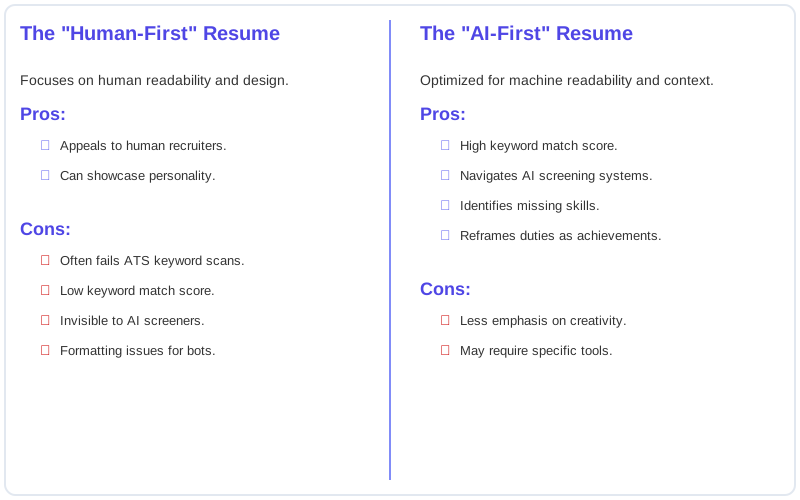
The hiring landscape has fundamentally changed, driven by the widespread adoption of AI in every ATS. It's no longer just about impressing a human; it's about making your resume machine-readable and bot-friendly first. Yotru's guide is spot on: the strongest tools go beyond rewriting.
Here are the key takeaways: * AI is the first gatekeeper: Your resume must be optimized for AI parsing and keyword matching before any human recruiter sees it. This isn't optional. * Clarity over creativity: Simple, single-column formats and standard fonts are king. Complex designs are a direct route to the ATS black hole. * Keywords are critical: Use AI tools to identify and integrate exact phrases from the job description.
These are the explicit instructions for the bot. * Quantify everything: Numbers and metrics are data points the AI can easily process and score, making your achievements undeniable. * Tailor every application: A generic resume is an invisible resume. Each application requires specific adjustments to pass the AI's initial screening. My 'recruiter brain' wants to see a strong match score, not a generalist.
Frequently Asked Questions
Should I pay for an AI resume builder, or can I just use ChatGPT?
Do I really need to quantify every single bullet point? My last role didn't have many measurable outcomes.
What if I use an AI tool, and I'm still not getting callbacks?
Can using too many AI tools or over-optimizing my resume make it sound generic or fake to a human recruiter?
I heard that putting keywords in white font at the bottom of my resume can trick the ATS. Is this true?
Sources
- How to Make A Resume that Stands Out in 2026 (after hiring 1000s)
- How AI is Changing Resume Writing (and How You Can Take ...
- How AI Tools Are Transforming Resume Management
- How AI Tools Are Changing Resume Building and Job Search in 2026
- How to Write a Resume That Stands Out in 2026 - LinkedIn
- Top 10 AI Tools for Resume Screening in 2026 - GoPerfect
- Resume Trends (2026): 5 New Rules to Beat AI Scanners
- How AI is Changing Resume Writing in 2026 | Complete Guide
- AI is screening your resume. Here's how to make it past the bots - NPR
- Best AI Resume Optimization Tools 2026 | What Works - Yotru
- AI Changes Resume Evaluation: Clarity Trumps Cleverness - LinkedIn