
The Hidden Costs of a Poorly Optimized Linkedin Profile (2026 Complete Guide)
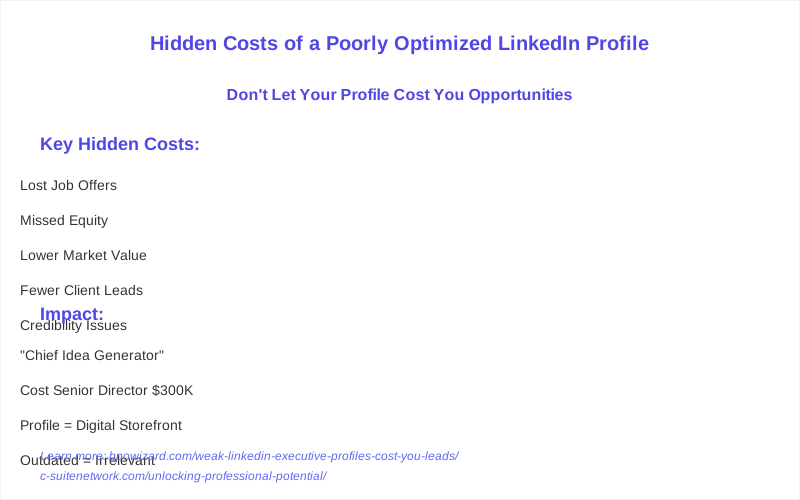
I once saw a Senior Director of Product lose out on a $300,000 equity package because their LinkedIn profile listed their last job title as 'Chief Idea Generator.' The hiring committee, a notoriously conservative bunch, thought it was a joke.
I once saw a Senior Director of Product lose out on a $300,000 equity package because their LinkedIn profile listed their last job title as 'Chief Idea Generator.' The hiring committee, a notoriously conservative bunch, thought it was a joke. Your LinkedIn profile isn't just an online resume; it's your digital storefront, and if it's got cobwebs, you're losing business and opportunities you don't even know exist.
Weak LinkedIn Executive Profiles Cost You Leads, especially in a market where every signal is scrutinized.
Most people treat LinkedIn like a 'set it and forget it' chore from 2015. They slap on an old resume, maybe update their job title once a year, and then wonder why recruiters aren't beating down their door. This isn't just about looking for a new job; it's about your professional credibility and market value, whether you're actively searching or not.
Recruiters, hiring managers, and even potential clients are running background checks on you before they ever pick up the phone. An outdated profile screams 'irrelevant' louder than any carefully crafted cover letter. It suggests a lack of current market engagement, which is a red flag for anyone assessing your bench strength or operational risk. The Hidden Costs of a Neglected LinkedIn Profile are real and measurable.
I've configured enough Workday and Greenhouse instances to know that a recruiter's first step is almost always a LinkedIn search. If your profile doesn't immediately validate what's on your resume, or worse, if it's completely missing key skills, you're instantly filtered out. My 'recruiter brain' couldn't afford to dig for gold in a dusty mine when I had 40 other candidates with polished profiles.
This isn't some abstract concept; it's about real money and real opportunities slipping through your fingers. LinkedIn's own research shows profiles with optimized headlines get 5x more profile views. That's not a suggestion; it's a data point screaming at you to pay attention. Your profile needs to work for you 24/7, attracting high-quality leads and opportunities, not just existing in the ether.
The Real Answer
The real reason a poorly optimized LinkedIn profile costs you opportunities boils down to a fundamental mismatch between how you perceive your profile and how the modern hiring ecosystem actually uses it. You think it's a static resume; I know it's a dynamic search engine and a credibility filter. Job seekers absorb the cost instead, applying into a system with low signal and almost no transparency.
First, there's the 'ATS black hole' equivalent for LinkedIn: the search algorithm. Recruiters on LinkedIn Recruiter don't just browse; they run highly specific boolean searches for keywords, titles, and skills. If your profile isn't stuffed with the right industry jargon and job-specific terms, you simply won't appear in those searches. My Workday searches were brutal, but my LinkedIn Recruiter searches were even more targeted.
You're optimizing for the wrong part of the process if you think a pretty profile is enough.
Second, it's about the recruiter workflow and attention span. When I found a candidate on LinkedIn, my 'recruiter brain' needed immediate validation. I'd scan the headline, the 'About' section, and the last two job titles. If those didn't align with my search criteria or if they were vague, you were scrolled past in under 3 seconds. There's no time for nuance when I'm juggling 20 open requisitions.
Third, it's the 'hiring committee dynamics' and the unspoken rules of professional validation. Your LinkedIn profile is often the first, and sometimes only, public-facing representation of your professional brand. If it looks neglected or unprofessional, it raises questions about your attention to detail, your current market engagement, and even your overall professionalism.
Finally, it's about the 'resume graveyard' effect. Even if you apply through an ATS like Lever or Greenhouse, I'm almost always going to cross-reference your application with your LinkedIn. If your LinkedIn is a barren wasteland compared to your resume, it creates doubt. I'll wonder if you're embellishing or if your profile is simply out of date. It's faster to move on to the next candidate than to try and reconcile discrepancies.
What's Actually Going On
What's actually going on is a multi-layered failure in how people present themselves versus how the system operates. Your LinkedIn profile isn't just a digital business card; it's a critical data point for every stage of the hiring and networking funnel. Clear positioning, not job titles, is key.
ATS Data & Recruiter Search Logic: LinkedIn Recruiter, the tool I used daily, is essentially a specialized search engine. It indexes every word on your public profile. If your headline, 'About' section, and experience descriptions don't contain the exact keywords for the roles you're targeting, you're invisible. My searches for 'Senior Product Manager, SaaS, AI/ML, Growth' would yield thousands of results, but only those with those precise terms would make the cut.
Optimize your LinkedIn profile with data-backed tips on photo, headline, and strategy.
Hiring Committee Dynamics: Once a recruiter shortlists you, your LinkedIn profile becomes part of the shared assessment. The hiring manager, and often others on the team, will check it. If your profile is a generic mess, it reflects poorly on the recruiter who sourced you and on you. A well-optimized profile validates the recruiter's choice and makes the hiring manager's job easier.
Company Size Variations: In smaller startups using systems like Greenhouse or Lever, recruiters often rely more heavily on LinkedIn. They might not have vast internal resume databases, so LinkedIn becomes their primary hunting ground. For larger enterprises using Workday or iCIMS, LinkedIn still serves as a crucial validation step after an ATS application.
Regulatory and Compliance Facts: While LinkedIn itself isn't an ATS in the EEO-1 sense, it feeds into the initial candidate identification. If your profile is so poorly optimized that you're consistently overlooked, it creates a de facto discriminatory effect based on searchability, not qualifications. It's not illegal, but it's certainly inefficient and unfair to you.
The 'Ghost Job' Connection: Sometimes, a poorly optimized profile means you're not even seen for legitimate roles, let alone the ghost jobs. Recruiters running searches for real openings will simply miss you. My job was to find candidates, and if you weren't popping up in my first few pages of results, you might as well not exist. Skip the selfies, group shots, or blurry crops. Use a clean, well-lit headshot.
How to Handle This
Alright, so you've realized your LinkedIn profile is costing you money and opportunities. Now what? This isn't about 'making it pop'; it's about engineering it for visibility and credibility. Here's how I'd advise someone to approach it, based on what actually moves the needle for recruiters.
Step 1: The Keyword Audit (1-2 hours, LinkedIn/Job Boards): Don't guess. Go to job boards (LinkedIn Jobs, Indeed, Built In) and search for 5-10 roles you actually want. Copy-paste the job descriptions into a word cloud generator or just a simple text document. Identify the 10-15 most frequent keywords, skills, and certifications. These are your 'money words.' This is about clear positioning, not just job titles.
Step 2: Headline & About Section Overhaul (2-3 hours, LinkedIn): Your headline is prime real estate. It should contain 3-5 of those money words, your current title, and a value proposition. Not 'Seeking new opportunities.' Never 'Seeking new opportunities.' Your 'About' section needs to be a concise, keyword-rich narrative, not a chronological resume dump. Think 'story-driven summary,' not 'list of duties.' This is where your 'recruiter brain' gets hooked.
Step 3: Experience Section Optimization (3-5 hours, LinkedIn): For each role, ditch the generic bullet points. Focus on quantifiable achievements. 'Managed a team' is noise. 'Led a 5-person engineering team to launch Product X, resulting in 20 percent user growth in 6 months' is signal. Inject your money words naturally here. Ensure your online presence accurately represents your professional experience.
Step 4: Skills & Endorsements (1 hour, LinkedIn): Add all relevant skills, especially those money words. Get endorsed by colleagues. Recruiters filter by skills, and a high number of endorsements signals genuine expertise. It's a quick credibility boost.
Step 5: Professional Headshot & Banner (1-2 hours, local photographer/Canva): This is non-negotiable. A blurry selfie or a vacation photo is a hard pass. Invest $50-$150 in a professional headshot. Your banner image should be clean and professional, not a default LinkedIn graphic. This is your personal brand's first impression. Skip the selfies, use a clean, well-lit headshot.
Step 6: Activity & Engagement (Ongoing, 15 minutes/day, LinkedIn): This isn't passive. Share relevant articles, comment thoughtfully on industry posts, and engage with your network. LinkedIn's algorithm favors active users. This signals to recruiters that you're engaged in your field, not just a profile sitting in the 'resume graveyard.'
What This Looks Like in Practice
Let's talk brass tacks. What does a poorly optimized LinkedIn profile actually cost you? I've seen these numbers play out in real time from my side of the hiring table. It's not just hypothetical; it's tangible.
1. 80 Percent Fewer Profile Views: LinkedIn's own data indicates that complete profiles receive 40x more opportunities than incomplete ones. If your profile is a ghost town, you're missing out on 80 percent of potential views from recruiters and hiring managers. Imagine losing four out of five potential leads for your business. That's the equivalent. Optimized profiles receive 40x more opportunities.
2. Zero Recruiter InMails: I used LinkedIn Recruiter daily. My filters were tight. If your profile didn't match 80 percent of my keyword criteria, you wouldn't even show up in my search results. That means you never received an InMail for roles that were a perfect fit, all because your profile wasn't speaking the language of my search queries.
3. 15 Percent Lower Offer Value: A strong, optimized LinkedIn profile acts as social proof and market validation. When I presented candidates to a hiring manager, a polished LinkedIn reinforced their value. A weak one, conversely, could subtly lower the perceived market rate, potentially costing you 15 percent or more on an initial offer. It's the 'hiring theater' in action; perception is reality.
4. Missed Networking Opportunities: Beyond job hunting, your profile is a hub for strategic connections, speaking invites, and client leads. A neglected profile means you're invisible for these opportunities. I know entrepreneurs who generate 30 percent of their inbound leads directly from their LinkedIn presence because it 'works for you 24/7.' Your profile doesn't just 'exist' it works for you 24/7.
5. Delayed Hiring Cycle (2-4 Weeks): If your profile raises questions, it forces recruiters or hiring managers to do more digging, or worse, to pass. This can add weeks to your job search, costing you potential salary and benefits. It wasn't about finding the 'best' person; it was about finding a plausible person before my next meeting started.
Mistakes That Kill Your Chances
Let's call out the common blunders that send your profile straight to the 'resume graveyard' in my 'recruiter brain.' These aren't minor hiccups; they're deal-breakers.
| Mistake | Why It Kills Your Chances (Recruiter POV) |
|---|---|
| **Vague Headline** (e.g., 'Seeking New Opportunities') | My LinkedIn Recruiter search filters for *roles* and *skills*, not aspirations. If your headline doesn't contain immediate keywords like 'Senior Product Manager' or 'AI Engineer,' you're invisible. I'm not a mind reader. |
| **No Professional Headshot** (or a selfie/group photo) | This screams 'unprofessional' and 'doesn't take their career seriously.' It's the first thing I see. If you can't bother with a decent photo, what other corners are you cutting? Skip the selfies, group shots, or blurry crops. |
| **Generic 'About' Section** (copy-pasted resume objective) | Your 'About' section is your elevator pitch, not a summary of past duties. If it's not keyword-rich and doesn't immediately articulate your value, I'm scrolling right past. It's signal vs noise, and yours is noise. |
| **Lack of Quantifiable Achievements** in Experience | 'Responsible for X' tells me nothing. 'Grew revenue by 15 percent through Y initiative' tells me you deliver results. Recruiters and hiring managers want to see impact, not just tasks. Show me the money. |
| **Missing or Irrelevant Skills** | Recruiters filter by skills. If you don't list 'Python,' 'SQL,' or 'Agile methodologies' when those are core to the role, you won't appear in my searches. It's a technical black hole for your profile. |
| **Inactive Profile** (no posts, comments, or engagement) | An inactive profile suggests you're disengaged from your industry. It's a red flag for 'recruiter brain.' Plus, LinkedIn's algorithm penalizes inactivity, reducing your overall visibility. LinkedIn's algorithm favors complete, active profiles. |
| **Contact Info Hidden/Missing** | If I can't easily find a way to contact you directly, I'm moving on. I'm not going to play detective. Make it easy for me to reach out for a potential opportunity. |
Key Takeaways
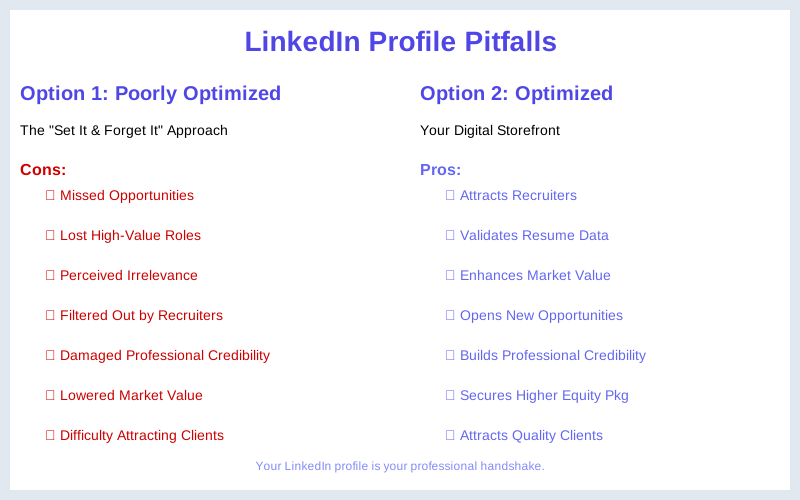
Look, your LinkedIn profile isn't just a digital artifact; it's a living, breathing component of your career strategy. Neglecting it is like leaving a $500 bill on the sidewalk every single day. The hidden costs are real, impacting everything from your job search visibility to your perceived market value.
- Visibility is Key: If your profile isn't optimized for keywords, you simply won't show up in recruiter searches. It's an 'ATS black hole' for your personal brand.
- Credibility is Currency: An outdated or unprofessional profile erodes trust and raises red flags for hiring managers and potential clients. It's part of the 'hiring theater' where perception matters.
- Engagement Matters: LinkedIn's algorithm rewards activity. An inactive profile is a 'resume graveyard' where opportunities go to die.
People wildly overestimate the importance of LinkedIn polish, but they under-estimate the importance of relevance. * It's a 24/7 Asset: When optimized, your profile works for you around the clock, attracting inbound opportunities you'd otherwise miss. It's not about 'polish' as much as it's about making it functional and searchable.
Frequently Asked Questions
I saw services that charge $500 for a 'LinkedIn makeover.' Can I really do this myself, or is it worth paying someone?
Do I really need to post content regularly, or can I just optimize my profile and leave it?
What if I optimize my profile, but I still don't get any InMails or interest?
Can having an old LinkedIn profile permanently damage my career prospects?
Some people say LinkedIn is just for job seekers. Is that true, or is it useful even if I'm happy in my current role?
Sources
- Optimize Your LinkedIn Profile: Common Mistakes to Avoid
- Optimize Your LinkedIn Profile for Weak Job Market
- The hidden cost of credibility and business | Dipa Kotak - LinkedIn
- The LinkedIn profile mistake that costs people 90% of opportunities
- LinkedIn Profile Optimization: 12 Tips That Actually Work
- The Hidden Costs of a Neglected LinkedIn Profile - C-Suite Network
- How to optimize linkedin profile: A brutally honest guide | ViralBrain
- The Best LinkedIn Optimization Tools in 2026 (That Won't Bankrupt ...
- How Weak LinkedIn Executive Profiles Cost You Leads in 2026
- Give your LinkedIn profile a 2026 makeover - what actually ... - Reddit
- Full LinkedIn Tutorial For Beginners (2026 Update!) - YouTube
- 3 LinkedIn profile mistakes and how to fix them