
The Ethical Dilemmas Faced By AI Professionals (2026 Complete Guide)
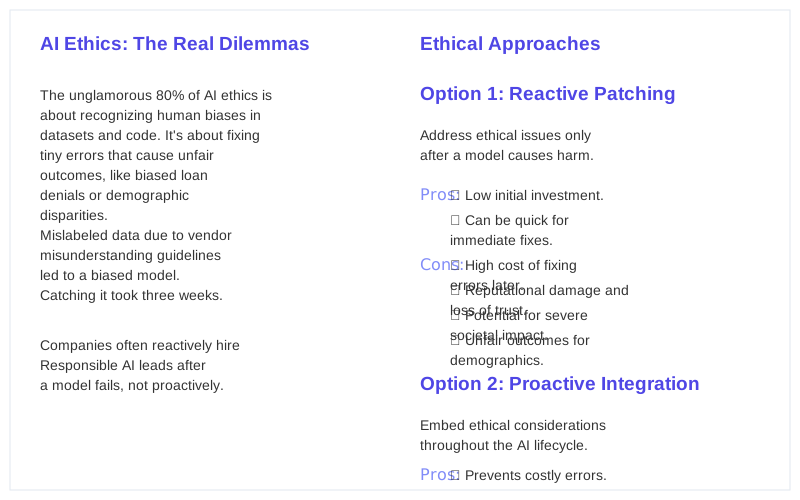
I remember a project where 12 percent of our training data was mislabeled because a vendor's annotation team in a different time zone misunderstood a nuance in our guidelines. The model was learning to be biased, and it took us three weeks to catch it.
I remember a project where 12 percent of our training data was mislabeled because a vendor's annotation team in a different time zone misunderstood a nuance in our guidelines. The model was learning to be biased, and it took us three weeks to catch it. This isn't just about bad data; it's about the very real ethical dilemmas faced by AI professionals every single day, the stuff LinkedIn posts conveniently ignore when they're showing off a new generative art piece.
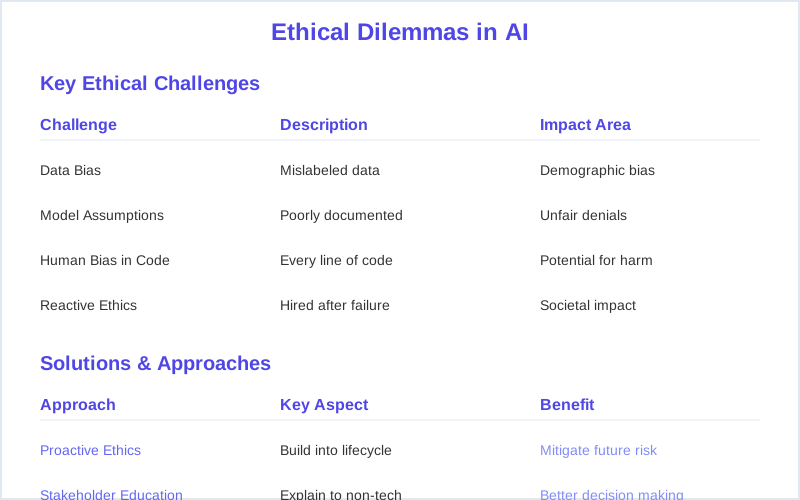
Everyone talks about AI ethics in grand philosophical terms: 'Will robots take over?' or 'What about sentient machines?' The actual job, what LinkedIn won't tell you, is far more mundane and insidious. It's about a tiny error in a data pipeline that disproportionately impacts a specific demographic, or a poorly documented assumption in a model that leads to unfair loan denials. Harvard Gazette highlights how these concerns are mounting as AI takes a bigger decision-making role.
The unglamorous 80 percent of AI ethics isn't about halting Skynet. It's about recognizing that every line of code, every dataset chosen, every model parameter, carries human biases and potential for harm. You are the one who has to catch it, debug it, and then explain it to a non-technical stakeholder who just wants the model to 'work faster.'
Companies are starting to pay attention, but often it's reactive. They're hiring 'Responsible AI' leads because a model went sideways, not because they proactively built ethics into their development lifecycle. EBS Education points out that understanding these limitations is mission-critical for executives. It's a pivot tax many firms are paying now, trying to patch up systems built without a second thought about their societal impact.
My first real brush with this was when a marketing model I helped build started recommending products to certain demographics based on outdated, stereotypical assumptions. It wasn't malicious, just ignorant, reflecting the historical data it was fed. The impact was small-scale, but it made me realize the power, and the responsibility, we wield. Barbri's CLE course for 2026 even covers these pervasive legal ethics issues, showing it's not just a tech problem anymore.
The Real Answer
The real reason ethical dilemmas plague AI professionals isn't because we're evil, but because the incentives are often misaligned. We're pressured to deliver models fast, to hit accuracy targets, and to show clear ROI. 'Ethical implications' often fall into the 'nice-to-have' category until a crisis hits. Your manager cares about that 0.5 percent accuracy bump, not the subtle bias it might introduce to 0.01 percent of users.
This happens because the entire pipeline, from data collection to deployment, is a series of human decisions, each embedded with assumptions and priorities. If your data scientists are measured solely on F1 score, they'll optimize for F1 score. They won't spend an extra 40 hours meticulously auditing edge cases for fairness unless it's explicitly mandated and rewarded.
It's a classic signal vs hype problem. The hype promises frictionless automation, but the signal from the ground is that every AI system is a reflection of its creators' blind spots and the messy, biased data of the real world. Interlegal's guide on generative AI and ethical risk for law firms really hammers this home for 2025-26, noting that balancing speed and efficiency with professional responsibility is a core challenge.
The insider framework here is that ethics isn't a separate module you bolt on at the end. It's a continuous integration and continuous deployment problem. Every data change, every model update, every new feature, needs an ethical review. But who has the budget or the time for that? Most companies don't, until a news headline forces their hand.
My mental model for this is simple: assume your model is biased until proven otherwise. And 'proven otherwise' means more than just looking at overall accuracy metrics. It means slicing your data by demographics, by geography, by age. It means asking uncomfortable questions about the data's origin. Harvard Gazette emphasizes privacy, bias, and control as major areas of concern, which are all born from these fundamental misalignments and assumptions.

What's Actually Going On
What's actually going on is a clash between rapid technological advancement and slow-moving regulatory and organizational structures. The EU AI Act, for example, is set to take effect in 2025, labeling legal AI tools as 'high-risk' and imposing strict rules like mandatory risk checks and human oversight. Interlegal highlights these upcoming regulations.
Meanwhile, in the US, it's a sector-based approach, with FTC guidelines pushing for openness and accountability. This means one company might face different ethical scrutiny depending on its industry and location. My friend in healthcare AI deals with HIPAA, while I, in marketing, worry more about data privacy regulations like CCPA. Ethical considerations in AI/ML in healthcare are incredibly complex.
Bias and fairness are perennial problems. AI systems learn from historical data, which often reflects societal biases. If your hiring AI is trained on past hiring decisions, and those decisions historically favored one demographic, the AI will perpetuate that bias. USC Annenberg explains this can lead to discriminatory outcomes in hiring, lending, and law enforcement.
Transparency is another huge one. Deep learning models are often black boxes. Explaining why a model made a particular decision to a VP or, worse, to a customer, is incredibly difficult. This lack of interpretability erodes trust and makes accountability almost impossible. Nobody wants to be told 'the algorithm said so.'
Job displacement is also a real concern. While AI creates new roles, it also automates others. Companies need to consider the societal impact, not just their bottom line. It's not just about efficiency; it's about the human cost. Data Axle advises marketers to use smarter data and transparent models to avoid pitfalls, which is easier said than done when deadlines loom.


How to Handle This
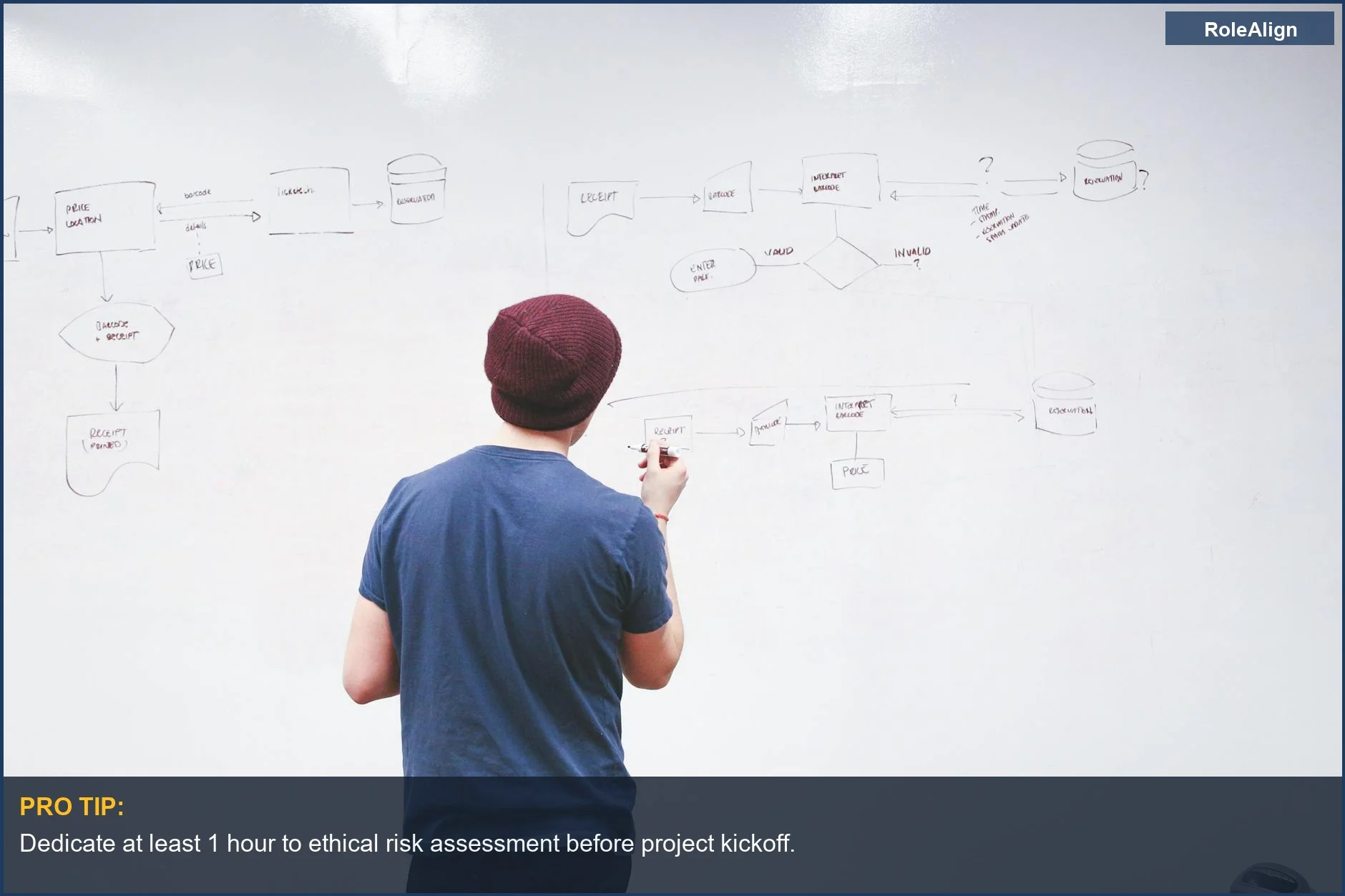
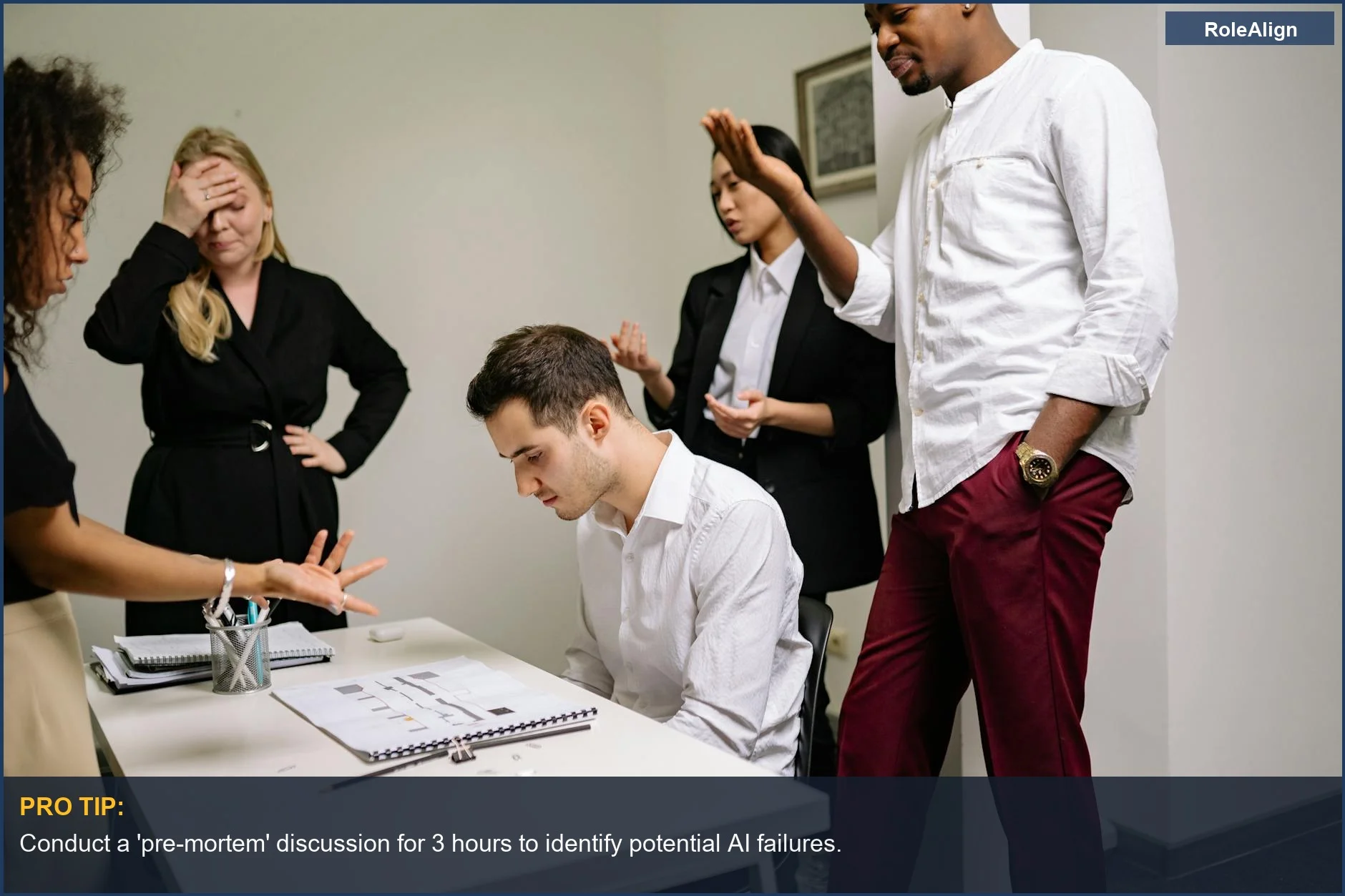
First, when you're handed a new project, don't just dive into coding. Spend 2-3 hours on a 'pre-mortem' with your team. Ask: 'If this model goes horribly wrong, how will it happen?' This isn't about being negative; it's about proactively identifying blind spots. USC Annenberg suggests these kinds of preemptive discussions are crucial for addressing ethical dilemmas.
Next, implement a 'data provenance' checklist. For every dataset, document its origin, collection method, and any known biases. This isn't just a README file; it's a living document. I spend 30 minutes every two weeks updating mine. This helps you understand the 'why' behind model behavior, not just the 'what.'
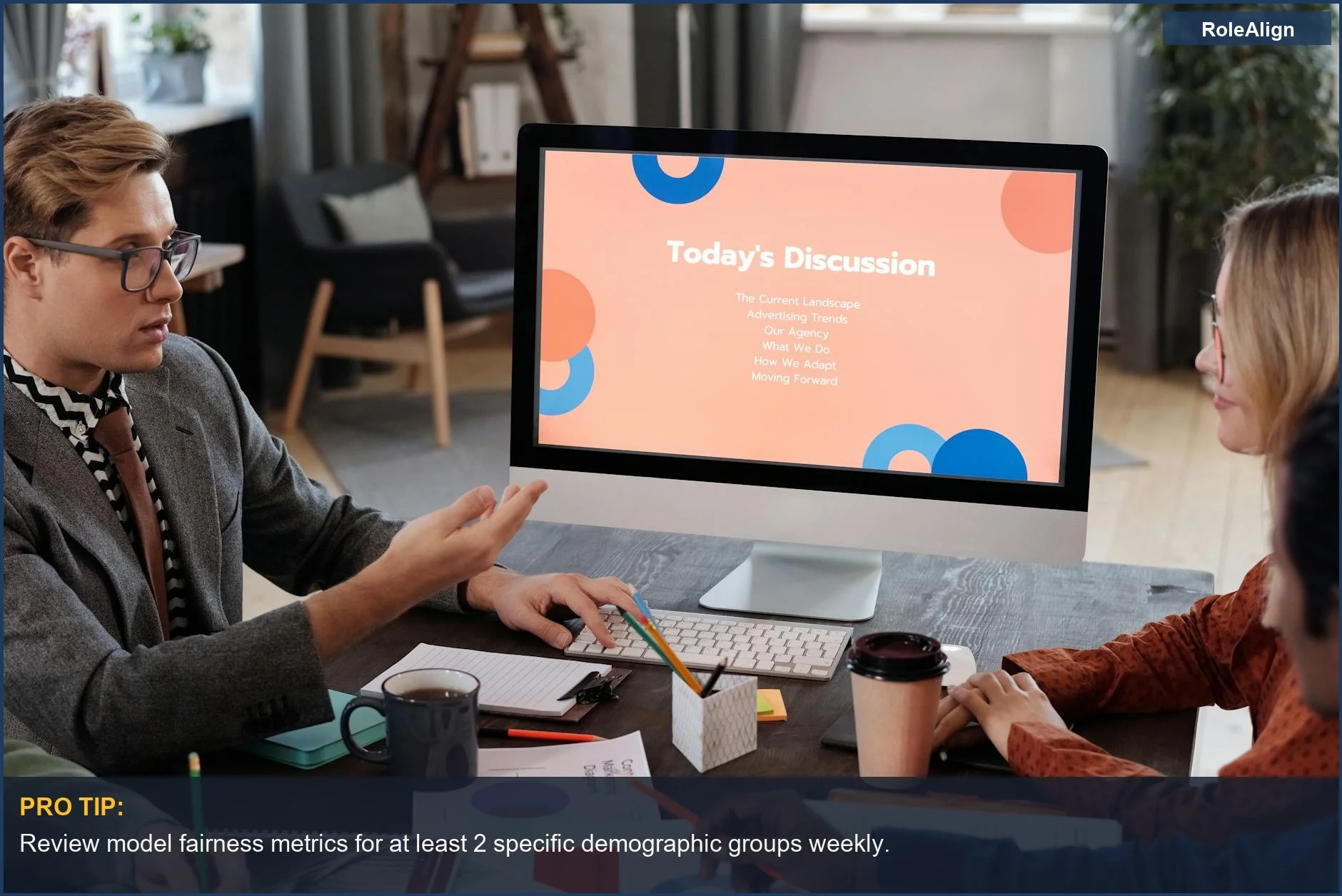
During model development, don't just optimize for a single metric like accuracy. Build in fairness metrics from the start. Tools like Aequitas or Fairlearn can help you evaluate disparate impact across different groups. Your model might hit 90 percent accuracy overall, but if it's 60 percent for one minority group, you have a problem. Medium's summary on AI ethics emphasizes that human judgment is required here.
Before deployment, conduct a 'red team' exercise. Have a separate team try to break your model, to find its biases, to make it behave unethically. This simulates real-world misuse scenarios. It's like finding the weak points in your car's security before someone else does.
Finally, establish a clear 'accountability matrix.' Who is responsible if the model makes a bad decision? Is it the data scientist, the product manager, or the VP who signed off? This isn't about blame; it's about ensuring someone owns the problem and has the authority to fix it. This is how you move from theoretical ethics to operational reality. USC Annenberg discusses accountability as a key ethical issue.

What This Looks Like in Practice
Imagine a credit scoring model that, despite appearing fair overall, consistently assigns lower scores to applicants from a specific zip code - not because of individual credit risk, but because historical lending practices in that area were discriminatory. The model's overall accuracy might be 95 percent, but its fairness metric for that zip code could be 60 percent. This is one of eight ethics scenarios information professionals face.
Or consider a generative AI tool used for legal document drafting. It might hallucinate legal citations 15 percent of the time, leading to lawyers filing documents with fake precedents. The efficiency gain might be 30 percent, but the professional liability risk skyrockets. Baker Donelson's 2026 AI Legal Forecast warns about the rise of agentic AI liability.
In marketing, an AI-powered ad targeting system might inadvertently exclude certain age groups or ethnicities from seeing housing or job advertisements, even if the intent was to optimize for conversion. The click-through rate might be 1.2 percent higher, but the potential for a discrimination lawsuit becomes a 20 percent higher risk.
Then there's the 'deepfake' problem. A company uses AI to generate realistic spokesperson videos, but the technology could be misused to create defamatory content. The cost saving on hiring actors could be $10,000 per campaign, but the reputational damage from a deepfake scandal could be in the millions. The 2026 AI Legal Forecast specifically mentions legislative momentum shifting toward protecting individuals from unauthorized synthesized likenesses.
Finally, a medical diagnostic AI might achieve 98 percent accuracy for common diseases but only 70 percent for rare conditions that disproportionately affect certain populations. The overall impressive metric hides a critical failure for a vulnerable group. These are the stakes we're actually dealing with.
Mistakes That Kill Your Chances
| Mistake | Why It Kills Your Chances | The Real Impact |
|---|---|---|
| Ignoring data provenance | You build on a shaky foundation, inheriting biases you don't even know exist. | Your model, despite 'high accuracy,' will repeatedly fail minority groups, leading to PR nightmares and regulatory fines ($100K+). |
| Optimizing for single metric | You chase a number (e.g., F1 score) without considering its downstream ethical impacts. | A model that's 'accurate' but discriminates, like a loan approval system rejecting 1 in 5 qualified applicants from certain areas. |
| Treating ethics as a checkbox | You run a quick 'ethics review' at the end, rather than integrating it throughout the lifecycle. | Ethics becomes a reactive cleanup job. You'll spend 3 weeks refactoring code that should've taken 3 hours to design ethically. |
| Lack of interpretability | You build a black box model you can't explain. | You can't justify decisions to stakeholders or regulators, leading to distrust and potential bans on your AI system. This YouTube guide on ethical AI stresses the importance of transparency. |
| No red teaming | You assume good intent and don't test for malicious use or unintended consequences. | Your model is vulnerable to adversarial attacks or can be easily tricked into generating harmful content. |
| Poor stakeholder communication | You speak in F1 scores to VPs who think AI is magic. | You fail to translate technical risks into business impact, leading to underinvestment in ethical safeguards and eventual project failure. |
Key Takeaways
The ethical dilemmas faced by AI professionals are not theoretical; they are baked into the daily operational reality of building and deploying AI systems. I've spent 43 minutes in a single meeting debating the ethical implications of a new feature, not because it was groundbreaking, but because the data had known biases. Mediate.com notes that every ethical dilemma is a practice-building opportunity.
- Bias is everywhere: Assume your data, and therefore your models, are biased. It's the default state, not an anomaly. Your job is to find and mitigate it.
- Ethics is continuous: It's not a one-time check. It's an ongoing process, from data collection to model monitoring. Treat it like security - always on.
- Communication is key: You need to translate technical ethical risks into business impact for non-technical stakeholders.
If they don't understand the 'pivot tax' of ignoring ethics, they won't fund it. * Regulations are coming: The regulatory landscape is evolving fast. What's permissible today might be illegal tomorrow, especially in high-risk sectors. Keep an eye on global trends. * Human judgment is irreplaceable: AI ethics cannot be solved by AI. It requires human oversight, critical thinking, and a willingness to challenge assumptions, even when it slows things down. That's the unglamorous part that truly matters.
Frequently Asked Questions
My manager says an 'ethics audit' tool costs $5,000 per month. Can I just do it myself for cheaper?
Do I really need to document every single data source and transformation, or can I just use a general 'data quality' report?
What if I meticulously audit my model for bias, but it still performs poorly for a specific demographic in production?
Can focusing too much on ethical considerations permanently slow down my career progression or make me seem like I'm not a 'team player'?
I heard that AI can solve its own ethical problems. Is that true?
Sources
- Ethical AI in Business Complete 2026 Guide (2+ Hours) - YouTube
- Generative AI & Ethical Risk in Law Firms 2025–26 Guide - Interlegal
- How to avoid AI pitfalls in 2026: A marketer's guide to smarter, safer AI
- Ethical concerns mount as AI takes bigger decision-making ...
- Ethical Considerations - AI and Machine Learning in Health Care
- 2026 AI Legal Forecast: From Innovation to Compliance
- The ethical dilemmas of AI - USC Annenberg
- AI Challenges in 2026: 15 Risks & Limitations Leaders Must Overcome
- The 8 AI Ethics Trends Creating Unprecedented Practice-Building ...
- The Ethics of AI for Information Professionals: Eight Scenarios
- The Ethical Dilemmas of AI: A Complete Summary and Final ...
- Ethics 2026: AI, Joint Representation, and More | CLE Course - Barbri