
Why Most AI Job Postings Are Misleading (2026 Complete Guide)
You just spent another hour scrolling through job boards, each AI job posting a siren song of inflated titles and unrealistic expectations. The rejection email from yesterday still stings, a sterile, automated dismissal that offers no feedback. You're prepping for an interview tomorrow for a role that sounds promising, but a nagging doubt persists: is this AI job posting misleading?
You just spent another hour scrolling through job boards, each AI job posting a siren song of inflated titles and unrealistic expectations. The rejection email from yesterday still stings, a sterile, automated dismissal that offers no feedback. You're prepping for an interview tomorrow for a role that sounds promising, but a nagging doubt persists: is this AI job posting misleading? Job boards are packed with fake or low-quality roles, and the promise of AI-driven hiring has, for many, devolved into a noisy, crowded arms race of automation. The reality in 2026 is that while AI can streamline hiring, it's also amplified existing problems, leading to a deluge of misleading AI job postings and a frustrating experience for job seekers. The allure of "AI expert" roles often masks a lack of substance, and many companies are posting these roles simply to signal technological prowess to investors and competitors rather than genuine hiring needs. This creates a landscape where spotting genuine opportunities requires a critical eye.
The current job market, particularly within the AI sector, is rife with exaggeration and a disconnect between advertised roles and actual responsibilities. Many "AI specialist" or "AI lead" positions, for instance, may simply require basic data analysis skills or the ability to use off-the-shelf AI tools, rather than deep expertise in machine learning model development or cutting-edge research. This phenomenon is partly driven by a desire for companies to appear innovative. As noted, companies may post these roles to project an image of technological sophistication to stakeholders rather than to fill an immediate, critical need for advanced AI talent. Furthermore, the rapid pace of AI development means that many advertised "AI expert" roles are filled by individuals who are, in reality, still learning and experimenting, leading to a situation where "most 'AI Experts' in 2026 Are Faking It" in terms of true mastery. This makes it incredibly difficult for genuine AI professionals to find roles that accurately reflect their skills and for aspiring individuals to understand what is truly required. The advice ecosystem itself has become a source of confusion, with much of the career guidance being actively misleading about what it takes to build a successful AI career. This environment necessitates a discerning approach from job seekers, as the promise of AI-powered efficiency in hiring has, ironically, contributed to a more opaque and challenging job search.
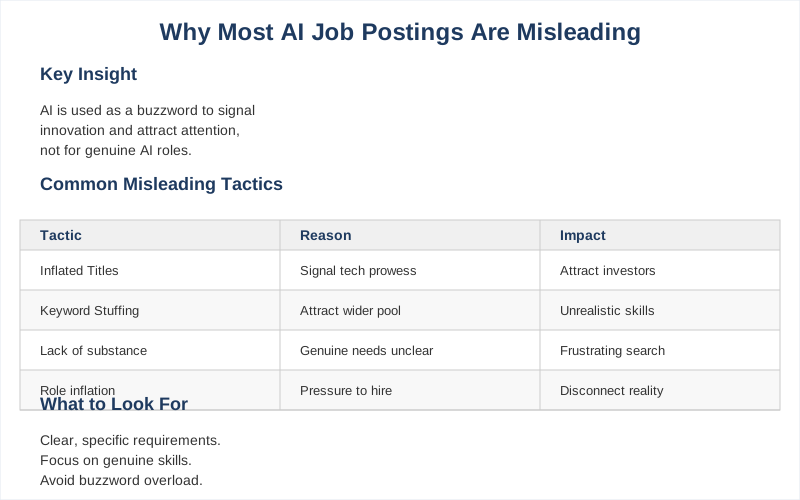
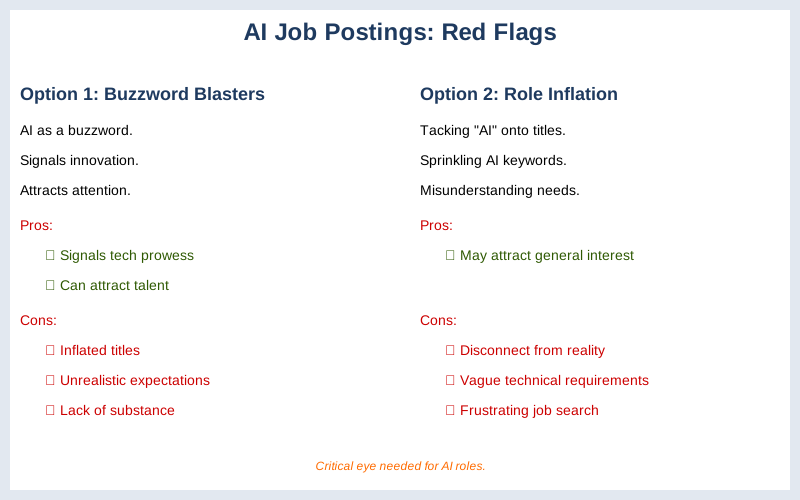
Most AI job postings are misleading because recruiters often use "AI" as a buzzword to signal innovation and attract attention, rather than reflecting genuine, well-defined AI roles.
The core issue is role inflation and a misunderstanding of what constitutes an AI-specific position. Recruiters, under pressure to fill roles quickly and attract top talent, may tack "AI" onto job titles or sprinkle AI-related keywords throughout descriptions without a clear understanding of the actual technical requirements. This creates a disconnect between the perceived opportunity and the reality of the day-to-day tasks. Job boards are packed with these fake or low-quality roles, making it difficult for candidates to discern genuine opportunities from aspirational marketing Job hunting in 2026 is brutal — so I use ChatGPT to spot red flags in ....
This practice isn't necessarily malicious but stems from a desire to appear cutting-edge. Posting AI jobs can signal to investors, partners, and competitors that the company is actively pursuing advanced technologies, even if the actual role involves more tangential AI integration or data analysis rather than core AI development linkedin.com. The result is often a flood of AI job fake requirements that don't align with the candidate's skillset or the company's actual needs.
AI itself has exacerbated this problem. While AI can streamline hiring, it also allows for the rapid generation of job descriptions that sound impressive but lack substance. This can lead to AI recruitment mistakes where bias is introduced or roles are poorly defined from the outset AI Recruitment Mistakes in 2026: 5 Pitfalls & Fixes - Juicebox. Hiring systems are being stress-tested, and the initial design of roles, often influenced by the hype around AI, shapes who is even considered Why Hiring Systems Will Be Stress-Tested In 2026 - Forbes.
Candidates often use AI to draft their resumes and applications, which can further complicate matters. While AI can help optimize for Applicant Tracking Systems (ATS), if used improperly, it can lead to generic phrasing and inflated skills that fall apart under scrutiny, making it one of the fastest ways to get rejected Using AI in Your Job Search: What Helps vs. What Hurts in 2026. Consequently, many AI job postings are misleading because they are either marketing tools or poorly constructed roles, amplified by the very AI tools candidates use to apply.
- The "AI Everything" Senior Software Engineer
A Series B startup, desperate to appear cutting-edge, slaps "AI" onto every engineering role. They'll list requirements for deep learning expertise, NLP mastery, and experience with frameworks like TensorFlow and PyTorch, often for a role that primarily involves building standard web applications with minimal AI integration. This is AI role inflation.
- What happened: Candidates with genuine AI skills are lured by the impressive tech stack and salary, only to find themselves doing mundane software development tasks. The company claims AI prowess without investment.
- What worked: The startup successfully creates a perception of innovation.
- What didn't work: Frustrated engineers leave quickly, damaging the company's reputation and increasing turnover.
- The "AI-Adjacent" Entry-Level Data Analyst
Fortune 500 companies, under pressure to adopt AI, post entry-level data analyst roles with overwhelming AI prerequisites. Demands include experience in model deployment, MLOps, and advanced statistical modeling, far beyond an entry-level position. This stems from poorly designed AI screening tools or HR's misunderstanding of AI roles, as highlighted by concerns about AI screening shaping candidate pools.
- What happened: Qualified candidates are discouraged by steep, often irrelevant, requirements, leading to fewer applicants. The company misses out on trainable talent.
- What worked: The company ticks the box of "seeking AI talent."
- What didn't work: The hiring process becomes inefficient, and the company struggles to fill the role with suitable candidates or hires less experienced individuals who can't meet inflated expectations.
- The "Career Pivot" Product Manager with Unrealistic AI Demands
Individuals transitioning into Product Management from non-tech fields encounter job postings demanding deep AI and ML understanding. Descriptions ask for experience developing AI-powered features, understanding complex algorithms, and even a data science background, for roles focused on user experience and market strategy. This reflects confusion around AI career paths, where most AI career advice is misleading.
- What happened: Career changers may overstate AI knowledge, only to be found lacking. Those honest about their learning curve are screened out by AI-driven applicant tracking systems (ATS).
- What worked: The job posting appears to target highly skilled candidates.
- What didn't work: The role is often too technical for a true product manager, leading to a mismatch in expectations and job performance.
- Job boards feature misleading AI job postings. Vague listings, unrealistic pay, and unclear employers make them "résumé black holes" Job hunting in 2026 is brutal - so I use ChatGPT to spot red flags in .... This role inflation inflates the difficulty of the 2026 job market.
- AI recruitment mistakes are frequent. Biased training data or programming errors can lead to discrimination and overlook qualified candidates AI Recruitment Mistakes in 2026: 5 Pitfalls & Fixes - Juicebox, making the AI screening process less effective and potentially unfair.
- AI-generated applications can backfire. Over-reliance on AI for resumes and LinkedIn profiles results in generic phrasing and inflated skills that hiring managers can spot, with 80% discarding AI-generated applications Using AI in Your Job Search: What Helps vs. What Hurts in 2026.
- The "AI expert" label is often inflated. Many claiming expertise lack deep knowledge, and companies may use "AI" in titles to signal innovation rather than need, as AI adoption hasn't yet shown broad productivity increases Most "AI Experts" in 2026 Are Faking It | by Analyst Uttam - Medium.
- Recruiters' off-the-record advice: "Don't trust the job description at face value. Do your homework on the company and the role, and be prepared to ask direct questions about the actual responsibilities and the team's AI initiatives. Many AI job postings are misleading."
Frequently Asked Questions
I keep seeing 'AI Specialist' or 'AI Engineer' jobs with ridiculously high salaries like $150k-$200k, but the requirements seem so basic. Are these real opportunities?
Are many of the AI jobs I see online actually fake or low-quality?
How can I tell if an AI job description is just fluff or designed to mislead me?
I've heard AI is making hiring worse. How are these AI job postings contributing to that problem?
With so many AI jobs listed, are employers actually hiring for them, or is it just a trend to look good?
Sources
- Why Hiring Systems Will Be Stress-Tested In 2026 - Forbes
- Why Most AI Career Advice Is Actively Misleading Right Now
- Why So Many AI Job Postings Are Fake - LinkedIn
- AI Recruitment Mistakes in 2026: 5 Pitfalls & Fixes - Juicebox
- linkedin.com
- Using AI in Your Job Search: What Helps vs. What Hurts in 2026
- Most “AI Experts” in 2026 Are Faking It | by Analyst Uttam - Medium
- medium.com
- juicebox.ai
- job-hunting-in-2026-is-brutal-so-i-use-chatgpt-to-spot-red-flags-in-listings
- Why 80% Of Hiring Managers Discard AI-Generated Job ... - Forbes
- AI Has Made Hiring Worse—But It Can Still Help
- Job hunting in 2026 is brutal — so I use ChatGPT to spot red flags in ...
- why-so-many-ai-job-postings-are-fake-david-linthicum-wvfse