
The Reality of AI Job Titles vs Day to Day Work (2026 Complete Guide)
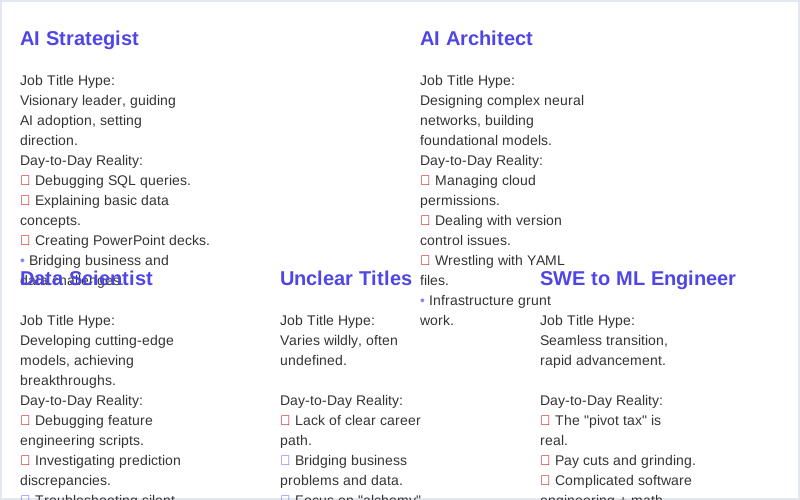
I recently saw a job posting for an 'AI Strategist' that listed 'SQL experience' as a desirable skill. Desirable? My first week on the job, I spent 43 minutes debugging a SQL query that powered a 'mission-critical' dashboard. The reality is, if you can't yank data out of a database, your AI strategy will remain a PowerPoint slide.
I recently saw a job posting for an 'AI Strategist' that listed 'SQL experience' as a desirable skill. Desirable? My first week on the job, I spent 43 minutes debugging a SQL query that powered a 'mission-critical' dashboard. The reality is, if you can't yank data out of a database, your AI strategy will remain a PowerPoint slide. The New York Times pointed out that people in the AI hype loop often overestimate how fast things change.
They also gloss over the dirty work.
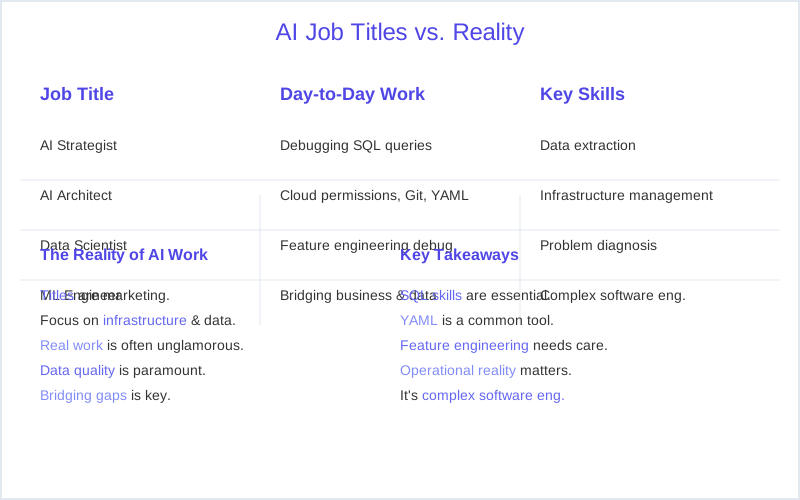
Job titles in AI are a marketing exercise, not a job description. You'll see 'AI Architect' and imagine someone designing neural networks. The actual job involves spending 70 percent of your time wrestling with cloud permissions, version control, and YAML files. Nobody talks about the YAML files. The unglamorous part of AI is the infrastructure.
Forget the LinkedIn posts showing someone's glorious model inference results. I've spent entire weeks helping a 'Data Scientist' track down why their model's predictions were off by 15 percent for a specific customer segment. Turns out, the feature engineering script had a silent failure mode. That's the actual job.
Medium highlighted that the hardest AI jobs in 2026 won't even have clear titles or career paths. They'll be the ones bridging the gap between a business problem and a messy data lake, not just training models. It's less about algorithms and more about alchemy.
The 'pivot tax' is real, too. People coming from traditional software engineering often expect a straight line. I've seen folks take a 10 percent pay cut and six months of grinding to move from backend dev to ML engineering. The hype machine sells a different story, but operational reality bites. It's not magic; it's just very complicated software engineering with extra math.
The Real Answer
The core reason AI job titles are often divorced from day-to-day work is simple: companies are still figuring this out. They're slapping 'AI' or 'ML' on roles to attract talent and signal innovation to investors, without a clear understanding of the underlying tasks. It's signal vs hype. Reddit discussions confirm that thinking about jobs as tasks, not titles, is crucial.
My mental model is this: every AI role is a bundle of tasks. Some tasks are glamorous - model training, algorithm selection. Most are not - data validation, pipeline orchestration, stakeholder education. The job title highlights the glamorous 20 percent, while the unglamorous 80 percent defines your actual week.
This isn't unique to AI. Remember 'Webmaster' in 1998? That person was a designer, developer, content editor, and server admin all rolled into one. AI roles are in a similar, nascent phase. Companies are trying to fit new tech into old organizational structures.
The 'ML Engineer' title, for example, often hides a 'Data Engineer who occasionally deploys models.' You're building robust data ingestion systems, not just pushing code to production. Your Jupyter notebook is a prototype; the actual product lives in Docker containers and Kubernetes pods.
As one YouTube expert notes, AI isn't just replacing jobs, it's shifting task mixes. This means a 'Data Scientist' might spend more time on MLOps than statistical analysis. The company needs someone to make the models run reliably, and that's often not the person who built the initial proof-of-concept.
So, when you see a title, mentally break it down. What are the actual tasks? How much of that is data wrangling? How much is infrastructure? How much is communicating to non-technical folks? The smaller the company, the more hats you'll wear, regardless of your official designation.


What's Actually Going On
What's actually going on in the industry is a massive re-bundling of tasks. AI isn't eliminating jobs wholesale; it's automating specific, repetitive tasks within existing roles. Forbes points out that AI is disassembling jobs into tasks, changing human responsibilities. This means 'Data Analyst' might still be the title, but the day-to-day work shifts from manual Excel manipulation to validating AI-generated reports.
ATS data - Applicant Tracking Systems - are still keyword-driven. Companies list 'Machine Learning' or 'Deep Learning' to catch candidates, even if the actual role is 80 percent SQL and 20 percent Python scripting. This creates a mismatch where candidates optimize for buzzwords, and companies hire for them, but the work is fundamentally different.
Company size matters significantly. A startup with 15 employees might hire an 'AI Lead' who does everything from data engineering to model deployment to presenting to investors. A Fortune 500 company, however, will have specialized 'ML Platform Engineers,' 'Applied Scientists,' and 'ML Researchers.' The larger the company, the more granular the role.
Regulatory facts also play a role. As more industries face AI-specific regulations (e.g., explainability in finance, fairness in hiring), 'AI Ethicists' or 'Responsible AI Leads' emerge. These roles are less about coding and more about policy, compliance, and auditing. Their impact on model performance metrics is zero, but their impact on legal risk is huge.
The Atlantic noted that America isn't ready for what AI will do to jobs. This 'unpreparedness' translates to messy job descriptions. Entry-level jobs are especially vulnerable to task shifts. Harvard Business Review highlights that AI impacts entry-level roles by automating routine tasks, shifting the focus to oversight and problem-solving.
My first 'ML Engineer' role involved 40 percent data cleaning, 30 percent building APIs for model inference, 20 percent debugging CI/CD pipelines, and 10 percent actual model training. The title was aspirational, the work was foundational. That's the norm, not the exception.


How to Handle This
To navigate this mess, you need a strategy. First, ignore the job title. Seriously. Your first step (Day 1-7): read the responsibilities section like a hawk. Count how many bullet points involve data pipelines, infrastructure, or deployment versus pure model building. If 'build production-grade ML systems' is there, assume 70 percent of your time is not model building.
Next (Week 2-4): target your learning. If the role mentions Kubernetes, spend a week setting up a local cluster and deploying a dummy service. If it mentions Airflow, build a simple DAG that pulls data from an API and stores it. Don't just watch tutorials; actually build. HBR research suggests AI intensifies work, meaning you'll need to be more efficient with tools.
Then (Month 2-3): tailor your portfolio projects. Don't just show model accuracy. Show how you deployed a model, how you monitored its performance in 'production' (even if it's just a local Flask app), and how you handled data drift. This demonstrates operational reality, not just academic knowledge.
For interviewing (Month 3-6): channel your inner software engineer. Expect system design questions, not just algorithm questions. Be ready to discuss data schemas, API design, and error handling. The technical interviews will often reveal the true nature of the role, regardless of the title.
Finally (Ongoing): focus on communication. I've seen brilliant engineers fail because they couldn't explain their work to a VP who thinks AI is just a magic box. Practice translating technical jargon into business impact. Forbes reiterates that new human responsibilities emerge as AI breaks jobs into tasks. This includes explaining what those tasks accomplish.
My pivot into AI from traditional software engineering took me 8 months of focused effort. I spent 3 months just on practical MLOps skills. It's not a sprint; it's a marathon of learning the unglamorous parts.
What This Looks Like in Practice
When a company posts for a 'Senior Data Scientist' with a salary range of $150,000-$180,000, and the job description includes 'build and maintain production data pipelines,' expect 60 percent of your sprint tickets to be data engineering tasks. Your model accuracy metrics will be secondary to pipeline uptime.
If you see 'develop and deploy large language models' for an 'Applied Scientist' role, know that 75 percent of the work will be fine-tuning open-source models, managing GPU clusters, and optimizing inference latency. Building a model from scratch is rare outside of research labs.
For a 'Machine Learning Engineer' at a Series A startup, your first 90 days will likely involve setting up the entire ML infrastructure from scratch. This means choosing a feature store, deploying a model serving framework, and probably arguing about cloud providers. PwC estimates up to 30 percent of jobs could be automatable by the mid-2030s, but the human work shifts to managing that automation.
My last project involved an 'AI Product Manager' who spent 80 percent of their time coordinating data access and defining data quality requirements. Their job title suggested strategic vision, but the reality was tactical data wrangling. A YouTube discussion points out how job titles are going away, replaced by skills.
An 'AI Researcher' role in industry often means building prototypes that might never see production, but the underlying data engineering work to support those experiments is still real. You'll spend 40 percent of your time managing experiment tracking and versioning, not just writing papers.
Metrics like 'model uptime' and 'data freshness' will matter more than 'ROC AUC' in most production roles. The business cares if the model is running and providing value, not just how theoretically perfect it is.
Mistakes That Kill Your Chances
| Mistake | Why It Kills Your Chances |
|---|---|
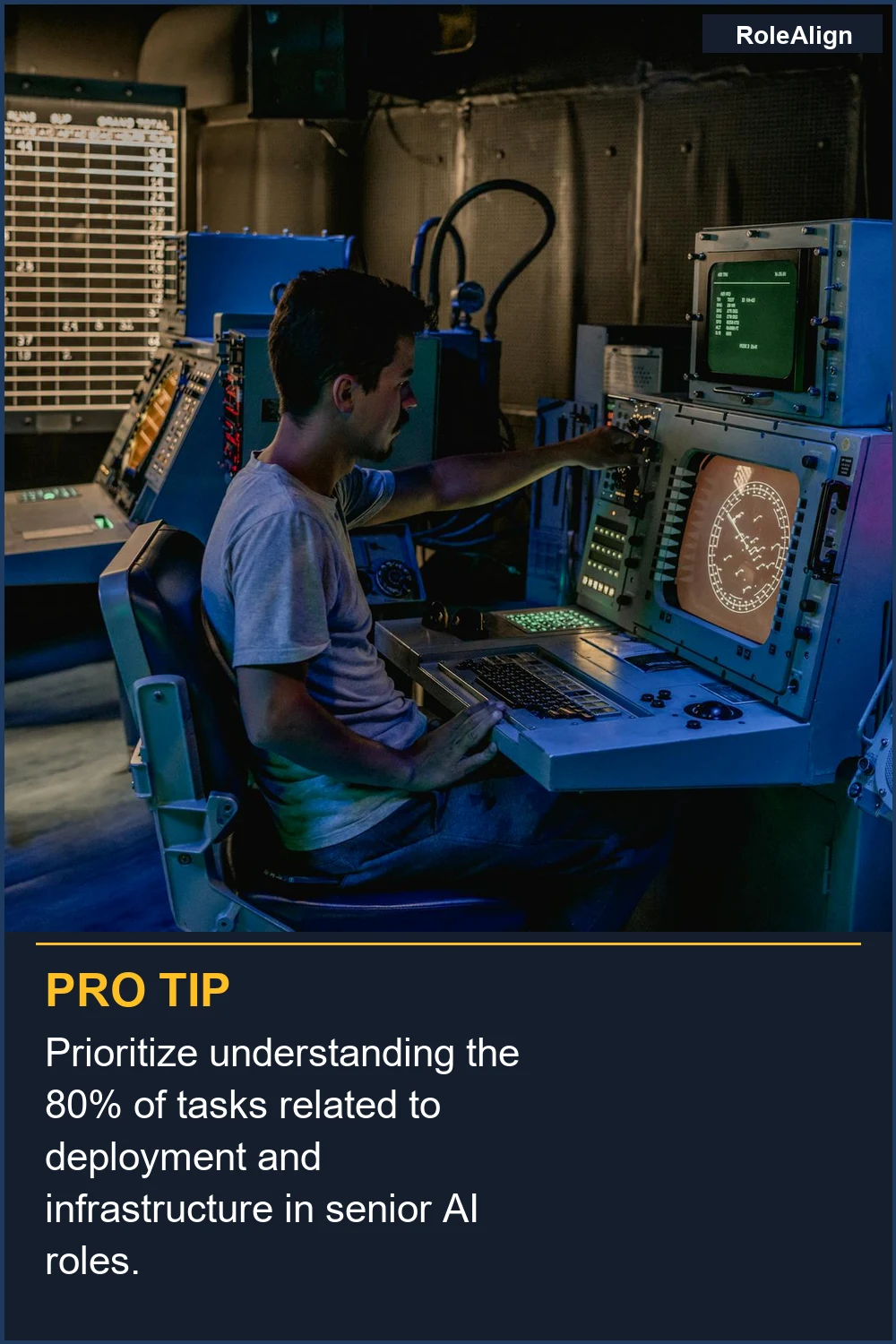
| Focusing only on model building | The actual job is 80% infrastructure, data, and deployment. If you can't get a model into production, it's useless. |
| Ignoring MLOps/Data Engineering | Companies need reliable systems, not just cool algorithms. Your brilliant model won't matter if the data pipeline breaks daily. |
| Poor communication skills | Brilliant researchers fail because they can't translate F1 scores into business impact for a VP who thinks AI is magic. |
| Not building end-to-end projects | Bootcamp projects often stop at model training. Real-world projects require deployment, monitoring, and error handling. |
| Chasing buzzwords over fundamentals | 'Generative AI Engineer' sounds great, but if you don't understand Git, SQL, and Docker, you're dead in the water. |
| Expecting a straight career path | The AI landscape is fluid. Roles evolve rapidly. Flexibility and continuous learning are non-negotiable. |
| Underestimating the 'pivot tax' | Transitioning takes time and often a temporary pay cut. The bootcamp ads promising $200K in 12 weeks are selling a fantasy. |
| Not understanding business context | An AI model is a tool for a business problem. If you don't grasp the problem, your solution will miss the mark. |
LinkedIn insights confirm that companies will invest in training people to work with AI agents, meaning the human role shifts. Don't be the person who only knows how to train.
Key Takeaways
The AI job market is a wild west, full of shiny titles that hide gritty realities.
- Job titles are misleading: They're often marketing tools, not accurate reflections of daily tasks. Expect to spend 70 percent of your time on data, infrastructure, and deployment.
- Focus on the unglamorous 80 percent: SQL, Git, Docker, cloud platforms, and MLOps skills are more critical than advanced algorithms for most roles. Reddit discussions confirm that AI is automating tasks, but human roles shift.
- Communication is paramount: You must be able to translate technical metrics into business value.
Your F1 score means nothing if your VP doesn't understand its impact on revenue. * The pivot tax is real: Don't believe the hype about instant, high-paying transitions. It takes time, effort, and often a temporary step back in salary. My own experience taught me this. * Build end-to-end projects: Show you can deploy, monitor, and maintain models, not just train them. This demonstrates operational experience, which is what companies actually need.
Ultimately, the actual job in AI is less about being a wizard and more about being a highly competent, adaptable engineer who can navigate complexity and communicate effectively. It's hard work, but the problems are genuinely interesting.
Frequently Asked Questions
My bootcamp instructor said I just need to learn PyTorch. Why are you telling me to learn Docker and SQL? That sounds like boring IT work.
Do I really need to get good at SQL if I'm going to be an 'ML Engineer'? I thought that was for data analysts.
What if I spend months learning MLOps and still can't land an 'ML Engineer' role? Am I just wasting my time?
Can focusing too much on the 'unglamorous' parts of AI, like data cleaning, permanently pigeonhole me away from cutting-edge research?
Everyone on LinkedIn says AI will make our jobs easier and reduce our workload. Is that true?
Sources
- AI Is Breaking Jobs Into Tasks, And That Changes Everything - Forbes
- How will Artificial Intelligence Affect Jobs 2026-2030
- America Isn't Ready for What AI Will Do to Jobs - The Atlantic
- How Fast Can A.I. Change the Workplace? - The New York Times
- Is AI Really Going to Take Over Jobs? Or Is This Just Another Tech ...
- Thinking about jobs as tasks, not titles, and how AI is shifting the mix
- The Perils of Using AI to Replace Entry-Level Jobs
- AI Doesn't Reduce Work—It Intensifies It | Harvard Business Review
- The Hardest AI Job in 2026 Won't Have a Job Title - Medium
- Is AI Replacing IT and Tech Jobs? The Truth in 2026 - YouTube
- Future of Work: 2026 Predictions on AI, Employment, and Careers
- Job Titles Are Going Away With AI. These 7 Skills Will Replace Them.