
The Cost of Ats Errors for Both Companies and Candidates (2026 Complete Guide)
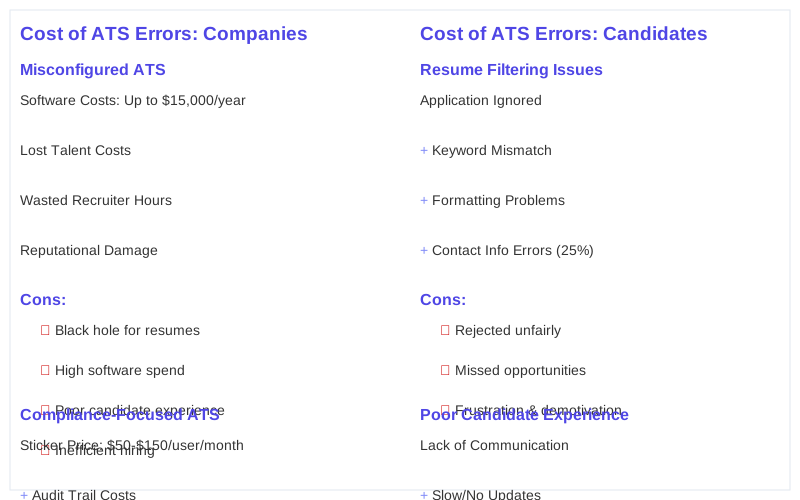
I've seen companies blow 15,000 USD a year on an ATS that barely works, and then blame candidates for not 'optimizing' their resumes. It's a classic move. We're talking about systems like Workday or Greenhouse, which, when misconfigured, can turn into a black hole faster than you can say 'Series B funding.' The cost isn't just in the software; it's in the lost talent and wasted recruiter hours, which, believe me, adds up.
I've seen companies blow 15,000 USD a year on an ATS that barely works, and then blame candidates for not 'optimizing' their resumes. It's a classic move. We're talking about systems like Workday or Greenhouse, which, when misconfigured, can turn into a black hole faster than you can say 'Series B funding.' The cost isn't just in the software; it's in the lost talent and wasted recruiter hours, which, believe me, adds up.
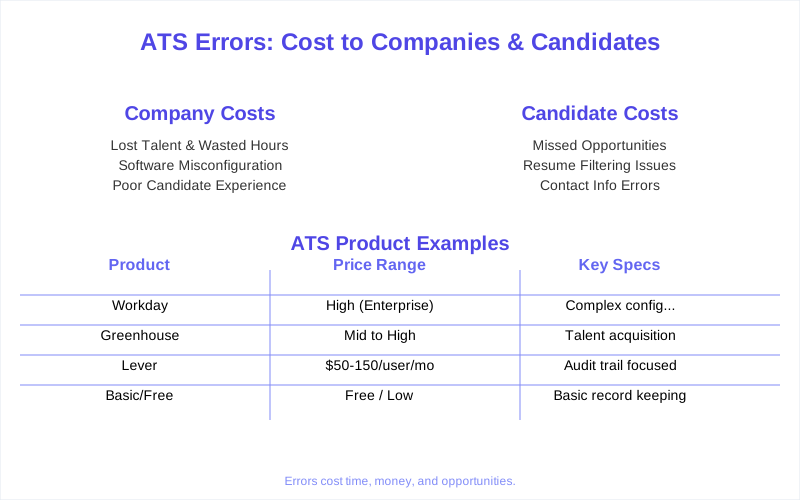
ATS pricing varies widely, ranging from free basic versions to enterprise plans costing over $125,000+ per year. But that's just the sticker price.
The Real Answer
The real reason ATS errors cost companies and candidates so much is because most organizations view their ATS as a compliance tool, not a talent acquisition engine. I've personally seen HR directors choose Lever based on the cheapest per-user license starting around $50 to $150 per user per month, without understanding how it would impact candidate experience or recruiter workflow. They cared more about the audit trail than finding the right person.
What's Actually Going On
What's actually going on is a fundamental mismatch between what an ATS is designed to do and what companies expect it to do. An ATS, at its core, is a system of record. It's for managing active applicants and maintaining a legal audit trail from 'Applied' to 'Hired.' It's a reactive system.
How to Handle This
To handle this mess, first, assume the ATS is actively trying to filter you out. That's my default setting after years of configuring these things. For every job, grab the text of the job description, paste it into a word cloud generator, and identify the top 10-15 keywords. These are your golden tickets. Studies even confirm ATS systems struggle with contact info 25 percent of the time.
What This Looks Like in Practice
I once saw a company lose a top-tier Senior Data Scientist because their iCIMS instance was set to automatically reject any resume that didn't include 'Python 3.8' exactly, even though the job description just said 'Python.' It was a keyword mismatch, a classic ATS black hole scenario. The candidate had Python 3.9 listed, which the system didn't recognize. ATS integration failures are a real problem.
Mistakes That Kill Your Chances
| Mistake | Why it Kills Your Chances (Recruiter Brain Perspective) |
|---|---|
| Fancy Formatting | Multi-column layouts and graphics often parse as gibberish in Taleo or Workday. My recruiter brain sees a wall of text, or worse, nothing. |
| Generic Resume | If your resume doesn't have the 3-5 specific keywords from the job description, my CTRL+F search comes up empty. You're signal vs noise, and you're noise. |
| Applying to Ghost Jobs | If a role has been open for 6+ months and constantly reposted, it's likely hiring theater. You're generating resumes for a pipeline that leads nowhere. I've been there. |
| Ignoring the 'Why' | A well-written cover letter, even if brief, can sometimes override an ATS red flag if it's compelling enough. But most people just skip it. |
| Keyword Stuffing | Over-optimizing by listing keywords repeatedly makes your resume unreadable to a human. My eyes glaze over, and you look desperate. |
| Outdated Contact Info | If your phone number or email is wrong, even if the ATS parses everything else perfectly, I can't reach you. Basic, but happens constantly. |
| Applying to Everything | My Lever dashboard shows me how many times you've applied. If you've applied to 15 different roles in a week, you look like a spray-and-pray candidate, not a focused one. |
Choosing the right ATS is critical for HR leaders.
Key Takeaways
The ATS landscape is a minefield for both companies and candidates, and frankly, most organizations are tripping over their own feet. It's not about finding the 'perfect' candidate, it's about not letting a poorly configured Workday instance filter out the plausible ones. Understanding ATS pricing models is key, but so is understanding how they actually function.
Frequently Asked Questions
My resume got rejected, but a friend with less experience got an interview for the same job. Should I just pay for a 'resume optimization service'?
I heard that converting my resume to a .txt file bypasses ATS issues. Is that true?
What if I tailor my resume perfectly for every job, and I'm still not getting any callbacks?
Can applying to too many jobs at the same company, even different roles, permanently flag my profile in their ATS?
Is it true that most ATS systems automatically reject 75 percent of resumes?
Sources
- Applicant Tracking System Pricing Guide (Updated for 2025)
- ATS Integration Failures 2026 - Pitch N Hire
- ATS Buyer's Guide 2026: Choose the Right Solution | HR Cloud
- Recruiting CRM vs. ATS: The Ultimate 2026 Guide to Integrated ...
- Breaking Down ATS: How We Make Sure Recruiters Read Your CVs
- Applicant Tracking Systems Pricing Guide 2025
- Understanding Applicant Tracking System Pricing