
What Recruiters See When They Search Ats Databases (2026 Complete Guide)
You just got another rejection email. Staring at your laptop, you wonder if anyone actually *reads* your carefully crafted resume. The truth is, they likely do, but not before it navigates a digital gatekeeper: the Applicant Tracking System (ATS). Recruiters don't just passively wait for applications; they actively search the ATS database, much like you'd query Google or a specialized database using keywords, job titles, and experience filters .
You just got another rejection email. Staring at your laptop, you wonder if anyone actually reads your carefully crafted resume. The truth is, they likely do, but not before it navigates a digital gatekeeper: the Applicant Tracking System (ATS). Recruiters don't just passively wait for applications; they actively search the ATS database, much like you'd query Google or a specialized database using keywords, job titles, and experience filters. An ATS collects and stores candidate information, making it searchable. While some systems might use weighted formulas to rank candidates, a 2025 recruiter study found that the vast majority of recruiters manually review applications, with the ATS primarily serving to sort and prioritize who gets surfaced first. Understanding what recruiters see when they perform a recruiter ATS search is the first step to getting your application noticed.
This means that your resume isn't just being read; it's being indexed and filtered. Recruiters leverage the ATS as a powerful search engine. They input specific queries, much like you would on Google, to find candidates who match their needs. These queries often include precise keywords related to the job description, desired job titles, and specific ranges of experience. For instance, a recruiter looking for a senior software engineer might search for terms like "Java," "Spring Boot," "microservices," and filter by candidates with "5-10 years of experience" in a particular industry as they search the ATS like a database. Some ATS platforms also employ weighted formulas to assign a composite score to candidates, which can significantly influence who gets shortlisted, moves to the recruiter's dashboard, and who ultimately gets overlooked as this composite score decides who gets shortlisted. Therefore, the ATS acts as a crucial initial filter, determining which applications even make it to human eyes for manual review.
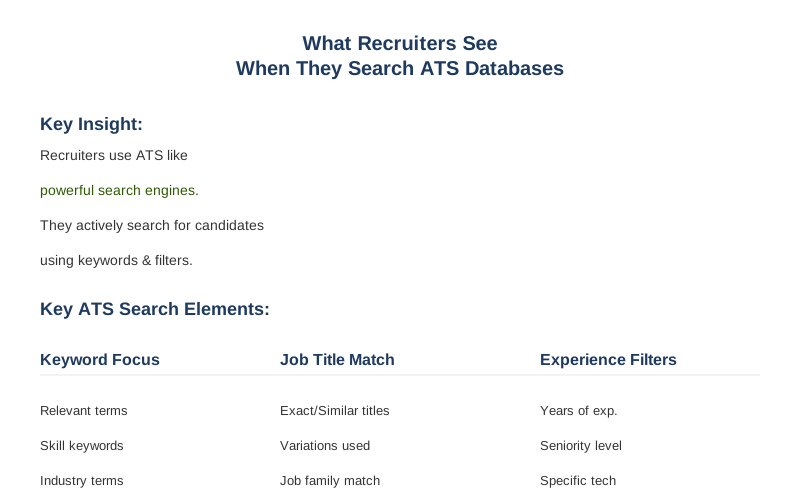
Recruiters treat ATS databases like powerful search engines, not magical resume sorters. They are actively searching for candidates using specific keywords and filters, making a candidate's ability to be found paramount.
When recruiters search ATS databases, they aren't just passively waiting for matches to appear. They are actively engaging with the system like a database search engine, inputting keywords, job titles, and experience ranges to find the most relevant candidates like a database. The ATS's primary function in this context is to efficiently retrieve this information, rather than making complex judgments on its own.
The core functionality recruiters rely on is CV parsing to extract key data points like names, contact information, and work history accurately so they can actually search later. This parsed data then populates searchable fields within the ATS. While some systems might offer scoring, the fundamental action is a direct query for specific information.
A 2025 recruiter study found that the vast majority of recruiters manually review applications; the ATS simply helps them sort and prioritize sort and prioritize. This means that while the ATS may flag potential matches, the recruiter is still the ultimate decision-maker, scanning the results to identify promising candidates. The system's goal is to reduce the noise, not eliminate the human element.
Recruiters need the ATS to be a fast and reliable search tool. Features like CV parsing, candidate searching, and applicant status tracking are essential for their day-to-day workflow essential. They are looking for systems that allow them to quickly find qualified individuals within their existing talent pool, making the recruiter ATS search a proactive process.
Essentially, the ATS acts as a centralized repository of candidate data, enabling recruiters to efficiently query this information. When recruiters search ATS databases, they are performing targeted searches to identify candidates who meet specific criteria, which is why optimizing your resume for keyword inclusion is crucial for discoverability.

- Senior Software Engineer at a Series B Startup A recruiter searches for "Senior Software Engineer" with keywords like "Python," "AWS," and "Kubernetes," filtering by 5-7 years of experience and specific tech stacks. What worked: A resume clearly listing these keywords, along with quantifiable achievements in project scalability and team leadership, surfaced the candidate for review. What didn't: A generic resume lacking specific tech terms or focusing only on outdated technologies meant the candidate was buried deep in the ATS database. Recruiters rely on precise keyword matches for their recruiter ATS search. Source
- Entry-Level Data Analyst at a Fortune 500 The recruiter inputs "Data Analyst," "SQL," "Excel," and "Tableau," setting the experience to "0-2 years." What worked: A resume highlighting academic projects involving data analysis, proficiency in relevant software, and any internships or volunteer work demonstrating analytical skills got flagged. The ATS parsed these skills accurately. What didn't: A resume with a broad skill set but no specific mention of data analysis tools or projects, or one heavily focused on administrative tasks, failed to meet the search criteria. Source
- Career Changer from Teaching to Product Management A recruiter searches for "Product Manager" with keywords like "Agile," "Roadmap," "Stakeholder Management," and "User Stories," but might also include "Project Management" or "Curriculum Development" as secondary terms. What worked: A resume that strategically translated teaching experience into product management competencies, emphasizing skills like communication, planning, and problem-solving, and clearly listing any relevant certifications or bootcamps, had a better chance of appearing. What didn't: A resume that strictly adhered to teaching terminology without bridging the gap to product management skills was unlikely to match the recruiter's search parameters. The ATS simply looks for direct keyword matches. Source

- The most crucial takeaway from any recruiter ATS search is that the system is fundamentally a database. Recruiters actively query it using keywords, job titles, and experience filters, much like any other search engine Source. Your resume needs to be a direct match to be surfaced.
- ATS systems are primarily built for efficiency, focusing on core functionalities like CV parsing, candidate searching, and status tracking Source. While advanced AI features are emerging, the majority of recruiters still rely on these fundamental capabilities to manage their candidate pools.
- A 2025 recruiter study found that the vast majority of recruiters manually review applications, with the ATS serving as a crucial tool for sorting and prioritizing candidates Source. This means the initial ATS screening is your gatekeeper; if it fails, a human never sees your application.
- Recruiters are looking for clear, concise information that directly maps to the job requirements. Overly complex formatting or jargon can hinder the ATS's ability to parse your resume accurately, burying your qualifications Source.
- The single most important thing a recruiter would tell you off the record? Keywords are king, and relevance is everything. If your resume doesn't explicitly contain the terms recruiters are searching for, you simply won't be found in the ATS database.
Frequently Asked Questions
How do recruiters actually search for candidates in an ATS?
What information does an ATS extract from my resume that recruiters can see?
Do recruiters manually review every resume, or does the ATS filter them first?
What makes a resume 'visible' or 'invisible' to a recruiter searching an ATS?
Besides keywords, what other filters do recruiters use when searching ATS databases?
Can recruiters see my past applications within the ATS if I apply for multiple roles?
How important is CV parsing accuracy for recruiters using an ATS?
Do recruiters rely on AI scoring or weighted formulas within the ATS?
Sources
- I spent 8 months testing how ATS systems actually parse resumes
- linkedin.com
- Here are 10 ATS myths debunked by a recruiter who's used 5+ ...
- What Is an ATS? 2026 Guide to Applicant Tracking Systems?
- adeptiq.be
- Top 10 ATS systems: The ultimate recruiter's guide - PeopleForce
- What Recruiters Actually Need in an ATS: Our 2026 Survey - Adeptiq
- top-free-resume-score-checkers-to-boost-your-job-search
- careerkit.me
- Free Resume Score Checkers: What They Actually Check (2026 ...