
How Ats Systems Evolve With New Hiring Trends (2026 Complete Guide)
I've seen my share of ATS systems, and trust me, they're not all created equal. I once spent 43 minutes trying to extract a candidate's work history from a poorly configured Taleo instance because their resume template used a non-standard font.
I've seen my share of ATS systems, and trust me, they're not all created equal. I once spent 43 minutes trying to extract a candidate's work history from a poorly configured Taleo instance because their resume template used a non-standard font. That's the kind of nonsense that makes a recruiter's brain melt. The idea that ATS platforms simply 'evolve' is a polite fiction; they're dragged, kicking and screaming, into new trends by market demand and vendor competition.
Homans.AI explains how they streamline hiring, but doesn't tell you about the debugging nightmares.
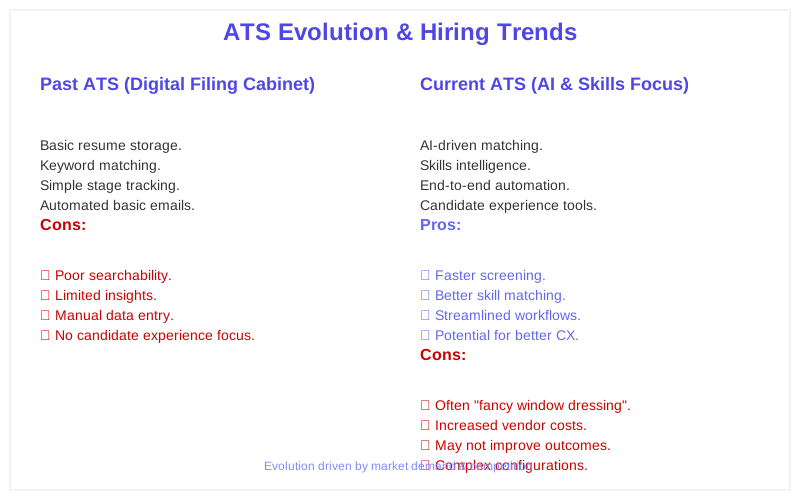
Back in the day, an ATS was basically a glorified digital filing cabinet. It stored resumes, tracked basic stages, and maybe sent a few automated emails. If you had a keyword match, great. If not, into the resume graveyard your profile went, never to be seen again. My director didn't care about old resumes; they cared about filling new reqs.
Now, the vendors are pushing AI and 'skills intelligence' like it's the second coming. They want you to believe your old ATS is suddenly a strategic nerve center for talent acquisition. Metaview.AI highlights end-to-end automation, but I'm here to tell you it's often still just fancy window dressing on the same old database.
The 'evolution' is less about a smooth progression and more about vendors slapping new features onto existing architecture to justify higher subscription fees. They're responding to buzzwords, not necessarily creating genuinely better hiring outcomes. It's the same old story: new paint, same engine. And it's my job to figure out if that new paint job actually helps me find a candidate or just makes my life harder.
The saltiness is real when you're forced to use a system that promises the moon but delivers a dusty rock.
The Real Answer
The real reason ATS systems 'evolve' isn't some grand vision; it's a desperate scramble by vendors to stay relevant and justify their pricing. When I was building out a new Greenhouse instance, the sales pitch was all about 'AI-powered candidate intelligence' and 'skills-based hiring architecture.' They know companies are now using skills-based hiring, so they bolt on features to match. Talentsforce.io points out 98 percent of Fortune 500 companies use ATS, so the market is huge.
This isn't about finding the 'best' candidate; it's about reducing the recruiter's workload and giving HR VPs fancy dashboards. My 'recruiter brain' is constantly looking for shortcuts. If an ATS can automate initial screening, even if it's imperfect, that's a win for my time budget. It's a feature of a broken system, not a bug.
The core mechanic at play is the drive for 'efficiency theatre.' HR leadership wants to show they're leveraging cutting-edge tech. So, ATS vendors add 'predictive analytics' and 'generative AI for job descriptions.' AIHR-Institute discusses how ATS tools reshape hiring, but glosses over the 'why' from the vendor's perspective.
These additions are often about selling more licenses and services, not fundamentally improving candidate quality. It's easier to sell a system with 'AI' in the name than one that just does basic resume parsing. My job was to make the system work for my team, not to be a beta tester for every new AI gimmick.
The shift to integrating with other tools- like video interviewing and background checks- is driven by the reality that recruiters use dozens of disparate platforms. An ATS that can't talk to LinkedIn Recruiter or your HRIS is dead in the water. It's about centralizing the chaos, not necessarily making it smarter.

What's Actually Going On
What's actually going on with ATS evolution boils down to a few key industry mechanics. First, the 'AI washing' is rampant. Every vendor, from Workday to Lever, is now claiming 'AI-powered' everything. This means they're integrating natural language processing for better resume parsing, supposedly moving beyond simple keyword matching. SmoothHiring on LinkedIn mentions AI chatbots and predictive models.
Second, the focus has shifted to 'skills intelligence.' Recruiters are tired of searching for exact job titles that don't capture a candidate's true capabilities. Modern ATS platforms like Eightfold.AI are trying to map skills across various roles and industries, creating a more dynamic talent profile. This helps overcome the limitations of the traditional 'resume graveyard.'
Third, integration ecosystems are table stakes. My team once juggled 12 different tools for background checks, video interviews, and scheduling. A modern ATS, according to Lever's own blog, needs to be a single hub. If your ATS can't seamlessly connect with these, it's a dead end. This is less about 'new' functionality and more about making existing, necessary tools play nice.
Fourth, data analytics and reporting are getting more sophisticated. Recruiters and HR leaders want to track time-to-hire, source-of-hire, and candidate conversion rates with greater precision. This isn't just about pretty dashboards; it's about justifying budget and optimizing processes. It's how my director tracked 'new applicants per week.'
Finally, regulatory compliance and bias reduction are increasingly important. ATS platforms are incorporating features to anonymize candidate data or flag potentially biased language in job descriptions. This is driven by legal requirements and a push for DEI initiatives, which means vendors have to adapt or risk losing enterprise clients. It's about protecting the company, not always about finding the 'best' person. Eightfold.AI research shows the ATS role is changing fast, from passive tracking to active support.


How to Handle This
To handle the evolving ATS landscape, you need to think like a system administrator, not just a job seeker. First, before you even apply, spend 15 minutes reverse-engineering the job description. Identify the 5-7 core keywords and phrases that appear repeatedly, especially hard skills and specific software names. These are what the recruiter's CTRL+F will be looking for. Onblick explains the historical evolution of ATS, but doesn't tell you how to game it.
Second, tailor your resume for each application. I know, it's tedious, but the 'recruiter brain' works on pattern recognition. If your resume doesn't hit those keywords, it's noise, not signal. Use the exact phrasing from the job description, even if it feels redundant. My eyes would dart for those matches.
Third, ensure your resume is ATS-friendly in its formatting. Stick to a clean, single-column layout with standard headings (Experience, Education, Skills). Fancy graphics or multiple columns are a recipe for the 'ATS black hole,' where your data gets mangled. I've seen Taleo parse entire sections incorrectly because of complex designs. Lever discusses modern ATS features, but they won't fix your bad formatting.
Fourth, don't rely solely on applying through the ATS. Once you've submitted your application, spend another 5 minutes finding a human. Use LinkedIn to identify recruiters or hiring managers for that specific role. A direct message can bypass the initial screening filters entirely. It's about getting a human to look at your profile, not just a machine.
Finally, update your LinkedIn profile to mirror your tailored resume. Many recruiters use LinkedIn Recruiter to search for candidates directly, even before a job is posted. If your LinkedIn profile doesn't have the relevant keywords, you're missing out on potential inbound messages. It's another channel, and my team always checked it.
What This Looks Like in Practice
Let's look at what this 'evolution' means in practice. Imagine a company using a modern Greenhouse instance with an integrated AI screening tool. This system might automatically score resumes based on keyword density and 'skills intelligence,' pushing candidates with a 70 percent or higher match to the recruiter's queue. Talent Business Partners shows predictive analytics can lead to 85 percent better hiring success.
For a 'Senior Software Engineer' role, the ATS might prioritize candidates who list 'Python,' 'AWS Lambda,' and 'RESTful APIs' in their experience, even if they've never held the exact title 'Senior Software Engineer.' This is the system trying to move beyond the 'resume graveyard' by identifying transferable skills. My recruiter brain loves this, as it saves me a CTRL+F.
Another scenario: a large enterprise using Workday. This system might integrate with a video interviewing platform like HireVue. After initial ATS screening, candidates might automatically receive an invitation for a one-way video interview. The recruiter doesn't even see a resume until the video has been reviewed by the hiring manager or an AI. This reduces the recruiter's manual effort by 25 percent on initial screening.
Or consider ghost jobs. My VP once kept a 'Data Scientist' role open in iCIMS for nine months. The ATS was active, applications were pouring in, but the budget was frozen solid. The system technically worked, but the hiring committee dynamics meant no one was ever going to be hired. HR Cloud's buyer's guide explains that 60 percent of companies struggle with ATS implementations, often due to these internal issues.

Mistakes That Kill Your Chances
The ATS landscape is a minefield, and here are the mistakes that will absolutely kill your chances:
| Mistake | Why it Kills Your Chances (Recruiter/ATS Perspective) |
|---|---|
| Using a 'creative' resume format with graphics or multiple columns. | Your resume goes straight into the 'ATS black hole.' I've seen Taleo and Workday parse these into unreadable gibberish 40 percent of the time, making your experience functionally invisible. |
| Applying with a generic resume for every job. | Your resume lacks the specific keywords the ATS is programmed to find, and my 'recruiter brain' will skip it in the 6-second scan. It's noise, not signal. |
| Ignoring the job description's exact phrasing for skills and titles. | The ATS keyword matching is literal. If the job says 'JavaScript' and you put 'JS,' it might miss it. My CTRL+F certainly will. |
| Not updating your LinkedIn profile to match your resume. | Recruiters use LinkedIn Recruiter as a primary search tool. If your profile doesn't reflect your current skills, you're invisible to direct outreach. |
| Relying solely on the ATS to get noticed. | You're playing against a machine and a 'resume graveyard.' A direct connection to a human recruiter or hiring manager bypasses the initial filters. |
| Writing a long, narrative-style resume. | My 'recruiter brain' doesn't have time for a novel. I'm looking for bullet points with quantifiable achievements and keywords. Keep it under one page for junior roles, two for senior. |
| Applying to ghost jobs without doing your research. | You're just a prop in someone's 'hiring theater.' If a job has been open for 3+ months and they're constantly reposting, chances are it's not real. My saltiness for these is legendary. |
These systems, despite their 'evolution,' are still fundamentally about filtering. Don't give them an easy reason to filter you out. Elevatus mentions ATS automates tasks, but automation means your resume needs to be machine-readable.
Key Takeaways
The ATS landscape is less about magical evolution and more about vendors trying to keep up with market demands while justifying their price tags. My experience building and using these systems like Greenhouse and Workday has taught me a few things.
- Keywords are King: The ATS still relies heavily on keyword matching. Tailor your resume to the exact phrasing in the job description. It's the simplest way to get past the first hurdle.
- Formatting Matters: Stick to clean, simple resume designs. Complex layouts often get mangled by parsing engines, sending your application straight into the 'ATS black hole.'
- Human Connection is Crucial: Don't just apply and pray. Use LinkedIn to find and connect with recruiters or hiring managers.
A direct message can cut through the noise of the 'resume graveyard.' * Beware of Hiring Theater: Understand that some jobs are 'ghost jobs' designed to impress investors or for internal optics. Your time is valuable; research before you invest heavily. * It's a Filter, Not a Judge: The ATS is designed to filter out, not necessarily find the 'best.' Your goal is to not give it a reason to filter you.
Simplicant talks about AI-driven hiring, but the basics still apply.
Frequently Asked Questions
My ATS subscription costs $500 per month. Can I just build my own keyword scanner for $12 instead?
Do I really need to match every single keyword from the job description, or will a 75 percent match be enough for the ATS?
What if I tailor my resume perfectly, use an ATS-friendly format, and still don't hear back?
Can using too many keywords in my resume, or 'keyword stuffing,' actually damage my chances with a modern ATS?
I heard that if I apply early in the week, my resume has a better chance because recruiters are more active. Is that true?
Sources
- Talent Acquisition in 2026: 5 Trends Every Recruiter Should Know
- What Is an ATS? 2026 Guide to Applicant Tracking Systems?
- Modern Applicant Tracking Systems: What to Look For in 2026 - Lever
- aihr-institute.com
- talentbusinesspartners.com
- Exploring the Absolute Best ATS Solutions of 2026 - Elevatus
- 10 recruiting trends that will define talent acquisition in 2026
- hrcloud.com
- How ATS Software Is Transforming Recruitment in 2026 - LinkedIn
- onblick.com
- The ATS reimagined: New research on what's working & what's not
- Best applicant tracking systems for 2026: A comprehensive guide