
A Day in the Life of an Applied AI/ML Engineer (2026 Complete Guide)
You just spent 43 minutes debugging a `KeyError` in a Pandas DataFrame that was supposed to be a 'clean' input to your new model. The job posting said 'innovate with large language models,' but what LinkedIn won't tell you is that innovation often starts with screaming at a CSV.
You just spent 43 minutes debugging a KeyError in a Pandas DataFrame that was supposed to be a 'clean' input to your new model. The job posting said 'innovate with large language models,' but what LinkedIn won't tell you is that innovation often starts with screaming at a CSV. I've been there, staring at a blank screen wondering if I signed up for data janitorial services or AI engineering.
Becoming an AI Engineer in 2026: A Real Roadmap highlights that fundamentals matter, but the operational reality is far grittier.
The Real Answer
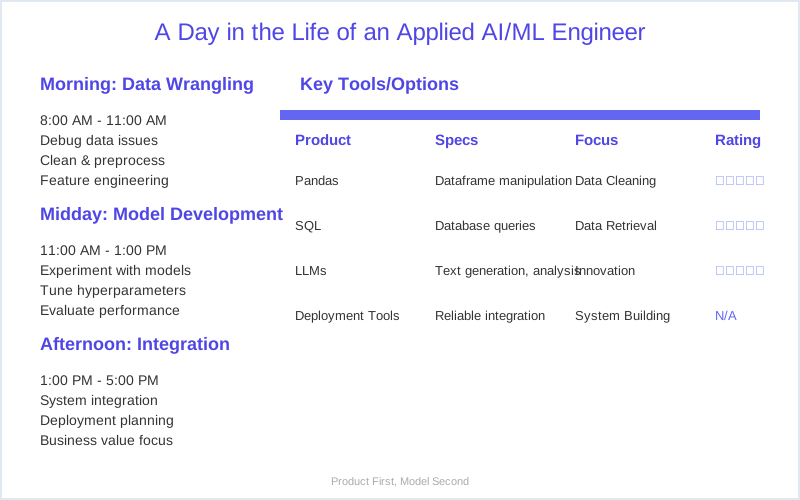
The actual job of an applied AI/ML engineer isn't about conjuring models from thin air; it's about wrestling data into submission and then making sure your code plays nice with everyone else's. The core mental model is 'product first, model second.' You're not a researcher pushing state-of-the-art accuracy, you're building systems that work and deliver tangible business value. How to Become an AI Engineer FAST (2026) might tell you to learn Python, but it misses the point.
What's Actually Going On
What's actually going on in the market is a massive disconnect between hype and reality. IBM found that 40 percent of companies adopting AI cite a lack of AI engineering skills as their biggest barrier. This isn't because people can't train a model; it's because they can't deploy one reliably or integrate it into existing systems.
What Does an AI Engineer Do? points out that 'AI engineer' is one of the most inconsistently defined roles in tech, which means you're often walking into a messy situation.


How to Handle This
To handle this, you need a targeted action plan, not just a list of buzzwords. First, spend 2-3 months mastering SQL and data manipulation. Seriously. I've seen junior engineers paid $120,000 who couldn't write a proper join. You'll query more than you code, especially for feature engineering. A Day in the Life of an AI Engineer emphasizes that it's a mix of technical tasks.


What This Looks Like in Practice
What this looks like in practice is less about groundbreaking research and more about incremental improvements and bulletproof pipelines. Your model might achieve 88 percent accuracy, but if the data pipeline feeding it breaks 15 percent of the time, that accuracy is worthless. I've spent entire weeks optimizing a data ingestion process from 3 hours down to 20 minutes, which had a far bigger business impact than any model tweak.
Building the AI Roadmap for 2026 discusses fine-tuning and traditional ML systems, but the infrastructure around them is the real work.


Mistakes That Kill Your Chances
| Mistake | Why It Kills Your Chances | The Operational Reality |
|---|---|---|
| Obsessing over LeetCode hard problems | Signals you value theoretical puzzles over practical problem-solving. | Your first PR will get rejected 3 times for style, not algorithmic complexity. |
| Only building models in Jupyter notebooks | Shows you don't understand production environments or deployment. | Production doesn't care about your Jupyter notebook. It needs Docker, Kubernetes, and CI/CD. |
| Ignoring SQL and data engineering fundamentals | You'll be useless for 60 percent of the job, which is data prep and pipelines. | You'll spend more time debugging Airflow DAGs than tuning hyperparameters. |
| Thinking model accuracy is the only metric | Misses the point of business value, scalability, and maintainability. | A 95 percent accurate model that costs $1000/hour to run is often worse than an 80 percent accurate model that costs $10. |
| Focusing solely on LLMs without understanding core ML | Signals you're chasing hype, not building foundational knowledge. | LLMs are tools. Understanding regression, classification, and feature engineering makes you adaptable. AI Engineer Roadmap 2026: The Complete Skill Stack covers ML data preparation for a reason. |
| Poor communication skills | You can't translate technical work into business impact. | I've seen brilliant researchers fail because they couldn't explain F1 scores to a VP. |
Key Takeaways
The AI career landscape is a minefield of conflicting advice, but the signal vs hype filter is simple: focus on what makes a system work in the real world, not just what makes a model look good on a benchmark. The unglamorous 80 percent of the job - data cleaning, pipeline maintenance, stakeholder management - is where the actual value lies.
A Day in the Life of an AI Engineer paints a picture, but it's the invisible work that defines your day. This is the pivot tax, and it's real. But two years in, I'm back above my old salary and solving problems I actually care about. It's worth it. Just don't expect it to look like LinkedIn.
Frequently Asked Questions
What's the actual cost difference between self-learning Python for ML versus a typical bootcamp?
Do I really need to master Docker and Kubernetes if I'm just starting out?
What if I spend months building a portfolio project, and it still doesn't get me interviews?
Can I permanently damage my career prospects by focusing too much on niche AI research instead of applied engineering?
Is it true that AI will automate all the 'grunt work' like data cleaning and feature engineering soon?
Sources
- Building the AI Roadmap for 2026 - The Neural Maze
- What Does an AI Engineer Do? (2026 Guide for Beginners ...
- AI Engineer Roadmap 2026: The Complete Skill Stack (2 ... - YouTube
- How to Become an AI Engineer FAST (2026) - YouTube
- Becoming an AI Engineer in 2026: A Real Roadmap - LinkedIn
- A Day in the Life of an AI Engineer
- A Day in the Life of an AI Engineer | by Fahmi Adam, MBA | Medium