
Demystifying AI Specializations: NLP, Computer Vision, Reinforcement Learning Careers (2026 Complete Guide)
I once sat through a 43-minute meeting debating the optimal learning rate for a model that was, frankly, never going to production. That's the signal vs hype of AI specializations: everyone wants to talk about the cool algorithms, but the actual job is often far less glamorous.
I once sat through a 43-minute meeting debating the optimal learning rate for a model that was, frankly, never going to production. That's the signal vs hype of AI specializations: everyone wants to talk about the cool algorithms, but the actual job is often far less glamorous. LinkedIn posts show folks celebrating a new model, not the three weeks they spent wrestling with data schema mismatches.
I've seen too many people dive into a specialization without understanding what the day-to-day actually involves. They chase the 'hot' field only to discover it's 80 percent data labeling or obscure library debugging. The bootcamp ads promising '$200K salaries in 12 weeks' are selling a fantasy, especially if you're not clear on your niche. Employers increasingly seek specialists, yes, but they also want someone who can actually deliver.
Understanding the operational reality of NLP, Computer Vision, or Reinforcement Learning is crucial before you commit. It's not just about the algorithms; it's about the data, the infrastructure, and the sheer grit required to make something work in the real world. Don't fall for the highlight reel. My goal here is to give you the unvarnished truth about these paths, what the real requirements are, and where your time will actually go. Forget the glossy brochures.
Let's talk about the pivot tax and the dirty work.
The Real Answer
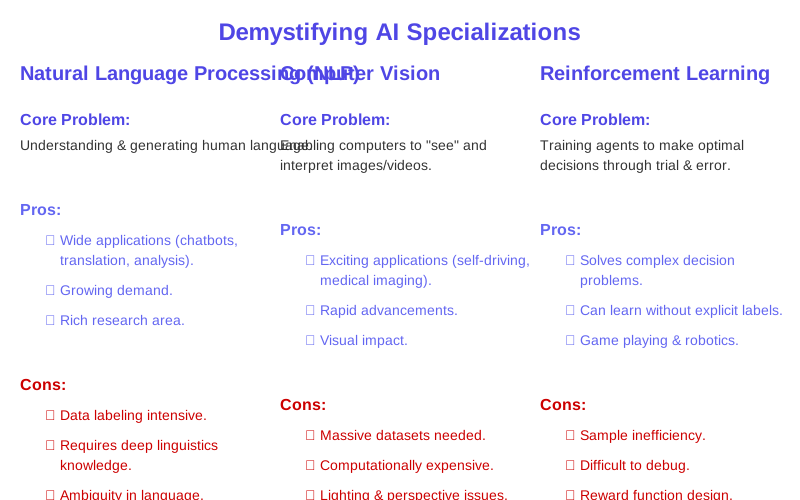
The real answer to navigating AI specializations is understanding the core problem each field tries to solve, not just the fancy models. NLP, Computer Vision, and Reinforcement Learning aren't just collections of algorithms; they're fundamentally different approaches to different types of data and decision-making. Machine learning, at its core, is about making useful predictions. The 'why' behind choosing one over the other boils down to the input data and the desired output.
If your data is text - customer reviews, legal documents, chatbot conversations - you're probably looking at NLP. If it's images or video - security footage, medical scans, autonomous driving - then Computer Vision is your domain. If you're trying to optimize a system through trial and error, like robot navigation or financial trading, Reinforcement Learning is the path. This isn't about memorizing definitions; it's about framing business problems.
I've seen companies throw Computer Vision engineers at text classification problems because 'AI is AI,' and then wonder why nothing works. The actual job involves recognizing these fundamental distinctions. Learning AI from scratch means understanding these foundational differences. You need to develop a mental model where each specialization is a specialized tool in a larger toolbox, not just a cooler version of the last one. It's about knowing when to grab the wrench versus the screwdriver.


What's Actually Going On
What's actually going on in the industry is a push for focused expertise, but the day-to-day job still involves a lot of undifferentiated heavy lifting. For NLP roles, you're not just fine-tuning BERT models. You're cleaning messy text data, dealing with tokenization issues, and often building custom pre-processing pipelines. Natural Language Processing (NLP) algorithms teach computers to understand human language. This involves more SQL for text data extraction and feature engineering than you'd expect.
Compensation for a mid-level NLP Engineer might start at $120,000, but that's for someone who can actually get a model into production, not just train it on a clean dataset. Computer Vision, similarly, isn't just about deploying YOLO or ResNet. The unglamorous part is often managing massive image datasets, dealing with annotation inconsistencies, and optimizing models for edge devices with limited compute. I've spent days debugging why a camera feed was dropping frames, which directly impacted model performance.
Deep learning is a core concept here, but so is understanding hardware limitations. Reinforcement Learning is perhaps the most research-heavy and least production-ready for most businesses outside of specific niches like robotics or complex optimization. The actual job involves extensive simulation environments, hyperparameter tuning that feels like black magic, and a deep understanding of control theory.
These roles often command higher salaries, sometimes starting at $150,000, but the demand is narrower and the skill gap for true production-ready RL is significant. Regulatory facts also play a huge role; explainability requirements for NLP models in finance or CV models in healthcare are a massive part of the job that LinkedIn won't tell you.


How to Handle This
So, how do you actually get into one of these specializations? First, accept the pivot tax. It's real. I recommend starting with a strong foundational course in general machine learning. Andrew Ng's original Stanford course or the Deep Learning Specialization on Coursera are still gold standards. Many experts suggest the MLS and then DLS courses. My experience: DLS first then MLS for practice. For NLP, after foundational ML, dive into specific courses like 'Natural Language Processing Specialization' on Coursera.
You'll spend 10-15 hours a week for 4-6 months. Cost: $49/month for Coursera, so about $200-300 total. Look for courses that emphasize practical application, not just theory. Ask yourself: 'Does this course teach me how to build a working chatbot or just explain transformers?' For Computer Vision, the 'Deep Learning Specialization' also covers it, but then follow up with specific CV courses, perhaps from fast.AI or university extensions. Again, expect 4-6 months of dedicated study, same cost range.
Focus on understanding image preprocessing, augmentation, and model architectures like CNNs. NLP algorithms are critical for understanding human language. Reinforcement Learning is tougher to self-teach effectively without a strong math background. If you're serious, look for university extension courses or specialized bootcamps. These can run $5,000-$15,000 and take 6-12 months. When evaluating any course, ask: 'What specific projects will I build?
Can I deploy them to a cloud platform?' Demystifying building NLP models isn't about watching videos; it's about doing. The 'how to do it' is always about getting your hands dirty with real data and real code, not just theory.


What This Looks Like in Practice
In practice, these specializations manifest in very different day-to-day realities. For an NLP Engineer at a large e-commerce company, your week might involve 30 percent data labeling review, 40 percent debugging a sentiment analysis pipeline that's misclassifying customer complaints, and 30 percent optimizing inference speed for a chatbot. Your success metrics are often 'reduction in manual review time' or 'increase in customer satisfaction score' by 0.5 percent. AI/ML Engineers are building core models.
A Computer Vision Engineer at a drone company might spend 50 percent of their time annotating aerial imagery, 30 percent optimizing model size for onboard processing, and 20 percent explaining why a model misidentified a tree as a person to a non-technical manager. Key metrics: 'detection accuracy' on specific object classes, 'inference latency' on target hardware, and 'false positive rate'. Reinforcement Learning is often less about direct production deployment in many companies.
An RL Researcher at a financial firm might spend 70 percent of their time designing new reward functions for a trading agent in a simulated environment, 20 percent analyzing simulation results, and 10 percent presenting findings to quant traders. Metrics here are 'portfolio return improvement' in simulation or 'reduction in risk exposure'. The unglamorous 80 percent of the role is rarely about model accuracy graphs; it's about data quality, infrastructure, and stakeholder management.


Mistakes That Kill Your Chances
| Mistake | Why it Kills Your Chances | The Operational Reality |
|---|---|---|
| Focusing solely on algorithms | Ignores the 80 percent data prep and deployment. | You'll spend more time cleaning CSVs than coding models. |
| Skipping foundational software skills | Production doesn't care about your Jupyter notebook. | SQL, Git, Docker are non-negotiable for any ML role. |
| Ignoring communication & business impact | Brilliant models fail if they can't be explained to VPs. | Translating F1 scores into dollar signs is paramount. |
| Chasing 'hot' tech without passion | You'll burn out during the unglamorous parts. | The actual job involves a lot of tedious debugging. |
| Not building a real-world portfolio | Bootcamp certificates are not enough. | Your portfolio needs projects that actually work on real data. |
| Underestimating the 'pivot tax' | Expect a pay cut and longer job search. | My 8-month pivot took a 15 percent pay cut initially. AI offers diverse career opportunities, but requires dedication. |
Key Takeaways
To wrap this up, chasing AI specializations without understanding the operational reality is a fast track to disappointment. My goal is to improve my UX skills and help others in the community. The LinkedIn posts showing someone's model accuracy graph? That was a good Tuesday. The other four days were spent figuring out why the feature store was returning nulls for 12 percent of production traffic. Don't be fooled by the hype.
The real requirements involve a deep understanding of data, robust engineering skills, and the ability to translate technical jargon into business value. The pivot tax is real, but so is the satisfaction of building something that actually works. Focus on practical skills, build a portfolio that solves real problems, and be prepared for the unglamorous 80 percent. That's where the actual job gets done.
Frequently Asked Questions
I saw an online course for $19.99 that promises to make me an NLP expert in a weekend. Is that legit?
Do I really need to master SQL if I want to be a Computer Vision Engineer? I thought it was all about images.
What if I pick a specialization like Reinforcement Learning, spend a year learning it, and then realize there are no jobs in my area?
Can focusing too narrowly on one AI specialization, like just NLP, permanently damage my career prospects by making me too niche?
Is it true that if I know PyTorch, I don't need to learn TensorFlow?
Sources
- 9 Essential AI Specialization Courses to Boost Your Career in 2026
- What you need to know before taking the ML course by Stanford
- Guide for Machine Learning, NLP, Computer Vision - AI Discussions
- Demystifying Types of AI | AI for Decision Makers
- AI Roles Evolve in 2026: Specialization at Scale - LinkedIn
- Demystifying Building Natural Language Processing ML Models and ...
- Demystifying AI: The Ultimate Beginner's Guide to Core Concepts
- How to Learn AI From Scratch
- Demystifying NLP Algorithms: A Comprehensive Guide
- How to Learn Artificial Intelligence in 2026
- Demystifying AI: From Machine Learning to the Future of Natural ...