
Beyond Prompt Engineering Niche AI Roles Emerging Now (2026 Complete Guide)
I remember seeing a job posting for 'Prompt Engineer' offering '$175,000' and thinking, 'This is either a typo or someone's selling snake oil.' Turns out, it was a bit of both. The LinkedIn posts showing people 'crafting prompts' are the highlight reel, not the 43 minutes spent in a meeting explaining why a hallucination happened.
I remember seeing a job posting for 'Prompt Engineer' offering '$175,000' and thinking, 'This is either a typo or someone's selling snake oil.' Turns out, it was a bit of both. The LinkedIn posts showing people 'crafting prompts' are the highlight reel, not the 43 minutes spent in a meeting explaining why a hallucination happened. Upwork's guide might make it sound straightforward, but the actual job is a lot messier.
The hype around prompt engineering was deafening. Everyone thought they could just type better questions and suddenly be indispensable. I saw bootcamps popping up, promising '$200K salaries in 12 weeks' for what amounted to glorified Google searching. It was a gold rush, but most of the prospectors were sifting sand. This YouTube video on AI writing teams hinted at a deeper reality, but few were listening.
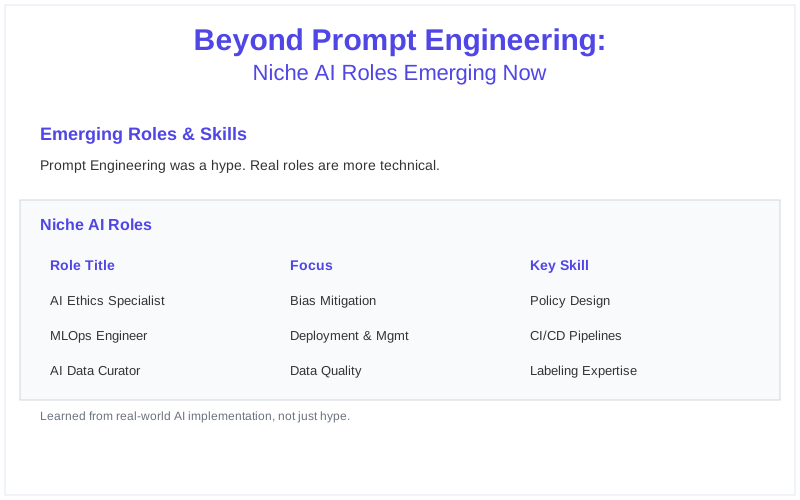
The unglamorous part of this 'new' role quickly became apparent. It wasn't about finding the magic words; it was about understanding model limitations, data biases, and deployment headaches. The signal vs hype was clear to anyone actually working with these systems day-to-day. You can dress it up, but a glorified QA role is still QA.
Companies were dabbling, but few were building core products around prompt engineering as a standalone role. It was often an add-on, a skill, not a career path with deep progression. The real requirements were always more technical than the ads let on. And the pivot tax for those chasing the dream? Brutal, in many cases.
The Real Answer
The 'prompt engineer' as a standalone, highly paid role was largely a mirage. It was a critical skill, absolutely, but rarely a full-time, dedicated position for more than a handful of specialized companies. Most organizations quickly integrated prompting into existing roles like ML engineering, data science, or even product management. Medium articles tried to create a hierarchy, but reality moved faster.
What actually emerged were roles demanding a much broader skill set. Companies realized that 'talking to the AI' was only 10 percent of the problem. The other 90 percent involved integrating LLMs into existing systems, building robust guardrails, and managing the entire lifecycle. This requires actual engineering.
My mental model for this shift is simple: prompt engineering is a feature, not a product. You don't build a company around a single feature. You build it around a robust system that uses that feature. This is why you see Reddit discussions asking if it was all just hype.
The real answer is that the underlying need for effective AI interaction didn't disappear. It just got absorbed and elevated. Now, it's about AI Engineering, AI Architecture, and roles that require deep technical chops, not just clever phrasing. The 'magic' part of AI needs engineers to make it real.


What's Actually Going On
What's actually going on is a maturation of the AI industry. Companies moved past the 'wow, it generates text!' phase into 'how do we make this reliable, scalable, and secure?' This isn't a pivot; it's an evolution. Refonte Learning highlights AI engineering trends, and they're not about prompt-only roles.
ATS data now prioritizes skills like MLOps, distributed systems, and cloud platforms over just 'prompting.' A job description might mention prompt optimization, but it's usually buried under requirements for Python, Kubernetes, and TensorFlow. The 2026 job market demands engineers who can build, not just converse. LinkedIn's report on fastest-growing skills confirms AI engineering, prompting, and model tuning are surging.
Company-size variations are key here. A small startup might have a 'Prompt Specialist' for a few months to explore use cases, but once they scale, that person needs to become an ML engineer or product manager. Enterprise companies never really bought into the standalone role; they always saw it as a skill for their existing tech teams.
Regulatory facts also play a role. As AI systems become more regulated, the need for robust, auditable, and explainable models increases. This demands engineers who understand the entire stack, not just the input layer. You need to know why the model outputted what it did, not just how to make it say something different. Refonte Learning also notes new roles emerging, but they're deeply technical.
The 'next big thing' isn't a single role, but a suite of integrated capabilities. It's about bridging the gap between raw model output and tangible business value. That bridge is built with code, data pipelines, and robust infrastructure, not just clever prompts. The pay signal for these deeper roles is clear: they command salary premiums.


How to Handle This
First, ditch the idea of 'prompt engineer' as your primary career goal. Think of prompting as a specialized tool in a much larger toolkit. Your first step should be to solidify your core engineering skills. DataCamp talks about prompt engineering's significance, but it's within a broader context.
Next, spend 3-4 months deep-diving into MLOps. Learn Docker, Kubernetes, and CI/CD pipelines. Your Jupyter notebook is cute, but production cares about containerization and automated deployments. This is the unglamorous 80 percent of making AI actually work in the real world.
Then, build a portfolio project that demonstrates end-to-end AI deployment. Don't just fine-tune a model; deploy it, monitor it, and show how you handle model drift. This project should take 2-3 months and involve real-world data, not just textbook examples. It's about proving you can handle the actual job.
For channel specifics, focus on companies building AI products, not just using them. Look for 'AI Engineer,' 'MLOps Engineer,' or 'Applied Scientist' roles. These are the jobs where prompting is a skill, not the entire job description. This video on full-stack devs highlights the need for AI engineering skills.
Finally, dedicate 1-2 months to interviewing and networking. Emphasize your ability to deploy and maintain systems, not just experiment. The pivot tax is real, but showing you understand the full lifecycle will shorten your time in the wilderness. I've seen candidates get hired for less pay because they only focused on the 'fun' part of AI.

What This Looks Like in Practice
In a mid-sized e-commerce company, an 'AI Engineer' spends 40 percent of their week maintaining feature stores and debugging data pipelines. Another 30 percent is dedicated to A/B testing different model versions. Prompt optimization is maybe 15 percent, often integrated into model tuning. The remaining 15 percent is spent in meetings, explaining why the recommendation engine is occasionally suggesting cat food to dog owners. LinkedIn's data shows model tuning as a fast-growing skill.
At a large financial institution, an 'AI Architect' designs the entire LLM infrastructure. This involves selecting cloud providers, setting up security protocols, and ensuring regulatory compliance. Prompting is a design consideration, not a primary task. They're managing a budget of $500,000 for infrastructure alone. They're looking for stability and auditability, not just clever prompts.
For a startup developing a generative AI product, an 'ML Engineer' is responsible for fine-tuning open-source models, deploying them via Kubernetes, and monitoring performance. They might spend 10 percent of their time on prompt experimentation, but the bulk is spent on model training, inference optimization, and integrating with APIs. Paybump lists high-paying AI careers that are deeply technical.
The unglamorous part is constant monitoring. I saw a system that returned 'I cannot fulfill this request' for 12 hours because a downstream API changed its schema. Nobody posted about fixing that, but it was a 3 AM wake-up call for the ML Engineer.


Mistakes That Kill Your Chances
| Mistake | Why It Kills Your Chances | The Reality |
|---|---|---|
| Focusing solely on prompt engineering courses | Signals a lack of understanding of the broader AI ecosystem. Companies need builders, not just communicators. | Prompting is a skill, not a standalone career. It's like only learning how to use a screwdriver when you need to build a house. |
| Ignoring MLOps and deployment skills | Your brilliant model is useless if it can't be reliably deployed, monitored, and scaled in production. | The actual job involves debugging Airflow DAGs, managing Kubernetes clusters, and ensuring uptime. Nobody posts about that. |
| Lack of understanding of data pipelines | Garbage in, garbage out. If you can't ensure clean, consistent data, your models will fail spectacularly. | You will spend more time cleaning CSVs and writing SQL queries than crafting prompts. SQL is king. |
| Expecting rapid career progression in a 'prompt' role | The 'prompt engineer' role has limited upward mobility without broader technical skills. It's often a stepping stone, not a destination. | The pivot tax is real. True advancement comes from mastering the entire AI lifecycle, not just one input method. |
| Believing AI is magic and not math/engineering | Shows a fundamental misunderstanding of how AI systems actually work under the hood. | The math matters. Understanding model limitations, bias, and explainability requires a solid grasp of fundamentals. |
| Not building end-to-end projects | Bootcamp projects often stop at model training. Real-world applications require deployment, monitoring, and iteration. | Your portfolio needs to show you can take a model from concept to production, warts and all. LinkedIn guides often miss this nuance. |
Key Takeaways
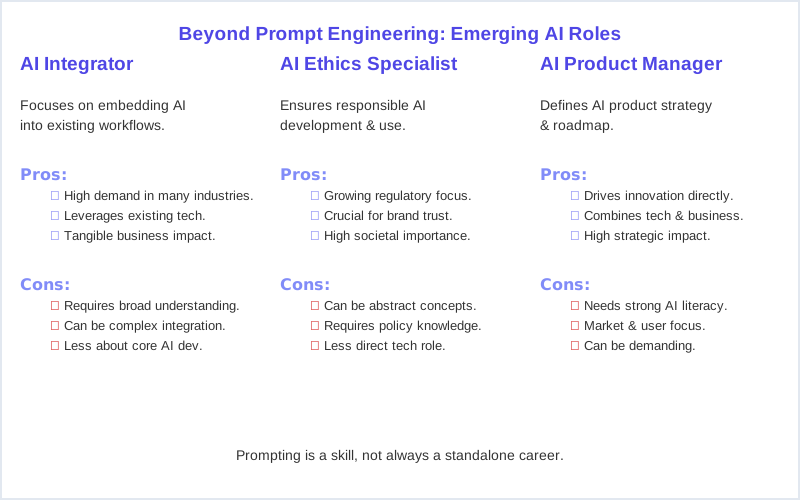
The prompt engineering hype cycle has largely passed. The signal vs hype is now clear: it's a valuable skill, but not a standalone career for most. The actual job involves a much broader, deeper technical skill set. IBM's guide acknowledges its importance but within a comprehensive AI framework.
Key Takeaways: - 'Prompt Engineer' as a primary job title is rare and often a temporary role. - The real requirements are AI engineering, MLOps, and robust data skills. - You will spend more time debugging systems and cleaning data than 'prompting.' - The pivot tax into true AI roles is substantial, requiring significant upskilling. - Focus on end-to-end system deployment and monitoring for career advancement. - Communication skills, translating F1 scores to business impact, are critical.
Don't chase a fantasy. Chase operational reality. That's where the real opportunities, and real salaries, are found.
Frequently Asked Questions
If I need a prompt for a new LLM feature, should I just hire a prompt engineer, or can my existing team handle it?
Do I really need to learn Docker and Kubernetes if I'm mostly focused on prompt optimization?
What if I spend months learning MLOps and data engineering, but still can't land an AI Engineer role?
Can focusing too much on prompt engineering early in my career permanently damage my long-term AI career prospects?
Is it true that prompt engineers get paid more than traditional software engineers because AI is so new and specialized?
Sources
- Prompt Engineering: The Next Big Thing in AI for 2025
- What is AI Prompt Engineering? Course, Jobs & Salary, Complete ...
- 10-high-paying-ai-careers-that-didn%E2%80%99t-exist-3-years-ago
- What is Prompt Engineering? A Detailed Guide For 2026 | DataCamp
- The 2026 Prompt Engineering Hierarchy: 7 Levels from Beginner to ...
- So was "Prompt Engineering Jobs" just a hype? - Reddit
- AI Engineering in 2026: Trends, Skills, and Career Opportunities
- LinkedIn: AI Engineering, Prompting & Model Tuning Are the Fastest ...
- 5 Core Skills Full-Stack Devs Need to Become an AI Engineer ...
- Prompt Engineering Beyond 2026: Next-Gen AI for Writers - YouTube
- The 2026 Guide to Prompt Engineering | IBM
- How To Become a Prompt Engineer: A 2026 Guide - Upwork