How to Get Past Ats Filters Without Keyword Stuffing (2026 Complete Guide)
RoleAlign Team
13 min read
Prices verified February 2026
Includes Video
You just spent hours perfecting your resume, meticulously detailing every achievement for the Senior Data Analyst role at TechCorp. You hit submit, confident you're a perfect fit. Then, silence. Weeks later, a generic rejection email arrives. The problem? Your meticulously crafted resume never even reached a human hiring manager.
You just spent hours perfecting your resume, meticulously detailing every achievement for the Senior Data Analyst role at TechCorp. You hit submit, confident you're a perfect fit. Then, silence. Weeks later, a generic rejection email arrives. The problem? Your meticulously crafted resume never even reached a human hiring manager. It was likely flagged and discarded by an Applicant Tracking System (ATS) before. This isn't about having the right experience; it's about speaking the system's language. Many believe stuffing your resume with keywords is the answer to beat ATS filters, but modern systems are far smarter than that. In fact, keyword stuffing can be a quick way to get rejected entirely. Understanding how these systems actually work is the first step to ensuring your application gets past the initial screening and into the hands of someone who can appreciate your qualifications. This guide will show you how to effectively get past ATS without resorting to outdated, ineffective tactics.
For instance, a common misconception is that simply repeating a keyword like "data analysis" multiple times will guarantee success. However, ATS algorithms are designed to detect unnatural phrasing and excessive repetition, viewing it as an attempt to manipulate the system. Instead, the focus should be on context and relevance. Modern ATS solutions analyze the context in which keywords are used, looking for genuine demonstrations of skills and responsibilities. This means integrating keywords naturally within your bullet points, ensuring they accurately reflect your experience. For example, instead of just listing "Python," describe a project where you "Utilized Python for advanced data manipulation and statistical modeling, resulting in a 15% improvement in predictive accuracy." This approach not only satisfies the ATS but also provides a more compelling narrative for a human reviewer. Furthermore, the formatting of your resume plays a crucial role. ATS can struggle with complex layouts, graphics, tables, or columns, often misinterpreting or failing to parse this information correctly. Opting for a clean, simple template with standard fonts and clear section headings is essential for ensuring all your hard work is read by the system. Hidden formatting can also be a significant hurdle. Many resumes get filtered by ATS, with some estimates suggesting as high as 80% are filtered. Therefore, understanding these nuances is key to getting your application seen.
Key specifications for How to Get Past ATS Filters Without Keyword Stuffing
## The Real Answer
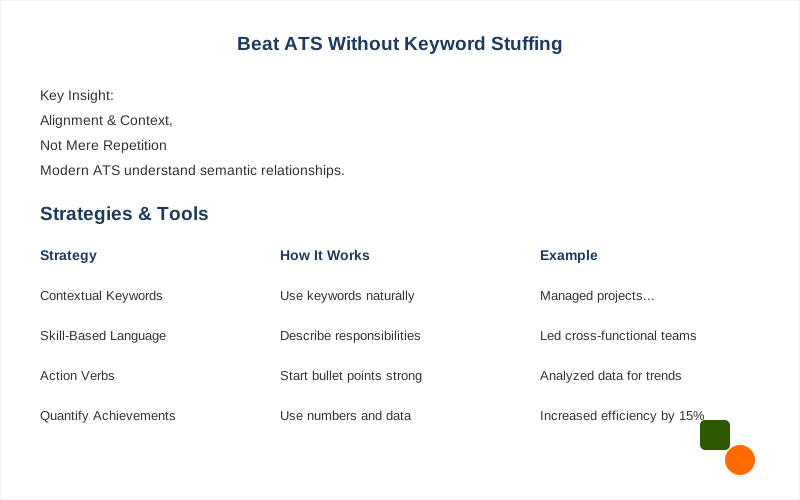
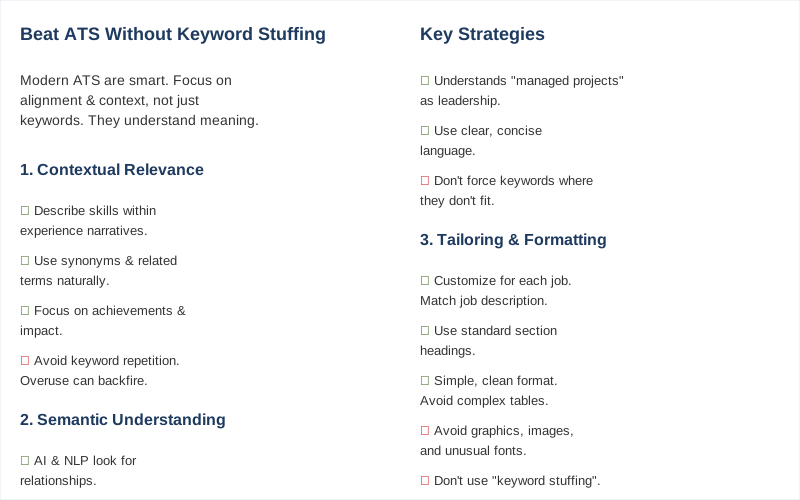
The core principle to beat ATS filters without keyword stuffing is alignment and context, not mere repetition. Recruiters and modern ATS don't just count keywords; they evaluate relevance and understanding. Your resume's job is to prove you can do the work, not just that you know the buzzwords.
Forget the old advice of hitting a specific keyword percentage. Modern ATS, powered by AI and Natural Language Processing (NLP), understand semantic relationships. This means they can infer your skills from how you describe your experience, not just by matching exact phrases. For instance, understanding "managed projects" is equivalent to "project management" is key Reztune.
The real goal is to demonstrate competency through context. Instead of stuffing "analytics" into every sentence, weave it naturally into your accomplishments. For example, "Analyzed customer data to identify trends, resulting in a 15% increase in targeted campaign effectiveness." This shows you don't just know "analytics," you know how to apply it to achieve results.
Many resumes get filtered out because they don't speak the ATS's language, with 80% of resumes rejected before a human sees them Upplai. Recruiters assume you know this and are looking for proof. They use ATS to scan for relevant skills and experience. Your task is to make that connection clear and undeniable.
To effectively get past ATS, focus on extracting keywords and phrases directly from the job description. Tools like Jobscan can help identify what you're missing reddit. Then, integrate these terms naturally into your bullet points and summary, ensuring they accurately reflect your experience. This creates alignment without sounding like a broken record.
A clean, simple resume format is also crucial. Avoid complex layouts, tables, or graphics that can confuse ATS parsers LinkedIn. Stick to standard section headers like "Work Experience" and "Skills" to ensure the system can easily parse your information.
Understanding how ATS systems work can help you develop strategies from our article on beating ATS effectively.
A diverse team strategizes in a bright office, illustrating how clear communication and relevant experience are key to getting past ATS.
| Photo by Rebrand Cities
A diverse team strategizes in a bright office, illustrating how clear communication and relevant experience are key to getting past ATS.
| Photo by Rebrand Cities
## What's Actually Going On
1
ATS parsing has evolved from simple keyword counting to sophisticated semantic search. Early systems required exact keyword matches. Modern AI-powered ATS understand context and relationships between words, recognizing related concepts even if phrasing differs. The focus is now on demonstrating experience through context, not just stuffing keywords. This means that instead of merely listing "project management" multiple times, an advanced ATS will recognize that phrases like "led cross-functional teams," "delivered complex initiatives on time and within budget," or "oversaw project lifecycles" all indicate project management experience, even if the exact phrase isn't present. ATS Keyword Optimization: How to Beat Filters (Free AI) - Reztune
2
Recruiters seek relevant experience and clear skill alignment. While 80% of resumes get filtered by ATS before a human sees them ATS Resume Keywords Guide: What Actually Works in 2026 - Upplai, the goal is to pass this initial hurdle. Keyword stuffing can be a red flag for both ATS and human reviewers, often making a resume appear unnatural and desperate. Instead of overloading your resume with every possible variation of a keyword, focus on integrating them naturally within your accomplishments and responsibilities. This approach not only satisfies the ATS but also presents a clear and compelling narrative to the human recruiter who will eventually review it. Keyword Density for ATS: 7 Tips to Avoid Stuffing 2026 |...
3
ATS screening nuances vary by company size, industry, and seniority. Startups may use simpler keyword matching, where a more direct correlation between job description terms and resume content is expected. Enterprise companies often employ advanced NLP (Natural Language Processing) which can understand synonyms, context, and the intent behind your descriptions. Tech industries, for instance, tend to prioritize specific technical skills, programming languages, and certifications. Finance roles emphasize regulatory knowledge, compliance terms, and financial acumen. Healthcare requires adherence to strict protocols, medical terminology, and patient care experience. For seniority, ATS may prioritize leadership responsibilities, strategic impact, and team management keywords; entry-level roles will focus more on foundational skills, educational achievements, and transferable abilities. Understanding these industry and role-specific variations is key to tailoring your resume effectively. How to Optimize Your Resume for ATS in 2026 (Updated Guide)
4
Formatting is critical. Use a clean, simple template; avoid tables, sidebars, headers, and footers, as these can be parsed incorrectly or ignored by ATS. Stick to standard fonts and a straightforward layout. Standard section headings like "Work Experience," "Education," and "Skills" help ATS categorize your information accurately. Follow job posting instructions for file format compatibility – .docx is often preferred for its editability, but some systems may specify PDF. The goal is to make keyword extraction easy and unambiguous for the ATS. When copy-pasting from other documents, be aware that hidden formatting can be brought over, confusing ATS systems. Resume Filtering System Exposed: How to Beat ATS - LinkedIn, How to Optimize Your Resume for ATS in 2026 (Updated Guide)
5
Achieve alignment, not just repetition. Integrate keywords naturally within accomplishments, mirroring job description language without sacrificing readability. For example, if the job posting requires "stakeholder management," don't just list it under skills. Instead, weave it into your experience by describing how you "managed communication and expectations with key stakeholders across multiple departments to ensure project alignment and buy-in." This contextual approach demonstrates your practical application of the skill. Tools like Jobscan or 10XApplication can help you compare your resume against a job description to identify missing keywords and phrases, allowing you to strategically incorporate them. Beat the ATS: Optimize Resumes via Writing & AI: 2026 Guide - Klaxos, Full Guide to Optimizing Resume Keywords to Pass ATS Screening
To better understand these trends, it's essential to explore how ATS systems score candidates beyond just keyword matching.
Professionals brainstorm in a lively meeting, showcasing how understanding modern ATS parsing is crucial for job applications.
| Photo by Christina Morillo
Professionals brainstorm in a lively meeting, showcasing how understanding modern ATS parsing is crucial for job applications.
| Photo by Christina Morillo
## How to Handle This
1
Analyze the Job Description Thoroughly - This is your primary intelligence gathering. Recruiters and ATS systems pull directly from the job posting to build keyword filters and assess fit. They seek alignment between your language and their requirements. Skipping this means applying blind; your resume will lack the specific terminology the ATS identifies, leading to it being filtered out before a human sees it. For senior or technical roles, analyze explicit keywords and implied skills/methodologies.
2
Integrate Keywords Contextually, Not by Density - Demonstrate proficiency, not just presence. Modern ATS platforms use semantic search and NLP to understand context. Instead of repeating a word, weave it naturally into accomplishment descriptions. For example, for "data analysis," describe a project where you "performed complex data analysis to identify key performance indicators, leading to a 15% increase in customer retention." This shows you *did* the work. Failing to do this creates an unnatural resume, harming your ATS score and alienating recruiters. For entry-level roles, focus on foundational skills; for executive roles, emphasize strategic application.
3
Use Standard Formatting and File Types - Technical formatting can break the ATS. Avoid tables, columns, headers, and footers, as these can confuse the parsing engine. Stick to simple, clean templates. Unless specified, use .docx. PDFs can sometimes retain formatting that hinders ATS readability. Recruiters rely on the ATS to parse your resume into a database. If formatting prevents this, the system cannot read it.
4
Incorporate Both Acronyms and Full Terms - Many keywords have common acronyms (e.g., "Search Engine Optimization" and "SEO"). Include both to beat ATS filters. The ATS might look for the full phrase, while a recruiter might search using the acronym. Use the full term first, followed by the acronym in parentheses on its first mention, e.g., "Managed comprehensive Search Engine Optimization (SEO) strategies." This covers both bases. Skipping this risks being missed by one or the other. This is crucial in tech and finance industries.
Team members use technology in a meeting, emphasizing the importance of analyzing job descriptions for ATS resume tips.
| Photo by Christina Morillo
Team members use technology in a meeting, emphasizing the importance of analyzing job descriptions for ATS resume tips.
| Photo by Christina Morillo
## What This Looks Like in Practice
Senior Software Engineer at a Series B Startup. A candidate with strong technical chops applied for a role requiring expertise in cloud infrastructure. They initially used a resume filled with generic software engineering terms and minimal specific cloud technologies. The ATS filtered them out, likely because the resume lacked the precise terminology of the job description ATS Resume Keywords Guide: What Actually Works in 2026 - Upplai. After revising to incorporate keywords like "AWS Lambda," "Terraform," and "Kubernetes" naturally within project descriptions, they successfully beat ATS filters and secured an interview.
Entry-Level Data Analyst at a Fortune 500. A recent graduate with a degree in statistics applied for an entry-level data analyst position. Their resume was clean and well-formatted but lacked specific data analysis tools and methodologies mentioned in the job posting. Despite being qualified, their application was not advanced by the ATS, highlighting that 80% of resumes get filtered by ATS ATS Resume Keywords Guide: What Actually Works in 2026 - Upplai. They learned to integrate terms like "SQL," "Python (Pandas, NumPy)," and "data visualization (Tableau)" into their project descriptions and skills section, leading to a significantly improved ATS score and interview invitation.
Career Changer from Teaching to Product Management. An experienced teacher transitioning into product management faced challenges getting past ATS. Their resume focused on pedagogical skills rather than product lifecycle management. The ATS likely flagged a mismatch because the resume didn't use product management jargon Keyword Density for ATS: 7 Tips to Avoid Stuffing 2026 |.... By carefully analyzing product management job descriptions and weaving in terms like "product roadmap," "user stories," "agile methodology," and "stakeholder management," they demonstrated relevant experience and successfully navigated the initial screening to get past ATS.
Understanding how to tailor your resume can enhance your chances, so consider strategies outlined in how to pass ATS.
A focused group collaborates, demonstrating how strategic use of ATS keywords can significantly boost your application's visibility.
| Photo by cottonbro studio
A focused group collaborates, demonstrating how strategic use of ATS keywords can significantly boost your application's visibility.
| Photo by cottonbro studio
## Mistakes That Kill Your Chances
Mistake
Using overly complex or visually busy resume templates.
Why candidates make it
Candidates believe visually appealing resumes stand out, opting for templates with multiple columns, graphics, or unusual formatting to be memorable, especially new grads.
What recruiters actually see
ATS systems struggle to parse complex layouts. Hidden formatting, tables, and sidebars can cause AI to misinterpret or miss crucial information like job titles, dates, and skills, leading to a lower match score. Modern ATS platforms are confused by this hidden formatting.
The fix
Stick to a clean, simple, and standard resume format. Use a single column layout with clear headings. Avoid headers and footers, as they can cause parsing issues, ensuring the ATS can easily read and categorize your information.
Mistake
Copy-pasting job description phrases verbatim without context.
Why candidates make it
This tactic stems from the "exact match" ATS era, where candidates assume replicating keywords is the surest way to pass initial screening.
What recruiters actually see
Modern ATS systems use NLP and semantic search. Context is king. A resume filled with disjointed phrases reads like "keyword spam" and lacks narrative flow, potentially leading to rejection.
The fix
Integrate keywords naturally within your experience descriptions. Describe situations where you applied skills, rather than just listing them. Aim for alignment, not repetition, to demonstrate understanding and application.
Mistake
Over-reliance on acronyms or jargon without providing full terms.
Why candidates make it
Experienced professionals use industry-specific terms, assuming universal understanding and believing it saves space while signaling expertise.
What recruiters actually see
While some acronyms are understood, others may not be recognized by the ATS or recruiter. If the ATS looks for "Application Programming Interface" and your resume only says "API," it might miss the match.
The fix
Use both acronyms and their full terms where appropriate. For instance, include "API (Application Programming Interface)." This ensures the ATS and human readers can easily identify your relevant skills.
Mistake
Believing that higher keyword density automatically improves ATS scores.
Why candidates make it
This myth persists; candidates believe cramming more keywords guarantees they'll be noticed and obsess over keyword percentages.
The fix
Focus on strategic keyword integration. Use keywords from the job description, but weave them into descriptive bullet points that showcase accomplishments. The goal is relevance and context, not just frequency.
To enhance your chances, understanding keyword optimization for ATS can make a significant difference.
Product comparison for How to Get Past ATS Filters Without Keyword Stuffing
## Key Takeaways
Use a clean, simple resume format, avoiding tables, sidebars, and excessive graphics that confuse ATS parsing. Stick to standard section headers like "Work Experience" and "Skills" Resume Filtering System Exposed: How to Beat ATS - LinkedIn.
Test your resume using tools like Jobscan or Rezi to identify potential issues and improve ATS compatibility. This is crucial, as 80% of resumes are filtered out by ATS before a human sees them ATS Resume Keywords Guide: What Actually Works in 2026 - Upplai.
Your resume must tell a coherent story of your value, not just be a list of buzzwords. If it reads like a broken record or a shopping list, it's likely headed for the digital bin Keyword Density for ATS: 7 Tips to Avoid Stuffing 2026 |....
To enhance your understanding of ATS functionality, explore how they evaluate experience and impact in our article on ATS parsing techniques.
Frequently Asked Questions
How do I make sure my resume actually gets seen by a person and doesn't just get tossed by the computer?
To beat ATS filters without keyword stuffing, focus on aligning your resume with the job description's language. Modern ATS systems look for context and semantic meaning, not just exact word matches. Tools like Jobscan or Reztune can help you identify missing keywords and phrases from the job posting, guiding you on how to integrate them naturally.
I'm worried about overusing keywords. What's the best way to include them without sounding like a robot?
Instead of repeating keywords, focus on demonstrating your skills and experience in context. Modern ATS understand the relationship between words, so using synonyms and related terms that accurately reflect your abilities is key. For example, if a job asks for 'data analysis,' you can describe projects where you 'interpreted data sets' or 'conducted statistical reviews' to show you understand the concept without stuffing the phrase.
What are the most important keywords for my resume to get past the initial screening?
The most critical keywords are those directly pulled from the job description. Identify job titles, specific skills (like 'Python,' 'SQL,' 'Salesforce'), software names, certifications ('PMP,' 'CPA'), and industry terms ('Agile,' 'DevOps') mentioned. Prioritize these terms and integrate them into your summary, skills section, and work experience bullet points where they genuinely apply.
My resume has tables and fancy formatting. Will that mess things up with the ATS?
Yes, complex formatting like tables, sidebars, and unusual fonts can confuse ATS systems. Stick to a clean, simple resume template with standard headings like 'Work Experience' and 'Skills.' Avoid headers and footers as well, as these can sometimes be ignored or misinterpreted by the software.
Is there a way to check if my resume is ATS-friendly before I submit it?
Absolutely! You can use free online tools like Jobscan or Reztune to scan your resume against a specific job description and get an ATS compatibility score. These tools highlight missing keywords and suggest areas for improvement, helping you optimize your resume without overdoing it.
R
RoleAlign Team
Experienced car camper and automotive enthusiast sharing practical advice.