
Future of AI Resume Analysis Predictive Career Pathing (2026 Complete Guide)
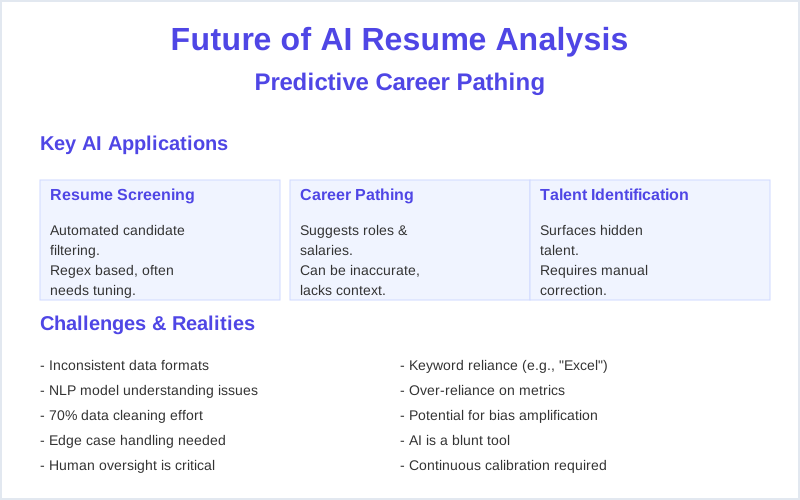
I once saw a 'predictive career pathing' tool recommend a former nuclear physicist become a social media influencer. It even suggested a starting salary of $45,000, which is about what I pay for coffee in a year. The hype around AI in hiring, especially resume analysis and career prediction, is off the charts, but the operational reality is far less glamorous.
I once saw a 'predictive career pathing' tool recommend a former nuclear physicist become a social media influencer. It even suggested a starting salary of $45,000, which is about what I pay for coffee in a year. The hype around AI in hiring, especially resume analysis and career prediction, is off the charts, but the operational reality is far less glamorous. AI has made hiring worse, but it can still help, they say.
I'd argue it's just made it different, and often, more frustrating.
The actual job of an AI practitioner in this space isn't building Skynet for HR. It's wrestling with inconsistent data formats, trying to make an NLP model understand that 'full stack developer' and 'full time coffee taster' are not the same thing, despite both containing 'full.' The unglamorous part is spending 70 percent of your time on data cleaning and feature engineering, not crafting elegant algorithms.
AI-powered resume screening sounds sophisticated, but often it's just regex on steroids.
Companies are pouring money into these solutions, promising to reduce time-to-hire by 60 percent and magically surface hidden talent. What LinkedIn won't tell you is that behind those impressive metrics, there's a team of engineers manually correcting the AI's 'insights' or building complex exception handling for edge cases.
I've seen systems flag a candidate with a Ph.D. in quantum physics as 'underqualified' for an entry-level data analyst role because their resume didn't explicitly use the keyword 'Excel.'
The signal vs hype here is critical. Yes, AI can help. But it's not a magic bullet for your career path or for hiring. It's a tool, often a blunt one, that requires immense human oversight and continuous calibration.
The real requirements involve understanding its limitations and how to work around them, not just celebrating its theoretical potential.
That pivot tax for new entrants is even steeper when you're trying to outsmart an algorithm that doesn't understand nuance.
So, when you see those flashy ads for AI career coaches or resume optimizers, remember: someone like me is probably on the backend, trying to debug why the system thinks a 'project manager' is a good fit for a 'senior ML engineer' role, simply because both titles contain the word 'manager.' It's a mess, but it's our mess.
The Real Answer
The real answer to AI's role in resume analysis and career pathing isn't about futuristic predictions; it's about pattern matching and statistical correlation. These systems, like MokaHR, are fed millions of resumes and job descriptions, then trained to find commonalities between successful hires and specific job requirements. They learn from historical data, which is both their strength and their biggest weakness.
Think of it as a very sophisticated filter, not a crystal ball.
When an AI analyzes your resume, it's looking for keywords, phrases, and structural patterns that previously led to a good hire for a similar role at that company or in that industry. It's not inferring your hidden potential; it's comparing you to a dataset of past outcomes. I asked AI to predict my best career path once, and it suggested I become a 'data entry clerk' after seeing my early career internships.
It missed the entire trajectory.
The insider framework is simple: these systems are optimizing for efficiency and reducing the initial screening load on human recruiters. Their primary goal is to quickly surface candidates who are a high probability match based on historical data, not to uncover diamonds in the rough. This means if your resume doesn't align almost perfectly with the expected keywords and experience levels, you're often filtered out.
A common mental model is that AI is 'smart.' It's not.
It's just very good at finding statistical relationships within the data it's given. If the training data is biased - for example, if a company has historically hired only from specific universities or with certain keyword combinations - the AI will perpetuate that bias. It's a reflection of past hiring decisions, not an objective judge of talent.
This is the unglamorous part: dealing with data that often carries human baggage.
For career pathing, the AI similarly looks at career trajectories within its dataset and suggests paths that statistically align with your past experiences. It's excellent at identifying common transitions, like 'Junior Developer to Senior Developer.' It's terrible at spotting truly innovative or non-linear career moves. It's like asking a GPS for the fastest route and expecting it to recommend a scenic detour through a national park.
The math matters, but the context matters more, and AI struggles with context.

What's Actually Going On
What's actually going on with AI in hiring boils down to a few industry mechanics and the cold hard facts of ATS data. Most large companies, and increasingly smaller ones, use Applicant Tracking Systems (ATS) that often integrate AI-powered screening. These systems process resumes at scale, and their primary function is to filter. We're talking about AI for recruitment that can churn through thousands of applications.
ATS data is king.
When you upload your resume, it's often parsed into structured fields. If your resume format is unusual, or you use graphics instead of plain text, the parsing can fail, rendering your carefully crafted experience as gibberish to the machine. This isn't about being fancy; it's about being machine-readable. I've seen resumes with beautiful infographics get completely mangled, appearing blank to the AI.
Company-size variations play a huge role.
A small startup might still have a human review every resume, especially for niche roles. A Fortune 500 company hiring for 50 identical entry-level positions? They're absolutely relying on AI to thin the herd. Career trend reports for 2026 emphasize AI literacy, but also highlight how regional dynamics affect prospects.
Regulatory facts are starting to catch up. There's growing scrutiny on algorithmic bias, with some jurisdictions implementing rules requiring audits of AI hiring tools.
This puts pressure on developers like me to build explainable AI, but the core functionality of pattern matching remains. AI-based suitability measurement is getting more sophisticated, but it's still about fitting you into a pre-defined box.
For predictive career pathing, the AI is essentially performing a sophisticated regression analysis on historical career data. It identifies common skill progressions and role transitions.
It can tell you that 'Data Analyst' often leads to 'Senior Data Analyst' or 'BI Developer.' It struggles with predicting a leap from 'Marketing Coordinator' to 'Machine Learning Engineer' unless there's explicit, quantifiable evidence of that skill transition in the dataset. This is the pivot tax in action: the AI doesn't see your potential, only your past.
The actual job for us is to make these systems less terrible, not perfect.
We try to tune them to recognize transferable skills, but it's an uphill battle. If your resume doesn't explicitly state 'SQL' but you've managed large databases in another role, the AI might miss it. This is why tailoring your resume isn't just good advice; it's a necessary operational reality when dealing with these systems.
How to Handle This
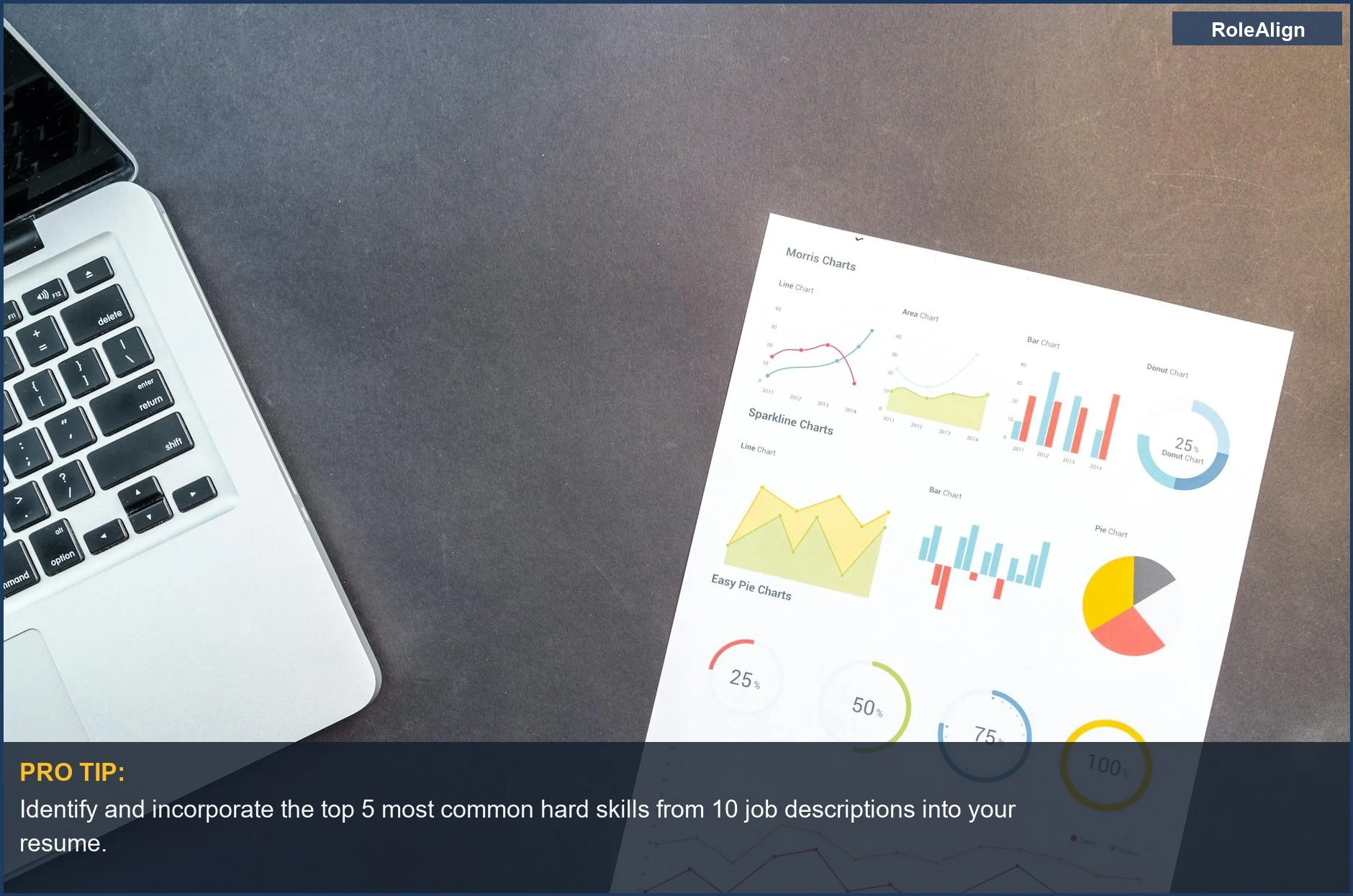
Okay, so how do you handle this mess? First, forget the generic 'optimize your resume' advice. Here's what the recruiter's AI actually looks at in the 6 seconds it spends on your resume: keywords. Go through 5-10 job descriptions for the role you want and literally copy-paste the most common hard skills and technologies into a 'Skills' section. Don't be subtle. Understanding AI in recruiting means understanding its literal parsing.
For timing, apply as early as possible.
Many AI systems prioritize newer applications, or at least process them first. If a role has 500 applicants, being in the first 50 gives you a better chance of being seen by a human, even if the AI flags you. The channel matters: apply directly on the company website, not through LinkedIn Easy Apply. Direct applications usually go straight into their primary ATS.
Context specifics are vital. Don't just list skills; demonstrate them with quantifiable achievements.
Instead of 'Managed projects,' write 'Managed 3 ML projects, reducing deployment time by 15 percent and improving model accuracy by 5 points.' The AI can parse numbers and impact. Toward more realistic career path prediction shows context is key.
Build a 'master resume' with every skill and project you've ever touched. Then, for each application, create a tailored version. This isn't just about human readability; it's about feeding the AI exactly what it expects.
If the job description says 'Python, PyTorch, AWS,' make sure those exact words are on your resume, even if you just used them for a personal project. The pivot tax is real, so make the AI's job easy.
Networking is your cheat code. A referral from an existing employee often bypasses the initial AI screen entirely, pushing your resume directly to a hiring manager. That's 90 percent of the battle won right there.
The unglamorous part of networking is actually doing it, not just connecting on LinkedIn.
Finally, consider a portfolio. For ML roles, a GitHub repo with working projects (not just tutorials) can provide the 'proof' the AI can't fully grasp. While the AI won't 'read' your code, a human might check it after the AI flags you as a potential match. This is what LinkedIn won't tell you: you need to play both sides of the fence.
What This Looks Like in Practice
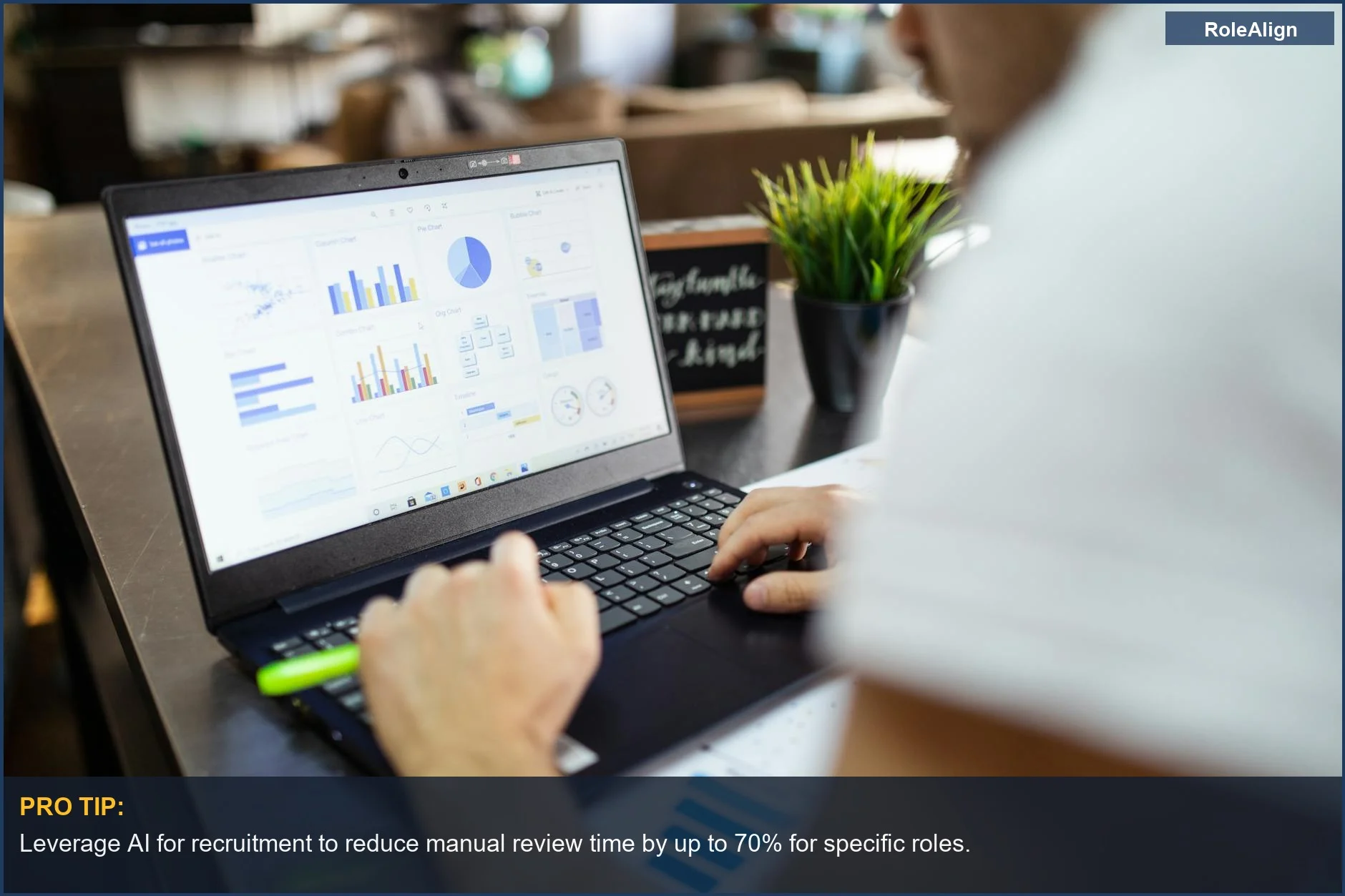
In practice, this looks like a mid-sized tech company using AI for recruitment to screen 500 applicants for a 'Junior Data Scientist' role. The AI's metrics might show a 70 percent reduction in manual review time.
What it won't show is that 40 percent of qualified candidates were initially filtered out because their resumes didn't explicitly mention 'Scikit-learn' or 'Pandas,' even if they had extensive experience with similar libraries.
Another scenario: a large enterprise uses AI for predictive career pathing for internal mobility.
An employee with 8 years in 'Customer Success Management' wants to move into 'Product Management.' The AI, based on historical data, might give them a 'suitability score' of 30 percent, recommending they stay in customer-facing roles.
This is because the dataset contains few, if any, direct transitions between those two specific departments without a formal MBA or explicit product training.
I've seen a candidate for an ML Engineering role get a 'skills mismatch' flag because their resume used 'TensorFlow' extensively but the job description emphasized 'PyTorch.' The underlying NLP model didn't have a strong enough semantic understanding to equate the two as similar deep learning frameworks.
This is a common operational reality, not a theoretical flaw.
For university career centers, AI-powered career and life design tools might predict 'Software Developer' for 80 percent of Computer Science graduates. This isn't because 80 percent are uniquely suited, but because the training data primarily consists of CS grads becoming software developers.
The AI reinforces the most common path, not necessarily the best individual path.
A common metric is 'time-to-hire.' AI systems often claim to reduce this by 50 percent or more. This is true for initial screening. However, the total time-to-hire might only drop by 10 percent if the AI filters out too many good candidates, leading to a shallow pool and extended search for qualified individuals. The unglamorous part is realizing that efficiency gains at one stage can create bottlenecks elsewhere.
Mistakes That Kill Your Chances
| Mistake | Why It Kills Your Chances | The Operational Reality |
|---|---|---|
| Generic Resume | AI doesn't infer; it matches keywords. A resume not tailored to the job description gets a low relevance score. | The AI is looking for exact or near-exact matches to job description keywords. Your 'diverse experience' is just noise to it. |
| Fancy Formatting | Complex layouts, graphics, or non-standard fonts can break ATS parsing, making your resume unreadable. | Your beautiful PDF might appear as a blank document or garbled text to the system, getting an automatic rejection. |
| Omitting Keywords | Assuming the AI understands synonyms or implied skills. If the JD says 'SQL,' you need 'SQL.' | I've seen systems miss 'database management' when 'SQL' was required. The math is literal, not semantic. |
| Focusing on Soft Skills | While important for humans, AI prioritizes quantifiable hard skills and technologies in initial screens. | 'Strong communication' means nothing to an AI. 'Presented 12 technical briefings' means something. |
| Ignoring the 'Pivot Tax' | Expecting AI to recognize transferable skills for a drastic career change without explicit evidence. | The AI's predictive model is based on historical transitions. A sudden shift without explicit upskilling is a statistical anomaly it flags. |
| Applying Too Late | Many systems prioritize new applications or have cutoffs, especially for high-volume roles. | If 500 people applied, your resume might not even be processed by the human until after the first 100-200 are reviewed. |
| Not Networking | Relying solely on online applications means you're always subject to the AI's filter. | A referral bypasses the AI and gets your resume directly to a human. This is the ultimate cheat code for the unglamorous part of job hunting. |
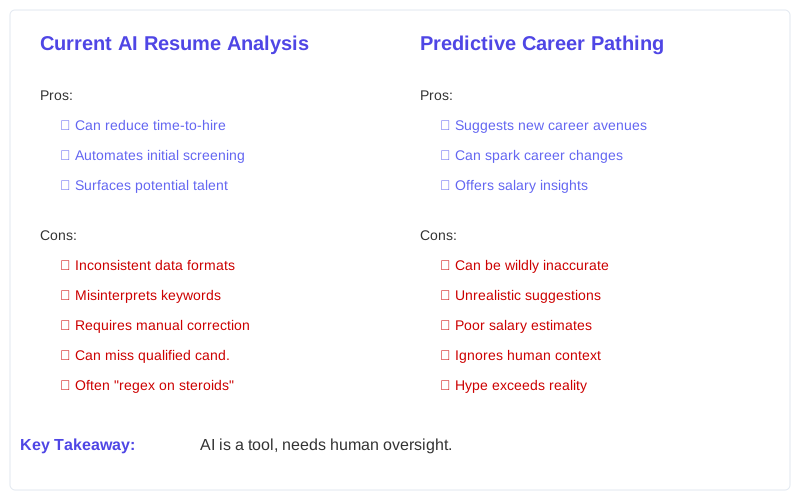
Key takeaways for anyone navigating this landscape:
- **Keywords are King:** Tailor your resume explicitly to each job description. The AI doesn't infer; it matches.
- **Data Quality In, Data Quality Out:** AI is only as good as the historical data it's trained on. Expect biases and blind spots.
- **The Pivot Tax is Real:** If you're changing careers, be prepared for AI to struggle with your non-linear path. You'll need to overcompensate with explicit skill demonstrations.
- **Networking Trumps Algorithms:** A human referral is still the most effective way to bypass the initial AI screen.
- **Operational Reality Over Hype:** Focus on what the actual job involves - data cleaning, stakeholder management, debugging - not just the shiny model building. This is what LinkedIn won't tell you.
- **AI is a Filter, Not a Fortune Teller:** It screens for probability based on past performance, it doesn't predict your true potential.
Sources
- 10 Careers AI Is Transforming in 2026 And 100 Tasks You Can ...
- Guide to Understanding AI in Recruiting: Pros and Cons
- Future-Proof Your Path: Career Trend Reports for 2026 - AAA
- The Best AI Resume Screening Software of 2025
- AI based suitability measurement and prediction between job ...
- Toward more realistic career path prediction: evaluation and methods
- AI in Recruitment: A Guide for the Future of Hiring in 2026 | iMocha
- I Asked AI to Predict My Best Career Path: The Results Changed ...
- AI-Powered Resume Screening & HR Software - OrangeHRM
- Helping Students Design Their Future With AI-powered Career and ...
- AI Has Made Hiring Worse—But It Can Still Help