
Future of Resume Design for AI and Human Readers (2026 Complete Guide)
The average job opening now receives 242 applications, giving individual candidates a brutal 0.4 percent chance of landing the role. This isn't just about competition; it's about the machinery behind the scenes. I've spent years configuring ATS systems like Workday and Greenhouse, and I can tell you, what you think matters on your resume often gets chewed up and spit out long before a human ever sees it.
The average job opening now receives 242 applications, giving individual candidates a brutal 0.4 percent chance of landing the role. This isn't just about competition; it's about the machinery behind the scenes. I've spent years configuring ATS systems like Workday and Greenhouse, and I can tell you, what you think matters on your resume often gets chewed up and spit out long before a human ever sees it. Novorésumé's analysis confirms this brutal reality.
Everyone's buzzing about AI in hiring for 2026, and how it's going to change everything. My recruiter brain just rolls its eyes. It's not some magic bullet; it's another layer of filtering, another set of rules you have to understand to even get a foot in the door.
Recruiters are getting better at spotting AI-written content, with 74 percent of hiring managers claiming they can identify resumes generated by AI, especially if they're not edited properly. This finding from Novorésumé means your 'clever' AI-generated resume might be doing more harm than good.
I've seen the data. AI can definitely boost your resume's visibility in the ATS black hole, helping with keywords and structure. But then it hits my desk, and if it smells like generic AI spam, it's straight to the resume graveyard. It's a tightrope walk between getting past the machine and not annoying the human.
Your resume isn't just a document anymore; it's a data packet. It needs to be optimized for parsing algorithms in systems like iCIMS and Lever, and simultaneously compelling enough to pass my six-second scan. The future isn't about one or the other; it's about mastering both because my director still wants bodies, not just well-parsed text.
My job was always about finding plausible candidates, not perfect ones. And with AI on both sides of the application, the signal vs noise ratio has never been more critical. The systems are evolving, but the core human element, for now, remains a critical gatekeeper.
I've configured these systems, so I know their quirks. If your resume isn't formatted correctly, or if it lacks the right semantic context, it's not even making it to my screen. It's lost in the digital ether, a ghost job of a different kind - one that exists, but can't be found.
The Real Answer
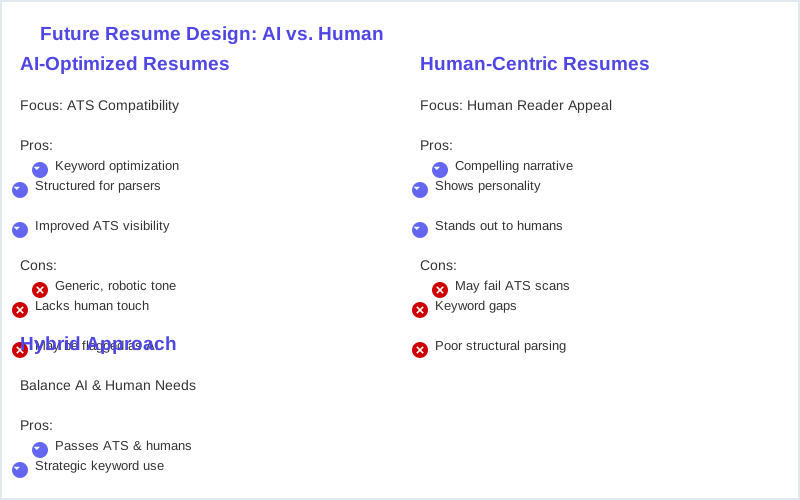
Here's the brutal truth: the future of resume design isn't about picking AI over humans, or vice versa. It's about understanding that your resume is now a two-stage rocket. The first stage gets you past the AI gatekeepers, and the second stage convinces a human not to send you to the resume graveyard. It's a delicate balance of keywords and credibility.
My recruiter brain is looking for proof, not just buzzwords. LinkedIn News emphasizes tailoring and keyword richness for AI. But when I see a resume loaded with AI-generated fluff, I can smell it from a mile away. It tells me you're trying to game the system, not that you actually have the skills.
The 'Old Rule' of keyword stuffing is dead. The 'New Rule' for 2026 is semantic context and evidence. Resume Adapter highlights this shift, moving from objective statements to value propositions, and from responsibilities to impact metrics. My ATS, whether it's Greenhouse or Workday, is getting smarter, moving beyond simple keyword matching.
Recruiters are tired of generic 'AI Spam.' We're looking for authenticity and proof of competence. This means your resume needs to be optimized for the parsing engines of platforms like Paradox and hireEZ, but still read like a human wrote it, showcasing your unique value proposition.
It's not enough to just use AI to generate content; you need to use AI to enhance your authentic experience. The data shows that resume builders strategically integrating AI can improve efficiency, but only when they're used to boost genuine qualifications, not replace them. A new analysis confirms this.
My goal as a recruiter is to find the best fit, not the best AI prompt engineer. If your resume screams 'ChatGPT' without any real substance, it's a massive red flag. The real reason AI is helpful is to ensure your legitimate experience isn't lost in the ATS black hole, not to create a fictional one.
Think of it this way: AI gets you past the bouncer, but you still need to be able to dance once you're inside the club. The hiring committee isn't going to be impressed by perfectly optimized but ultimately hollow prose.
What's Actually Going On
ATS platforms like Workday, Greenhouse, and Lever are constantly evolving their parsing algorithms. What worked last year for keyword matching might get your resume filtered out today. The shift is towards semantic analysis, meaning the system tries to understand the meaning and context of your words, not just their presence. Resume Adapter points out that keyword stuffing is out, semantic context is in.
This means a simple list of buzzwords is less effective than demonstrating those skills within accomplishment statements. My old trick of CTRL+F for keywords is becoming less reliable for the initial screen, as the ATS does a deeper dive. If your resume looks like a keyword salad, it's a red flag for both the machine and my recruiter brain.
Company size also dictates the ATS sophistication. A small startup using Lever might still rely heavily on direct keyword matches, while a Fortune 500 company on Workday or iCIMS will have advanced AI screening tools like GoPerfect or Eightfold AI. These larger systems are better at spotting inconsistencies and generic phrasing. GoPerfect lists some of these top platforms for 2026.
The 'recruiter brain' is adapting too. We've seen the flood of AI-generated applications, and we're on the lookout for them. Generic 'AI spam' makes my job harder, and it often leads to a quick rejection. We value authenticity and proof of competence more than ever. This shift is highlighted by Resume Adapter as a positive for career changers.
Regulatory facts are starting to catch up. Some jurisdictions are implementing rules around AI in hiring, requiring transparency about how algorithms are used. This puts pressure on HR to ensure their ATS isn't just a black box, but a system that can be audited for fairness. This is a slow burn, but it's coming.
My hiring committee, especially for senior roles, is explicitly telling me they want to see resumes that demonstrate critical thinking and problem-solving, not just a list of AI-generated skills. While AI can help with formatting and initial keyword optimization, it can't fake genuine experience. Extern emphasizes balancing hard, soft, and AI skills.
Ultimately, the goal of these systems, from my perspective, is to reduce the signal vs noise ratio. If your resume is noisy - either through poor parsing or generic AI content - it's going straight into the resume graveyard, regardless of how many keywords it contains.
How to Handle This
First, understand that a single resume format for both AI and humans is a myth. You need to create a 'master resume' that's clean, text-based, and keyword-rich for ATS parsing. Then, you'll adapt it for human eyes, adding a touch of personality and impact.
-
Build Your ATS-Optimized Base (2-3 hours): Strip down your resume to a plain text format. Use standard fonts like Calibri or Arial, size 11-12. Avoid fancy graphics, columns, or tables, as these often cause the ATS black hole to swallow crucial information. Focus on action verbs and quantifiable achievements. This YouTube guide on beating AI emphasizes passing screening.
-
Integrate Relevant Keywords (Ongoing): Don't just list keywords; embed them naturally within your experience descriptions. Use tools like Jobscan or even ChatGPT to analyze job descriptions and identify the core competencies. My ATS is looking for semantic context, not just keyword stuffing. Resume Now highlights AI trends that suggest smarter keyword integration.
-
Craft a Human-Readable Version (1-2 hours per application): Once your ATS-friendly base is solid, create a slightly more visually appealing version for direct human review. This can include subtle branding or a cleaner layout, but still prioritize readability. This is where you inject your unique 'value proposition' instead of a generic objective statement. Resume Adapter details this shift.
-
Proofread for AI-isms (30 minutes): If you use AI to draft or enhance your resume, meticulously edit it for generic phrasing, overused buzzwords, and repetitive sentence structures. My recruiter brain flags these immediately. You want AI to help you articulate, not fabricate. Michael Page discusses the pros and cons of AI resume writing, and this is where the cons hit.
-
Seek Professional Review (Optional, $100-$500): If you're struggling, consider a professional resume writer who understands both ATS mechanics and human psychology. They can help ensure your resume passes both filters. Ask them specifically about their experience with various ATS systems like Workday or Greenhouse, and how they handle AI integration.
-
Test Your Resume (10 minutes): Upload your resume to a free ATS scanner online or even paste it into a plain text editor to see how it renders. This helps identify any parsing issues before it hits a real system. It's like checking your oil before a long drive; a quick, necessary step.
What This Looks Like in Practice
I once had a 'Senior Software Engineer' role open at a startup using Lever. We received 300 applications in the first 48 hours. My initial screen involved a Lever search for 'Python,' 'AWS,' and 'Kubernetes.' Any resume where these keywords weren't clearly parsed, or were buried in a two-column layout, immediately went to the 'no' pile. That's the ATS black hole in action.
After that, my recruiter brain kicked in. I'd open the top 50-70 resumes. If the first two bullet points under 'Experience' didn't immediately show quantifiable impact - like 'Reduced latency by 15 percent' or 'Managed a team of 5 engineers' - it was a quick flick to the resume graveyard. I wasn't reading stories; I was scanning for metrics. Resume Adapter calls for impact metrics.
Another scenario: a candidate applied for a 'Marketing Manager' role at a large enterprise using Workday. Their resume was beautifully designed, but the ATS parsed their 'Skills' section as a single block of text, making individual skills unsearchable. My Workday filters for 'SEO,' 'Content Marketing,' and 'HubSpot' returned zero matches. The candidate was perfectly qualified, but the system made them invisible.
Conversely, I've seen resumes that were plain text, almost ugly, but perfectly optimized for the ATS. They had the right keywords, clear dates, and quantifiable achievements. These were the ones that made it to my desk, even if they didn't win any design awards. They understood the mechanics of the hiring theater. HBR notes AI's impact on hiring, and often it's about this initial screening.
For a 'Data Scientist' role, my hiring manager insisted on 'SQL proficiency' and 'Machine Learning experience.' If a resume generated by AI listed these skills but didn't back them up with specific projects or technologies like 'TensorFlow' or 'PyTorch' in the experience section, it was a fast no. The AI-generated content was too generic, lacking the specific signal vs noise I needed to see.
The real reason these filters exist is efficiency. With hundreds of applications, I don't have time to be a detective. The system needs to surface plausible candidates quickly, and your resume needs to speak its language. The Reddit HR community discusses the future of resumes, and it's clear automation is here to stay.
Mistakes That Kill Your Chances
| Mistake | Why It Kills Your Chances
Key Takeaways
- AI is a Filter, Not a Fix: AI helps your resume get seen by the ATS, but it won't hide a lack of relevant experience from my recruiter brain. It's about optimizing, not fabricating. Novorésumé's analysis shows AI can improve efficiency.
- Prioritize ATS-Friendly Formatting: Clean, text-based resumes without complex designs are essential for systems like Workday and Greenhouse. Fancy layouts often lead to the ATS black hole.
My systems need to parse your data, not admire your graphic design skills. * Focus on Quantifiable Impact: My recruiter brain and the smarter ATS systems are looking for measurable achievements, not just responsibilities. Use numbers and clear results to showcase your value. This is the ultimate signal vs noise filter. * Beware of Generic AI Content: If you use AI, edit it rigorously. Generic phrases and buzzwords are red flags to human recruiters.
You want to sound authentic, not like a bot generated your entire professional history. We can tell the difference. * Balance Keywords with Context: Don't stuff keywords. Integrate them naturally within your experience. Modern ATS platforms are moving towards semantic understanding, and my hiring managers want to see genuine expertise, not just a list of terms. * Your Resume is a Tool, Not a Trophy: The goal is to get an interview, not to have the prettiest resume.
Understand the mechanics of the hiring process, from the ATS to the human reviewer, and design your resume to navigate both effectively. The real reason to optimize is to get past the gatekeepers.
Frequently Asked Questions
Should I pay for an 'AI resume review' service, or just use a free online tool?
Do I really need to use a plain text resume, or can I use a slightly more designed template if it's 'ATS-friendly'?
What if I tailor my resume perfectly for a job, and still don't hear back?
Can using too much AI-generated content on my resume permanently damage my reputation with a company?
I heard that if I include a tiny, white font keyword list at the bottom of my resume, it'll trick the ATS. Is this true?
Sources
- 10 Best AI Resume Screening Tools for 2026 - GoPerfect
- New Analysis Reveals How Job Seekers Who Use AI on Their ...
- How to Write a Resume That Beats AI & Lands Interviews in 2025
- "What is the future of resumes?" With this all AI generated content. [N ...
- Resume Trends (2026): 5 New Rules to Beat AI Scanners
- The pros and cons of using AI to write resumes for job seekers
- AI Has Made Hiring Worse—But It Can Still Help
- New Analysis Reveals How Job Seekers Who Use AI on Their ...
- How To Write a Resume With AI in 2026 - LinkedIn
- 50+ Skills to Put on Your Resume in 2026 (Hard, Soft & AI) | Extern
- AI Trends Heading Into 2026: Resume Now's Year in Review
- New Analysis Reveals How Job Seekers Who Use AI on Their ...