
Creating a Compelling Project Portfolio for a New Career Field (2026 Complete Guide)
The bootcamp ads promising '$200K salaries in 12 weeks' are selling a fantasy. I once saw a job description that required 5 years of experience in a technology that was only 3 years old. That's the signal vs hype problem in AI careers.
The bootcamp ads promising '$200K salaries in 12 weeks' are selling a fantasy. I once saw a job description that required 5 years of experience in a technology that was only 3 years old. That's the signal vs hype problem in AI careers. You need to cut through the noise, and a portfolio is your best weapon, but not the one LinkedIn tells you to build.
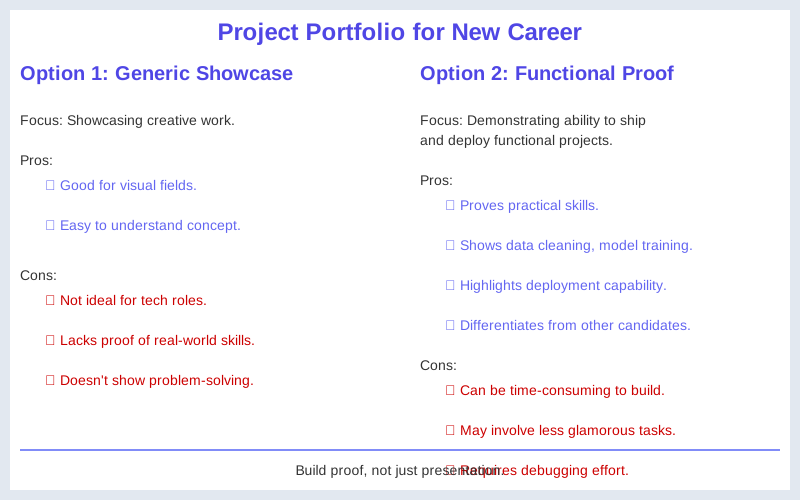
Coursera articles will tell you to 'showcase your creative work.' That's fine for graphic designers. For AI, it's about proving you can actually ship something that doesn't immediately break in production. The 'pivot tax' is real, and it often means taking a step back in salary or role for a year or two to gain relevant experience. My own pivot from software engineering took 8 months and a 15 percent pay cut.
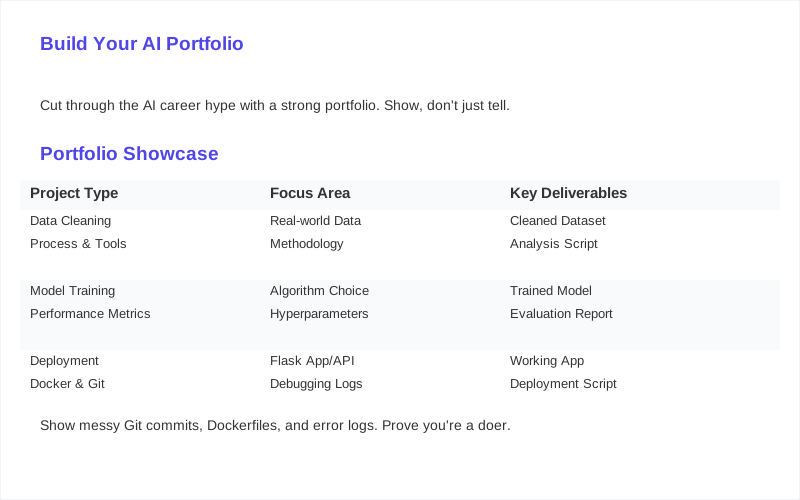
I spent 3 months on fast.AI courses, 2 months building a portfolio project that actually worked on real data, and 3 months interviewing. The portfolio was the differentiator. It wasn't just a list of skills, it was proof. It showed I could clean data, train a model, and deploy it, even if it was just a small Flask app. That's what hiring managers actually want to see.
Not just 'learn Python and machine learning,' which is like saying 'learn English and business' to become a CEO. The real requirements are far more granular. LinkedIn News suggests including an 'About Me' section and links to published work. Sure, do that. But also show me the messy Git commits, the Dockerfile that took you 3 hours to debug, and the error logs from your first failed deployment.
That's the unglamorous 80 percent of the job, and it's what separates the talkers from the doers.
The Real Answer
You need to build a portfolio that reverse-engineers the job you want, not just the one you've had. This isn't about listing every course certificate you've ever earned. It's about demonstrating you can solve actual business problems. A step-by-step guide might tell you to refresh it every few months. I say refresh it every time you apply for a job. The actual job of an ML Engineer involves understanding the business context. Your portfolio needs to reflect that.
It's not enough to show a high F1 score; you need to explain what that F1 score means for the company's bottom line. I've seen brilliant researchers fail because they couldn't translate F1 scores into business impact. The mental model here is 'proof of work, not proof of study.' Recruiters spend about 6 seconds on your resume. Your portfolio is where you grab them for another 60.
It's the difference between saying 'I know SQL' and showing a complex query that extracted critical insights from a 100-million-row database. That's the real requirement: tangible impact. LinkedIn mentions descriptive headlines and high-level achievements. I'd add: show the messy middle too. Show the problem, the data wrangling, the failed attempts, and the final solution. This isn't just about what you built, but how you built it, and why.
It's about demonstrating your problem-solving process, not just the shiny end result. That's the unglamorous part that actually gets you hired.
What's Actually Going On
What's actually going on is that companies are drowning in resumes that all look the same. Everyone 'knows Python' and 'has experience with TensorFlow.' The ATS systems are just filtering for keywords. Your portfolio is what breaks you out of that keyword prison. Merit America notes a portfolio showcases skills and accomplishments. But it's more than just a collection; it's a narrative of your problem-solving journey.
For a mid-level ML role in 2025, knowing SQL (you will query more than you code), Git (your first PR will get rejected 3 times), Docker (production does not care about your Jupyter notebook), and the ability to explain your model to a VP who thinks AI is magic are non-negotiable. The math matters less than the communication. Small to medium-sized companies often value generalists who can wear multiple hats.
Your portfolio should reflect this by showing diverse projects, from data cleaning scripts to simple deployment pipelines. Larger enterprises might look for specialization, so tailor your portfolio to highlight depth in a specific area like NLP or computer vision. The key is to understand the specific role requirements and speak directly to them through your projects. Indeed lists work samples and awards. I'd argue a robust, well-documented project is worth ten 'awards' from online courses.
Regulatory facts, especially in fields like finance or healthcare, mean your projects should demonstrate an understanding of data privacy (GDPR, HIPAA). Showing you can handle sensitive data responsibly is a huge plus. This is what LinkedIn won't tell you: the unglamorous part of compliance is a daily reality.
How to Handle This
Okay, so how do you actually build this thing? First, identify 3-6 standout projects that align with the jobs you want. Dice advises future-focused projects that solve real business problems. Don't just pick something cool; pick something relevant. If you want to work in e-commerce, build a recommendation engine, not another MNIST classifier. Next, document everything. This means clear READMEs on GitHub, explaining the problem, your approach, the tools used, and the results.
Think of it as a mini-case study for each project. Include screenshots, code snippets, and even a link to a live demo if possible. For timing, dedicate 2-3 months to a solid portfolio project. This isn't a weekend hackathon. This is deep work. I spent 2 months on my first real portfolio piece, which involved scraping data, building a Flask API, and deploying it to Heroku. It was ugly, but it worked.
Your channel for showcasing this can be GitHub, a personal website, or even a detailed LinkedIn post linking to your work. A personal website gives you the most control. For context, if you're pivoting from traditional software engineering, focus on projects that bridge your old skills with new AI ones. For example, use your software engineering chops to build robust data pipelines for an ML project. The 'pivot tax' is real, but a strong portfolio minimizes it.
University of Rochester emphasizes examining key choices. I say, examine the job descriptions you're applying for and build projects that directly address their pain points.

What This Looks Like in Practice
Let's talk metrics. For an entry-level ML Engineer, a strong portfolio often means 3-5 well-documented projects. Each project should have a clear problem statement and measurable results, even if those results are just 'reduced data cleaning time by 43 minutes per week.' That's concrete. BYU Design Review suggests 3-6 standout projects. I agree with that number. For a Data Scientist role, your portfolio should showcase EDA skills, statistical analysis, and compelling visualizations. Think about telling a story with data.
The 'what LinkedIn won't tell you' part is that recruiters often look at your GitHub commit history. They want to see consistent effort, not just a single perfect commit. For a Machine Learning Researcher, your portfolio might include links to preprints or even a well-written blog post dissecting a complex paper. The goal isn't just to show you can do something, but that you have done it, repeatedly. Stukent mentions encouraging students to build portfolios.
I'd add: encourage them to build things that actually work, not just academic exercises. If your project isn't deployed, even a simple Flask app on a free tier, it's missing a huge chunk of the operational reality.
Mistakes That Kill Your Chances
There are plenty of ways to screw this up. Here are some common blunders that will get your portfolio tossed faster than a bad PR review. YouTube videos might give general advice, but the specifics matter.
| Mistake | Why it Kills Your Chances | The Operational Reality |
|---|---|---|
| **Only showing toy datasets** | Recruiters know MNIST and Iris. It shows you haven't dealt with real-world messiness. | The actual job is 60 percent data cleaning. Show you can handle nulls and dirty CSVs. |
| **No deployment, just Jupyter notebooks** | Suggests you can't get a model into production. Jupyter is for exploration, not shipping. | Production does not care about your Jupyter notebook. Show Docker, APIs, or cloud deployments. |
| **Too many projects, none deep** | Quantity over quality. A shallow dive into 10 projects is less impressive than 3 deep dives. | Focus on 3-5 strong, well-documented projects. Show depth, not breadth of superficial knowledge. |
| **No explanation of business impact** | Fails to connect technical work to company value. You built X, but why? | I've seen brilliant researchers fail because they couldn't translate F1 scores into business impact. Explain the 'why.' |
| **Private GitHub repos** | If I can't see the code, it doesn't exist. Don't make me jump through hoops. | Make your relevant projects public. If you can't, provide detailed code snippets or a video walkthrough. |
| **Outdated technologies** | Shows you're not keeping up. Using Python 2 in 2024 is a red flag. | The field moves fast. Demonstrate current skills. Your first PR will get rejected 3 times for a reason. |
These mistakes scream 'academic project' rather than 'production-ready engineer.'
Key Takeaways
Building a compelling portfolio for an AI career isn't about checking boxes; it's about proving you can handle the unglamorous 80 percent of the job. It's about showing, not just telling. Invensis Learning talks about documenting successes and challenges. That's the core.
- Focus on Problem-Solving: Your projects should address real-world business problems, not just academic exercises. Show the 'why' behind your 'what.'
- Demonstrate the Full Stack: From data cleaning and feature engineering to model deployment and monitoring. Nobody posts about debugging Airflow DAGs for 12 hours, but that's the job.
- Communicate Impact: Translate technical metrics into business value.
A VP doesn't care about AUC-ROC; they care about revenue or cost savings. * Show, Don't Tell: Provide links to live demos, public GitHub repos, and detailed documentation. Your first PR will get rejected 3 times, so show you can iterate. * Embrace the Messy Middle: Don't just show the polished final product. Show the data wrangling, the failed experiments, and the lessons learned. This is the signal vs hype. This is the real requirement.
Frequently Asked Questions
If I need to learn deployment, should I just buy a cloud certification course?
Do I really need to put my code on GitHub, or can I just send screenshots?
What if my portfolio project doesn't have a perfect F1 score or isn't 'state-of-the-art'?
Can building a portfolio around a niche problem limit my job opportunities?
I've heard that recruiters only care about enterprise projects. Is it true my personal projects are worthless?
Sources
- How to Create a Job Portfolio That Stands Out: A Complete Guide
- How To Craft A Winning CV And Portfolio For Opportunities In 2026
- How to Create a Design Portfolio That Drastically Improves Your Job ...
- Build your career portfolio to elevate your job search
- How to Make a Portfolio to Land Your Next Job - Coursera
- A Step-by-Step Guide to Building Your Digital Portfolio in 2026
- Teaching Students to Build a Career Portfolio: A Step-By-Step Guide ...
- Career Change to Project Management: A Strategic Guide for 2026
- How to Create a Project Portfolio that Will Actually Land You a Job
- How to Build a Job-Winning Portfolio To Stand Out In Your Job Search
- 12 Elements To Include in a Career Portfolio (With Tips) | Indeed.com
- How To Build a Work Portfolio in 2026 - LinkedIn