
Crafting a Personal Narrative That Sells Your Career Pivot (2026 Complete Guide)
I've seen resumes with a 20-year career history get passed over in 7 seconds flat because the candidate couldn't articulate *why* they wanted the new role. It wasn't about their skills; it was about their story, or lack thereof. The problem with most career pivots isn't a deficiency in technical ability, it's a failure in narrative construction.
I've seen resumes with a 20-year career history get passed over in 7 seconds flat because the candidate couldn't articulate why they wanted the new role. It wasn't about their skills; it was about their story, or lack thereof. The problem with most career pivots isn't a deficiency in technical ability, it's a failure in narrative construction.
You can be a world-class accountant who wants to build apps, but if your resume just lists Excel formulas, my recruiter brain sees a spreadsheet jockey, not a software engineer.
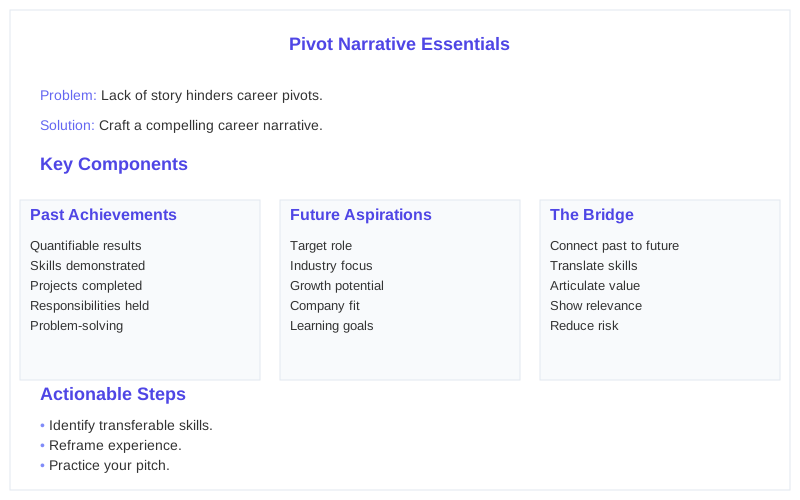
I've configured enough Workday and Greenhouse instances to know that the 'career objective' section is a waste of 30 words. Recruiters skip it. What we do look for, especially in a pivot, is a clear, concise bridge between your past achievements and your future aspirations. This isn't some touchy-feely exercise; it's a critical piece of the hiring mechanics.
If you're trying to shift from, say, project management to product marketing, your resume needs to explicitly translate 'managed cross-functional teams' into 'drove go-to-market strategies.' It's not magic; it's a specific linguistic translation that most ATS systems and human recruiters are programmed to recognize. Without that, you're just another profile in the resume graveyard, regardless of your potential.
My job was to fill roles, not decipher riddles. If your narrative made me work too hard to connect the dots, I moved on. It's a brutal truth, but understanding this workflow is the first step to making your pivot stick. You need to craft a story that practically screams 'I belong here' before I even hit 'forward' to the hiring manager.
The Real Answer
The real reason your career pivot isn't landing isn't typically a lack of capability; it's a fundamental misunderstanding of the hiring committee's risk assessment. When I presented a candidate with a non-linear background to a hiring manager, the first question was always, 'Can they actually do this, or are we taking a flyer?' They're looking for certainty, not potential.
The insider framework here is the 'mitigation of perceived risk.' Your narrative isn't just a story; it's a risk reduction strategy. Every bullet point, every experience you highlight, needs to directly address the hiring manager's implicit question: 'How does this person's past, which looks different, directly prepare them for the challenges of this specific role?'
I've sat in countless debriefs where a candidate was rejected, not because they lacked skills, but because their story didn't provide a compelling 'why now?' for the pivot. My director would say, 'It feels like they're just trying something new,' which translates to 'too risky.'
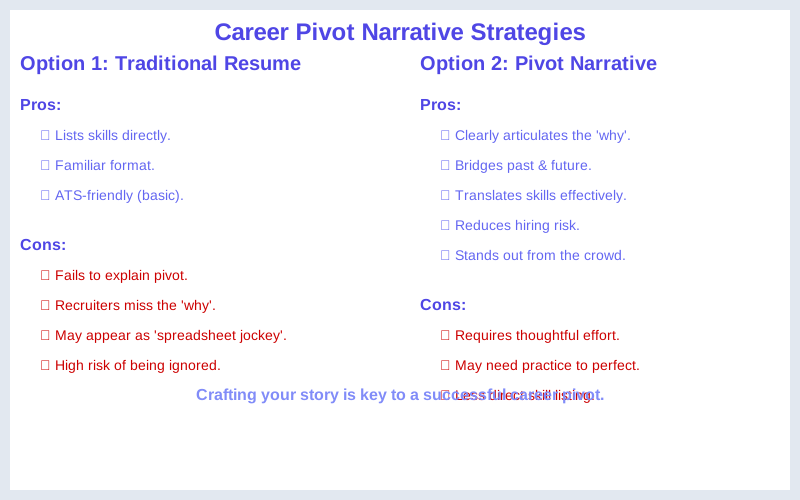
Your personal narrative, therefore, must function as a bridge, explicitly linking seemingly disparate experiences. It's about demonstrating transferable skills in a way that makes the new role feel like a logical, inevitable next step, not a wild leap of faith. This is why a simple chronological resume often fails a pivot; it doesn't provide the necessary context.
When I was a recruiter, my goal was to find the path of least resistance. A well-crafted narrative meant I didn't have to spend 15 minutes explaining your background to a skeptical hiring manager. It did the heavy lifting for me, making my job easier. That's the signal vs noise I was looking for.


What's Actually Going On
What's actually going on behind the scenes is that ATS systems like Lever and iCIMS are optimized for keyword matching and linear career progression. If you're pivoting from 'Senior Financial Analyst' to 'Marketing Operations Manager,' the system won't naturally connect the dots between 'GAAP compliance' and 'CRM automation.' It's looking for direct hits.
My experience configuring these systems showed me that a two-column resume design, popular with creative types, could completely scramble parsing, making your 'skills' section appear as gibberish to the system. This is a technical black hole, not a human judgment.
Company size also dictates how much a narrative matters. At a 50-person startup, a founder might actually read your cover letter and appreciate a compelling pivot story. They're often looking for scrappy generalists. At a 50,000-person enterprise, however, you're a number in a database.
Large companies often have stricter HR policies and compliance rules that favor candidates with direct experience. Their internal transfer processes are sometimes more forgiving, but for external hires, the system is designed for low-risk, high-volume applicant processing. They prioritize a clear, well-trodden path.
Recruiters at larger firms are also under intense pressure to hit metrics like 'time-to-fill' and 'applicant-to-hire ratio.' Spending extra time to understand a complex pivot story often isn't rewarded. It's faster to move on to the next candidate who fits the mold perfectly. This is the human element of the resume graveyard.

How to Handle This
To effectively pivot, you need to treat your career narrative like a product launch: strategic, targeted, and with a clear value proposition. First, conduct a ruthless self-assessment. Don't just list skills; identify the outcomes you achieved. Did you increase efficiency by 15 percent? Reduce costs by $20,000? These are your raw materials.
Next, research your target roles intensely. Read 10-15 job descriptions for the exact role you want. Circle the keywords, the required skills, and the desired outcomes. These are the specific terms your narrative must incorporate to pass ATS filters and catch a recruiter's eye.
Then, build a 'translation matrix.' On one side, list your past achievements. On the other, translate them into the language and context of your target role. For example, 'managed project budgets' becomes 'oversaw financial forecasting for marketing campaigns,' if you're pivoting to marketing.
This is where many people get stuck. If you're struggling to connect the dots, you have a few options. A reputable career coach, not just a resume writer, can cost anywhere from $200 to $1,500 for a package of 3-5 sessions. Look for coaches with specific industry experience in your target field, not just generalists. Ask for their success rates with pivots and specific examples of how they helped clients bridge skill gaps.
A good coach helps you uncover the 'why' behind your pivot and articulate it effectively.
Alternatively, consider a specialized resume service that focuses on career transitions. These typically run $300 to $800. Be cautious here; many are just glorified copy-paste operations. Ask for samples of pivot resumes they've created and ensure they explain how they'll translate your experience, not just 'make it shine.' They should be able to articulate the specific linguistic bridges they'll build. A cheap, generic service often won't pass the ATS sniff test.
Finally, craft a concise, compelling 30-second 'elevator pitch' that summarizes your pivot. This isn't just for networking; it's the internal script you need to have ready for every interview. It should clearly state your past, your desired future, and the bridge connecting them.


What This Looks Like in Practice
I once saw a candidate with 10 years in accounting try to pivot to a Data Analyst role. Their resume was a list of audit functions. The hiring manager immediately flagged it for 'lack of relevant technical skills.' We declined them in 43 minutes.
What should have happened: The candidate needed to highlight how their accounting work involved data extraction, reconciliation, and reporting using tools like SQL or advanced Excel. 'Developed complex financial models for forecasting, reducing variance by 10 percent' would be translated to 'Performed data analysis to identify trends and inform strategic decisions.' This is the narrative shift.
Another example: A teacher wanting to become a Corporate Trainer. Their resume focused on classroom management and curriculum design. My recruiter brain saw 'teacher,' not 'corporate trainer.'
The pivot narrative should have emphasized 'designed and delivered engaging presentations to diverse audiences,' 'developed learning objectives aligned with organizational goals,' and 'evaluated program effectiveness using quantitative metrics.' Those are the keywords the ATS and the hiring manager's brain are looking for, not 'graded papers.'
I've seen candidates successfully pivot from military to tech by reframing 'led a platoon of 30 soldiers' into 'managed cross-functional teams in high-pressure environments, achieving project completion rates of 98 percent.' It's all about the translation.

Mistakes That Kill Your Chances
| Mistake That Kills Your Chances | Why It Fails (Recruiter/ATS Perspective) |
|---|---|
| Generic, untargeted resume | ATS systems filter for specific keywords. If your old industry terms aren't translated to the new industry's language, you're functionally invisible. My Workday searches wouldn't find you. |
| No clear 'why' for the pivot | Hiring managers view this as high risk. They see a flight risk or someone 'just trying things out,' not a committed professional. I couldn't sell that to my VP of Talent. |
| Over-reliance on a cover letter | Most recruiters, especially at scale, don't read cover letters until *after* the resume passes initial screening. Don't put crucial pivot info there. |
| Ignoring transferable skills | You have valuable skills, but if you don't explicitly connect them to the new role's requirements, I'll assume they don't exist. My job isn't to guess your potential. |
| Using old job titles without context | 'Accountant' doesn't tell me you can code. 'Financial Analyst' doesn't tell me you can build marketing funnels. The title alone is signal, but the bullet points need to be noise-free and relevant. |
| Applying to every job vaguely related | This signals a lack of clarity and focus to the recruiter. We see it as desperate, not driven. It makes you a generalist in a world demanding specialists. |
| Not networking in the target industry | Hiring committees often prioritize internal referrals or candidates known in the industry. Without that pre-existing social proof, your pivot is a harder sell. You need allies. |
Key Takeaways
Crafting a compelling narrative for a career pivot isn't about fabricating experience; it's about strategically reframing your existing expertise. I've seen too many brilliant people get stuck in the resume graveyard because they couldn't translate their past into a future.
- Translate, don't just list: Every past achievement needs to be re-articulated in the language of your target industry. This is non-negotiable for ATS parsing and recruiter comprehension.
- Mitigate perceived risk: Your narrative must explicitly answer the 'why now?' and 'can they really do this?' questions for the hiring manager. Make your pivot feel like a logical progression, not a gamble.
- Keywords are king: Research target job descriptions and embed those specific terms into your resume.
This gets you past the initial ATS filter and into a recruiter's hands. * Invest wisely in help: If you're stuck, a specialized career coach or resume service can provide the objective perspective and linguistic translation needed to bridge your experience effectively. Don't cheap out on this; a bad service is worse than none. * Network strategically: Personal connections provide the social proof and context that a resume alone often can't.
A referral can bypass many of the initial screening hurdles.
Frequently Asked Questions
I'm thinking about paying for a 'pivot resume service' online. Is that worth the $150 I saw, or should I just DIY?
Do I really need to change my entire LinkedIn profile and personal website for a pivot, or is just the resume enough?
What if I meticulously craft my narrative, translate all my skills, and I still don't get interviews for my target roles?
Can over-explaining my pivot in interviews make me sound indecisive or desperate?
Some people say 'just apply to everything and see what sticks.' Is that a valid strategy for a career pivot?
Sources
- Career Change Guide 2026 | How to Successfully Pivot - Clever CV
- My Career Pivot Story: The Steps I Took to Shift From Feeling Stuck ...
- Navigating Career Transitions: The 2026 Guide to Pivoting
- How To Pivot Your Career Quickly When Stakes Are High - Forbes
- Preparing for a Career Change: a Step-by-Step Guide for 2026
- Career Change in 2026: A Practical Roadmap for Making the Leap
- Why A Compelling Story Is Vital For Career Change - Careershifters
- How to Craft a Career Narrative: 5 Steps That Tell Your Story
- #4: Your 2026 Career Blueprint: A Step-by-Step Guide to Building ...
- Crafting Your Career Story: Beyond the Bullet Points - Oreate AI Blog
- Beyond the resume: master the art of telling your career story
- How to Build Your Dream Career in 2026 With High ... - YouTube