
Advanced Storytelling Techniques for Behavioral Interview Questions (2026 Complete Guide)
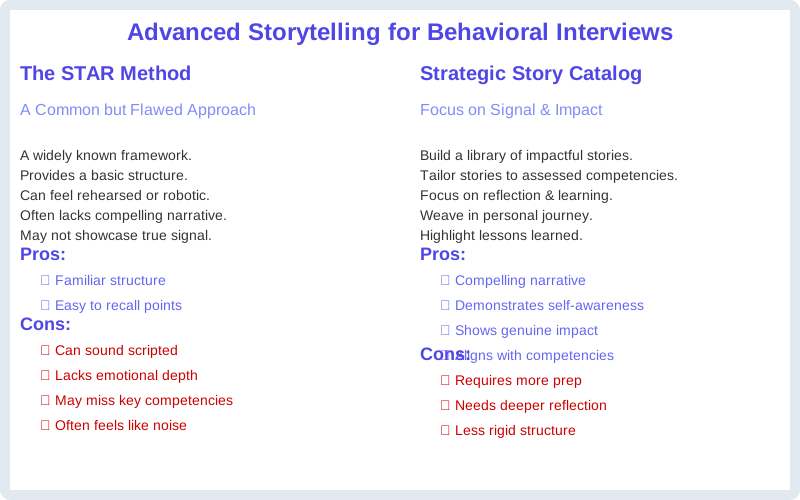
I've sat through 1,200 behavioral interviews in my career, and I can tell you that 95 percent of candidates think the STAR method is a magical incantation. It's not. It's a structure, a barebones framework that most people use to build a perfectly forgettable answer.
I've sat through 1,200 behavioral interviews in my career, and I can tell you that 95 percent of candidates think the STAR method is a magical incantation. It's not. It's a structure, a barebones framework that most people use to build a perfectly forgettable answer. Your 'Situation, Task, Action, Result' often sounds like you're reading from a script, because, let's be honest, you probably are. You're not telling a story; you're reciting a Wikipedia entry of your own life.
As one industry veteran puts it, most tech candidates approach behavioral prep completely wrong. They either wing it, practice random questions, or just read about STAR and think they're ready. They're not.
Recruiters like me aren't listening for perfect adherence to the STAR acronym. My recruiter brain is scanning for specific competencies, not just a chronological recounting of events. We're looking for signal vs noise, and a generic STAR answer is often pure noise. It's like asking for a five-course meal and getting five ingredients laid out separately. Technically all there, but completely unappetizing.
I've seen candidates with phenomenal experience tank interviews because their stories were flat, devoid of real impact or personal reflection. They had the facts, but they lacked the compelling narrative that separates 'good enough' from 'we need to hire this person.' The hiring committee isn't swayed by bullet points read aloud. They want to connect with your journey, your challenges, and how you navigated them.
This isn't about memorizing 100 answers. It's about building a strategic story catalog that actually covers the signal areas they're assessing. Mastering the behavioral interview means understanding what's truly happening behind the curtain.
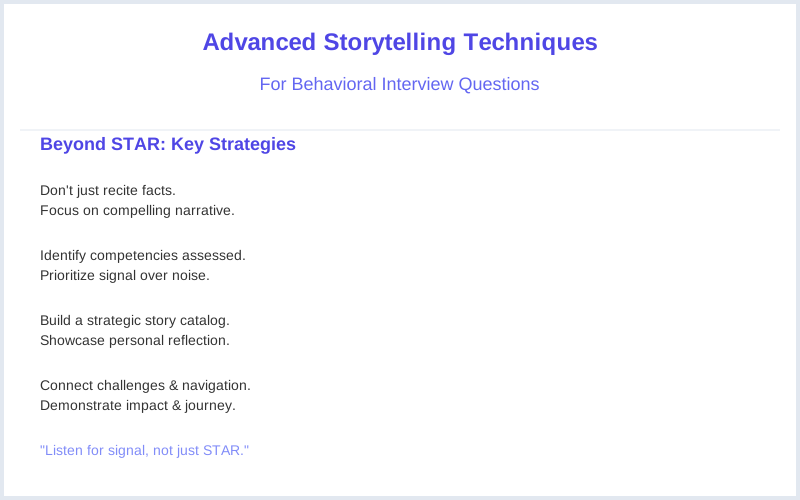
The Real Answer
The real reason your STAR answers are falling flat isn't because the method is broken; it's because you're using it as a checklist, not a storytelling framework. Recruiters, especially at larger companies using systems like Greenhouse or Workday, are trained to listen for specific 'competencies' or 'values' that map directly to the job description and the company's culture deck. One pragmatic approach suggests you write down your stories first, then narrate them.
When a hiring manager tells me they need someone with 'strong ownership' or 'resilience under pressure,' my job isn't just to find someone who says they have it. I need to hear a story that proves it. Your generic STAR story might hit the bullet points, but if it doesn't evoke the underlying competency, it's dead air. It's a feature of a broken system where candidates are taught to parrot, not to persuade.
Think of it this way: every behavioral question maps to one or more 'signal areas' the company cares about. 'Tell me about your most impactful project' isn't just asking about a project; it's assessing 'Scope' and 'Ownership.' 'Tell me about a time you disagreed with your manager' is evaluating 'Conflict Resolution,' 'Communication,' and 'Scope.' Preparing personal stories with clear structure and strong ownership is key.
My 'recruiter brain' is constantly translating your story back to these core competencies. If your story about a project doesn't clearly demonstrate your unique ownership or the specific scope you managed, it's just another anecdote. It doesn't move the needle for the hiring committee. They're looking for evidence, not just an account.
This isn't about finding the 'best' story, but the one that most effectively signals the specific traits the role demands. It's about understanding their internal rubric and feeding it exactly what it craves, wrapped in a compelling narrative.
What's Actually Going On
What's actually going on behind the scenes is that companies, especially those with mature HR departments using tools like iCIMS or Lever, have standardized behavioral interview rubrics. These aren't just vague guidelines; they're often detailed scoring sheets that interviewers fill out after each conversation. Each question isn't random; it's designed to probe a specific competency like 'leadership,' 'problem-solving,' or 'adaptability.' One LinkedIn expert offers an 8-step guide to prepare in 60 minutes.
Your interviewer isn't just listening for the story; they're listening for keywords and specific actions that align with these competencies. If your story about 'teamwork' focuses entirely on what you did, and not how you collaborated or supported others, it misses the mark. It's a failure of alignment, not a failure of your experience.
At a large enterprise, these rubrics are often tied to global talent profiles and even internal promotion criteria. So, a 'senior' role isn't just about years of experience; it's about demonstrating 'strategic leadership' and 'mentorship' through your stories. A junior role might prioritize 'learning agility' and 'initiative.' Having core stories prepared allows you to answer many behavioral questions.
Small startups, while less formal, still operate on similar principles, though often informally. The founder or hiring manager might not have a written rubric, but they have an intuitive sense of what they need. Your stories need to resonate with that intuitive 'recruiter brain' for them to see you as a fit. It's less about a formal scoring system and more about gut feeling, but the underlying needs are the same.
This is why a generic STAR answer often lands you in the resume graveyard. It doesn't provide the specific, compelling evidence that the interviewer needs to check off their internal boxes or to advocate for you to the hiring committee. It's just a bland recounting, not a persuasive argument for your candidacy.
How to Handle This
Okay, so how do you actually get good at this? First, stop thinking about 'answers' and start thinking about 'stories.' You need a 'story toolbox,' not a script. The complete guide emphasizes writing out the full STAR response and practicing it aloud.
1. Identify Your Core Competencies: Before you even think about questions, list the 5-7 core skills for the role you want. Think 'leadership,' 'problem-solving,' 'conflict resolution,' 'adaptability,' 'initiative,' 'collaboration,' 'dealing with ambiguity.' These are the signals the hiring committee is looking for. Don't guess; look at the job description and the company's values.
2. Mine Your Experience: Go through your resume, project by project, and brainstorm specific situations where you demonstrated each of those core competencies. Don't just list them; think about the challenge, your specific role, the actions you took, and the quantifiable results. Aim for 2-3 stories per competency.
3. Craft Your Narrative, Not Just STAR: Yes, use STAR as your skeleton. But flesh it out. Inject emotion, describe the stakes, highlight the conflict, and emphasize your specific impact. What did you learn? How did you grow? One UX professional advises recording yourself for self-critique.
4. Quantify Everything: This is where most people fail. Instead of 'I improved efficiency,' say 'I implemented a new process that reduced project delivery time by 15 percent, saving the team an average of 4 hours per week.' Numbers are magic to a recruiter's ear.
5. Practice, Record, Refine: Don't just practice in your head. Record yourself telling these stories. Do you sound natural? Are you engaging? Is your voice monotone? Recruiters can spot a rehearsed answer from a mile away. Refine until it sounds like a compelling conversation, not a recitation. This is where a good coach can earn their $500 fee in 30 minutes.
What This Looks Like in Practice
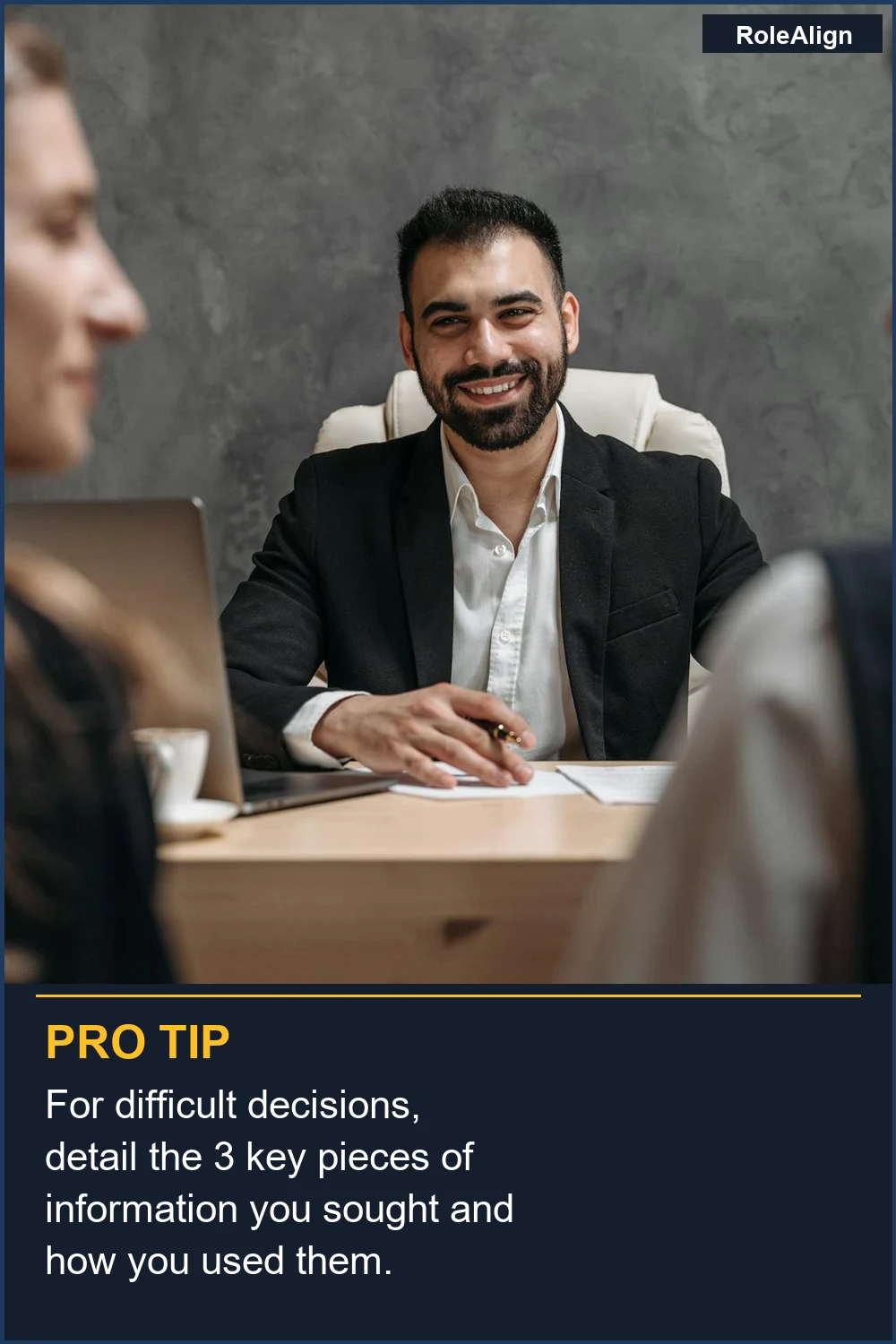
Let's say you're interviewing for a Senior Product Manager role. A common behavioral question might be, 'Tell me about a time you had to make a difficult decision with incomplete information.' The STAR method is a widely used framework for structuring responses.
-
Scenario 1: The Generic Answer (Noise) 'At my last company, we had to decide on a new feature. I gathered some data, talked to the team, and we decided to launch it. It was okay.' (This provides no signal, just a vague recounting. It's the equivalent of a blank line in the ATS.)
-
Scenario 2: The Advanced Story (Signal) 'At Acme Corp, we were 43 days from our Q3 launch, and our analytics showed a 12 percent drop in user engagement on a core feature. We lacked clear data on why.' (Situation: clear, quantifiable context, high stakes.)
'My task was to either deprioritize the feature, risking our Q3 targets, or push a speculative fix without full confidence.' (Task: defined, high-pressure dilemma.)
'I assembled a rapid-response task force of three engineers and one UX designer. We ran 24-hour A/B tests on two hypotheses, leveraging existing telemetry data, and conducted 10 rapid user interviews. I personally synthesized 300 data points in 48 hours.' (Action: specific, quantifiable, demonstrating leadership, initiative, and data analysis.)
'We identified a critical UI bug affecting 8 percent of our active users, pushed a hotfix, and saw a 7 percent rebound in engagement within 72 hours. This prevented a projected 1.5 million dollar revenue loss for the quarter and informed our new rapid deployment protocol.' (Result: quantifiable impact, clear positive outcome, and a lesson learned. This video offers 5 powerful techniques for behavioral questions.) This story demonstrates leadership, analytical skills, and decision-making under pressure.
Mistakes That Kill Your Chances
Look, I've seen every flavor of 'bad' behavioral answer. Here are the mistakes that will land you in the resume graveyard, even if you're a perfect fit for the job. Experienced developers often ask how many stories to prepare for behavioral interviews, highlighting the need for a robust catalog.
Key Takeaways
Look, behavioral interviews aren't about trick questions; they're about predicting your future performance based on your past behavior. But they're also a hiring theater where you need to play your part convincingly. Mastering them means understanding the mechanics behind the curtain.
- Understand the 'Why': Every question maps to specific competencies the company values. Your job is to demonstrate those competencies, not just recount events.
- Build Your Story Catalog: Don't memorize answers. Develop 5-7 robust stories that you can adapt to various questions, hitting different competencies each time. One guide recommends adding a 'Lesson Learned' to the STAR method.
- Quantify Everything: Numbers are your best friends. They provide concrete evidence of your impact and make your stories memorable.
Aim for 2-3 specific metrics per story. * Focus on 'I': While teamwork is crucial, your stories need to highlight your specific actions and contributions. * Practice, Don't Perform: Practice until your stories flow naturally, not like a script. Authenticity is key to connecting with your interviewer.
This isn't just about getting a job; it's about making sure your actual value isn't lost in the ATS black hole or the resume graveyard of forgettable answers. Give them the signal they're looking for.
Frequently Asked Questions
I'm thinking of paying $500 for an interview coach to review my STAR stories. Is that worth it, or can I just use an AI tool for $12 a month?
Do I really need to quantify every single result? Sometimes the impact wasn't a perfect number, like 'I improved team morale.'
What if I prepare all these amazing stories, and the interviewer asks a question that none of them directly address?
If I exaggerate my numbers or impact to make a story more compelling, can that permanently damage my career if they find out?
I heard that interviewers only care about STAR stories for entry-level roles. Is it true that for senior positions, they want more conversational answers?
Sources
- Prepare for Behavioral Interviews with a Story Toolbox - LinkedIn
- Mastering Storytelling for Behavioral Interviews: A Guide...
- The Complete Guide to Behavioral Interview Questions (2026)
- Mastering the Behavioral Interview: Tips & Strategies
- How to Prepare Personal Stories for Behavioral Interviews Guide
- 5 Secrets to Never Fail a Behavioral Interview with the STAR ...
- Let's pragmatically get better at behavioral interviews (and ...
- Core 4 Stories for Behavioral Based Job Interviews
- Behavioral Interview Questions: 25 Examples & Storytelling Tips
- An Updated Roadmap - Mastering Behavioral Interviews in 2026
- How many stories do you prepare for Behavioral Interviews ... - Reddit
- how-to-ace-behavioral-interviews-by-framing-powerful-stories