How to Prepare for a Behavioral Interview (A Realistic Guide)
RoleAlign Team
13 min read
Prices verified February 2026
Includes Video
You just finished another interview, and the polite rejection email landed in your inbox. You stare at the screen, the familiar sting of disappointment setting in. This isn't the first time. You know you have the skills, but something isn't connecting in those crucial conversations.
You just finished another interview, and the polite rejection email landed in your inbox. You stare at the screen, the familiar sting of disappointment setting in. This isn't the first time. You know you have the skills, but something isn't connecting in those crucial conversations. Behavioral interview prep is the missing piece, and understanding how to tackle these questions is vital for your next career move. Hiring managers aren't just looking for skills; they want proof you can apply them. In fact, over 80% of HR rely on behavioral techniques to assess candidates' skills source. These interviews, often starting with "Tell me about a time when..." source, are designed to predict your future performance based on past actions. Ignoring this crucial aspect of the hiring process means leaving your success to chance. It's time to stop hoping for the best and start preparing strategically.
The core of effectively navigating these inquiries lies in a structured approach, and the STAR method has emerged as a widely recognized and highly effective formula for crafting compelling responses source. This acronym stands for Situation, Task, Action, and Result, providing a clear narrative arc for your answers source. By breaking down your experiences into these distinct components, you can present a coherent and impactful story that demonstrates your capabilities. For instance, the "Situation" component allows you to "Set the scene" and provide context so the interviewer can follow the plot source. Following this, you'll outline the "Task" you needed to accomplish, detailing your specific responsibilities. Then comes the "Action," where you explain the concrete steps you took, and finally, the "Result," where you quantify the positive outcomes of your efforts. This method ensures your answers are specific, relevant, and recent, highlighting the "why" and intention behind your actions source. It’s about transforming past experiences into predictive indicators of your future success, turning your interview from a guessing game into a strategic presentation of your professional journey. Preparing at least two answers for common STAR interview questions is a recommended practice source.
Key specifications for how to prepare for a behavioral interview
## The Real Answer
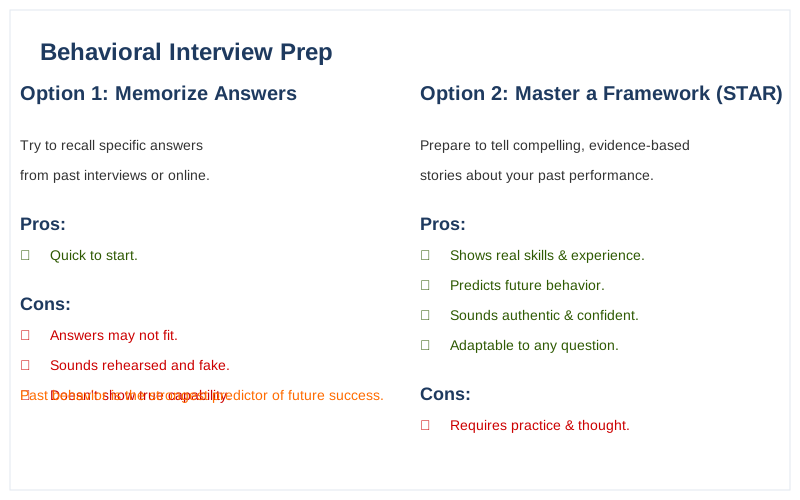
Behavioral interview prep isn't about memorizing answers; it's about mastering a framework to tell compelling, evidence-based stories about your past performance. Recruiters use these questions because past behavior is the strongest predictor of future success.
The core insight from the recruiting side is that "past behavior often predicts future behavior." Schwab Jobs highlights this principle, explaining that behavioral interviews aim to assess how you've handled situations before to gauge your future performance. Forget trying to guess the "right" answer; focus on showcasing your actual capabilities. In fact, over 80% of HR professionals rely on behavioral techniques to assess candidates' skills, according to nl.edu.
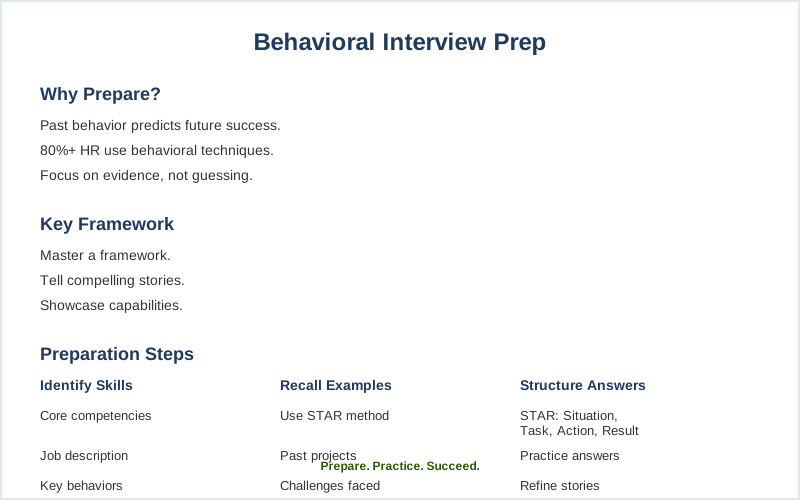
The universally accepted structure for answering these questions is the STAR method. This acronym stands for Situation, Task, Action, and Result. The Situation provides the necessary context, like setting the scene for a story. The Task outlines the challenge or responsibility you faced. Action details the specific steps *you* took, emphasizing your individual contribution even in team settings. Finally, the Result quantifies the outcome and impact of your actions, demonstrating your effectiveness. This structured approach prevents rambling and ensures your response is focused and impactful.
To prepare, identify key competencies relevant to the role and brainstorm specific examples from your experience that demonstrate them. Think about times you've faced challenges, led projects, resolved conflicts, or learned something new. Common behavioral questions often start with "Tell me about a time when..." or "Give me an example of..." Indeed.com lists examples like handling a situation when a manager was unavailable or overcoming a personal failure.
The STAR method is a useful acronym and an effective formula for structuring your behavioral interview response capd.mit.edu. Practice articulating these stories concisely, focusing on your specific role and the tangible outcomes. The goal is to provide concrete evidence of your skills, not just theoretical capabilities. This robust behavioral interview prep will make your answers clear, memorable, and persuasive.
Mastering behavioral interview prep involves showcasing your professional experience through compelling stories. Over 80% of recruiters use these questions to gauge future performance.
| Photo by Edmond Dantès
Mastering behavioral interview prep involves showcasing your professional experience through compelling stories. Over 80% of recruiters use these questions to gauge future performance.
| Photo by Edmond Dantès
## What's Actually Going On
1
Understand the Core Mechanic: Past Behavior Predicts Future Performance - This is the bedrock of behavioral interviewing. Recruiters and hiring managers use these questions to gauge your real-world problem-solving, teamwork, and leadership skills. They're not just looking for what you *say* you can do; they want proof of what you *have* done. Over 80% of HR professionals rely on these techniques to assess candidates, making effective preparation crucial for a behavioral interview prep strategy. How to Use the STAR Method to Answer Behavioral Questions
2
Decode the ATS and Recruiter Screen - Before a human sees your resume, Applicant Tracking Systems (ATS) often parse it for keywords related to skills and experiences. Recruiters then perform initial screens, often looking for specific accomplishments and quantifiable results. They're scanning for evidence that you've handled situations relevant to the job description, prioritizing candidates who demonstrate a clear pattern of success. Using the STAR method for your next behavioral interview
3
Company Size and Industry Nuances Matter - Startups might prioritize adaptability and a "roll-up-your-sleeves" attitude, looking for examples of initiative and resourcefulness. Enterprise companies often seek demonstrated experience with process, scalability, and cross-functional collaboration. In tech, technical problem-solving and innovation are key; finance emphasizes analytical rigor and risk management; healthcare demands patient care, ethical decision-making, and regulatory adherence. Seniority levels also shift focus: junior roles might highlight learning agility and task completion, while senior roles demand strategic thinking, team leadership, and complex project management.
4
Master the STAR Method for Concrete Answers - The STAR method (Situation, Task, Action, Result) is your framework for delivering clear, compelling narratives. Situation: Set the scene and provide necessary context. Task: Describe the challenge or responsibility you faced. Action: Detail the specific steps *you* took. Result: Quantify the outcome and impact of your actions. This structured approach ensures you don't ramble and provides interviewers with the evidence they need. Use the STAR Interview Method to Land Your Next Job, How to Prepare for a STAR Interview |Schwab Jobs
5
Prepare a Repertoire of Stories - Don't just prepare one answer; build a library of examples that showcase different skills and competencies. Think about common behavioral questions like "Tell me about a time you faced a significant challenge" or "Describe a situation where you had to work with a difficult colleague." Have at least two distinct, well-rehearsed stories ready for each common question. This allows you to tailor your responses and demonstrate a breadth of experience, rather than relying on a single, potentially irrelevant anecdote. 10 Behavioral Interview Questions (With Sample Answers)
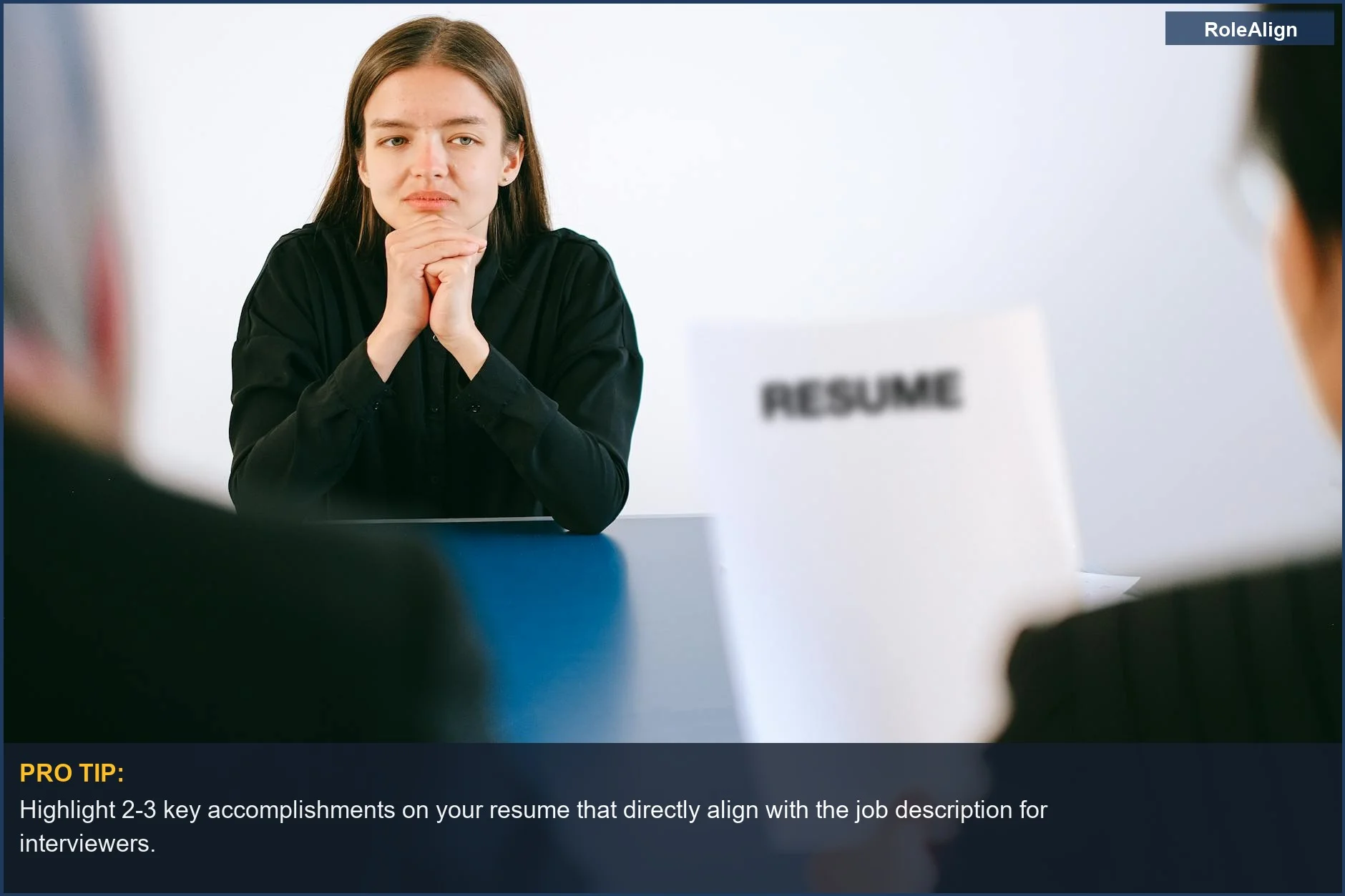
When preparing for behavioral question answers, your resume serves as a powerful visual aid to support your claims. Focus on quantifiable results.
| Photo by Anna Shvets
When preparing for behavioral question answers, your resume serves as a powerful visual aid to support your claims. Focus on quantifiable results.
| Photo by Anna Shvets
## How to Handle This
1
Identify 5-7 core behavioral themes - Recruiters use these questions to predict your future performance based on past behavior, and over 80% of HR rely on these techniques [Source Name]. Think about common themes like problem-solving, teamwork, leadership, handling conflict, and adaptability. For senior roles, expect questions probing strategic thinking and managing complex projects; for entry-level, focus on learning agility and initiative. Skip this, and you'll be caught off guard by the sheer volume of potential questions, leading to vague or generic answers.
2
Develop STAR stories for each theme - The STAR method (Situation, Task, Action, Result) provides a clear, structured narrative that recruiters can easily follow [Source Name]. For each theme, brainstorm 2-3 specific, relevant, and recent examples from your experience. Recruiters want proof you can apply skills, not just list them [Source Name]. If you don't have pre-prepared stories, you'll be forced to improvise, which often results in rambling, incomplete answers, or worse, fabricating details on the spot, which can come across as disingenuous [Source Name].
3
Tailor stories to the specific role and company - While you need a bank of stories, generic answers won't cut it. Research the company's values, mission, and recent projects. Understand the specific skills and challenges mentioned in the job description. Recruiters are looking for a fit with their culture and the immediate needs of the role. Failing to tailor means your examples might be irrelevant, showing a lack of genuine interest or understanding of their business. This is crucial for every role level and industry, from tech startups to established financial institutions.
4
Practice articulating your STAR stories - Rehearse your answers out loud, ideally with a friend or mentor. Focus on conciseness and impact, ensuring each part of the STAR method is clearly defined. Recruiters need to understand your contributions quickly; rambling wastes their time and yours. If you skip practice, you risk forgetting key details, losing your train of thought, or sounding hesitant and unprepared, which undermines your credibility and the strength of your experiences.
A thoughtful expression during a STAR method interview can convey deep consideration. Focus on identifying recurring positive behaviors in your career history.
| Photo by www.kaboompics.com
A thoughtful expression during a STAR method interview can convey deep consideration. Focus on identifying recurring positive behaviors in your career history.
| Photo by www.kaboompics.com
## What This Looks Like in Practice
Behavioral interviews, which hinge on the principle that past behavior predicts future performance How to Prepare for a STAR Interview |Schwab Jobs, require candidates to draw upon specific experiences. The STAR method – Situation, Task, Action, Result – provides a robust framework for structuring these responses How to Use the STAR Method to Answer Behavioral Questions. It helps candidates set the scene and provide context for their interviewer How to Use the STAR Method in Interviews in 2025. Preparing by reviewing common questions and crafting multiple answers for each is a recommended strategy How to Use the STAR Interview Method to Land Your Next Job.
Entry-Level Data Analyst at a Large Financial Institution Analyzed customer transaction data to identify trends, focusing on presenting initial findings with clear visualizations. Struggled to translate complex statistical outputs into actionable business insights for non-technical stakeholders. Developed a concise summary slide for each analysis, highlighting the key takeaway and recommended next steps, which improved comprehension and buy-in. This involved clearly defining the situation (complex data, non-technical audience), the task (communicating insights effectively), the action (creating a simplified summary slide), and the result (improved understanding and stakeholder engagement) How to Use the STAR Interview Method to Land Your Next Job.
Senior Software Engineer at a Mid-Stage SaaS Company Led the migration of a critical microservice to a new cloud infrastructure with minimal downtime. Meticulously planned rollback strategies and conducted extensive load testing. The migration occurred during off-peak hours, and proactive communication with other engineering teams about potential impacts was crucial. The candidate clearly articulated the challenging situation, the critical task of a seamless migration, the detailed actions taken in planning and execution, and the positive result of a successful, low-impact deployment How to Prepare for a STAR Interview |Schwab Jobs.
Product Manager transitioning from a Non-Profit Background Demonstrated strategic thinking and ability to drive product roadmaps in a fast-paced tech environment. Prepared by researching behavioral interview questions and practicing answers using the STAR method. Initially relied too heavily on anecdotes from previous roles without clearly articulating transferable skills and the business impact of actions. The key learning here was to ensure the 'Result' component of the STAR method explicitly linked actions to tangible business outcomes, not just personal accomplishments How to Use the STAR Method to Answer Behavioral Questions.
Marketing Specialist at a Series A Startup Launched a new digital marketing campaign with aggressive growth targets, focusing on rapid A/B testing of ad creatives and landing pages. Underestimated the importance of aligning campaign messaging with the broader brand strategy, leading to initial disconnects. In retrospect, the candidate would emphasize the Situation (launching a new campaign with high stakes), the Task (achieving aggressive growth), the Action (implementing A/B testing), and the Result (recognizing the need for strategic alignment to ensure long-term brand consistency and effectiveness) Using the STAR method for your next behavioral interview.
Understanding what interviewers value can enhance your storytelling, so it's helpful to explore what interviewers look for.
Completing questionnaires is often the first step in behavioral interview prep. Be ready to articulate your experiences clearly and concisely.
| Photo by Sora Shimazaki
Completing questionnaires is often the first step in behavioral interview prep. Be ready to articulate your experiences clearly and concisely.
| Photo by Sora Shimazaki
## Mistakes That Kill Your Chances
Symptom Over-reliance on generic, "perfect" stories.
Signal Interviewer asks follow-up questions and the candidate struggles to provide specifics beyond the rehearsed narrative.
Symptom Lack of specific details, leading to vague answers.
Signal Answers feel like hypothetical situations rather than concrete past experiences.
Symptom Focusing solely on "what" happened, not "how" or "why."
Signal The interviewer can't discern the candidate's thought process or decision-making.
Symptom Using "we" exclusively when describing team efforts.
Signal The candidate's individual contribution is unclear.
Symptom Neglecting the "Result" or downplaying its significance.
Signal The impact of the candidate's actions is not quantifiable or clear.
Symptom Preparing too few stories for common behavioral question themes.
Signal Candidate panics or defaults to irrelevant examples when asked a slightly different question.
Many candidates make the mistake of rehearsing one perfect story for each potential behavioral interview question. This sounds good in theory, but it often backfires. Recruiters want to see how you think on your feet, not just how well you can deliver a memorized script. If the interviewer probes deeper, you'll quickly reveal that you're just reciting. The goal of behavioral interview questions is to understand your past actions as a predictor of future performance .
Another common pitfall is vague storytelling. Recruiters aren't interested in generalities; they want specifics. Instead of saying "I improved efficiency," explain *how* you did it, *what tools* you used (e.g., implementing Jira workflows or automating reports with Python scripts), and the *measurable impact*. This level of detail is crucial for demonstrating your capabilities. Over 80% of HR rely on behavioral techniques to assess candidates' skills .
For new grads, a major mistake is failing to connect academic or extracurricular projects to professional scenarios. Even if you haven't had formal work experience, elaborate on group projects, leadership roles in clubs, or challenging coursework. Explain the situation, your task, the actions you took, and the results achieved, just as you would for a professional role. This demonstrates your ability to apply the STAR method.
Mid-career professionals often err by oversharing or focusing on blame. When discussing challenges, keep the focus on your actions and learning, not on complaining about past colleagues or managers. The interviewer wants to see your problem-solving skills and resilience, not your capacity for negativity. Senior leaders sometimes fall into the trap of delegating too much credit. While teamwork is vital, ensure you articulate your specific role and leadership in achieving outcomes. Use "I" statements to highlight your individual contributions, especially in collaborative efforts .
Finally, a non-obvious mistake is preparing too many "hero" stories. While showcasing successes is important, interviewers also want to see how you handle failure or adversity. Prepare at least one story about a time you didn't succeed, but crucially, focus on what you learned and how you grew from the experience. This demonstrates self-awareness and a growth mindset .
To enhance your chances of success, consider these essential interview preparation tips alongside your response strategy.
Product comparison for how to prepare for a behavioral interview
## Key Takeaways
Behavioral interview prep boils down to demonstrating past performance as a predictor of future success How to Prepare for a STAR Interview |Schwab Jobs. This means moving beyond hypothetical answers and providing concrete examples of your actions and their outcomes.
The STAR method interview provides the essential framework: Situation (set the scene), Task (describe the challenge), Action (detail your steps), and Result (reveal the impact) nl.edu. Mastering this structure ensures your behavioral question answers are clear, concise, and compelling.
Prepare at least two to three distinct stories for common behavioral questions, focusing on specific achievements and your individual contributions, even in team settings Use the STAR Interview Method to Land Your Next Job. Highlight how you tackled challenges and learned from them, showcasing adaptability.
Over 80% of HR professionals rely on behavioral techniques to assess candidates nl.edu. Therefore, having well-rehearsed, authentic stories is paramount.
The single most important thing a recruiter would tell you off the record? Be authentic. While the STAR method provides structure, interviewers can spot rehearsed or fabricated answers. Your genuine experiences and the lessons learned are what truly set you apart.
Understanding how to effectively convey your experiences can be complemented by exploring how AI interview prep tools assess your non-verbal cues.
Frequently Asked Questions
What are the top 5 behavioral interview questions I should really have solid answers for?
You should definitely prepare for questions about handling challenges, teamwork, dealing with difficult people, and your biggest successes and failures. For example, 'Tell me about a time you faced a significant obstacle at work' or 'Describe a situation where you had to collaborate with a difficult colleague.' Having at least two specific examples ready for each of these categories is a good goal.
How do I answer 'tell me about a time you failed' without sounding like a total disaster?
The key is to focus on what you learned and how you improved. Frame the failure as a learning opportunity, detailing the specific situation, your role, the outcome, and most importantly, the actionable steps you took afterward to prevent a similar issue. This demonstrates self-awareness and a growth mindset, rather than incompetence.
Is the STAR method still the best way to structure my answers for these kinds of questions?
Yes, the STAR method (Situation, Task, Action, Result) remains a highly effective framework for answering behavioral interview questions. It provides a clear, concise, and logical structure that helps you tell a compelling story and demonstrate your skills and experience. It ensures you cover all the necessary details without rambling.
How long should my answer be when they ask a behavioral question?
Aim for answers that are roughly 2-3 minutes long, which typically translates to about 200-300 words. This length allows you to provide sufficient detail using the STAR method without being too brief or too lengthy. Focus on being specific and impactful within that timeframe.
What happens if an interviewer thinks I'm making up a story during a behavioral interview?
Interviewers are trained to spot inconsistencies and vagueness. If they suspect you're fabricating a story, they might ask follow-up questions to probe for more detail or challenge specific points. Being truthful and focusing on actual behaviors rather than hypothetical scenarios is crucial to avoid this.
R
RoleAlign Team
Experienced car camper and automotive enthusiast sharing practical advice.