
What Happens to Your Application After You Hit Submit (2026 Complete Guide)
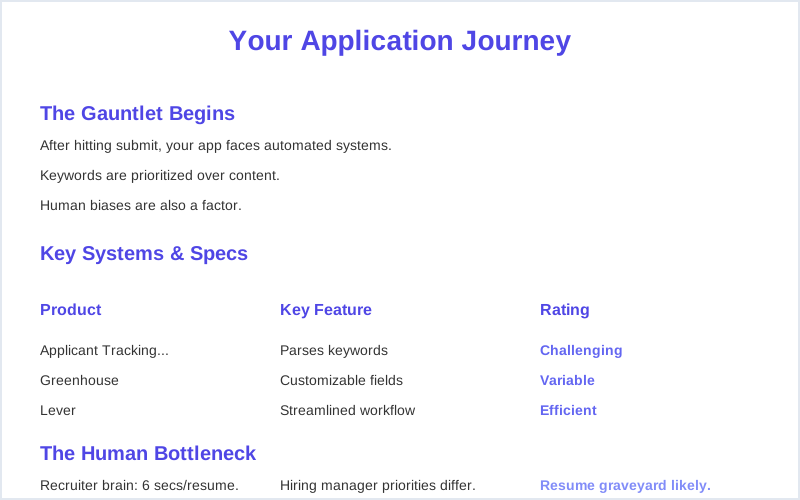
I've seen resumes with perfect qualifications get immediately binned because the applicant used a fancy two-column template that Workday chewed up, spitting out a garbled mess of text. That's 100 percent true. Most people think hitting 'submit' is the finish line, but it's actually the starting gun for a gauntlet of automated systems and human biases that are stacked against you.
I've seen resumes with perfect qualifications get immediately binned because the applicant used a fancy two-column template that Workday chewed up, spitting out a garbled mess of text. That's 100 percent true. Most people think hitting 'submit' is the finish line, but it's actually the starting gun for a gauntlet of automated systems and human biases that are stacked against you. What happens after you click that button is a far cry from a fair assessment of your skills.
LinkedIn's Katelyn Harris-Lange confirms applications can sit in review indefinitely.
We're talking about a process where your entire professional narrative can be reduced to a few keywords a recruiter's brain is frantically searching for. I've configured these systems, I've sat on hiring committees, and I've been the one sending those canned rejection emails for ghost jobs that never really existed.
The average recruiter spends about 6 seconds on a resume, a number I can personally attest to when I had 40+ open roles to fill.
That 'six-second resume review' isn't about finding the best candidate; it's about eliminating the most obvious mismatches before my next meeting. Your application enters a complex ecosystem of Applicant Tracking Systems (ATS) like Greenhouse or Lever, each with its own quirks and pitfalls.
Then it faces a recruiter's 'recruiter brain,' which is optimized for speed and pattern recognition, not deep dives.
Finally, if you somehow clear those hurdles, it might land in front of a hiring manager or committee that's often operating with a completely different set of priorities than what was advertised. It's a journey from a technical parsing challenge to a human bottleneck, often ending in the dreaded resume graveyard.
Fastweb's FAFSA guide shows how even financial aid forms require follow-ups and status checks, highlighting that submission is rarely the final step. Understanding this process is the only way to play the game effectively. You don't just submit; you strategize.
The Real Answer
Once you hit 'submit,' your application doesn't just float into a magical hiring ether. It immediately gets ingested by an Applicant Tracking System (ATS), often Workday, Greenhouse, Lever, or iCIMS. This is where the ATS black hole can first swallow your resume. The system's primary job is to parse your document, extracting key data points like job titles, dates, and skills into a structured database.
If your formatting is off, like that two-column layout I mentioned, crucial information can become unsearchable. As this YouTube overview suggests for college applications, there are always subsequent steps.
Next, the ATS often performs an initial keyword scan against the job description. This isn't about understanding your experience; it's a simple match-rate calculation.
If the keywords my hiring manager gave me - say, 'Java,' 'AWS,' and 'Kubernetes' - aren't present or are phrased differently, your application might get a low score or be automatically filtered out. I've seen resumes for stellar engineers get rejected because they used 'Amazon Web Services' instead of 'AWS.'
If you survive the ATS, your application lands in a recruiter's queue. This is where the 'recruiter brain' kicks in.
My goal wasn't to find a needle in a haystack; it was to find a plausible candidate within 60 seconds. My eyes would jump to the last two job titles, the dates, and then I'd scan for those non-negotiable keywords. This is pure signal vs noise filtering, driven by the sheer volume of applications and tight deadlines. Quora users also discuss the 'in review' status, confirming this human bottleneck.
Finally, if I deemed you a 'maybe,' your profile might be presented to the hiring manager or a hiring committee. Here, the dynamics shift again. The hiring manager might have specific, unstated preferences, or the role itself might be a ghost job designed to impress investors, as I experienced at that SaaS startup. The real reason jobs stay open isn't always about finding someone; it can be about optics, budget freezes, or internal politics.
It's a chain of increasingly human and often illogical filters, not a meritocracy.
What's Actually Going On
When your application hits 'submit,' it's typically routed to one of the major ATS players: Workday, Greenhouse, Lever, or iCIMS. Each has its own parsing engine. Workday, for instance, is notorious for struggling with complex resume layouts, often jumbling sections or completely missing bullet points if they aren't in a standard format. This is a technical failure that creates an ATS black hole for qualified candidates.
A FAFSA walkthrough demonstrates the importance of correct data entry for any official submission.
The ATS then assigns a status: 'Submitted,' 'Under Review,' 'Application Received.' Don't read too much into these. 'Under Review' often means it's sitting in a queue waiting for a recruiter to glance at it, or it passed the initial keyword filter but no human has seen it yet. It's not a guarantee of human eyes.
For larger companies, especially those with thousands of applicants, the ATS might run an initial automated screening for specific, non-negotiable criteria like minimum years of experience or specific certifications. If you don't meet these, it's an instant rejection, often without a human ever knowing you applied. This is why you need to match the job description almost perfectly. Spivey Consulting details how law school applications are processed and reviewed by multiple officers.
Smaller companies or startups often use simpler ATS platforms like Lever or Greenhouse. While they still parse, the recruiter's 'recruiter brain' might be the first filter, not the second. This means less automated keyword matching and more immediate human pattern recognition. Your resume might get seen faster, but the review time is still brutally short - often under 10 seconds.
Regulatory compliance also plays a role.
HR policies often dictate how long applications must be kept, even for rejected candidates. This contributes to the resume graveyard, where millions of perfectly good profiles sit unsearched. My director would track new applications, not how many old ones I revived. It was always easier to post a new req and get fresh candidates than dig through stale data. The system incentivizes new activity, not thorough review of past applicants. That's a feature, not a bug.
How to Handle This
First, optimize your resume for ATS parsing. Use a simple, single-column layout. Avoid graphics, tables, and fancy fonts. Stick to standard headings like 'Experience,' 'Education,' and 'Skills.' I've spent hours debugging Taleo instances where non-standard formats broke the parsing engine, making resumes unsearchable. Indeed offers tips for making your resume software-friendly.
Second, mirror the job description's language.
If the job description says 'Python,' don't write 'proficient in scripting with Python.' Use 'Python.' If it says 'CRM software,' don't say 'customer relationship management platforms.' The ATS is a dumb keyword matcher, not a linguist.
Third, track your applications. Create a simple spreadsheet with the company, role, date applied, and the job description itself. This helps you tailor follow-up emails and remember what you applied for, especially when you're sending out 50+ applications.
A Facebook group post on college applications highlights the importance of keeping track of submission details.
Fourth, network. A referral from an employee often bypasses the initial ATS filters and lands your resume directly in front of a human recruiter. This is the single most effective way to cut through the noise. My 'recruiter brain' always prioritized referred candidates because they came with an implicit stamp of approval.
Fifth, follow up strategically.
If you haven't heard back in 7-10 business days, a polite, concise email to the recruiter (if you can find their contact information on LinkedIn) is acceptable. Reference a specific skill from your resume that matches a key requirement. Don't spam them; one follow-up is enough. If it's a ghost job, they won't reply anyway, and you'll save yourself time. This isn't about being pushy; it's about making sure your application didn't get lost in the ATS black hole.
What This Looks Like in Practice
I once posted a 'Senior Product Manager' role, and within 48 hours, we had 300 applications in Greenhouse. My initial scan, driven by the 'recruiter brain,' eliminated 250 of them in under an hour because they either lacked specific industry experience or didn't have 'roadmap' or 'go-to-market' in their resumes. Pure keyword filtering. Reddit users confirm the ATS scoring system.
For a 'Data Scientist' role at a large tech company, our Workday ATS was configured with strict minimum requirements: a Master's degree and 3 years of experience with Python and SQL. Any resume lacking these exact phrases was automatically binned, regardless of actual skill. I once found a PhD who used 'statistical programming' instead of 'Python' in the ATS black hole.
At a startup, we had a 'Front-End Developer' role that was open for 4 months.
The hiring manager kept interviewing people but never extended an offer. The real reason? They were secretly waiting for a specific candidate to finish a project at their current company. All those interviews were just hiring theater to keep the pipeline warm.
I've seen internal HR policies mandate that every role receive at least 50 external applications before it could be filled internally.
This meant I was often screening candidates for roles that were already unofficially earmarked for an internal transfer. More ghost jobs, more wasted applicant time.
Sometimes, a hiring manager would suddenly change their mind on key requirements mid-process. My 'recruiter brain' would then have to re-evaluate the existing applicant pool in Lever, often leading to a mass rejection of candidates who were perfectly qualified for the original job description. It's a messy, dynamic process, not a static one.
Mistakes That Kill Your Chances
| Mistake | Why it Kills Your Chances | The Insider's View |
|---|---|---|
| Fancy Resume Layouts | ATS parsing engines (like Workday's) often fail to read non-standard formats, rendering your skills invisible. | I've seen entire 'Experience' sections disappear from parsed data because of two-column templates. Your resume goes into the ATS black hole. |
| Generic Cover Letters | Recruiters rarely read them. If they do, a generic one shows zero effort and doesn't stand out from the signal vs noise. | My 'recruiter brain' skipped 95 percent of cover letters unless the hiring manager specifically requested them. Time is money. |
| Missing Keywords | ATS systems filter based on keyword matching. If you don't use the exact terms from the job description, you're out. | If I was searching for 'Salesforce Admin' and you wrote 'CRM Specialist,' the ATS wouldn't find you. Simple as that. |
| Applying to Every Role | Recruiters see this as a lack of focus. It signals you haven't thought about what you actually want or where you fit. | I'd flag candidates who applied for 10+ wildly different roles in Lever. It tells me they're desperate, not a good fit. |
| No Networking/Referral | Without a referral, you're just another anonymous application in a sea of hundreds, facing stricter ATS filters. | A referral often bypasses initial ATS filters and gets your resume directly onto my desk. It's a cheat code. |
| Vague Experience Descriptions | Recruiters need concrete metrics and achievements. 'Managed projects' isn't as good as 'Managed 5 projects, reducing costs by 15 percent.' | My 'recruiter brain' needs numbers. If I can't quantify your impact in 5 seconds, it's harder to sell you to a hiring manager. |
| Emailing the Hiring Manager Directly | This can be seen as circumventing the process and annoying the hiring manager, who likely forwards it to HR anyway. | Hiring managers would often forward these to me with a 'handle this' note. It just added an extra step and didn't impress. |
Marks Education also warns against common application errors, emphasizing attention to detail.
Key Takeaways
Hitting 'submit' is just the first hurdle in a complex race, not the finish line. Your application navigates a series of technical and human filters, each designed to reduce the applicant pool.
ATS Parsing: Your resume first enters an Applicant Tracking System (ATS) like Workday or Greenhouse, where formatting can make or break its readability and searchability.
Keyword Matching: The ATS then performs a basic keyword match against the job description, acting as a gatekeeper before human eyes ever see your application.
Recruiter Brain: If you pass the ATS, a recruiter's 'recruiter brain' performs a rapid, pattern-based scan, prioritizing speed and signal vs noise.
Hiring Theater: Be aware of ghost jobs and hiring theater, where roles may not be genuine or the hiring process is influenced by external factors like investor optics.
Strategic Follow-Up: Don't just apply and wait. Optimize your resume, use keywords, network for referrals, and follow up strategically to cut through the noise. GMAT Club confirms that applications go through multiple rounds of review. Understanding these mechanics is your only real shot at getting noticed.
Frequently Asked Questions
Should I pay a 'resume optimization service' that guarantees ATS compatibility for $200, or can I just DIY it?
How many specific keywords from the job description should I aim to include in my resume to pass the ATS?
What if I get a referral, but my resume is still rejected by the ATS? Does that mean the referral was useless?
Can applying to too many jobs at the same company, even different roles, permanently damage my chances with that company?
I heard that if a company doesn't contact you within 24 hours, it means you're rejected. Is that true?
Sources
- Common app submission for class of 2026 - Facebook
- WHAT HAPPENS TO YOUR APPLICATION AFTER YOU HIT SUBMIT?
- Applied Now What 2026 - YouTube
- What happens to your job application once you click submit?
- What does it mean if after you submitted a job application ... - Quora
- What to Do After Submitting Your 2025-2026 FAFSA - Fastweb
- Screen-by-screen walkthrough of the 2026-27 FAFSA - YouTube
- What Happens After You Hit Submit on Your College Applications
- What Happens To My Resume After I Click Apply? Plus Tips for ...
- What happens to your application once it's submitted to law schools ...
- What Actually Happens After You Hit "Submit Application"? - Reddit