What Happens After You Click Apply on a Job Posting (The Full Timeline)

RoleAlign Team
15 min read
Includes Video

You just clicked "Submit" on that job posting, and now the waiting game begins. For many, this is where the mystery starts: what happens after applying for a job online? It's a black box, often filled with anxiety. The reality is, your application immediately enters a sophisticated, automated pipeline designed to sift through hundreds, sometimes thousands, of submissions.

You just clicked "Submit" on that job posting, and now the waiting game begins. For many, this is where the mystery starts: what happens after applying for a job online? It's a black box, often filled with anxiety. The reality is, your application immediately enters a sophisticated, automated pipeline designed to sift through hundreds, sometimes thousands, of submissions. Applicant Tracking Systems (ATS) are the gatekeepers, scanning your resume for keywords and parsing your experience into structured data for recruiters Best Practices for Applicant Tracking System (ATS) Integration. These systems, increasingly powered by AI, are crucial for managing the sheer volume of applications Modern Applicant Tracking Systems: What to Look For in 2026 - Lever. While the goal is efficiency, it often means your resume is judged by algorithms before a human ever sees it. The median time-to-fill a position is around a month and a half The State of Recruiting 2025: Insights to Maximize Recruitment, a timeline that begins the moment you hit apply.

ATS software helps companies not only store job applications but also screen them and match them to job descriptions, streamlining the entire hiring process 5 Ways an ATS Can Streamline your Hiring Process - Smart Recruiters. By 2025, ATS adoption is expected to accelerate, driven by AI integration and automation How Applicant Tracking System Works — In One Simple Flow (2025). This means your resume is likely being parsed for specific skills, experience, and keywords that align with the job description. If your resume doesn't contain the right terms or is not formatted in a way the ATS can easily read, it might be filtered out before it even reaches a human recruiter. The ATS acts as a powerful filter, ensuring that recruiters are presented with candidates who most closely match the initial requirements, preventing delays in hiring through workflow automation Best Practices for Applicant Tracking System (ATS) Integration. An Applicant Tracking System is essentially software designed to manage the entire hiring process, from the initial job posting to the final candidate selection Applicant Tracking Systems Explained: Everything You Need to Know. This initial automated screening is a critical first step in what can be a lengthy journey.

The Real Answer

Forget the idea of a human reading your resume immediately. After you click submit, your application enters a digital gauntlet, primarily managed by an Applicant Tracking System (ATS), before a human ever sees it. The goal for recruiters is to efficiently filter the sheer volume of applicants to find a few qualified candidates, not to give every application equal consideration.

When you hit apply, your resume is first processed by an Applicant Tracking System (ATS). These systems, which are becoming ubiquitous and increasingly AI-powered by 2025, parse your document to extract structured data like your name, contact info, work history, education, and skills. They then match keywords and qualifications against the job description. Think of it as a high-speed data sorter, not a discerning reader. If your resume doesn't contain the right keywords or formatting, the ATS might filter you out before a human even knows you applied. Modern ATS platforms are designed to manage the entire hiring process, from posting jobs to candidate selection .

The number of humans who actually review your application depends heavily on the company size and the role's competitiveness. For high-volume roles, especially at larger companies, your application might only be seen by a recruiter or HR screener if it passes the ATS. This initial human review often takes mere seconds, focusing on critical qualifications. Only a select few candidates, typically those flagged by both the ATS and the initial human screen, will progress to interviews with hiring managers. For smaller companies, there's a higher chance of more direct human review, but the overall volume of applications can still be overwhelming .

Realistic timelines vary, but expect a wide range. The median time-to-fill a job requisition is roughly a month and a half . However, this is just the average from requisition to offer acceptance. For candidates, the feeling can be much longer, especially if you don't hear back. Many job postings attract hundreds of applicants, and recruiters are optimizing for efficiency, not necessarily speed for every single applicant. The process involves multiple stages, including assessments and interviews, which contribute to the overall time .
To better understand the entire application process, explore our comprehensive 2026 complete guide.
Optimize your resume with at least 5 relevant keywords to pass the initial ATS scan for job application review.
Before a human sees your resume, an Applicant Tracking System (ATS) analyzes it. These systems often screen over 75% of applications first, filtering based on keywords. | Photo by ThisIsEngineering

What's Actually Going On

1
The ATS Gauntlet - When you hit "submit," your application enters the Applicant Tracking System (ATS). This is your first, and often most critical, human-less hurdle. Modern ATS platforms, like those from Lever, are sophisticated tools designed to manage the entire hiring process Applicant Tracking Systems Explained: Everything You Need to Know. They parse your resume, extracting data like your name, contact info, work experience, education, and crucially, skills and keywords. It's about matching structured data to predefined criteria.
2
Keyword Matching and Scoring - The ATS scans your resume for keywords directly from the job description. If your resume lacks terms like "Python," "project management," or "SQL" when the job requires them, the ATS might automatically rank you lower or even disqualify you. It's about mirroring the language used in the posting. Best Practices for Applicant Tracking System (ATS) Integration highlights how resume parsing creates structured candidate profiles for easier searching and filtering. Think of it as a literal search engine, not a discerning reader.
3
The Human Review (If You're Lucky) - For many roles, especially at larger companies, only a fraction of applications reach a human. Recruiters often review a shortlist generated by the ATS. A 2025 Talent Trends Report shows recruiters are handling more hires per quarter, meaning efficiency is paramount. A human recruiter might spend mere seconds - perhaps 6 to 10 - on your resume, scanning for direct experience, clear achievements, and a professional format. If your resume made it past the ATS, the recruiter is looking for quick confirmation you're viable.
4
Hiring Manager and Committee Decisions - If you pass the initial recruiter screen, your application might go to the hiring manager. Subjective evaluation begins here, focusing on how your skills and experience align with the team's needs and culture. For senior roles or specialized positions, a hiring committee might weigh in. The overall time-to-fill, from requisition to offer acceptance, is roughly a month and a half The State of Recruiting 2025.
5
Timelines Vary Wildly - Startups might offer a faster, more direct path. Enterprise companies have more layers and longer processes. Tech and finance roles might see quicker turnaround times due to market demand, while healthcare or government roles can take significantly longer. In 2025, the average time to get hired was around 43 days How Long It Really Takes to Get Hired in 2025. What happens after applying for a job online is a complex interplay of automation and human judgment.
Understanding the nuances of ATS filtering can be crucial, so let’s explore how Applicant Tracking Systems actually filter resumes.
Understand that ATS systems are the first point of contact, processing thousands of resumes before human review.
The journey of your job application begins with an ATS, the technological backbone of modern hiring. This system processes applications 24/7, handling high volumes efficiently. | Photo by Brett Sayles

How to Handle This

1
Submit Your Application - This is your first hurdle, and it's more automated than you think. Your resume immediately enters the company's Applicant Tracking System (ATS). Think of an ATS as a digital filing cabinet that organizes and sorts candidates . Modern ATS platforms use AI for screening . If your resume doesn't contain the right keywords or structure, the ATS might filter you out before a human even sees it. Tailoring your resume to the job description is critical, not optional.
2
ATS Parsing and Initial Screening - The ATS parses your resume, extracting key data like your name, contact info, work experience, education, and skills . It then scores your application against the job requirements. Many ATS systems are now integrated with recruitment marketing and video interviewing tools . Skipping keyword optimization or using unusual formatting can make parsing impossible, leading to an automatic rejection. Recruiters rely on this to manage the sheer volume of applications; for a single posting, hundreds of applicants are common.
3
Recruiter Review (The First Pass) - If your application passes the ATS, it lands in a recruiter's queue. For most roles, a recruiter will spend 6-10 seconds scanning your resume. They're looking for a quick match to the core requirements. Your summary or objective statement and recent, relevant experience are crucial. Many companies aim to streamline this process with integrated tools . A messy resume, poor formatting, or a lack of clear, quantifiable achievements means you'll likely be passed over. If you don't make an impact in those few seconds, you're out.
4
Hiring Manager Review and Interviews - A smaller pool of candidates (typically 5-15) moves to the hiring manager. Expect multiple rounds of interviews, including technical assessments and behavioral questions. Hiring teams conduct 42% more interviews per hire than in 2021 . Failing to prepare for interviews, not demonstrating a clear understanding of the role, or not articulating your value proposition will end your candidacy here. The median time-to-fill is roughly a month and a half .
Understanding how your application is filtered can be crucial, so let's dive into how ATS systems filter resumes.
Ensure your resume is formatted cleanly, as ATS systems struggle with complex graphics or unusual fonts.
Your submitted resume enters the ATS gauntlet. This crucial step involves automated parsing for relevant skills and experience, a key part of what happens after applying for a job online. | Photo by Christina Morillo

What This Looks Like in Practice

  • Screening by Applicant Tracking Systems (ATS) Your resume often hits an ATS first. These systems parse your resume for keywords and specific data points, creating a digital profile. Think of it as a digital filing cabinet that helps recruiters sort through potentially hundreds of applications. If your resume doesn't contain the right keywords or isn't formatted in a way the ATS can read, it might be filtered out before a human ever sees it. Modern ATS platforms are increasingly incorporating AI and machine learning to better understand candidate qualifications, moving beyond simple keyword matching to assess skills and experience more holistically and improve candidate experience. However, the core function remains to efficiently sift through high volumes of applicants, ensuring that only those who align with the job requirements are advanced. The system can also automate initial communications and schedule interviews, streamlining the early stages of the recruitment funnel by notifying recruiters of immediate actions needed.
  • Human Review Thresholds Vary Wildly For many roles, especially at larger companies, a human recruiter may only spend a brief amount of time scanning your application if it passes the initial ATS screen. This means your resume needs to make an immediate impact. In some cases, recruiters might review dozens of applications, but only a handful make it to the next stage. This initial human scan is often a quick skim, looking for key achievements, relevant experience, and clear indicators of qualification. The goal is to identify the top contenders efficiently. The pressure to make a good first impression is immense, given the limited time a recruiter has for each application.
  • Startup vs. Enterprise Application Paths Applying for a role at a rapidly growing startup might mean your application is seen by a hiring manager or founder within days, especially if the role is critical. At a large corporation, the process is more structured and often takes longer. The median time-to-fill hovers around a month and a half. Startups, with their leaner teams and urgent hiring needs, can often bypass some of the bureaucratic layers found in larger organizations, allowing for faster candidate evaluation and decision-making. This direct access can be a significant advantage for candidates who are a strong fit.
  • The "Noise" of High-Volume Roles For popular roles, companies can receive a significant number of applications, sometimes far exceeding what a single recruiter can thoroughly review. This volume contributes to the perception that timelines are slowing down, even as companies adopt more tools to streamline the process and conduct more interviews per hire. For instance, a single popular entry-level position might attract hundreds or even thousands of applications. The ATS is crucial here for initial filtering, but even after that, the human review stage can be challenging due to sheer numbers. This is where optimized resumes and strong networking can make a substantial difference. The increased number of interviews per hire also suggests a more rigorous evaluation process at later stages.
Understanding how to navigate the ATS process can significantly improve your chances, so consider strategies from our article on beating ATS.
Aim to have your resume match 80% of the job description keywords for a higher chance of ATS acceptance.
Applicant Tracking Systems (ATS) use algorithms to parse resumes, identifying key skills. This technology is central to how long after applying to hear back, determining initial candidate suitability. | Photo by Tima Miroshnichenko

Mistakes That Kill Your Chances

Symptom Your resume is rejected by an Applicant Tracking System (ATS).
Signal No automated rejection email, or an immediate rejection after applying.
Fix Use standard fonts, avoid tables/columns, and ensure keywords from the job description are present and naturally integrated.
Symptom A recruiter never reviews your application.
Signal Your application status remains "submitted" for weeks or months.
Fix Quantify achievements with numbers and focus on impact rather than just duties. Recruiters scan for results.
Symptom You are ghosted after an interview.
Signal No follow-up communication, or vague responses to your inquiries.
Fix Send concise, professional thank-you notes after each interview, reiterating your interest and key qualifications.

Mistake: Ignoring the ATS entirely Why candidates make it: Many believe a strong resume alone will get them past the initial screening, or that ATS systems are easily fooled. They focus solely on making it look good to a human. What recruiters actually see: Recruiters rely on ATS systems like Lever or Greenhouse to manage the sheer volume of applications; most postings attract hundreds of applicants Applicant Tracking Systems Explained: Everything You Need to Know. If your resume doesn't parse correctly or match keywords, it might never reach a human eye. Modern ATS platforms use AI integration to automate screening How Applicant Tracking System Works — In One Simple Flow (2025). The fix: Optimize for the ATS first, then the human. Use standard formatting, avoid graphics or headers/footers that confuse parsing, and strategically weave in keywords from the job description.

Mistake: Over-reliance on generic keywords Why candidates make it: The common advice is to stuff your resume with keywords from the job posting. This can make it sound unnatural. What recruiters actually see: While keywords are crucial for ATS matching, recruiters can spot keyword stuffing a mile away. It reads as inauthentic and makes it harder to understand your actual experience and impact. This is especially true for senior roles where nuanced achievements matter more. The fix: Integrate keywords contextually. Instead of just listing "project management," describe how you "managed cross-functional projects using Agile methodologies, delivering X results."

Mistake: Not quantifying achievements Why candidates make it: Especially for new grads or those in less quantifiable roles, it's hard to put numbers to work. They might list responsibilities instead of outcomes. What recruiters actually see: Recruiters are looking for evidence of impact. "Responsible for customer service" is weak. "Improved customer satisfaction scores by 15% by implementing a new feedback system" is compelling. This holds true across all career stages; senior candidates should highlight strategic impact. The fix: Back up every claim with data. Even if it's an estimate, quantify your contributions whenever possible. If you can't, focus on the specific problem you solved or the process you improved.

Mistake: Submitting the exact same resume for every job Why candidates make it: It's time-consuming to customize for each application, and many believe a strong general resume is enough. What recruiters actually see: Recruiters can quickly tell when an application isn't tailored. A generic resume signals a lack of genuine interest. This is particularly detrimental when applying for highly specialized roles. The fix: Tailor your resume and cover letter to each specific job. Highlight the skills and experiences most relevant to the posting and the company's mission. This shows you've done your homework.

Mistake: Believing a dazzling, unconventional resume format helps Why candidates make it: Some believe a visually unique resume will stand out and impress. What recruiters actually see: While creativity is valued, a resume that's difficult to parse by an ATS or read by a human will fail. Complex layouts, unusual fonts, or excessive graphics can hinder readability and get your application filtered out before a human even sees it. The fix: Prioritize clarity and scannability. Stick to clean, professional designs. ATS systems are designed to process standard text; complex formatting can break them.

Mistake: Not understanding the human review process Why candidates make it: Many assume recruiters meticulously read every single word of every resume. What recruiters actually see: Recruiters spend mere seconds on an initial scan. They're looking for specific keywords, quantifiable achievements, and clear career progression. If the ATS passes your resume, it still needs to pass this rapid human scan. For entry-level roles, this scan is even faster. The fix: Structure your resume for quick scanning. Use clear headings, bullet points, and bold text to highlight key achievements. Put the most impactful information at the top.

Understanding these mistakes can also enhance your approach to job searching, as detailed in our article on finding jobs effectively.
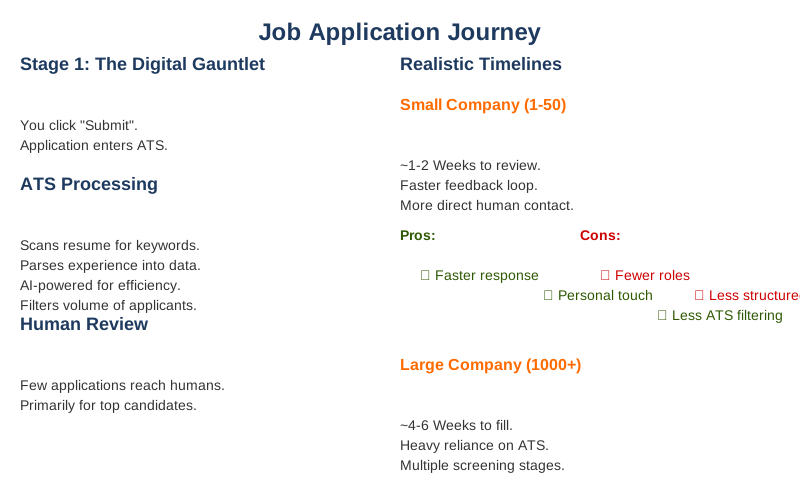
Job app lifecycle infographic: ATS, human review, timelines.
Comparison overview for The full lifecycle of a job application from the moment you click submit to rejection or offer, including how ATS systems process your resume, how many humans actually review each application, and realistic timelines by company size.

Key Takeaways

  • The reality is that most applications never reach a human reviewer. Applicant Tracking Systems (ATS) are the first gatekeepers, designed to manage high volumes by parsing resumes for keywords and qualifications Applicant Tracking Systems Explained. Modern ATS platforms, increasingly powered by AI, automate screening, saving recruiters countless hours Modern Applicant Tracking Systems.
  • For a typical job posting, expect hundreds of applicants. Only a fraction of these, often less than 10%, will be seen by a human recruiter, and even fewer by a hiring manager 2025 Recruiting Benchmarks Report. This initial human review is often very brief, lasting mere seconds.
  • Timelines vary wildly by company size and industry. The median time-to-fill in 2025 was about a month and a half State of Recruiting 2025. Larger companies with more complex processes and higher applicant volumes will generally take longer than smaller, agile startups.
  • The single most important thing a recruiter would tell you off the record? Stop trying to trick the ATS; focus on clear, relevant content. If your resume is genuinely packed with the skills and experience the job requires, the ATS will likely flag it, and a human will see it.
As AI reshapes job markets, it's also transforming hiring processes, including how AI screens resumes before human review.

Frequently Asked Questions

Okay, I hit 'submit' on a job application. What the heck happens next?
First, your application probably lands in an Applicant Tracking System (ATS), which is essentially a digital filing cabinet for resumes and candidate data. Most ATS platforms will parse your resume, extracting key information like your name, contact details, work history, and education to create a structured profile [Power.atsondemand.com]. Think of it as the system digitizing your application so it can be easily searched and filtered later.
How do these ATS systems actually read my resume? Is it just keyword matching?
Modern ATS systems go beyond simple keyword matching; they use resume parsing to break down your resume into structured data fields like experience, skills, and education [Nimble.com]. While keywords are still crucial for initial filtering, AI-powered ATS platforms are getting smarter at understanding context and matching your qualifications to job requirements, not just exact word matches [Lever.co].
So, does a human ever actually see my resume, or is it all just robots?
It depends on volume. For high-volume roles, the ATS will likely do a significant initial screen, ranking candidates based on how well they match the job description. Only the top-scoring candidates, often a small percentage, will be presented to a recruiter or hiring manager for a human review [Power.atsondemand.com].
How many people actually look at my application after the ATS filters it?
Ideally, a recruiter or a hiring coordinator will review your application first. If you pass that stage, the hiring manager for the role will then review it. In some cases, for senior or critical roles, you might also be reviewed by a department head or even someone on the executive team, though this is less common for entry-level positions.
How long should I expect to wait before hearing back after applying?
The median time-to-fill a position is roughly 43 days, but this can vary wildly. For smaller companies, you might hear back within a week or two if they're actively hiring. Larger corporations, especially those with complex HR departments and multiple hiring stages, can easily take 30-60 days, or even longer [Interviewpal.com].
What's a realistic timeline for hearing back from a big company vs. a startup?
Startups are often more agile; if they're excited, you might get a response in 3-7 business days. Large corporations, however, often have more bureaucratic processes, meaning it could take 2-4 weeks just to get an initial screening call, and the entire process can stretch to 60+ days [Interviewpal.com].
How many people usually apply for one job posting?
This is a massive range. A highly sought-after role at a major tech company could easily attract hundreds, if not thousands, of applicants. A niche position at a smaller organization might only get a few dozen applications [Power.atsondemand.com].
If I don't hear anything, does that mean I'm rejected?
Not necessarily immediately, but often yes. If weeks pass without any communication, it's a strong indicator that your application wasn't selected to move forward. Companies are often terrible at sending rejection notices due to volume, so silence can be a de facto rejection [Power.atsondemand.com].
What's the deal with getting rejected? Is it always a clear email?
Sometimes it's a clear email, but often it's just silence, which is frustratingly common. The ATS can flag candidates, but the final decision to reject or proceed is usually made by a human. Rejection is a part of the process, and while it stings, it's rarely personal; it's usually about a mismatch in qualifications or a better-fit candidate.
When do I get the offer? Is it a quick process once they decide they like me?
Once you've gone through all the interviews and the hiring team has decided you're the one, the offer stage can be relatively quick, sometimes within a few days of the final interview. However, background checks, reference checks, and HR approvals can add another week or two to the timeline before the official offer letter is generated.

Sources

Related Articles