
What Happens If You Try to Negotiate and They Pull the Offer (2026 Complete Guide)
You've just received a job offer, the one you've been waiting for. It's a step up, exciting projects, and a chance to use that skill you honed in school. The salary is a bit more than your current role, but you know the drill: negotiate.
You've just received a job offer, the one you've been waiting for. It's a step up, exciting projects, and a chance to use that skill you honed in school. The salary is a bit more than your current role, but you know the drill: negotiate. You've done it before, seen others do it, and figured it's standard practice. So, you politely ask if there's room for a $8,000 increase, stating you're excited about the position and wondering if they could consider it. The next day, the offer is rescinded. You immediately reply, ready to accept the original salary, but HR states they're moving forward with another candidate. Devastated, you don't understand what went wrong.
This scenario, while jarring, highlights a critical concern for job seekers: what happens if you try to negotiate and they pull the offer? While it's a common fear, research suggests it's less frequent than perceived. More than half of job seekers never negotiate, even though 73% of employers expect it How to Negotiate Salary After a Job Offer (2026) - AiApply. The fear of a rescinded offer negotiation is often greater than the reality; hiring managers report withdrawing offers in only about 1.73 cases out of roughly 26.9 on average across their careers How to Negotiate Salary After a Job Offer (2026) - AiApply. However, the possibility exists, and understanding the dynamics of offer withdrawal during negotiation is crucial.
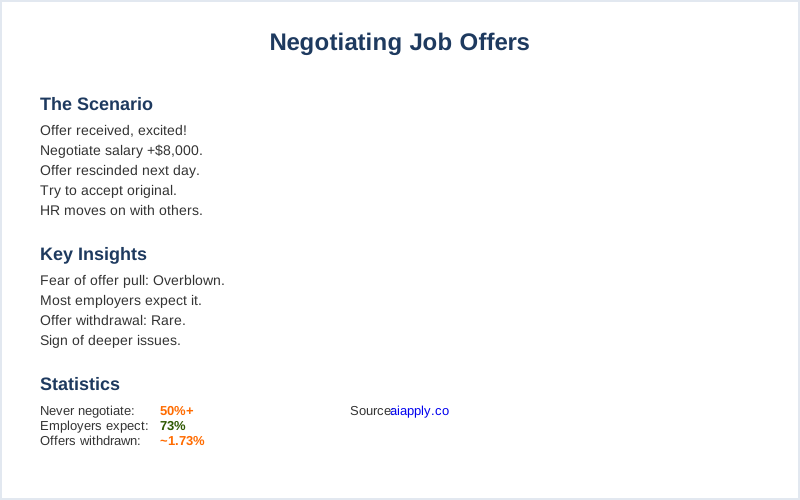
The fear of a company pulling an offer after negotiation is largely overblown. While it's a possibility, it's exceptionally rare, and most companies actually expect and welcome negotiation as a standard part of the hiring process.
From a recruiter's perspective, an offer being rescinded due to negotiation is almost always a sign of a deeper issue, not just the act of asking for more. Companies build offers within defined compensation bands and consider internal equity. If your request pushes beyond these boundaries, they might not be able to accommodate it, but this is a structural limitation, not a personal offense. The real red flag for a company is when a candidate is unreasonable, deceptive, or fundamentally misaligned with the role's value, not simply when they engage in salary discussions. Research indicates that hiring managers reported withdrawing only about 1.73 offers out of roughly 26.9 on average across their careers after a candidate negotiated AiApply.
The perception that negotiating is risky is a significant hurdle for many job seekers. A substantial 55% of job seekers never negotiate, even though 73% of employers actually expect it AiApply. This hesitation can be costly, as those who do negotiate end up with starting salaries that are 18.8% higher on average. The scenario where an offer is pulled simply because you asked for a reasonable increase is "so outside the realm of normal business" that it suggests a fundamental problem with the hiring company's process or culture The Cut.
When a negotiation leads to an offer being withdrawn, it's often because the candidate's request was significantly out of sync with the established salary range, or their approach was perceived as demanding rather than collaborative. A counteroffer is technically a rejection of the original offer; if the company doesn't meet it, they are not obligated to reinstate the original terms. However, this doesn't mean they will automatically pull it unless the negotiation itself signals a bad fit or a misunderstanding of the company's compensation structure Quora. The key is to negotiate professionally and within a realistic range, understanding that most companies anticipate and factor in a negotiation phase.






- Senior Software Engineer at a Series B Startup A candidate with strong technical skills and multiple offers negotiated aggressively for a higher base salary and a sign-on bonus. The startup, operating on tight margins and with a rigid compensation band, felt the request pushed beyond their established limits. While they had room to move slightly, the candidate's comprehensive counter-offer, including demands for equity adjustments, was perceived as misaligned with the company's early-stage financial realities, leading to the offer being rescinded. What didn't work was asking for too many concessions simultaneously without a clear understanding of the company's financial constraints.
- Entry-Level Data Analyst at a Fortune 500 A recent graduate received an offer slightly below their target but within the expected range for an entry-level role. They attempted to negotiate by citing a higher salary from a different, less comparable industry. The large corporation, with strict internal equity checks and pre-defined salary bands for new graduates, was unwilling to deviate significantly. The candidate's inability to provide concrete data justifying the higher ask within the company's framework meant their negotiation attempt was unsuccessful, and the offer was ultimately withdrawn because it was seen as outside the established pay scale without a clear business case.
- Career Changer from Teaching to Product Management An individual transitioning from teaching to product management received an offer that was a significant increase from their previous role but lower than their research indicated for experienced PMs. They negotiated by highlighting transferable skills and a commitment to rapid learning. While the company appreciated their enthusiasm, the lack of direct product management experience meant the offer was already at the higher end of their band for candidates without a proven track record in the field. The negotiation attempt, though polite, didn't provide enough leverage to move beyond the initial offer, and the company decided to pursue candidates with more direct experience, effectively pulling the offer because the candidate's ask exceeded the perceived value for their current experience level as perceived by the hiring manager.
- Mid-Level Marketing Manager at a FinTech Company A candidate with a strong performance record and a competitive offer from another firm attempted to negotiate a higher base salary and an earlier performance review for a bonus. The FinTech company, while impressed, had a tight budget for this specific role due to recent market shifts and a focus on retaining existing talent. Their negotiation strategy was perceived as a standard counter-offer, but the company's internal compensation committee had already finalized the offer within strict parameters. The candidate's request for an accelerated bonus review was seen as too complex to accommodate within their standard compensation structure, leading to the offer being rescinded because the negotiation involved too many variables outside their immediate control.


- The fear of an offer being rescinded after negotiation is often overblown. While it's a possibility, research suggests it's rare when negotiations are handled professionally The Cut. In fact, most companies actually expect candidates to negotiate. Data from 2024-2025 shows that negotiators achieve starting salaries that are 18.8% higher on average AiApply. This expectation is so common that recruiters often advise candidates to negotiate, as not doing so can lead to undervaluing oneself and setting a lower anchor for future compensation increases AiApply. The underlying sentiment from many in the recruiting field is that employers are generally not surprised by negotiation attempts, and it almost never results in an offer being pulled Ask a Manager.
- If an employer truly pulls an offer solely because you asked for more money and nothing else was at play, that's outside the realm of normal business The Cut. This scenario is highly unlikely. Instead, consider it a red flag about the company culture. Such an extreme reaction suggests a rigid and potentially difficult work environment, where open communication and reasonable requests are not valued.
- When a company withdraws an offer after you've attempted to negotiate, it's crucial to understand that the offer likely won't be reinstated. Don't hint at wanting it back. The focus should shift to moving forward and seeking opportunities where your value will be recognized and respected Wall Street Oasis.
- The single most important thing a recruiter would tell you off the record: Don't be afraid to ask, but be reasonable and professional. Most companies expect negotiation. If they pull the offer over a polite request, you've dodged a bullet with a company that likely wouldn't have been a good fit anyway. This approach emphasizes the importance of a balanced negotiation strategy, where your request is grounded in research and presented respectfully, rather than demanding or aggressive.
Frequently Asked Questions
My job offer was rescinded after I tried to negotiate for more money. Is this common?
I countered a job offer, and now they've withdrawn it. What does this mean?
What are the chances an employer will withdraw my job offer if I ask for a higher salary?
If a company pulls their job offer after I negotiated, should I try to get it back?
I negotiated my job offer and now they've rescinded it. What went wrong?
Sources
- askamanager.org
- How to negotiate your offer without losing the offer (The 2026 Master ...
- How to Negotiate Salary After a Job Offer (2026) - AiApply
- If I counter offer a job offer pay, can the company retract their ... - Quora
- Is it possible the employer can rescind a job offer for negotiating?
- 'My Job Offer Was Rescinded After I Asked for More Money' - The Cut
- how-to-negotiate-salary-after-a-job-offer