Hiring Discrimination

How Algorithms Discriminate in Hiring Without Anyone Noticing (2026 Complete Guide)

RoleAlign Team
13 min read
Prices verified February 2026
Includes Video

You just received another rejection email. It's vague, generic, and offers no real feedback. This isn't just bad luck; it's likely the work of an algorithm that decided you weren't a fit, without a human ever laying eyes on your resume.

You just received another rejection email. It's vague, generic, and offers no real feedback. This isn't just bad luck; it's likely the work of an algorithm that decided you weren't a fit, without a human ever laying eyes on your resume. In 2026, AI hiring is ubiquitous. In 2024 alone, AI-powered hiring tools processed over 30 million applications, and roughly seven in ten companies allow AI to reject candidates without human oversight AI Hiring Bias Lawsuits Are Reshaping Recruiting in 2026 - HiredAi. These systems are designed to streamline hiring, but they often embed and amplify existing biases, creating AI hiring discrimination that's incredibly difficult to detect. The processes employers use to narrow applicant pools are increasingly automated, with approximately 88% of companies utilizing some form of AI in candidate screening by 2025 When Artificial Intelligence Discriminates: Employer Compliance in .... This hidden layer of automated decision-making means that even seemingly neutral criteria can disproportionately impact certain groups, leading to systemic disadvantages that go unnoticed. Understanding this algorithmic bias hiring is crucial for anyone navigating today's job market.

The very nature of how these algorithms are trained is a primary culprit. They learn from historical data, which often reflects past discriminatory practices. For instance, if a company historically hired more men for a particular role, an AI trained on that data might learn to associate male characteristics with suitability for that position, inadvertently penalizing equally qualified female candidates. This can manifest in subtle ways, such as an algorithm down-ranking resumes that contain keywords or experiences more commonly found in the CVs of underrepresented groups. Furthermore, the complexity of these systems, often referred to as "black boxes," makes it challenging to pinpoint the exact reasons for a candidate's rejection. As legal frameworks like the EU AI Act and emerging U.S. regulations begin to address these issues, companies are increasingly facing scrutiny over the use of "automated-decision systems" (ADS) that discriminate against applicants HRDef: AI in Hiring: Emerging Legal Developments and Compliance .... The potential for lawsuits alleging discrimination against AI tools is a growing concern for employers An Update on Algorithmic Discrimination in Hiring, Screening, and ..., highlighting the urgent need for transparency and fairness in AI-driven recruitment processes.
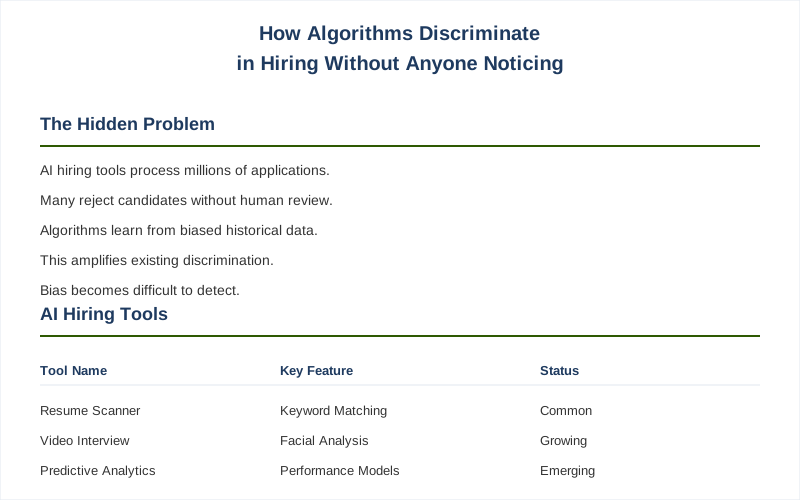
Infographic: How algorithms discriminate in hiring unnoticed.
Key specifications for How Algorithms Discriminate in Hiring Without Anyone Noticing

The Real Answer

The core problem with algorithm bias in hiring isn't malicious intent, but the way AI systems learn from and amplify existing human biases present in historical data. Recruiters assume AI is a neutral arbiter, but it often becomes a high-speed conveyor belt for past discriminatory practices, making it incredibly difficult to detect and prove.

Candidates assume AI tools objectively assess qualifications. In reality, these systems are trained on past hiring decisions, which are inherently flawed if those decisions were biased. This means AI can learn to penalize candidates with similar profiles to those historically overlooked, even if they are highly qualified. It's a case of AI hiring discrimination scaling up what humans did inefficiently.

The issue is compounded because many companies allow AI to reject candidates without human oversight. Research from 2024 found that roughly seven in ten companies allow AI tools to reject candidates without any human oversight HiredAi. This creates an "automated-decision system" that can discriminate, as highlighted by emerging regulations like New York City Local Law 144 and California's Civil Rights Council Regulations HRDef. These regulations emphasize that it is unlawful to use any "automated-decision system" (ADS) that discriminates against applicants or employees based on protected characteristics. The implications of these laws are significant, as they push for greater transparency and accountability in AI-driven hiring processes.

Identifying this automated hiring bias is challenging because the algorithms operate as "black boxes." Lawyers are now using privacy and consumer-protection statutes alongside traditional discrimination law to challenge these opaque systems Outten & Golden LLP. The algorithms aren't programmed to be discriminatory; they're programmed to find patterns, and if those patterns reflect past inequities, the AI will replicate them. For instance, if past hiring data shows fewer women in leadership roles, an AI trained on this data might inadvertently downrank female candidates for such positions, not because of their qualifications, but because the historical pattern suggests they are less likely to be hired. This can manifest in subtle ways, such as favoring certain keywords associated with historically dominant demographics or penalizing resume gaps that might disproportionately affect certain groups.

The World Economic Forum reported in 2025 that approximately 88% of companies are already utilizing some form of AI in candidate screening Employment Law Worldview. This widespread adoption, coupled with the inherent opacity of AI decision-making, makes it critical for employers to proactively audit their systems and ensure compliance with evolving laws designed to curb discriminatory practices HBRM. Such audits should include examining the training data for biases, testing the algorithm's outcomes across different demographic groups, and ensuring human review processes are robust enough to catch and correct any discriminatory outputs. As noted by Allwork.space, staying compliant with new AI hiring laws in 2026 and beyond, including frameworks like the EU AI Act and various U.S. regulations, is becoming increasingly complex and crucial for responsible recruitment Allwork.
Understanding how algorithms can amplify biases is crucial, especially when considering how age discrimination plays a role in hiring practices.
Review training data for at least 2 years to identify and remove historical biases influencing hiring decisions.
Unseen biases lurk in data. This granular analysis on a laptop reveals how historical hiring patterns can fuel algorithm bias in hiring, leading to unfair outcomes. | Photo by ThisIsEngineering

What's Actually Going On

1
Resume Parsing - Most companies use Applicant Tracking Systems (ATS) like Taleo or Greenhouse. These systems parse resumes, extracting keywords and structured data. Recruiters often rely on these parsed summaries, not the original resume. The problem? Parsing isn't perfect. It can misinterpret or drop crucial information, especially for non-traditional resume formats or candidates from underrepresented backgrounds who might use different phrasing. This initial filter can silently disqualify qualified applicants based on how their resume is read, not what it says An Update on Algorithmic Discrimination in Hiring, Screening, and ....
2
Recruiter Screening Criteria - Recruiters screen for a blend of explicit requirements and implicit biases. While job descriptions list hard skills, recruiters often look for "cultural fit" or "potential". AI tools, trained on historical hiring data, can inadvertently learn and perpetuate these biases. If past successful hires predominantly came from certain universities, demographics, or career paths, the AI might unfairly penalize candidates who don't fit that mold, even if their skills are equivalent When Artificial Intelligence Discriminates: Employer Compliance in .... This is a core mechanism of algorithm bias hiring.
3
Hiring Committee Decisions - Even when AI flags candidates, the final decision often involves a hiring committee. However, the AI's ranking and scoring heavily influence this process. If an algorithm consistently ranks candidates from specific demographic groups lower, committee members may unconsciously de-prioritize those candidates, viewing them as less "qualified" based on the AI's output. This creates a feedback loop of discrimination, where the AI's biased recommendations reinforce human biases, leading to AI hiring discrimination without overt intent. In 2024, research found that roughly seven in ten companies allowed AI tools to reject candidates without any human oversight AI Hiring Bias Lawsuits Are Reshaping Recruiting in 2026.
4
Company Size and Industry Nuances - Startups might rely on more off-the-shelf AI tools for speed, leading to less customization and higher risk of embedded bias. Large enterprises, while potentially having more resources for audits, can suffer from complex, siloed systems where bias can propagate undetected across departments. Tech industries often use sophisticated ML models that can be harder to audit, while finance might focus on predictive analytics for performance, inadvertently flagging risk factors correlated with protected classes. Healthcare may prioritize specific certifications, leading AI to undervalue transferable skills from other domains. Seniority levels also matter; entry-level roles might be subjected to more automated screening than executive positions, increasing the chance of automated hiring bias at lower rungs HRDef: AI in Hiring: Emerging Legal Developments and Compliance ....
To grasp the full impact of these systems, it's essential to understand how AI screens your resume before reaching a recruiter.
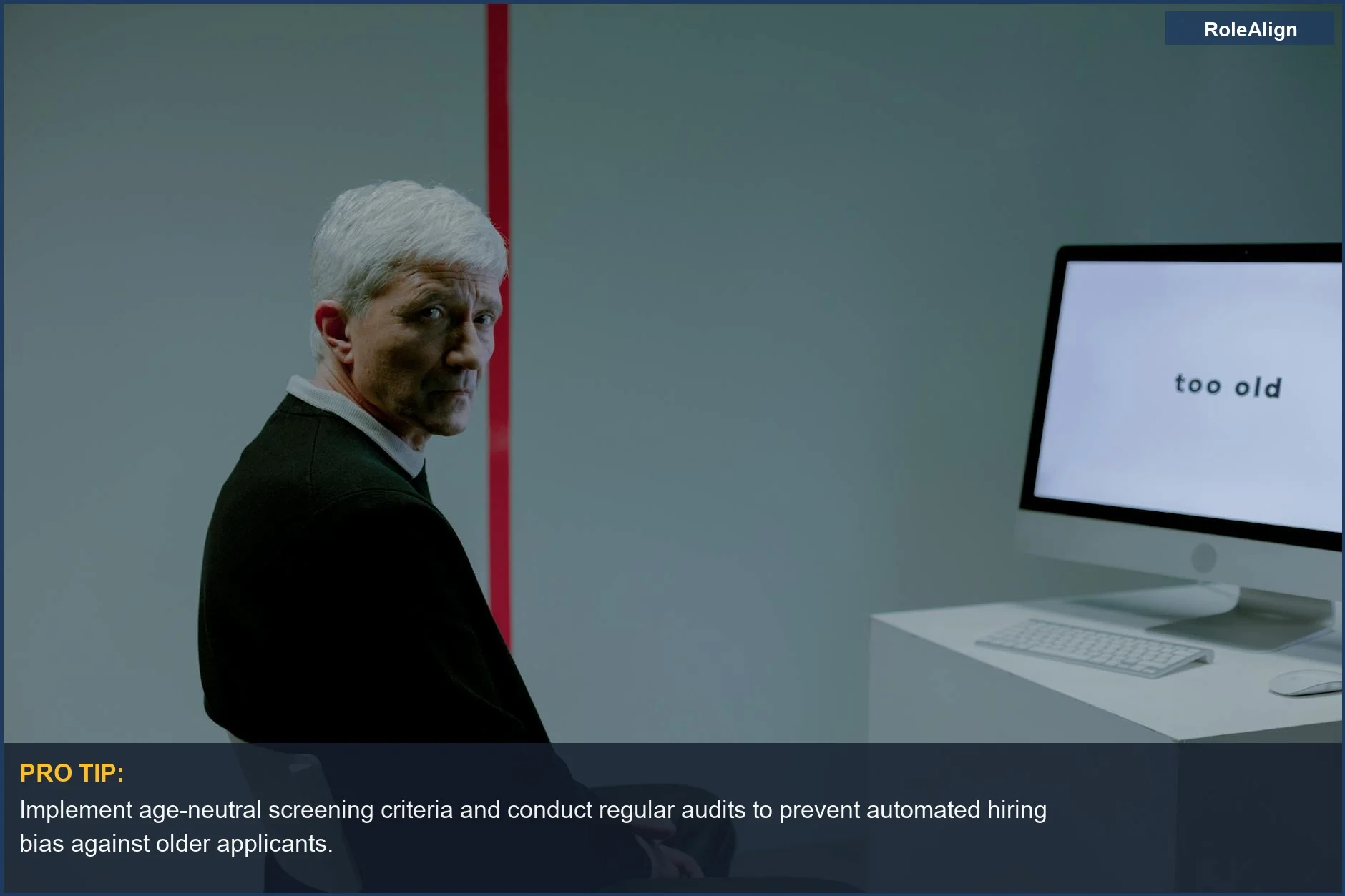
Implement age-neutral screening criteria and conduct regular audits to prevent automated hiring bias against older applicants.
Facing an unfair 'too old' message on screen, this senior professional highlights the stark reality of AI hiring discrimination, where age can be an invisible barrier. | Photo by Ron Lach

How to Handle This

1
Audit your AI hiring stack annually. As a recruiter, you need to proactively identify and mitigate algorithmic bias hiring risks. This means engaging an independent auditor to review any Automated Employment Decision Tools (AEDTs) used in your hiring process, especially those impacting candidate selection or ranking. New York City Local Law 144, for example, mandates this, with fines escalating rapidly for non-compliance HRDef: AI in Hiring: Emerging Legal Developments and Compliance .... Skipping this step means you're flying blind, potentially facing significant legal penalties and reputational damage if hidden biases are uncovered later When Artificial Intelligence Discriminates: Employer Compliance in ....
2
Implement human oversight with override authority. The goal is not to eliminate AI, but to ensure it serves as a tool, not a dictator. For any AI system that screens, scores, or ranks candidates, ensure a trained human recruiter or hiring manager has the final decision-making power. California's regulations, for instance, require "meaningful human oversight" HRDef: AI in Hiring: Emerging Legal Developments and Compliance .... If you allow AI to reject candidates without human review, you risk replicating or amplifying existing biases without recourse, as roughly seven in ten companies did in 2024 AI Hiring Bias Lawsuits Are Reshaping Recruiting in 2026 - HiredAi. This is critical for roles across all levels, from entry-level to executive, as AI can misinterpret nuanced experience.
3
Demand transparency from AI vendors. When selecting AI hiring platforms, push for detailed explanations of how their algorithms work, what data they are trained on, and how they mitigate bias. Understand that AI can scale bias if trained on historical data that reflects past discriminatory practices An Update on Algorithmic Discrimination in Hiring, Screening, and .... If a vendor cannot provide clear answers or audit reports, consider it a major red flag. This is particularly important for specialized roles where unique skill sets might be overlooked by generic AI scoring. Failing to question vendors leaves you vulnerable to automated hiring bias embedded within opaque "black box" technologies An Update on Algorithmic Discrimination in Hiring, Screening, and ....
4
Notify candidates about AI usage and offer alternatives. Be upfront with applicants about when and how AI is being used in the hiring process. New York City's law requires notifying candidates at least 10 business days before an AEDT is used and offering an alternative selection process HRDef: AI in Hiring: Emerging Legal Developments and Compliance .... This practice builds trust and provides a crucial fallback for candidates who might be unfairly disadvantaged by AI. Without this transparency, candidates may not understand why they were rejected, leading to frustration and potential legal challenges based on AI hiring discrimination claims.
Understanding how to craft your resume can also help you navigate AI's role in video interview scoring.
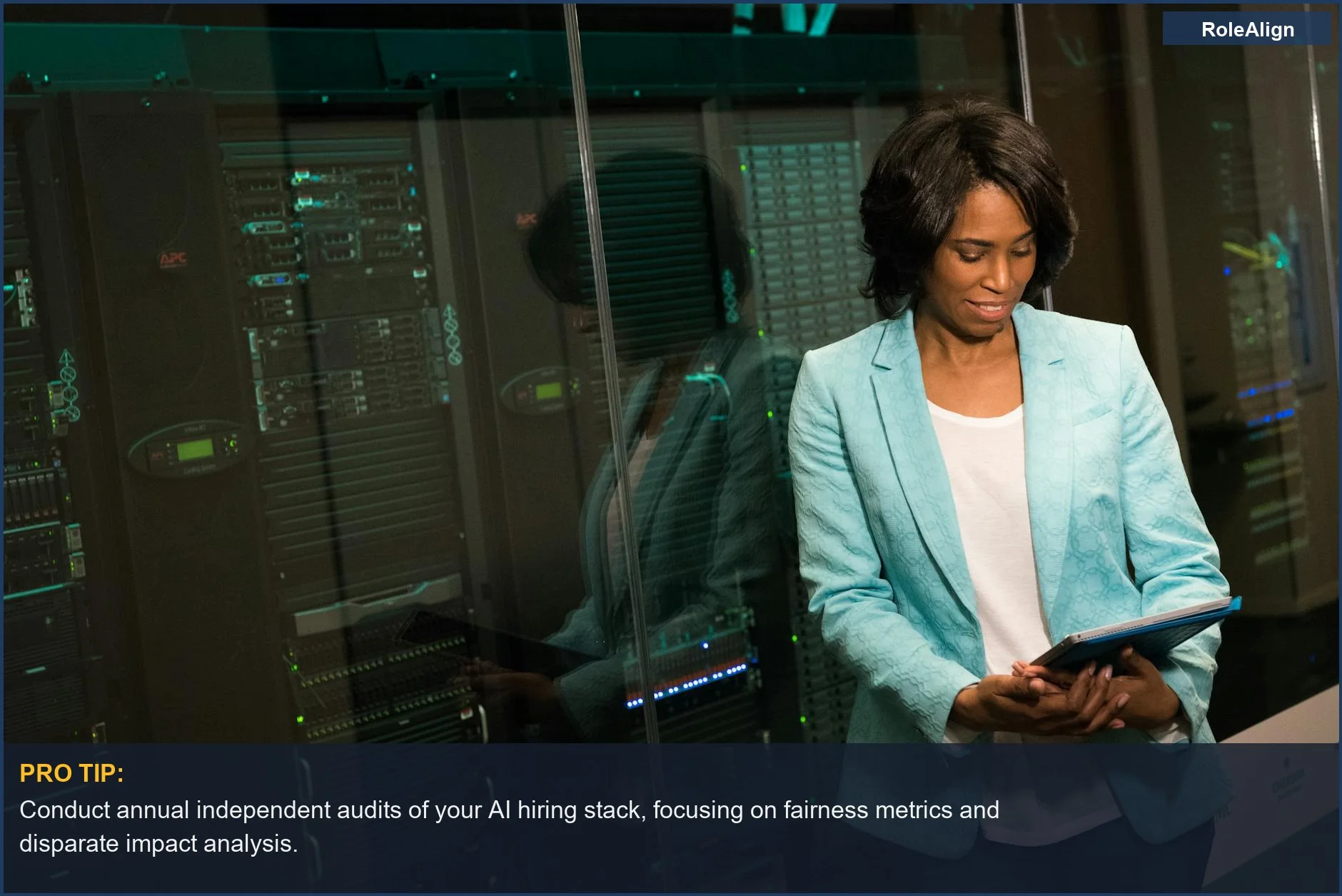
Conduct annual independent audits of your AI hiring stack, focusing on fairness metrics and disparate impact analysis.
Examining complex data servers, this IT professional underscores the need for meticulous auditing to combat algorithm bias hiring in tech recruitment processes. | Photo by Christina Morillo

What This Looks Like in Practice

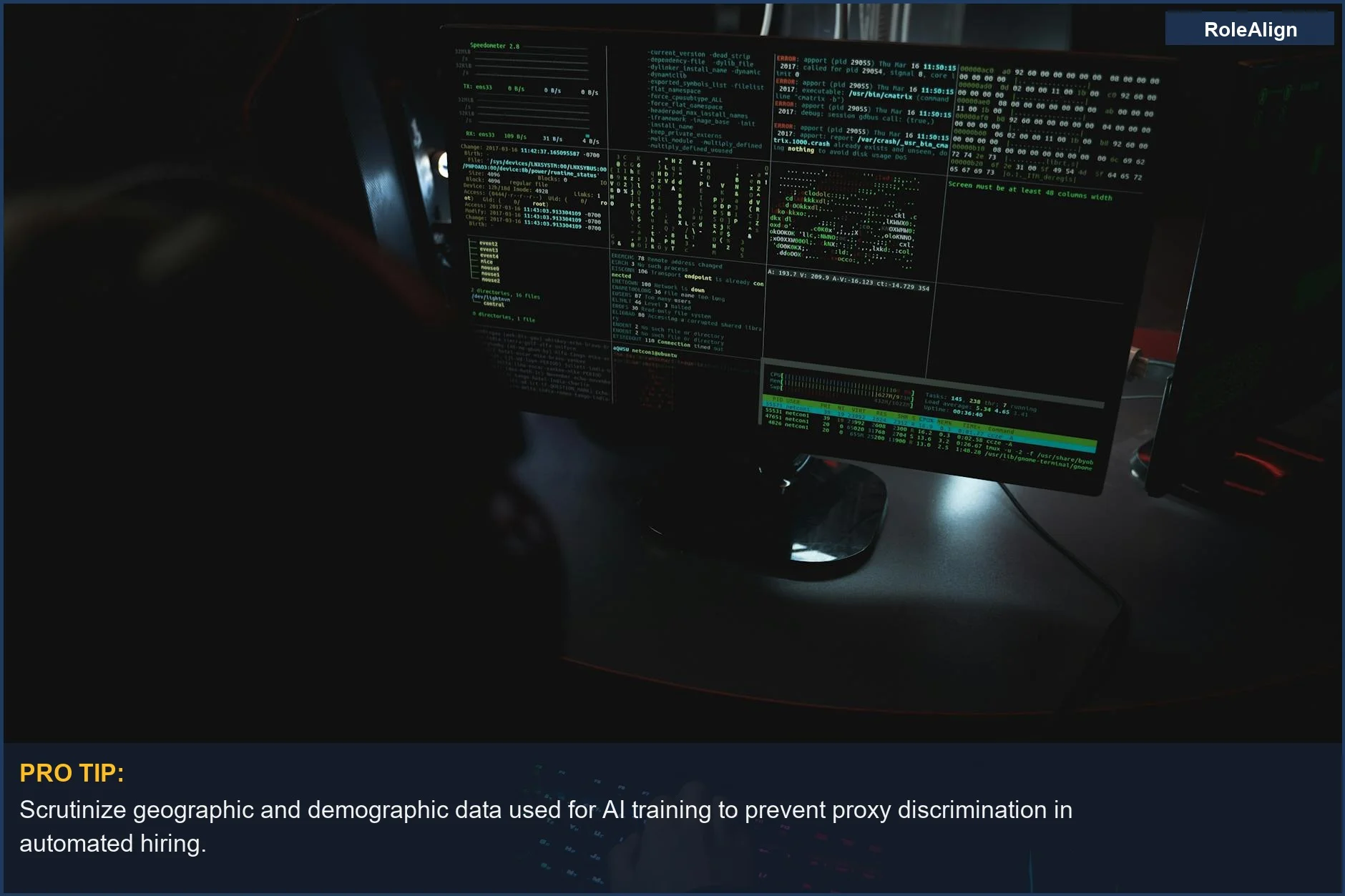
  • Proxy Discrimination via Geographic Data A hiring algorithm for a Senior Software Engineer at a Series B Startup trained on historical data inadvertently favored candidates from specific affluent zip codes, discriminating against qualified applicants from less privileged areas. The algorithm's "success predictor" correlated with geographical markers of wealth and access, not job-related skills, leading to a narrow candidate pool and missed diverse talent.An Update on Algorithmic Discrimination in Hiring, Screening, and ...
  • Skill Misinterpretation for Career Changers An AI screening tool for an Entry-Level Data Analyst at a Fortune 500 company flagged resumes from former teachers as a poor fit. Focusing on keywords and direct experience, it failed to recognize transferable analytical and problem-solving skills from curriculum development, student assessment, and pedagogical research, automatically rejecting qualified career changers.When Artificial Intelligence Discriminates: Employer Compliance in ...
  • "Culture Fit" Reinforcing Existing Homogeneity A tech company used an AI platform to assess candidates for a Mid-Level Product Manager role, aiming for "cultural alignment." The AI compared video interviews and written responses against profiles of its predominantly male, similarly educated existing team. It learned to favor candidates with these traits, perpetuating homogeneity and overlooking diverse, innovative perspectives.HRDef: AI in Hiring: Emerging Legal Developments and Compliance ...
  • Keyword Obsession Over Nuance for a Career Changer from Teaching to Product Management An AI resume scanner for tech roles penalized a candidate transitioning from education to Product Management. Despite strong project management, stakeholder communication, and strategic planning experience from teaching, the AI flagged the lack of "product roadmap" or "agile development" keywords, blocking consideration for roles where transferable skills would be invaluable.AI-Assisted Hiring in 2026: Managing Discrimination Risk
Understanding cryptocurrency compensation can also highlight issues around equity in pay, as discussed in our article on pay discrimination.
Scrutinize geographic and demographic data used for AI training to prevent proxy discrimination in automated hiring.
Lines of code flicker in a dark room, illustrating how subtle proxy discrimination in hiring algorithms can unintentionally exclude qualified candidates. | Photo by Tima Miroshnichenko

Mistakes That Kill Your Chances

Symptom Over-reliance on keywords and jargon.
Signal Resumes filled with buzzwords but lacking concrete achievements. Algorithms trained on historical data often prioritize these terms, inadvertently filtering out candidates who express skills more subtly or in different language.
Fix Focus on quantifiable achievements and impact. Instead of "proficient in Agile," describe "Led cross-functional team using Agile methodologies to deliver X project Y% ahead of schedule." Recruiters should look for evidence of application, not just recitation.
Symptom Assuming AI is inherently objective.
Signal Blind trust in AI screening outputs without validation. AI hiring discrimination can occur because algorithms are trained on historical data that reflects existing human biases. This can scale bias rather than eliminate it.
Fix Implement regular, independent bias audits for AI tools. Understand that AI can produce "a system that's accurate at predicting the wrong thing." Ensure human oversight is meaningful, with individuals empowered to override AI decisions, as mandated by regulations like those in New York City. Fines can escalate rapidly for non-compliance.
Symptom Generic resume tailoring for every application.
Signal Resumes that are too similar across different roles, lacking specific alignment with job descriptions. While keyword optimization is important, an algorithm might flag a resume that feels *too* generic as potentially less engaged or a poor fit, especially for senior roles where nuanced experience matters. AI tools are matching job postings with applicant credentials.
Fix Deeply customize your resume for each application, highlighting experience directly relevant to the specific role and company culture. For mid-career and senior candidates, emphasize leadership, strategic impact, and problem-solving beyond basic task completion. Recruiters see this as a sign of genuine interest and understanding of the role's demands.
Symptom Overuse of personal projects or volunteer work for new grads.
Signal Resumes disproportionately focusing on non-professional experience, potentially indicating a lack of direct professional experience that algorithms might be trained to recognize. These can dilute the impact of core skills if not framed correctly.
Fix Frame personal projects and volunteer work as demonstrations of specific, transferable skills. Quantify outcomes and connect them directly to job requirements. Recruiters want to see how these experiences translate into professional capabilities.
Understanding the implications of reporting discrimination can be crucial, so consider learning about reporting hiring discrimination.

Key Takeaways

Understanding these biases is crucial, especially when considering why many companies' AI job postings are misleading.

Frequently Asked Questions

How can AI hiring tools unfairly screen out qualified candidates without anyone realizing it?
AI hiring tools can discriminate by learning from historical hiring data that already contains human biases. If past hiring decisions favored certain demographics, the algorithm might inadvertently learn to replicate those patterns, leading to unfair rejections of equally qualified candidates from underrepresented groups. This can happen because the AI is trained to identify patterns associated with successful hires, which may unintentionally exclude those with different backgrounds or experiences.
What makes AI hiring systems susceptible to bias, even if they seem objective?
Even AI systems designed to be objective can exhibit bias if the data they are trained on reflects existing societal prejudices. For example, if an algorithm is trained on resumes of predominantly male engineers, it might learn to associate male-associated language or experiences with success, unfairly penalizing female applicants. This is a key concern, as many companies allow AI tools to reject candidates without human oversight, a practice observed in roughly seven in ten companies as of 2024 Source Name.
Are there ways AI can unintentionally discriminate against job seekers based on their background?
Yes, AI can discriminate by picking up on proxies for protected characteristics that are embedded in data. For instance, a system might learn to associate certain zip codes with higher performance, but this could unfairly disadvantage applicants from lower-income areas, effectively discriminating based on socioeconomic status or race. Laws like the Illinois AI Employment Act specifically prohibit the use of discriminatory proxy measures such as ZIP codes Source Name.
What are the legal implications if an AI hiring tool is found to be discriminatory?
Employers can face significant legal consequences if their AI hiring tools are found to be discriminatory, with lawsuits alleging bias on the rise Source Name. Regulations like New York City's Local Law 144 require annual bias audits for automated employment decision tools, with fines escalating for non-compliance. California's regulations also mandate meaningful human oversight for any automated decision system used in employment Source Name.
How can companies ensure their AI hiring processes are fair and don't perpetuate bias?
To mitigate bias, companies should conduct regular, independent audits of their AI hiring tools to identify and address any discriminatory patterns Source Name. It's crucial to use diverse and representative data for training AI models and ensure meaningful human oversight, where individuals are empowered to override AI recommendations. Transparency with candidates about the use of AI tools and offering alternative selection processes are also important steps.

Sources

Related Articles