
How to Identify Your Unique Value Proposition for a New Industry (2026 Complete Guide)
I once saw a candidate spend 43 minutes in an interview explaining their 'synergistic approach to cross-functional collaboration' for a job that mainly involved debugging legacy code. Nobody cared about the synergy; they cared if you could fix the broken thing.
I once saw a candidate spend 43 minutes in an interview explaining their 'synergistic approach to cross-functional collaboration' for a job that mainly involved debugging legacy code. Nobody cared about the synergy; they cared if you could fix the broken thing. This is the core problem when you're trying to identify your unique value proposition, especially when pivoting industries. You're speaking a language nobody in the new industry understands.
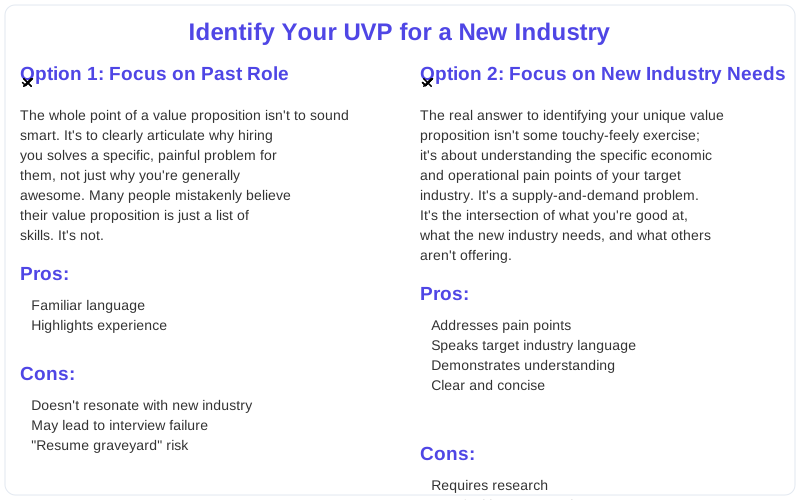
The whole point of a value proposition isn't to sound smart.
It's to clearly articulate why hiring you solves a specific, painful problem for them, not just why you're generally awesome. I've seen countless resumes hit the resume graveyard because they focused on what they did in their old role, not what value that translates to in the new one.
Think of it from my perspective as a recruiter.
When I'm sifting through hundreds of applications in Workday for a new Sales Development Rep, I'm not looking for someone who 'managed client relationships' in their past life as a barista. I'm looking for someone who can 'generate 20 qualified leads per day' or 'close 3 deals per week.' The skills might be transferable, but the language of value needs to shift.
Many people mistakenly believe their value proposition is just a list of skills. It's not.
It's the intersection of what you're good at, what the new industry needs, and what others aren't offering. If you can't articulate that in 15 seconds, you've lost me. My recruiter brain is already moving on to the next profile.
The Real Answer
The real answer to identifying your unique value proposition isn't some touchy-feely exercise; it's about understanding the specific economic and operational pain points of your target industry. It's a supply-and-demand problem, not a self-help mantra.
Your value is what they're willing to pay for, plain and simple.
When a hiring manager comes to me with a new req in Greenhouse, they're not asking for a 'well-rounded individual.' They're saying, 'I have a problem that costs us $X per month, and I need someone to fix it.' Your value proposition is the concise answer to that problem, framed in their terms.
I've configured enough Lever instances to know that keywords aren't just about matching skills; they're about matching solutions.
If a company is bleeding money on customer churn, and you come from an industry where you reduced churn by 15 percent, that's your value. Not 'customer service expert.'
Your unique value isn't about being 'better' in some abstract way. It's about being different in a way that directly addresses a gap or a competitive weakness they have.
Maybe everyone else in their industry is doing X, and you bring Y from a totally different sector that solves the problem more efficiently. That's a true differentiator. As LA Growth Machine explains, it must articulate what makes your offering unique and better than alternatives.
Think about the signal vs noise. Most candidates are noise, listing generic skills. The signal is the specific, quantifiable impact you can have on their bottom line or operational efficiency.
That's the only language the hiring committee truly understands.
What's Actually Going On
What's actually going on behind the scenes is that companies, especially larger ones using systems like Workday or iCIMS, are highly structured in how they define value. They're not looking for a generalist; they're looking for a specific cog to fit into a very specific machine.
Their budgets, their team structures, and their KPIs are all built around these defined roles.
For instance, a startup might value someone who can wear 10 different hats and 'figure it out,' because they're short on resources. Their value proposition is often 'agility' and 'growth potential.' A Fortune 500 company, however, will value someone who can navigate complex compliance frameworks and integrate into existing, well-defined processes.
Their value is 'stability' and 'risk reduction.'
Your unique value proposition needs to align with these underlying company mechanics. If you're applying to a large, regulated industry like finance or healthcare, your ability to streamline compliance processes from a different sector is gold. Your 'innovation' might be perceived as a risk. YITHemes states your UVP should powerfully and immediately convey what makes your business unique.
ATS systems like Taleo or Greenhouse are configured with specific keywords and skill taxonomies.
If your resume uses jargon from your old industry, even if the underlying skill is transferable, the ATS won't flag it. It's a purely mechanical matching process. Your unique value needs to be translated into the target industry's keywords.
The 'hiring committee dynamics' also play a huge role. Often, different stakeholders on the committee have different priorities. The Head of Engineering wants technical chops, HR wants culture fit and compliance, and the CEO wants someone who contributes to revenue.
Your value proposition needs to speak to all of those, even if you emphasize one over the others. Classic City suggests asking what problems your product/service solves.
Smaller companies, particularly those using simpler ATS like Lever or Zoho Recruit, might have a less rigid keyword structure. Here, networking and direct referrals become more powerful, allowing you to explain your unique value in person, bypassing the initial ATS filter entirely. But you still need a concise, compelling story.


How to Handle This
First, forget about what you think you're good at. Start by identifying the target industry's most painful problems. Read their industry reports, listen to their podcasts, follow their thought leaders on LinkedIn. What keeps their VPs up at 3 AM? Parallel HQ notes a clear value proposition aligns product, marketing, and revenue streams.
Next, map your existing skills to those specific pain points.
Don't just list 'project management.' Instead, think: 'I managed a project that reduced operational costs by 10 percent in three months.' How does that specific outcome translate to a problem they have?
Then, look for the 'white space.' Where are their existing solutions falling short? This is where your 'unique' comes in. Maybe everyone in their industry is using an outdated method, and you bring a fresh perspective from a different sector that's already solved that problem.
The Interaction Design Foundation explains the Value Proposition Canvas helps you work toward product-market fit.
Now, craft multiple versions of your value proposition, tailored to different roles or companies within that industry. Your pitch for a startup will be different than for an enterprise. Each version should be a single, punchy sentence. Think of it as your 15-second elevator pitch for when I inevitably ask, 'So, what do you do?'
Test these propositions. Don't just sit there.
Go to industry meetups, talk to people who work in those companies, and run your pitches by them. Ask, 'Does this sound valuable to your company?' Their feedback is gold. It will tell you if you're speaking their language or just mumbling.
Finally, integrate this refined value proposition into every single touchpoint: your resume, your LinkedIn profile, your cover letters, and your interview answers. Every word should reinforce that you are the solution to their specific problem.
BlueConic advises your UVP should explain why customers should choose your product or service.


What This Looks Like in Practice
I saw a former restaurant manager apply for a tech operations role. Most people would just list 'managed staff' and 'inventory control.' Total resume graveyard material.
Instead, this candidate reframed their experience: 'Implemented a supply chain optimization system that reduced food waste by 18 percent, saving $1,200 monthly.' This translates directly to 'cost reduction' and 'process improvement' - metrics tech operations teams care about.
Another example: a teacher pivoting to corporate training.
Instead of 'developed lesson plans,' they highlighted: 'Designed and delivered training modules that improved student performance by 25 percent on standardized tests.' This speaks to 'ROI on training' and 'measurable outcomes' for an L&D department.
A graphic designer wanted to move into UX. They didn't just show pretty pictures.
They presented case studies: 'Redesigned checkout flow for an e-commerce site, resulting in a 7 percent increase in conversion rate and a 12 percent reduction in cart abandonment.' That's revenue impact, not just aesthetics. Indeed recommends connecting your product to your customer.
The key is always to translate your past achievements into the specific metrics and pain points of the new industry. It's not about making yourself sound good; it's about making yourself sound valuable to them.


Mistakes That Kill Your Chances
| Mistake | Why It Kills Your Chances | Recruiter's Perspective |
|---|---|---|
| Generic Skill Lists | ATS systems on platforms like Workday or Greenhouse are looking for specific keywords related to the job description. A generic list of 'communication skills' gets ignored; 'optimized sales messaging leading to a 10 percent increase in MQLs' gets flagged. | 'Another one who can 'think outside the box.' Great. My hiring manager wants someone who can debug Python, not someone who's a philosopher.' |
| Focusing on Past Duties, Not Impact | Your old job description doesn't tell me what value you delivered. I don't care that you 'managed a team.' I care that your team exceeded targets by 20 percent. | 'So you did your job. What did that *do* for the company? I'm looking for problem-solvers, not just task-doers.' |
| Using Old Industry Jargon | If you're moving from academia to tech, no one in tech cares about your 'epistemological framework.' They care if you can ship code. ATS systems don't translate; they match. | 'I don't even know what half these words mean. Into the 'not a fit' pile you go. I'm too busy to play Rosetta Stone.' |
| Being Vague About Results | 'Helped improve efficiency' is meaningless. 'Reduced processing time by 30 percent, saving 4 hours per week for the team' is a measurable impact. Specificity is king. | 'Every resume says 'improved efficiency.' Show me the numbers. Show me the dollars. Show me *anything* concrete.' |
| One-Size-Fits-All Approach | Sending the exact same resume and cover letter to 15 different companies for 15 different roles shows you haven't done your homework. It's the definition of the resume graveyard. | 'Did they even read the job description? This resume is clearly for a different role. Next!' |
| Assuming Transferability | Just because you did something similar in a different context doesn't mean it's directly applicable or valued the same way. You need to explicitly bridge that gap for me. | 'Sure, you 'managed budgets' for a bake sale. This is a $5 million P&L. Not quite the same thing, chief.' |
- **Target Industry Pain Points:** Don't guess. Research what problems the new industry is actively trying to solve and where they're willing to invest.
- **Translate Your Impact:** Convert your past achievements into quantifiable results that directly address those pain points. Focus on outcomes, not just tasks.
- **Speak Their Language:** Ditch the jargon from your old industry. Adopt the keywords and terminology used in your target sector to ensure ATS systems like Lever or Greenhouse actually find you.
- **Highlight Your Differentiator:** What unique perspective or solution do you bring from your background that others in the new industry might lack? That's your true 'unique' value.
- **Test and Refine:** Your value proposition is a living document. Continuously test your messaging with industry insiders and refine it based on their feedback.
Frequently Asked Questions
I'm thinking about paying $300 for a professional resume writer to 'optimize' my value proposition. Is that worth it, or can I DIY?
Do I really need to quantify *everything*? What if my old role didn't have clear metrics?
What if I tailor my resume and still don't get callbacks? Does that mean my value proposition is wrong?
Can focusing too much on a niche value proposition limit my future career options?
Is 'passion' a unique value proposition? I'm really passionate about this new industry!
Sources
- Unique Value Proposition
- 7 Best Questions to Determine Your Unique Value Proposition
- Tips for Writing a Unique Value Proposition (With Examples) - Indeed
- Nailing Your Unique Value Proposition - Forbes
- How to Create a Unique Value Proposition for Your Business
- Value Proposition in Business Model Canvas: Guide (2025)
- What is The Value Proposition Canvas — updated 2026 | IxDF
- How to Determine Your Unique Value Proposition
- A Step-by-Step Guide for Creating a Unique Value Proposition
- Value Proposition Examples & Free Template (2026 Guide)
- Value Proposition: Ultimate Guide in 2023
- Unique Value Proposition - What It Is, How to Create It