
Why AI Resume Optimization Can Sometimes Backfire (2026 Complete Guide)
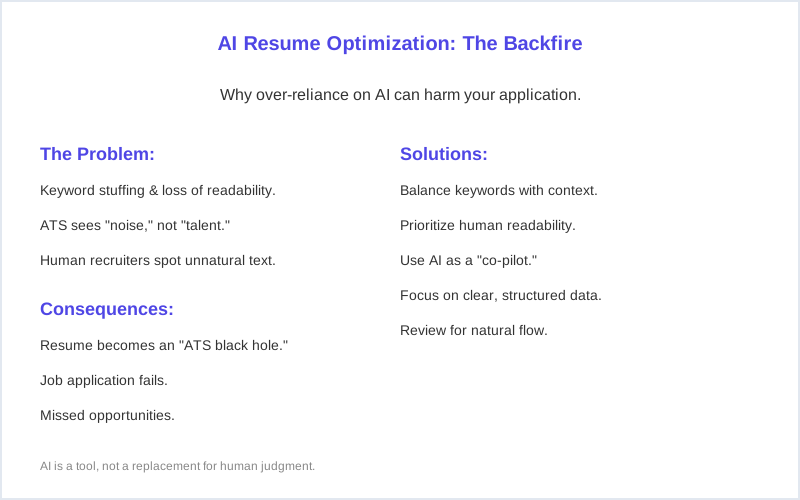
I've seen resumes with a 97 percent ATS match score get immediately binned by a recruiter, and you want to know why? Because the AI 'optimization' turned them into unreadable keyword soup. People think they're playing 4D chess by stuffing their resume with every possible variation of 'project management' and 'leadership,' but all they're doing is making my job harder.
I've seen resumes with a 97 percent ATS match score get immediately binned by a recruiter, and you want to know why? Because the AI 'optimization' turned them into unreadable keyword soup. People think they're playing 4D chess by stuffing their resume with every possible variation of 'project management' and 'leadership,' but all they're doing is making my job harder. It's like trying to impress a chef by throwing every spice in the cabinet into one dish.
Recruiters are drowning in AI-generated slop, and it makes finding actual talent a nightmare.
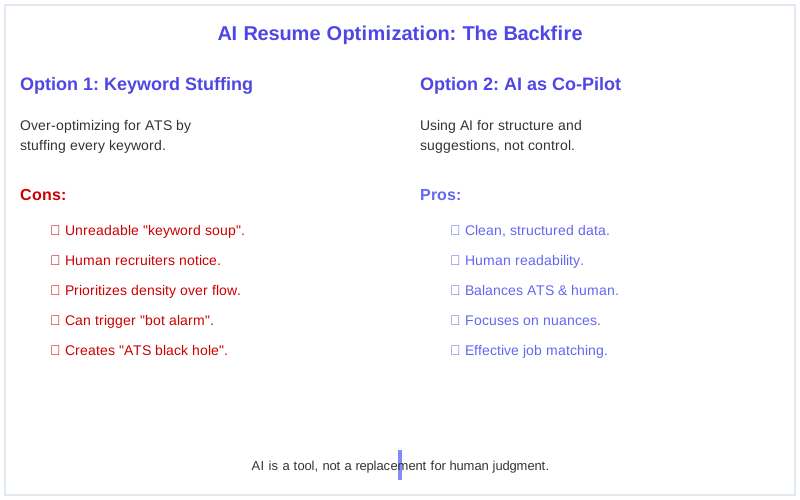
I've configured enough Workday and Greenhouse instances to know exactly what those parsing engines are looking for. They're not looking for a novel; they're looking for clean, structured data. When you let an AI tool go wild, it often prioritizes keyword density over human readability, turning your carefully crafted experience into an ATS black hole even if it technically 'matches.'
This isn't about being anti-AI; it's about understanding the mechanics. AI can be a powerful co-pilot, but if you let it fly the plane solo, you're going to crash. The 'AI black hole' is real, but it's not always a technical glitch. Sometimes, it's a feature of over-optimization, a human-induced bug where the system gets exactly what it was told to look for, but it's utterly useless to the person reviewing it.
My 'recruiter brain' is trained to spot patterns and anomalies. When I see a resume that looks like it was written by a bot, my internal alarm bells go off. It's not just about the keywords; it's about the flow, the context, and the subtle nuances that only a human can truly appreciate. Many job seekers are unsure what works and what backfires, and I'm here to tell you the 'why' behind the backfire.
The Real Answer
The real reason AI resume optimization can backfire is simple: your 'optimized' resume becomes a perfect example of signal vs noise, and the noise wins. Recruiters aren't just looking for keywords; they're looking for evidence of those keywords in a coherent, believable narrative. When an AI tool exaggerates or invents details, it creates a disconnect that a human will spot a mile away. AI inventing or exaggerating details can backfire during interviews.
My hiring committee, especially for senior roles, didn't just rubber-stamp ATS-approved candidates. They'd dig into the actual bullet points, looking for specific projects, quantifiable achievements, and a clear career progression. If your resume suddenly jumped from 'managed small projects' to 'spearheaded multi-million dollar initiatives' with no logical bridge, that was an immediate red flag.
On the other hand, the resume graveyard is full of profiles that were too generic. These were the ones where the AI spit out industry buzzwords without tailoring them to the specific role or company culture. They passed the initial keyword scan on Lever or Greenhouse, but then got lost in a sea of identical profiles because they lacked any unique identifiers.
My director always wanted to see 'quality candidates' not just 'matches.' An AI-overloaded resume might tick all the boxes for the ATS, but it often fails the human sniff test. We called them 'Frankenstein resumes' - stitched together from different parts, but ultimately lacking a soul. You need to prove keywords with evidence, not just list them.
When I was configuring iCIMS, I set up custom parsing rules to look for specific action verbs and quantifiable results. If your AI-generated resume used passive language or generic statements, it might still get parsed, but it wouldn't score high enough to land on my 'review' list. It's about depth, not just breadth, of keywords. When volume spikes, ATS filters matter more, and over-optimization can be a filter.
What's Actually Going On
What's actually going on behind the scenes is a clash between what an ATS system can technically parse and what a human recruiter is looking for. Most modern ATS platforms like Workday, Greenhouse, or Lever are pretty good at extracting text, even from PDFs. But 'extracting' isn't the same as 'understanding.'
ATS Parsing Behavior: I've seen Taleo instances where a resume with a two-column layout would have its entire 'Skills' section parsed into the 'Experience' field, making it completely unsearchable for skills-based queries. AI optimization tools often don't account for these specific parsing quirks, especially if they add complex formatting or hidden text. Complex formatting like columns or tables can confuse ATS software.
Recruiter Workflow: My 'recruiter brain' is looking for specific data points: job titles, company names, dates, and 3-5 keywords that the hiring manager has drilled into my head. If your AI-optimized resume has 30 keywords, it creates noise. It makes it harder for me to find the relevant keywords, increasing my review time by 10-15 seconds per resume, which adds up fast when I'm reviewing hundreds. Generic phrasing and inflated skills are fast ways to get rejected.
Hiring Committee Dynamics: For mid-to-senior roles, my hiring committee wasn't just looking for keyword matches; they were looking for culture fit and demonstrated problem-solving. An AI-generated resume often sounds generic, lacking the unique voice or specific examples that showcase personality and true capability. It's hard to sell a candidate to a VP of Engineering if their resume reads like a press release.
HR Policy Patterns: Many companies, especially larger ones, have strict HR policies against misrepresentation. If an AI tool fabricates or heavily exaggerates experience, and this comes out in an interview, it's an immediate disqualifier. I've had candidates get defensive in interviews because they couldn't elaborate on a bullet point that their AI tool had generated. That's a bad look.
Company Size Variations: Smaller companies using platforms like Lever or Breezy HR often have recruiters who are much more hands-on. They might not have the sophisticated keyword weighting of a Workday enterprise system. For them, a resume that's too 'optimized' with obscure keywords can actually be detrimental because it doesn't immediately convey the core skills they're looking for. AI lacks in-depth industry knowledge often.

How to Handle This
Okay, so you're scared of the AI black hole and the resume graveyard. Good. Now let's talk about how to actually use AI as a co-pilot, not a replacement. Here's how I'd advise my friends to do it, based on what I know about ATS and recruiter workflow.
Step 1: Start with Your Authentic Core (30 minutes): First, write your resume yourself. Get all your real experience, skills, and achievements down in a plain text document. Don't worry about formatting or keywords yet. This is your raw material. This ensures AI doesn't invent details. AI-generated resumes are slowing down the hiring process because they often lack this authentic core.
Step 2: Manual Keyword Identification (15 minutes per job): For each specific job you're applying to, manually pull 5-7 exact keywords and phrases from the job description. These are the non-negotiables. Don't let AI guess; you know what they're looking for. Prioritize quality, not quantity. Overloading with unnecessary keywords can backfire.
Step 3: AI for Language Refinement, Not Content Generation (10-20 minutes): Use an AI tool (like ChatGPT or Google Gemini) to refine your existing bullet points. Give it your raw bullet point and the job description, and ask it to rephrase for impact, conciseness, and to naturally integrate your chosen keywords.
Prompt it explicitly: 'Make this more impactful, using these keywords: [list keywords], but do NOT add any new experience.' AI can help improve resume language, but the content must remain yours.
Step 4: Human Proofreading and Context Check (5 minutes): This is non-negotiable. Read the AI-refined bullet points aloud. Do they still sound like you? Do they accurately reflect your experience? If it sounds too generic or robotic, rewrite it. My recruiter brain can tell when a human hasn't reviewed it. Hiring managers are seeing applications that fall apart under closer inspection.
Step 5: ATS Compatibility Check (2 minutes): Before submitting, paste your entire resume into a plain text editor (like Notepad) to check for formatting issues. Does it still look clean and readable? If tables, columns, or fancy fonts scramble, fix them. Most ATS systems convert to plain text anyway, so optimize for that. Use simple, single-column layouts for maximum compatibility. This avoids the technical 'black hole' I mentioned earlier.
What This Looks Like in Practice
I once posted a 'Senior Product Manager' role on Greenhouse. Within 48 hours, I had 250 applications. Roughly 40 percent of those resumes had identical phrasing in their 'Key Achievements' section, all variations of 'Drove cross-functional teams to deliver impactful product solutions.' Immediate red flag. My 'recruiter brain' knew it was AI.
Scenario 1: The Keyword Stuffer. A candidate applies for a 'Cloud Engineer' role. Their resume has 'AWS,' 'Azure,' 'GCP' listed 15 times each, sometimes in lists, sometimes hidden in white text. The ATS flags it as a 99 percent match. I open it, and it's an unreadable mess of buzzwords with no actual project details. Time spent: 5 seconds. Outcome: Resume graveyard.
Scenario 2: The Generic AI Writer. A job for a 'Marketing Manager' needs someone with 'SEO and Content Strategy.' The AI-optimized resume uses phrases like 'Enhanced digital presence' and 'Developed comprehensive content plans.' Sounds good, right? But there are no numbers, no specific campaigns, no URLs. It's too high-level. Time spent: 10 seconds. Outcome: 'Maybe later' pile, which is basically the graveyard. AI-generated resumes can make it harder to land a job.
Scenario 3: The Fabricated Detail. A candidate for a 'Data Scientist' role has a bullet point: 'Implemented a proprietary machine learning algorithm that reduced churn by 20 percent.' Sounds impressive. In the interview, I ask for details, and they stammer, unable to explain the algorithm or the methodology. It was AI-generated. Time spent: wasted interview slot. Outcome: immediate rejection. AI doesn't know your story like you do.
Scenario 4: The Formatting Disaster. An AI tool generates a beautiful, multi-column PDF. When it hits our Taleo ATS, the 'Experience' section gets scrambled, and all the dates are parsed into the 'Skills' field. The system thinks the candidate has '2020-2023' as a skill. Time spent: 2 seconds to see the garble. Outcome: ATS black hole. My team never even saw it.
Mistakes That Kill Your Chances
The landscape of AI-assisted applications is a minefield. Here are the common mistakes I've seen kill more applications than a bad cover letter, along with why they happen from my end. AI has made hiring worse, a noisy and crowded arms race.
| Mistake | What It Looks Like | Why It Backfires (Recruiter/ATS Perspective) |
|---|---|---|
| Keyword Stuffing | Repeating keywords 5+ times, often in unnatural sentences or hidden text. | ATS flags it as spam/low quality. My recruiter brain sees it as desperate and dishonest. It's noise, not signal. |
| Generic AI Phrasing | Bullet points like 'Drove initiatives for organizational growth' with no numbers or specifics. | Lacks quantifiable impact. Blends into the resume graveyard. Shows no real achievement, just buzzwords. |
| Fabricated Experience | AI invents projects, skills, or exaggerates responsibilities beyond reality. | Leads to immediate disqualification in interviews when candidate can't elaborate. Trust is broken. |
| Overly Complex Formatting | Multi-column layouts, graphics, custom fonts, or text boxes from AI templates. | ATS (especially older versions like Taleo) misparses critical info, creating an ATS black hole. Data is lost. |
| Inconsistent Tone/Voice | Parts of the resume sound robotic, others sound human. | Creates a sense of unease. My recruiter brain detects inconsistency, making the candidate seem inauthentic. |
| Missing Context | AI focuses only on keywords, ignoring the 'story' or 'why' behind achievements. | Doesn't explain career progression or impact. Fails to answer 'why this job' for the hiring manager. |
| Ignoring Job Description Nuance | AI uses general industry terms instead of specific company/role terminology. | Misses the precise keywords the hiring manager is looking for. Gets filtered out by specific search queries in Greenhouse or Lever. |
These mistakes turn your resume from a potential asset into a liability. It's not about avoiding AI; it's about using it intelligently.
Key Takeaways
Using AI for your resume isn't a silver bullet; it's a double-edged sword that can send you spiraling into the ATS black hole if wielded carelessly. My years configuring systems like Workday and sifting through countless applications have shown me that the 'recruiter brain' is still the ultimate gatekeeper, and it's looking for signal, not just noise.
Here are the key takeaways from the trenches:
- AI is a Tool, Not a Replacement: Use AI for refinement and optimization, not for generating content from scratch. Your authentic experience is irreplaceable. AI helps improve language, but content must remain yours.
- Human Review is Critical: Always, always, always proofread and fact-check anything an AI tool generates.
If you can't speak to it confidently in an interview, it shouldn't be on your resume. * Prioritize Readability Over Density: A resume that's easy for a human to read and understand will always beat one that's keyword-stuffed but incoherent. My 'six-second review' is about clarity. * Understand ATS Limitations: Simple, clean formatting is your best friend.
Complex layouts are often the first casualty of ATS parsing, creating an accidental resume graveyard. * Context is King: Tailor your resume to each specific job description, focusing on relevant keywords and accomplishments. Generic AI output ends up in the 'maybe later' pile, which is just a nicer way of saying 'no.'
Frequently Asked Questions
Should I pay $200 for an AI resume writing service, or just use a free online tool?
My AI tool suggested adding 'synergistic collaboration' to my resume. Is that a good idea?
What if I use AI to optimize my resume, and I still don't hear back?
Can using AI to write my resume actually damage my long-term career prospects?
I heard ATS systems can detect AI-generated text. Is that true?
Sources
- flashfirejobs.com
- Is AI Rejecting Your Resume? The Truth About Modern Hiring in 2026.
- Why AI Resume Builders Hurt Tech Job Seekers | Built In
- AI-generated resumes could be making it harder to land a job
- AI Has Made Hiring Worse—But It Can Still Help
- Prompt Injection vs Real Optimization: What Works (2026) - Yotru
- Here's why AI resume tools are hurting your application conversion ...
- reddit.com
- Common ATS Resume Mistakes That Kill Your Job Applications
- Using AI in Your Job Search: What Helps vs. What Hurts in 2026
- Why “Easy Apply” Backfires in 2026 — and What to Do Instead
- Hiring in tech has become impossible. Every resume is AI-generated ...