
The Unintended Consequences of AI Resume Keyword Stuffing (2026 Complete Guide)
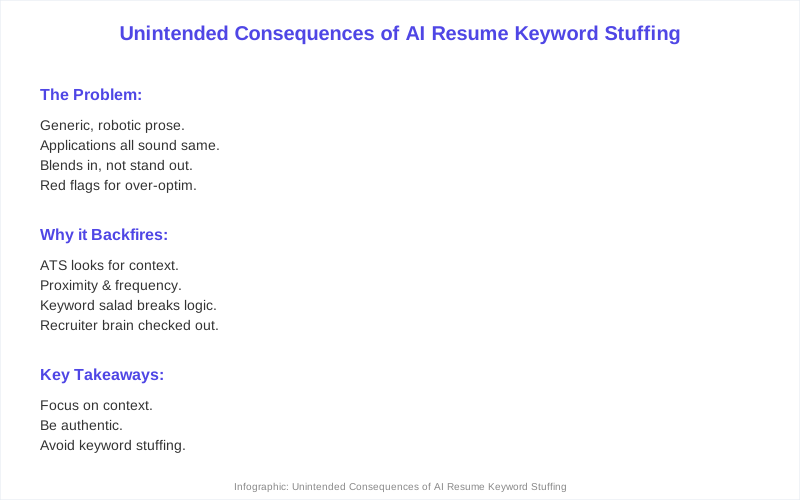
I've reviewed over 75,000 resumes in my career, and let me tell you, the rise of AI resume keyword stuffing has turned the process into a dumpster fire for everyone involved. What used to be a nuanced signal vs noise challenge has become a battle against generic, robotic prose.
I've reviewed over 75,000 resumes in my career, and let me tell you, the rise of AI resume keyword stuffing has turned the process into a dumpster fire for everyone involved. What used to be a nuanced signal vs noise challenge has become a battle against generic, robotic prose. Job seekers think they're gaming the system, but the Washington Post reported employers are seeing applications that all look and sound the same.
It's the equivalent of everyone showing up to a job interview wearing the exact same beige suit. "Oh, another 'results-driven professional with a proven track record'?" My recruiter brain is already checked out. It's not helping you stand out; it's making you blend in perfectly with the mediocrity. The problem isn't the AI, it's how people are using it, turning a potential advantage into a collective resume graveyard.
And I'm the one who has to sift through the digital debris.
The Real Answer
The real reason AI resume keyword stuffing backfires isn't because the ATS is too smart; it's because it's too dumb, and the recruiter on the other end is even dumber, sometimes. When I configured Workday or Lever, I wasn't just dropping in keywords; I was building a scoring algorithm. A basic keyword match is just one tiny component. The system looks for context, proximity, and frequency within logical sections.
Keyword stuffing often throws this out the window, creating a resume that triggers red flags for over-optimization. GoPerfect's blog notes AI screening offers "explainable scoring," meaning it can audit its own logic. When your resume is a keyword salad, the logic breaks down. My recruiter brain, after seeing a few hundred identical applications, quickly learns to spot the tell-tale signs of AI-generated fluff. It's like a bad cover band; they hit all the notes, but there's no soul.
I'm looking for a human, not a bot. These platforms, like Greenhouse and iCIMS, are designed to identify patterns of legitimate experience, not just word repetition. When your resume has "synergistic cross-functional collaboration" plastered 12 times, it doesn't scream 'top talent' to me. It screams 'someone used ChatGPT without thinking'. The ATS might give you a slightly higher score for keyword density, but the moment a human looks at it, your application becomes part of the resume graveyard.
It's a feature, not a bug, of how talent acquisition teams operate under pressure. We're looking for signal vs noise, and keyword stuffing is just more noise.


What's Actually Going On
What's actually going on when you submit that AI-optimized resume is a multi-layered process, and keyword stuffing only addresses the shallowest part. First, the ATS (whether it's Taleo, Workday, or Lever) parses your document. It's trying to extract structured data: job titles, companies, dates, and skills. If your resume is a text blob of keywords, it struggles, potentially miscategorizing critical experience. LinkedIn discussions highlight how AI can filter out qualified candidates unfairly due to this.
Then comes the actual matching. Modern ATS platforms use semantic analysis, not just exact keyword matches. They understand synonyms and related concepts. Stuffing your resume with 30 instances of 'project management' when 'PM' or 'PMP certified' would suffice, actually dilutes the impact. It signals a lack of understanding, or worse, desperation. This isn't just about small companies; even Fortune 500s using sophisticated systems like SuccessFactors have these mechanisms.
Smaller companies on Greenhouse might rely more heavily on raw keyword counts, but even there, a recruiter's eye will catch the obvious abuse. The Reddit community has plenty of recruiters explaining this. My internal KPI wasn't 'how many keywords did this resume have?', it was 'how many qualified candidates did I present to the hiring manager?'. A keyword-stuffed resume rarely translates to a qualified candidate in the real world.
It's like trying to win a spelling bee by just yelling all the letters in the dictionary. You might hit a few, but you're still wrong.

How to Handle This
So, how do you handle this without becoming a victim of the ATS black hole or the resume graveyard? First, understand that AI is a tool, not a ghostwriter. Start by using an AI tool like ChatGPT-4 or Claude to analyze the job description, not to write your whole resume. Ask it to identify the top 10-15 core skills and responsibilities. This gives you your target keywords. Next, manually integrate those keywords naturally into your existing experience.
Don't just list them; show how you used them. For instance, instead of 'SQL, Python, AWS', write 'Developed data pipelines using SQL and Python on AWS cloud infrastructure'. UMGC Career Services points out that AI can help highlight accomplishments, but you need to provide the raw material. If you're struggling, consider a professional resume writer. Expect to pay between $300-$700 for a solid rewrite, which includes a consultation to capture your authentic voice.
Ask them specifically about their process for integrating keywords naturally and avoiding generic phrasing, as Great Resume Writer warns against generic AI outputs. They should be able to explain how they balance ATS optimization with human readability. Don't be afraid to ask for examples of their work. A good writer will tailor for specific job descriptions, not just give you a blanket template. It's about precision, not volume. Think of it like tuning a race car.
You don't just dump more fuel in; you adjust the air-fuel mixture, timing, and suspension for optimal performance on a specific track.
What This Looks Like in Practice
I've seen this play out countless times. A hiring manager for a 'Senior Data Scientist' role at a large tech company, using Workday, received 400 applications. 150 of them were clearly AI-stuffed. The ATS flagged 20 of those 150 for unusually high keyword density in non-standard sections, which is a red flag for potential manipulation. My team immediately moved those to the 'do not contact' pile.
Out of the remaining 250, 50 had a good keyword match and readable, coherent experience. MyLiveCV notes the risks of over-optimization, including reduced clarity. We prioritized those 50 for review. Meanwhile, a candidate who used AI to refine their existing bullet points, ensuring their 'machine learning' and 'predictive modeling' experience was clearly articulated, landed an interview. Their resume had 8 key phrases, used an average of 3 times each, organically.
The stuffed resumes had 20+ keywords, used 5-10 times each, sometimes in a hidden white font. My recruiter brain saw the legitimate experience, not just the word count.

Mistakes That Kill Your Chances
Here's a breakdown of common mistakes that will send your resume straight to the resume graveyard, even with AI's 'help'. The rise of bots has created new challenges for job seekers. My advice? Don't be a bot.
| Mistake | Why It Kills Your Chances (Recruiter View) |
|---|---|
| Keyword Stuffing in White Font | This is an old trick. ATS sees it, flags it as spam. My recruiter brain sees the flag and laughs, then deletes. Instant resume graveyard. |
| Generic AI Buzzwords | 'Results-driven,' 'dynamic professional,' 'synergistic leader.' These are the hallmarks of a resume written by a bot without human oversight. Zero signal vs noise. |
| Inconsistent Tense/Voice | AI can sometimes mix tenses (past for current roles, etc.) or switch between first and third person. It screams 'not a human wrote this' to me. |
| Hallucinated Experience/Skills | AI will invent things if you don't give it enough real input. If I ask you about 'blockchain integration' and you stare blankly, you're done. |
| Over-optimization for one role, then applying to others | You stuffed it for 'Marketing Manager' but applied to 'Sales Director.' The ATS will reject for irrelevance, or I'll see the mismatch immediately. |
| Ignoring Formatting/Readability | AI can mess up column layouts or create weird spacing. A human reads left-to-right, top-to-bottom. If your resume is a visual mess, I skip it. |
These mistakes don't just make your resume look bad; they actively trigger rejection mechanisms within the ATS and my recruiter brain.
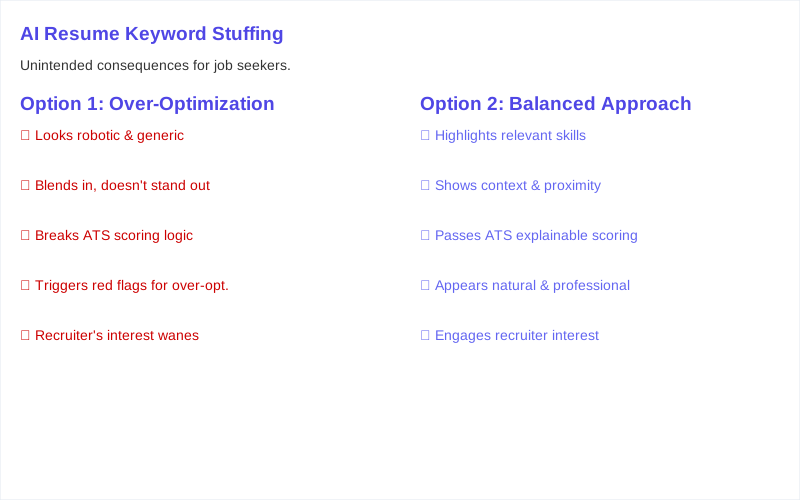
- **AI for Analysis, Not Creation:** Use AI to dissect job descriptions and identify core requirements, not to generate your entire resume.
- **Context Over Quantity:** Integrate keywords naturally within your accomplishments and responsibilities. Quality and relevance beat sheer volume every time.
- **Human Readability is King:** Always proofread for flow, grammar, and coherence. If it sounds robotic, a human won't bother reading past the first paragraph.
- **Authenticity Wins:** Your unique voice and genuine experience are what will truly make you stand out. Don't let AI strip that away.
- **Focus on Signal, Not Noise:** My recruiter brain is trained to find the signal. Don't add more noise to an already crowded inbox. As Joanne Shorey on LinkedIn notes, more volume doesn't mean better hiring, it means more noise.
Frequently Asked Questions
Should I pay $500 for an AI-powered resume builder or just use free online tools?
Do I really need to tailor my resume for every single job application, or can I get away with a 'master' resume?
What if I use AI just for grammar and spelling checks? Is that safe?
Can over-optimizing my resume permanently flag me in ATS systems, making it harder to apply for future jobs?
My friend said ATS systems are so smart now they can read between the lines and understand context. So keywords don't matter as much, right?
Sources
- The Hidden Risks of Over-Optimizing Resumes - MyLiveCV Blogs
- UK Talent Attraction Evolves: AI, Analytics, and End-to ... - LinkedIn
- AI in Recruitment: Keyword Stuffing and the Future of Hiring - LinkedIn
- The Rise of Bots in U.S. Job Applications: Implications for Employers ...
- Beating AI Screening Tools: Why Keyword Stuffing Fails - LinkedIn
- Creating an Effective Resume with AI | UMGC Career Services ...
- Employers to job seekers: Your AI résumé isn't fooling anyone
- The Hidden Challenges of Letting AI Write Your Resume
- Why Use AI Resume Screening for Hiring? 8 Reasons That Actually ...
- Why do a lot of recruiters say that keywords are not important in your ...