
When AI Job Search Automation Hurts Your Chances (2026 Complete Guide)
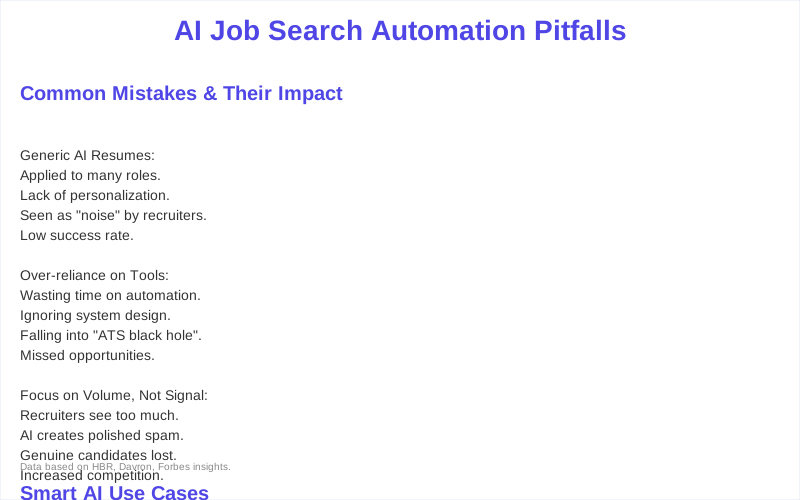
I've seen job seekers waste 43 minutes per application using AI automation tools, thinking they're gaining an edge. What they're actually doing is playing right into the hands of a broken system. The rise of AI in hiring has turned the job market into a noisy, crowded arms race, often making things worse for everyone involved, especially the candidates as HBR points out .
I've seen job seekers waste 43 minutes per application using AI automation tools, thinking they're gaining an edge. What they're actually doing is playing right into the hands of a broken system. The rise of AI in hiring has turned the job market into a noisy, crowded arms race, often making things worse for everyone involved, especially the candidates as HBR points out.
Everyone assumes AI is the new baseline for job searching in 2026. Recruiters expect you to use it for resume writing and LinkedIn optimization according to Davron. But there's a huge difference between using AI smartly and letting it drive your entire strategy off a cliff.
I've configured enough Workday and Greenhouse instances to know that throwing a generic, AI-generated resume at 500 different roles is the digital equivalent of spraying a firehose at a thimble. You're not getting in; you're just making a mess.
The 'ATS black hole' used to be about parsing errors. Now, it's about sheer volume. Recruiters are drowning in applications, many of which are AI-generated, perfectly polished, and utterly devoid of genuine signal. My recruiter brain just sees noise.
This isn't about whether to use AI. It's about understanding the internal mechanisms of how companies hire, how ATS systems actually filter, and where your automated efforts will inevitably backfire. Because if you don't, you're just adding to the resume graveyard, not getting hired as Forbes warns.
The Real Answer
The real reason AI job search automation often hurts your chances isn't some grand conspiracy; it's a simple function of recruiter workflow and ATS system design. When I was running a Lever instance, my goal was to reduce time-to-fill, not find the 'most' qualified candidate.
AI job search tools, especially the auto-apply ones, generate a flood of applications that are superficially optimized for keywords. They create a 'perfect' match on paper. But my hiring committee didn't care about paper perfection; they cared about actual skills and cultural fit.
For me, an application was signal vs noise. If an AI tool blasted out 500 applications for you, many of them were going to be a near-miss, not a direct hit. My ATS would still flag them as 'matching,' but the moment I looked, the disconnect was obvious.
This leads to what I call 'AI-induced fatigue' on the recruiter side. When I see 100 resumes for a role, and 80 of them are clearly AI-polished but lack genuine alignment, my 'recruiter brain' starts to filter more aggressively.
I'm looking for anomalies, for genuine human effort. The auto-apply tools often strip away that individuality, making you look like every other AI-generated candidate in the pile. It's a race to the bottom, not the top HBR notes.
The ATS systems like iCIMS are designed to filter based on specific criteria. AI can help you meet those criteria, but it can't invent experience or genuine interest. My job was to find someone who could do the job, not just talk about it perfectly.

What's Actually Going On
What's actually going on when you use AI for mass applications is a fundamental misunderstanding of the hiring mechanics. Most ATS platforms, whether it's Workday or Greenhouse, are set up with a 'new applicant' bias.
My director always tracked 'new applicants per week.' There was no metric for 'resurrected candidates from the resume graveyard.' So, the incentive was always to post a new req and get fresh applications, not dig through stale ones says Davron.
This means my initial six-second resume review is now even faster. I'm looking for the obvious red flags of AI generation: repetitive phrasing, buzzwords without context, and a lack of specific, quantifiable achievements that only a human could genuinely provide.
For companies using more advanced AI in their own recruiting, like conversational AI for first-round interviews, they're looking for problem-solving abilities and domain knowledge, not just keyword matching according to InterviewFlowAI. Your AI-generated resume might pass the initial filter, but you'll fail the next stage.
Even with AI, the core human element remains. My hiring committee wants to see a narrative, not just a data dump. AI can help structure that narrative, but it can't create the underlying story of your career.
How to Handle This
Don't let AI auto-apply for you. Period. That's a direct path to the resume graveyard. Instead, use AI as your personal assistant, not your replacement as LinkedIn suggests.
1. Targeted Resume Generation (15-minute investment per role): Input the job description and your raw experience into an AI tool like ChatGPT or Jasper. Ask it to draft a resume and cover letter tailored specifically to that single job. This helps with keyword optimization for ATS systems like Workday.
2. Keyword Identification (5 minutes per job posting): Use AI to scan job postings and highlight the exact keywords, skills, and even soft skills employers are repeatedly using explains Davron. Manually integrate these into your AI-drafted resume.
3. Interview Practice (30-60 minutes per session): Leverage AI tools for mock interviews. Give the AI the job description and your resume. Have it ask behavioral and technical questions, then provide feedback on your answers. This hones your ability to articulate your real experience.
4. LinkedIn Profile Optimization (Ongoing): Use AI to review your LinkedIn profile against target job descriptions. Ensure your profile uses the industry-specific language that recruiters using LinkedIn Recruiter will search for. This is your second resume; make it count.
5. Human Review (Priceless): After AI drafts, you must review and edit. Inject your unique voice, specific accomplishments, and genuine enthusiasm. My 'recruiter brain' can spot a generic AI-generated response a mile away; it's the lack of human touch that sends it to the 'maybe later' pile.

What This Looks Like in Practice
I saw a candidate apply for a 'Senior Data Scientist' role at a tech startup. Their resume, clearly AI-generated, perfectly matched every buzzword - Python, SQL, Machine Learning. It sailed through our Greenhouse ATS.
My initial screen took 10 seconds. On paper, it was a 95 percent match. But when I looked closer, the 'Experience' section was full of vague, generic phrases like 'leveraged data insights' without any quantifiable results or specific project details.
When I called them for a quick 15-minute screen, they couldn't elaborate on a single project listed. It was all high-level, AI-speak. The ghost job of a resume. I marked them as 'not a fit' within 5 minutes of the call.
Another scenario: a candidate for a 'Marketing Manager' role used an auto-apply tool for 300 jobs overnight. Their resume was a decent template, but it lacked any specific company names or campaigns from the job description.
Our Lever system still picked it up because of keyword density. But the moment I saw it wasn't tailored, it went into the 'resume graveyard.' My director wanted to see effort, not just volume, especially for marketing roles where attention to detail is key.
These auto-apply tools have a success rate as low as 0.01 percent per application according to Forbes. That's not efficiency; that's just spam. It creates more noise for me and zero signal for you. It's hiring theater, and you're the unpaid extra.
Mistakes That Kill Your Chances
| Mistake | Why It Hurts | Recruiter/ATS Perspective |
|---|---|---|
| Mass Auto-Applying | Generates volume without relevance, leading to a 0.01 percent success rate. | My 'recruiter brain' sees this as noise. ATS systems like Taleo prioritize tailored applications. |
| Over-reliance on AI for content generation | Produces generic, buzzword-heavy resumes lacking specific, quantifiable achievements. | I spot these immediately. They lack human detail and genuine experience. |
| Not editing AI-generated output | Leaves obvious AI phrasing, grammatical errors, or factual inaccuracies. | Shows lack of attention to detail. Instant red flag for any role. |
| Using AI for interview answers only | Candidates sound rehearsed and robotic, unable to elaborate spontaneously. | Hiring managers need authentic responses, not memorized AI scripts. |
| Ignoring company culture/values | AI doesn't effectively capture or convey alignment with a company's specific ethos. | My hiring committee cares about fit. AI can't fake genuine interest. |
| Failing to tailor cover letters | Submitting generic AI-written cover letters that don't address the specific role. | A generic cover letter is a waste of my time; it signals low effort. |
These mistakes turn your application into another entry in the resume graveyard. My job isn't to guess your intent; it's to find a clear signal.
Key Takeaways
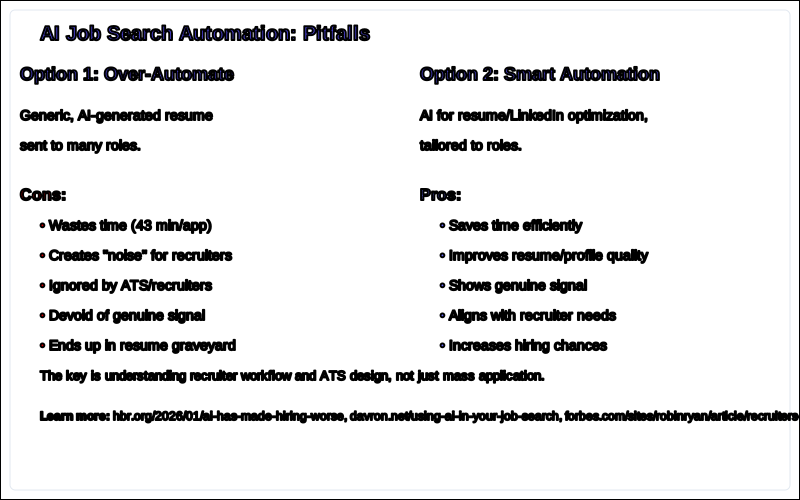
Look, AI is here to stay, and yes, not using it at all can hurt your career prospects as Analyst Uttam emphasizes. But it's a tool, not a magic bullet. My experience configuring ATS systems like iCIMS and reviewing thousands of applications has shown me the precise line between help and harm.
Here's the rundown:
- AI is for optimization, not automation: Use it to refine your resume and cover letter, not to auto-apply to hundreds of roles. My ATS doesn't care about volume; it cares about relevance.
- Human touch is non-negotiable: Inject your unique story and specific accomplishments.
My 'recruiter brain' is looking for signal, not generic noise. * Targeted effort beats mass application: Focus your energy on a few roles where you're a genuine fit, and use AI to make those applications shine. This is about quality over quantity. * Understand recruiter incentives: We're measured on time-to-fill and quality of hire, not the number of applications processed. Your goal is to make my job easier, not harder.
Treat AI as a powerful assistant that helps you get past the initial gatekeepers, but remember that the final decision always rests with human judgment. Don't let AI turn your job search into hiring theater.
Frequently Asked Questions
If I use an AI tool to generate 100 cover letters, what's the actual cost comparison versus writing them myself?
Do I really need to manually check the keywords AI generates, or can I trust the tool?
What if I use AI to tailor my resume, but I still don't get calls back?
Can using too much AI in my job search permanently damage my professional brand or reputation?
I heard AI can help me 'game' the ATS. Is that true?
Sources
- How to Actually Use AI in Your Job Search (Without Hurting Your ...
- The 2026 Guide to AI Recruiting: How Automation is Fixing the ...
- Using AI in Your Job Search: What Helps vs. What Hurts in 2026
- AI Has Made Hiring Worse—But It Can Still Help
- In 2026, Not Using AI Is a Career Risk | by Analyst Uttam - Medium
- Recruiters Are Drowning In AI Applications. Do This Instead To Get ...