
How to Craft a Compelling Linkedin Summary That Attracts Recruiters (2026 Complete Guide)
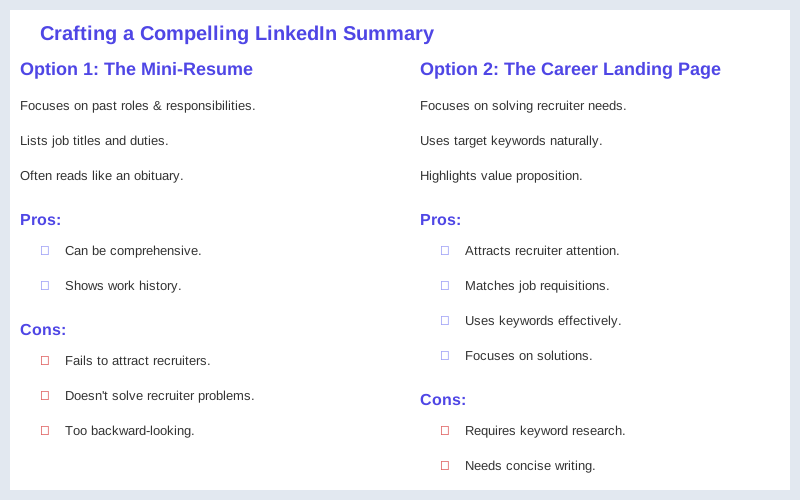
I've seen literally thousands of LinkedIn profiles where the 'About' section is a glorified, backward-looking obituary. Most job seekers treat it like a mini-resume, which is precisely why it fails to generate any real leads or conversations. Recruiters, myself included, spend an average of 15 seconds scanning your entire profile before deciding if you're worth a deeper look.
I've seen literally thousands of LinkedIn profiles where the 'About' section is a glorified, backward-looking obituary. Most job seekers treat it like a mini-resume, which is precisely why it fails to generate any real leads or conversations. Recruiters, myself included, spend an average of 15 seconds scanning your entire profile before deciding if you're worth a deeper look.
If your summary doesn't grab them in the first 3 seconds, you're already in the resume graveyard.Supergrow.AI calls this a 'landing page' for your career, and they're not wrong.
The Real Answer
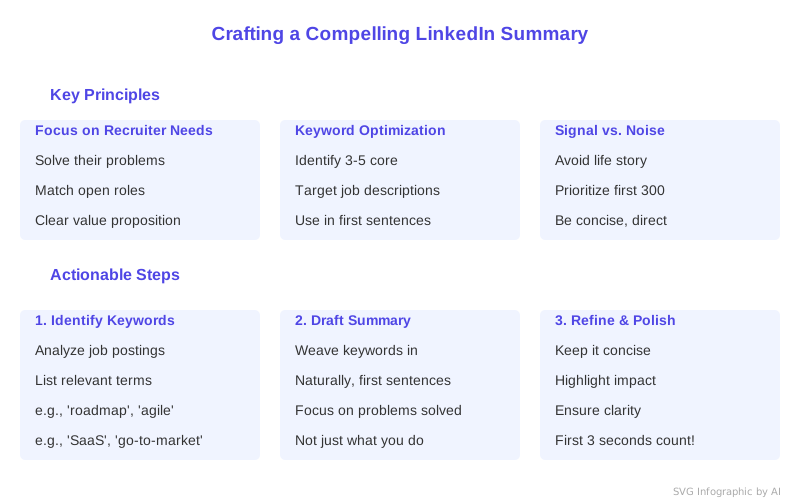
The real answer to a compelling LinkedIn summary isn't about telling your life story; it's about solving a recruiter's immediate problem. My 'recruiter brain' isn't looking for a narrative; it's looking for keywords and a clear value proposition that matches an open requisition. I need to quickly determine if you fit the role I'm desperately trying to fill before my next meeting starts. It's that simple.
What's Actually Going On
What's actually going on behind the scenes is a brutal game of signal vs noise. When I'm logged into LinkedIn Recruiter, I'm not browsing for inspiration. I'm executing a specific search query based on hiring manager requirements. Your profile summary, especially the first 300 characters, is prime real estate for those keywords. Redactai.io nails it: those characters are everything.
How to Handle This
So, how do you actually handle this? First, identify the 3-5 core keywords for the role you want. Don't guess; look at 10-15 job descriptions for that specific title. For a 'Senior Product Manager,' it might be 'roadmap,' 'agile,' 'SaaS,' 'go-to-market,' and 'cross-functional.' That's your target list. Next, draft your summary using those keywords naturally in the first two sentences. Think about what problems you solve, not just what you do.
Reddit users on r/linkedin correctly point out it's not a resume summary. It's a problem-solving statement. Don't just list skills; show how you apply them to achieve results. For instance, 'I empower SaaS startups to scale from 10 to 100 employees by optimizing product roadmaps and fostering cross-functional alignment.' See how those keywords fit? Now, for the real insider move: use a tool.
There are AI-powered resume and LinkedIn optimization tools out there, some charging upwards of $150 for a full profile review. Many of these are just glorified keyword stuffers. A better option for about $30-50 a month is a platform like Redact.AI or Supergrow.AI that offers 'ATS compatibility' checks. This isn't just about the summary; it's about your entire profile. What you're looking for is a tool that scans your profile against target job descriptions and highlights keyword gaps.
You're not paying for a writer; you're paying for a parser. Ask these services: 'Does your tool simulate a Lever or Greenhouse ATS parse?' and 'Can I upload multiple job descriptions for keyword analysis?' If they can't answer with specifics, they're probably selling snake oil. Another option is a professional resume writer who specializes in LinkedIn optimization. They typically charge $300-$1000. Ask for examples of summaries they've written that resulted in direct recruiter outreach, not just profile views.
The best ones understand the recruiter's workflow and how to game the search algorithms, not just write pretty prose. They often have access to recruiter-side data or have been former recruiters themselves. Their value is in knowing what I, the recruiter, am searching for and how those searches are weighted by the platform's algorithm. For example, some platforms weight keywords in the 'About' section more heavily than in 'Experience' for initial search results.
That's the kind of mechanical insight you're paying for. If they just say 'we make it compelling,' walk away.
What This Looks Like in Practice
In practice, a strong LinkedIn summary works like this for me:
Mistakes That Kill Your Chances
Look, I've seen some real resume graveyard material in my day. Here are the mistakes that instantly send your LinkedIn summary to the 'never call back' pile:
Key Takeaways
The bottom line is, your LinkedIn summary isn't a diary entry; it's a sales pitch to my 'recruiter brain.' Focus on what problems you solve and for whom, using the language of your target roles. Make it scannable, keyword-rich, and outcome-oriented. You've got about 3 seconds to prove you're not just another profile in the resume graveyard. Don't waste it on generic fluff.
Careerplan.commons.gc.cuny.edu emphasizes writing about what you want to do, not just what you have done, and that's solid advice for making it future-proof.