
The Black Box of AI Job Matching Algorithms Explained (2026 Complete Guide)
I remember spending 43 minutes perfecting a cover letter for a Senior ML Engineer role, only to get an automated rejection 12 seconds after hitting submit. That is the black box of AI job matching algorithms at work, and it is far more common than any LinkedIn influencer will admit.
I remember spending 43 minutes perfecting a cover letter for a Senior ML Engineer role, only to get an automated rejection 12 seconds after hitting submit. That is the black box of AI job matching algorithms at work, and it is far more common than any LinkedIn influencer will admit. The hiring process today is less about your nuanced skills and more about how well your resume's ASCII text parses through a system designed to filter, not to understand.
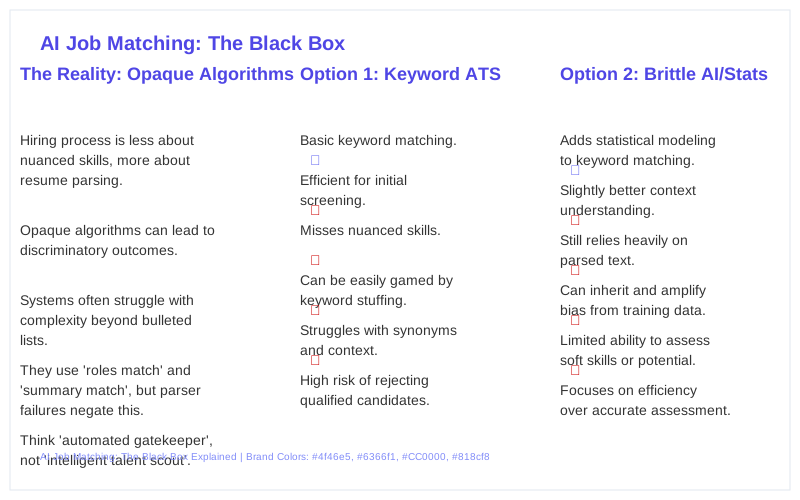
The reality is opaque algorithms can lead to discriminatory outcomes, leaving many qualified candidates in the dark.
Forget what the glossy career guides tell you about 'standing out.' Your first hurdle is a piece of software that often struggles with anything more complex than a bulleted list. These systems use 'roles match' to tell if you've actually done the work, and a 'summary match' to capture your overall career trajectory. But if the parser chokes, none of that matters.
The actual job of getting hired now involves understanding the unglamorous part of applicant tracking systems (ATS). These aren't sentient AI overlords; they're often brittle keyword matching engines with a dash of statistical modeling. They're built to cut down the 250+ applications per role to a manageable 10-15 for a human to review, not to find the next visionary.
So, when you hear about 'AI in hiring,' think 'automated gatekeeper,' not 'intelligent talent scout.' My own experience has shown me that the signal vs hype in this space is heavily skewed toward hype. Companies tout efficiency gains, cutting time-to-hire by 33 percent and cost-per-hire by up to 30 percent, but often at the expense of genuine candidate assessment.
AI use in HR tasks climbed to 43 percent in 2026, up from 26 percent in 2024, showing a clear shift to production workflows.
The 'black box' term isn't just marketing jargon. It refers to the fact that nobody, not even the people who implemented it, fully understands why a particular candidate was ranked higher than another. It is a system designed for scale, not necessarily for fairness or comprehensive evaluation, and that is a crucial distinction for anyone trying to navigate an AI career path.
The Real Answer
The real answer is that AI job matching algorithms are not trying to understand your unique potential or that brilliant side project you built over 3 weekends. They're glorified pattern matchers. Their primary goal is to filter out the 'noise' - everyone who does not perfectly align with a narrow, predefined set of criteria extracted from the job description and historical successful hires.
These tools claim to analyze social media to reveal 'real personas,' predicting traits like teamwork, but often it is just keyword density and basic semantic similarity.
Think of it as a very fast, very literal intern. This intern has been given 500 resumes and told, 'Find me everyone who has 'Python,' 'SQL,' and 'AWS' on their resume, and bonus points if they worked at a competitor.' It is less about intelligence and more about brute-force criteria matching. My first few applications to companies using these systems felt like I was speaking a different language than the job description itself.
The mental model you need is 'risk reduction,' not 'talent identification.' Companies use these systems to de-risk the hiring process by quickly eliminating candidates who don't fit a templated profile. This minimizes the time human recruiters spend on what they consider 'unqualified' candidates. Journalist Hilke Schellmann investigates software that automates resume screening and promotion recommendations in her new book, 'The Algorithm', showing just how widespread this filtering has become.
So, when your application vanishes into the 'black hole,' it is rarely personal. It means the system did not find enough of the specific keywords, phrases, or structural elements it was trained to look for. Your carefully crafted paragraph about 'synergistic team environments' might be ignored in favor of 'managed Git repositories for 3 years.' The math matters less than the exact string match, sometimes.
The unglamorous part of this is that the algorithm doesn't care about your passion. It cares about structured data points. If your resume format confuses its parser, you're out. If you use synonyms instead of exact keywords, you're out. It is a cold, hard truth that the system is designed to streamline, and often that streamlining means discarding anything that doesn't fit its mold, even if you are perfectly qualified.

What's Actually Going On
What is actually going on is a multi-layered filtering process, starting with the Applicant Tracking System (ATS). Every time you apply to a large company, your resume first hits an ATS. This software isn't just storing your resume; it's parsing it, extracting data points, and trying to map them to predefined fields. An ATS parses resumes, extracts hard-skill terms, and ranks candidates against a job description before a human ever sees it.
If your resume uses fancy fonts, graphics, or non-standard sections, the parsing stage can fail spectacularly. I've seen perfectly good resumes get garbled into unreadable messes because the ATS couldn't handle a two-column layout. When the parser fails, your profile is incomplete, and you become effectively invisible to the scoring algorithms that follow.
Then comes the 'matching' stage. Here, the AI, often a natural language processing (NLP) model, compares your extracted skills and experience against the job description's keywords. It's looking for direct matches, semantic similarities, and sometimes even contextual relevance based on its training data. The black box problem refers to the opacity of certain AI systems, where recruiters feed in data but don't understand the output.
Company size variations play a huge role. Small startups might still have a human look at every resume. But for any company receiving hundreds of applications per role, an AI filter is standard operating procedure. AI can quickly analyze resumes and applications to find the best matches, saving time and ensuring the right candidates are found.
Regulatory facts are slowly catching up. New York City's Local Law 144, for example, requires annual bias audits for AI hiring tools. This means companies using these systems in NYC must prove their algorithms aren't disproportionately screening out protected groups. This is a direct response to issues like Amazon scrapping an AI recruiting tool in 2018 after it showed bias against women.
The University of Washington found in 2025 that AI resume tools favored white-associated names in 85.1 percent of cases, highlighting the bias problem.
There's also a rising trend of lawsuits. A recently filed lawsuit claims the ratings assigned by A.I. screening software are similar to those of a credit agency, suggesting they should fall under regulations like the Fair Credit Reporting Act. This could force more transparency into these opaque systems, which would be a welcome change for job seekers.

How to Handle This
To handle this black box, you need to play its game. First, ditch creative resume formatting. Use a simple, clean, chronological layout with standard headings like 'Experience,' 'Education,' and 'Skills.' PDF is generally preferred over Word, but ensure it's text-searchable. Your goal is to make it as easy as possible for the ATS to parse your information without errors. Bad ATS formatting errors often mean your profile ends up incomplete or garbled, making you invisible.
Next, optimize for keywords. Go through the job description and identify every single hard skill, tool, and technology mentioned. List them out. Then, incorporate as many of these exact keywords as naturally possible into your resume. Don't just list them in a 'Skills' section; integrate them into your experience bullet points. For example, instead of 'Developed models,' write 'Developed machine learning models using Python, TensorFlow, and AWS Sagemaker.'
Timing matters. Applying within the first 24-48 hours of a job posting going live can give you an edge. Many ATS systems will surface the highest-scoring candidates to recruiters first, and that initial batch gets the most attention. Waiting a week means you're competing against hundreds more, and the algorithm might have already done its initial pass.
Leverage your network on platforms like LinkedIn. Even if the ATS is a gatekeeper, a direct referral from an employee can sometimes bypass the initial automated screening altogether. This is the ultimate cheat code against the black box. Only 26 percent of job applicants trust AI to evaluate them fairly, making transparency and human oversight critical. So, find a human.
Finally, understand the 'pivot tax' if you're changing careers. If your past titles don't explicitly contain keywords the algorithm expects, you'll need to work harder to make your transferable skills explicit. My own pivot meant meticulously rephrasing my software engineering experience to highlight ML-adjacent tasks, even if it wasn't my primary role at the time. This means literally changing 'optimized database queries' to 'optimized SQL queries for data feature extraction.'
What This Looks Like in Practice
I once saw a candidate with 10 years of Python experience get filtered out because the job description explicitly asked for 'Python 3.x' and their resume just said 'Python.' The algorithm didn't infer; it just flagged a mismatch. That's the level of literal interpretation you're up against. Metrics for success here are often about keyword density and exact phrase matching. Everything HR teams and candidates need to know about AI recruiting tools highlights the need for precision.
Another scenario: a job posting for a 'Data Scientist' listed 'Spark' as a required skill. A candidate had extensive experience with 'PySpark,' which is the Python API for Spark. The algorithm, however, only matched 'Spark' as a standalone term, resulting in a lower score. This isn't about intelligence; it's about database lookups.
For a mid-level ML Engineer role, the algorithm might assign a 0.85 match score if your resume has 80 percent of the exact keywords. But if a competitor's resume hits 0.92, guess who gets seen first? The difference is often negligible in actual skill but massive in algorithmic ranking. My own experience showed that a 5 percent increase in keyword overlap could push a resume from page 5 to page 1 of the recruiter's ATS dashboard.
Company A, a large tech firm, uses an AI tool that analyzes past successful hires to create a profile. If 90 percent of their current ML engineers came from specific universities or had specific certifications, the algorithm will implicitly favor those. You might be a brilliant self-taught prodigy, but the 'black box' will see a lower match score simply due to lack of historical data alignment.
AI tools show biases in ranking job applicants' names according to perceived race and gender, further complicating the issue.
I've coached candidates who spent weeks building impressive portfolio projects, only to have their resumes rejected because they didn't explicitly list 'Scikit-learn' or 'Pandas' as skills. They assumed their project description implied the tools. The algorithm doesn't infer. It wants to see the explicit keyword. This is the unglamorous 80 percent of job searching that LinkedIn posts won't tell you.
Mistakes That Kill Your Chances
| Mistake | Impact on AI Algorithm | What to Do Instead |
|---|---|---|
| Using fancy resume templates (multi-column, graphics) | ATS parsing failure; data extracted incorrectly (e.g., experience mixed with skills). | Stick to simple, single-column, chronological formats. No infographics. |
| Using synonyms instead of exact keywords from job description | Lower keyword match score; algorithm misses relevant experience. | Mirror the job description's exact terminology, e.g., 'SQL' vs. 'database querying.' |
| Omitting a 'Skills' section or burying it | Algorithm struggles to identify core competencies quickly; lower ranking. | Prominent, dedicated 'Skills' section with bulleted keywords. |
| Applying to too many roles at the same company with the same resume | Flagged as spam; indicates lack of specific interest; potentially blacklisted. | Tailor each resume. Apply to 1-2 highly relevant roles, then wait. |
| Not quantifying achievements with numbers | Lacks concrete impact metrics the algorithm can score for 'achievement.' | Use numbers: 'Increased model accuracy by 15 percent,' 'Managed a team of 3 engineers.' |
| Relying solely on job boards without networking | Higher competition in the ATS, lower visibility. | Prioritize referrals. Reach out to employees at target companies. |
ATS rejects many qualified resumes due to formatting and keyword misalignment, not necessarily a lack of qualifications. The biggest mistake is treating the ATS like a human. It's not. It's a literal-minded database with a scoring function. My first few attempts at an ML pivot involved submitting my old software engineer resume, thinking my skills would 'speak for themselves.' They didn't.
The algorithm just saw 'Java' and 'Spring Boot' and ignored the 'Python scripting' I had buried on page two. You have to explicitly show it what it's looking for. This is the pivot tax in action. You pay it with extra effort in resume tailoring, or with missed opportunities.
Key Takeaways
Navigating the AI job market means understanding that the initial gatekeeper is often a piece of software, not a human. Here are the brutal truths:
- Keywords are King: Your resume needs to explicitly mirror the job description's language. The algorithm doesn't infer; it matches. Many complex AI algorithms operate as 'black boxes', so precision is key.
- Formatting Matters: Simple, clean, and ATS-friendly formats are non-negotiable. Fancy layouts confuse the parser and can render your resume invisible.
I've seen a $15 resume template from Etsy kill more applications than a bad interview. * Bias is Real: AI hiring tools can carry inherent biases from their training data, sometimes favoring certain demographics or backgrounds. This is why you need to be strategic about your applications and not just spray and pray. * Network to Bypass: A direct referral can often circumvent the initial algorithmic screening, getting your resume directly into a human's hands.
This is the most effective way to beat the black box. * The Pivot Tax: If you're transitioning into AI/ML, be prepared for the extra effort required to reframe your experience in algorithm-friendly terms. It takes work, but it pays off. My own experience taught me that explicit skill declarations, even for basic tools, were critical for getting past the initial filters.
Frequently Asked Questions
Should I pay for an 'AI resume optimization service' that promises to beat the algorithms?
Do I really need to list every single tool and library I've ever touched, even minor ones like Matplotlib?
What if I tailor my resume perfectly for the algorithm, but then a human reads it and thinks it's too robotic or keyword-stuffed?
Can using AI resume builders or checkers actually hurt my chances long-term?
I keep hearing about 'soft skills' being important for AI roles. How do I get an algorithm to recognize my 'teamwork' or 'leadership'?
Sources
- AI-Assisted Hiring in 2026: The Complete Strategy Guide (No BS ...
- AI in Hiring: How It Works in 2026 - Articsledge
- The 2026 Guide to AI in Recruitment: Strategy & ROI | GLOZO
- Why AI In Recruiting Must Be Transparent And Traceable - Forbes
- Job Applicants Sue to Open 'Black Box' of A.I. Hiring Decisions
- AI tools show biases in ranking job applicants' names according to ...
- From Black-Box AI to Precision Matching: The Evolution of Our ...
- AI May Not Steal Your Job, but It Could Stop You Getting Hired
- AI Hiring Bias: Job Seekers Discrimination and Algorithmic Bias
- Behind the Black Box: Can Anyone Explain These Hiring Algorithms?
- The Ultimate Guide to AI in Recruiting [2026] - Joveo
- Beat the ATS: Optimize Resumes via Writing & AI: 2026 Guide - Klaxos